BLACK OLIVE SOURDOUGH BREAD

Inspired by a bread from Hamelman (Olive Levain), which I’ve made a few times in the past, I improvised on the basic sourdough method from Emmanuel Hadjiandreou and his “How to Make Bread“, that I recently blogged about.  You want this bread to deliver real big olive flavor, so keep the olives in large pieces, you can even leave some whole (but pitted, of course! 😉

BLACK OLIVE SOURDOUGH
(adapted from Emmanuel Hadjiandreou)

400 g (3 + 1/2 cups) bread flour
10 g (2 tsp) salt
200 g (3/4 cup) warm water
300 g (1 + 1/2 cups) sourdough starter (100% hydration)
4-5 ounces black olives (preferably Kalamata, pitted and chopped in large pieces – roughly 1 cup, loosely packed)

Add into one bowl the flour and the salt.   This is your dry mixture.

In another, larger bowl, mix the  water and the sourdough starter. This is  your wet mixture.

Add the dry mixture to the wet mixture and mix until it all comes together. Cover with a plastic wrap and let it stand for 10 minutes.  After 10 minutes, add the pieces of olives and knead the dough in the bowl, by pulling one portion of the dough from the side and pressing it down in the middle.  Repeat it turning the bowl slightly at each kneading, doing this kneading motion about 8 times and covering the full circumference of the ball of dough. The whole process should take about 20 seconds.   Cover the dough again and leave it resting for 10 minutes.

Repeat this kneading cycle three more times, 10 minutes apart.  Cover the bowl and let it rest for one hour.

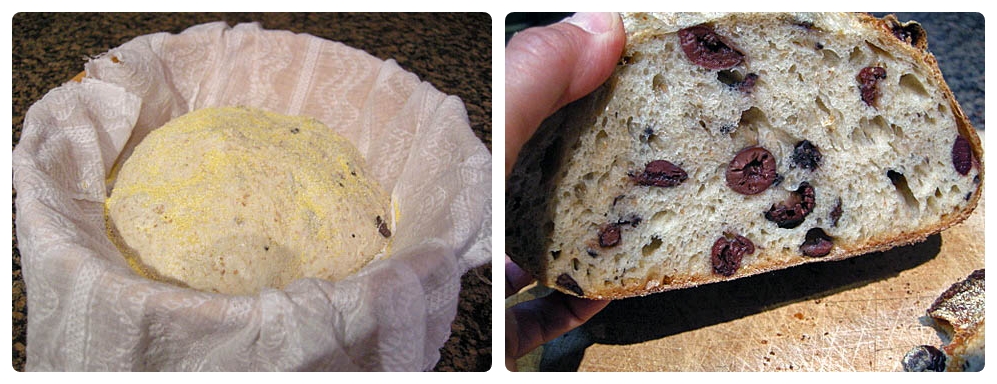
Turn the dough onto a floured surface, and shape it  as a round ball,  coat the surface lightly with cornmeal or rice flour, and place it in a suitable container for the final rise.  Let the dough rise until doubled in size, which should take from 3 to 6 hours, depending on how active your starter was.

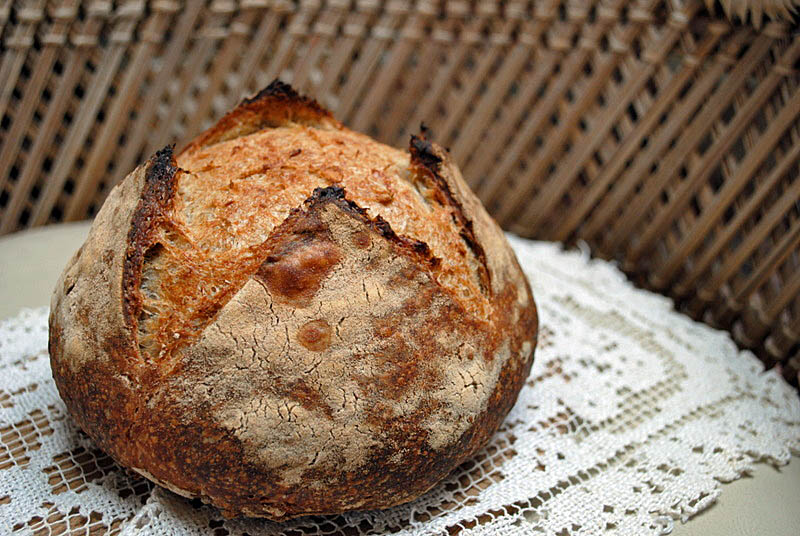
Heat the oven to 475 F, and have your method to generate steam ready.   Slide the bread on a parchment paper or a wooden peel, slash it, and place it in the oven.  I like to bake it over tiles, and place an inverted roasting pan moist with hot water over it for about 30 minutes, then remove it.   Once the bread is in the oven, reduce the temperature to 425 F.  Bake for a total of 40 minutes, or until the internal temperature is over 200F.

Let the bread cool completely before slicing.

ENJOY!

to print the recipe, click here

Comments:  I confessed before that I am a kalamata-cheerleader,  so this bread is obviously a favorite of mine.  I already have a spicy kalamata sourdough in the blog,  but in this version I took a minimalist approach and used only olives, nothing else.

Don’t worry if when you start kneading the dough, the pieces of olive insist on poking out, just let them be.   In the end, they will find their perfect spot in the crumb.   Try not to squish the pieces too much as you fold or knead the dough.

I used cornmeal to coat the surface of the bread during proofing, because I ran out of rice flour, but in the end it turned out pretty good, the cornmeal gave the bread an interesting golden hue, and did a good job releasing the proofed bread from the banetton.

I am sending this post to Susan’s Yeastspotting, make sure you stop by to get inspired by all the baking going on this past week…   😉

ONE YEAR AGO: Buttermilk Cluster

TWO YEARS AGO: Farfalle, Farfalle

Add to FacebookAdd to DiggAdd to Del.icio.usAdd to StumbleuponAdd to RedditAdd to BlinklistAdd to TwitterAdd to TechnoratiAdd to Yahoo BuzzAdd to Newsvine

THE DEVIL MADE ME DO IT

Things were going well, perhaps too well.   My decision of not buying a single cookbook during the year of 2012 had me strong and confident until April 19th. The date is a personal record, as in the past 5 years I caved before sunset on the last day of February.   But, reading this passionate review by Farine set the stage for my demise.   How could I possibly resist a book called “How to Make Bread?”    I succumbed. I got it.  And, you know what?  I LOVE IT!

TOMATO SOURDOUGH
(from “How to Make Bread“, published with permission from Emmanuel Hadjiandreou)

400 g (3 + 1/2 cups) bread flour
10 g (2 tsp) salt
2 + 1/2 Tbsp chopped rosemary leaves
6 g (1 + 1/4 tsp) nigella seeds
40 g (2 Tbsp) tomato paste
200 g (3/4 cup) warm water
300 g (1 + 1/2 cups) sourdough starter (100% hydration)
2 tsp olive oil

Add into one bowl the flour, salt, seeds, and rosemary. This is your dry mixture.

In another, larger bowl, mix the tomato paste, water, sourdough starter, and olive oil. This is  your wet mixture.

Add the dry mixture to the wet mixture and mix until it all comes together. Cover with a plastic wrap and let it stand for 10 minutes.  After 10 minutes, knead the dough in the bowl, by pulling one portion of the dough from the side and pressing it down in the middle.  Repeat it turning the bowl slightly at each kneading, doing this kneading motion about 8 times and covering the full circumference of the ball of dough. The whole process should take about 20 seconds.   Cover the dough again and leave it resting for 10 minutes.

Repeat this kneading cycle three more times, 10 minutes apart.  Cover the bowl and let it rest for one hour.

Turn the dough onto a floured surface, and shape it either as a round ball, or an oblong format, place it in a suitable container for the final rise.  Let the dough rise until doubled in size, which should take from 3 to 6 hours, depending on how active your starter was.

Heat the oven to 475 F, and have your method to generate steam ready.   Slide the bread on a parchment paper or a wooden peel, slash it, and place it in the oven.  I like to bake it over tiles, and place an inverted roasting pan moist with hot water over it for about 30 minutes, then remove it.   Once the bread is in the oven, reduce the temperature to 425 F.  Bake for a total of 40 minutes, or until the internal temperature is over 200F.

Let the bread cool completely on a rack before slicing.

ENJOY!

to print the recipe, click here

About the book:  if you are into bread baking and think you’ve got enough books on the subject, think again.  You need this one.  Your library won’t be complete without it, no matter what is your skill level.  Emmanuel is a natural teacher, and the step by step photos arranged in a single page will give you a very clear idea of how to handle the dough at the different stages of fermentation and shaping.

One of the things I love the most about the book is how it makes me want to design my own recipes, using his basic method.  He simplifies the instructions by describing each recipe as “this is your dry mixture”“this is your wet mixture”“mix one with the other”.  Basically, that is what bread baking is all about, and you can customize and be creative  if you keep this basic formula in mind follow his minimalist approach to kneading.  Plus, he will expand your horizon on ingredients to add to a bread.  A few examples are his beetroot sourdough, fig, walnut and anise sourdough,  chocolate and currant sourdough…   Emmanuel’s book made me want to experiment, and that is the mark of a great cookbook.  It shows you a path without restricting you to it.

You can tell that a lot of dedication and attention to detail went into the making of this book.  From photos to text, a real masterpiece!

Emmanuel, thank you for giving me permission to feature your recipe in my blog…

I am submitting this post to Susan’s Yeastspotting

ONE YEAR AGO: A Focaccia Experiment

TWO YEARS AGO: Pierre Nury’s Bougnat

Add to FacebookAdd to DiggAdd to Del.icio.usAdd to StumbleuponAdd to RedditAdd to BlinklistAdd to TwitterAdd to TechnoratiAdd to Yahoo BuzzAdd to Newsvine

WALNUT SOURDOUGH

Recently, this post over at Fig Jam and Lime Cordial made all the 11 bread recipes on my “to make soon list” run away in a panic, as Celia’s sourdough demanded to be baked right away!   Walnuts, spelt flour, plus a very active sourdough starter.  I simply could not wait to try it. Celia is such an accomplished baker that she throws a recipe together as if it’s nothing, and her breads turn out spectacular every single time.  I am a lot more insecure, so I asked her to virtually hold my hand and guide me through my take on her method.  Success! We loved the bread, it is rich, dense but not to the point of feeling heavy.  Outstanding with Roquefort cheese,  confirming the magical combination of walnuts with blue type cheeses. Unbeatable! And, let’s not forget the many benefits of walnuts… read a nice article about it here.

WALNUT SOURDOUGH BREAD
(adapted from Fig Jam and Lime Cordial)

150 g sourdough starter (at 166% hydration)
300 g water
300 g bread flour
200 g whole wheat flour
100 g walnuts, lightly toasted
9 g sea salt

Toast the walnuts in a 400 F oven just until fragrant.  Cut in pieces, not too small. Reserve.

Place the water in a bowl, add the sourdough starter and mix to dissolve.  Add the flours, mix to form a shaggy mass, and let the dough rest for 20 minutes.  Add the salt and knead the dough in the bowl a few times to incorporate it.  Let the dough rest for 30 minutes, add the walnuts and incorporate them in the dough by gently kneading it.   Let the dough rise for 2 more hours, folding twice at 45 and 90 minutes.   Thirty minutes after the last folding cycle, form the bread in the shape of your choice, place in a floured banetton or other appropriate container, and let it rise for 3 to 4 hours at room temperature, depending on how active your sourdough starter is.  The dough is ready to bake when it is not quite doubled in size, but feels airy when you gently poke the surface.

Invert the dough on parchment paper, score the surface with a sharp blade, and place in a 450F oven to bake with initial steam.  Total baking time will be about 40 minutes, I baked my loaf under an inverted roasting pan previously filled with water and emptied, so that some water stays clinging to its sides.  I removed the roasting pan after 25 minutes, and bake the loaf uncovered until done.    Internal temperature should be higher than 200 F.

Allow the bread to completely cool before slicing through.

ENJOY!

to print the recipe, click here

Comments:  In typical Sally-fashion, what I thought was a bag of spelt flour in my freezer turned out to be teff flour.  After frantically inspecting every single spot of the two freezers we own, I gave up and modified the recipe to use regular whole-wheat flour instead (triple sigh).  If you have spelt, use it 50/50 with the regular flour (for the amount of this recipe, that would be 250 g of each flour).

The 166% hydration might sound strange, but  keep in mind that it’s the hydration you obtain when feeding your starter by volume instead of weight and using equal amounts of flour and water (for instance 1 cup of each).  Very convenient, many bakers adapt their recipes to this level of hydration because it makes it a lot easier to keep the starter, no  need to use a scale. I was more of a 100% hydration lady, but must say I loved the way the more liquid starter performed and was so easy to mix with the dough.

For this type of bread, I don’t like to cut the walnuts too small, but if you prefer them to be less obvious in the crumb, go ahead and finely dice them.   Toasting before incorporating in the dough is optional, but I usually go for it.

Celia, thanks for yet another inspiring recipe, and for your help with the method.   I am counting on you to hold my hand again as I take a walk on the dark side (aka cake baking ;-)). 

  I am submitting this post to Susan’s Yeastspotting.

ONE YEAR AGO: Thai Chicken Curry

TWO YEARS AGO: Zen and the Art of Risotto

Add to FacebookAdd to DiggAdd to Del.icio.usAdd to StumbleuponAdd to RedditAdd to BlinklistAdd to TwitterAdd to TechnoratiAdd to Yahoo BuzzAdd to Newsvine

CODRUTA’S ROLLED OAT SOURDOUGH BREAD

I can read Portuguese, English, and French.  Stretching my brains a little I can get by in blogs written in Italian or Spanish, as the grammar and many words are similar to those from my native language.  Reading Romanian is another story altogether, but Codruta’s blog is on my blogroll list and will not be leaving anytime soon! Through Google Translate and a few email exchanges with her, I can profit from the bread masterpieces she regularly posts on “Apa. Faina. Sare”.   Agua. Farinha. Sal.  Water. Flour. Salt.  The basic ingredients for great bread, once you add the magic of wild yeast.

When she posted her own formula for a sourdough bread with flaky oats in the dough, I wanted to make it right away, as it involved a technique new to me: cold fermentation of the starter and dough until final proofing of the shaped bread.  Plus, it combined two different starters, one made with rye flour.  Indeed, not a bread for beginners, but I decided to take a leap of faith and play with the grownups. 😉   What do you think?

CODRUTA’S ROLLED OAT SOURDOUGH
(reprinted with permission, from Apa. Faina. Sare)

Makes one very large loaf or two medium-sized loaves.

for pre-ferment:
50 g very active starter made with regular flour (100% hydration)
50 g very active starter made with rye flour (100% hydration)
100 g bread flour
50 g water

for final dough:
all pre-ferment (250g)
450 g white bread flour
150 g whole wheat flour
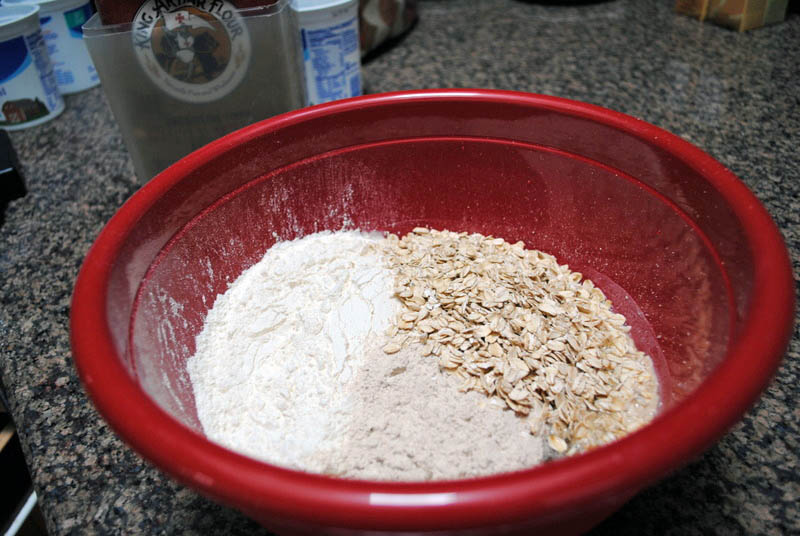
130 g rolled oats (rolled thick is better)
470 g cold water
17 g salt

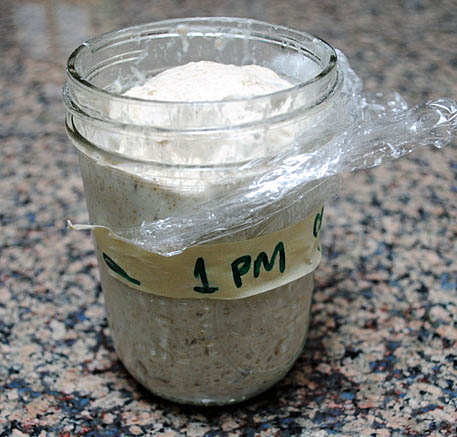
Prepare the pre-ferment by dissolving both types of starters in water, then add the flour. Stir and cover the container, placing it immediately in the refrigerator.  It is better to use a tall and narrow pot, transparent, so you can mark the level of your starter mixture as you place it in the fridge. Let it sit there 18-24 hours, until the yeast bubble grows up. You have a margin of a few hours to use for the yeast bubble will remain within, then begins to collapse.  Ideally, you should catch it when it’s almost doubled in bulk, as you can see in this photo.

When the starter is ready to be used, mix in a bowl the flours, rolled oats and cold water, let it sit 40 to 60 min (the autolyse step). Sprinkle salt on top, add the fermented starter straight from the fridge. Blend all ingredients together. Knead by folding directly into the bowl, a few minutes, until the dough comes off the fingers and the vessel walls. The dough will be quite dense, but do not add more water. Cover the pot, wait 15 minutes, and repeat the kneading by folding (one complete rotation of the vessel is sufficient). Cover and wait 15 minutes.

Transfer the dough in a greased rectangular dish with oil, make a set of stretch and fold (SF), wait 45 minutes, repeat the set of SF and place dough in the refrigerator.  Let dough in refrigerator for 15 to 18 hours.

Remove dough from refrigerator and leave it at room temperature for 1 hour. Divide the dough in two, and shape each half as a round or oval loaf.  Place the shaped loaves in a banetton or another appropriate container, with the seam up. Cover the pot with a light fabric, and then with plastic wrap. Let the dough proof at room temperature for 2 hours and 30 minutes.

Heat your oven 45 minutes before baking time. Have a baking stone inside and your method to generate steam planned. Bake at 460 F  for 45 min, with steam for the initial 15 min. Reduce temp to 440 F  if the bread seems to be browning too much.

Cool it completely before slicing.

ENJOY!

to print the recipe, click here

With this bread, I tried to work on shaping a batard, but next time I will divide the dough in uneven portions, making a slightly smaller batard and bigger “boule”.  I need a bit more practice with this shape of bread, but I feel I’m slowly making progress…  I was hoping for a shorter bread, with more pointed ends.  It will happen.  I know it will…  😉

The bread was absolutely delicious! The oats, although not previously soaked, more or less disappear into the dough, contributing flavor and a very slight hint of texture. Perfect! More and more I lean towards bread with whole wheat flour and grains or seeds inside, I find that they are very satisfying and more flavorful than white bread.

Unfortunately, I had a small problem with my camera – pilot error – and lost all my photos of the crumb.   Mine was not as perfect as Codruta’s bread, but no one who tried the bread seemed to mind…  Make sure to stop by her blog and marvel at the structure of her bread,  with a beautiful pyramidal shape, which is a sign of perfect handling of the dough.

Codruta, thanks for a great recipe,  I now only have about 8 others from your blog waiting in line!   😉

I am submitting this post to Susan’s Yeastspotting event…

ONE YEAR AGO:  Roasted Corn and Tomato Risotto

TWO YEARS AGO: Light Rye Bread

Add to FacebookAdd to DiggAdd to Del.icio.usAdd to StumbleuponAdd to RedditAdd to BlinklistAdd to TwitterAdd to TechnoratiAdd to Yahoo BuzzAdd to Newsvine

A SOURDOUGH EXPERIMENT

Would you like to bake bread with wild yeast, but the thought of   keeping a starter is too intimidating?  If that’s the case, I urge you to read this great post by Joanna, from Zeb Bakes. She will make you feel absolutely at ease with keeping the starter going, minimizing your work and the use of flour. She will also show you a simple schedule to bake bread on a weekly basis.  Awesome read! Sourdough baking made simple and easy, as it should be.

Now, time for some fun with it.  Remember the proofing bread box I gave myself for Christmas?   Well, I put it to the test, by making a batch of sourdough bread and dividing the dough in two.  Half went into the cozy environment of the box (78 F), half stayed outside in my kitchen kept (at this time of the year) at around 70F.  The recipe I chose for such a ground-breaking experiment comes from a great baker, who blogs at Breadcetera.  You can learn a ton of stuff from him, make sure to bookmark his site and visit often.   He developed this technique called “double flour addition,”  with the goal of maximizing the amount of air bubbles trapped in the dough from the very beginning of mixing.  These tiny air bubbles, created by whisking the very loose mixture of flour and water, later generates the pockets of air that every baker searches for in this type of rustic loaf.

SOURDOUGH BREAD WITH DOUBLE FLOUR ADDITION
(from Breadcetera)

680 g bread flour
90 g whole wheat flour
455 g water
15 g salt
300 g sourdough starter (at 100% hydration)

Combine the flours in a large bowl and lightly mix them with a whisk.

Add the water and the sourdough starter to the bowl of a Kitchen Aid mixer, and use the whisk attachment to work them together at the lowest speed for a minute or so.  At this point, you only need to combine them and have the starter dispersed through the water.    Add just 75g of the flour mixture, and increase the speed of the mixer to level 3. Whisk until the mixture seems quite aerated (about 3 to 4 minutes).

Remove the whisk attachment and place the dough hook in place. Add the rest of the flour, and knead for a couple of minutes, until the flour forms a shaggy mass.  Cover the bowl with plastic wrap and let it rest for 20 to 30 minutes.

Sprinkle the salt over the dough, and mix on speed 3 for 6 minutes.  Place the dough in an oiled bowl, cover and let it ferment for 2 hours, without any folding or kneading.  Divide the dough in two equal pieces, and lightly give it a round shape.   Let it rest for 15 minutes for the gluten to relax,  and do a final shaping, creating surface tension by pulling the sides of the dough up as you gather it all in the “boule” shape.   Place the balls of dough, seam side up, in a floured round container (such as a brotform), cover with plastic, and let it ferment for 3 hours at 78 F.

Invert the dough on a peel, score, and bake at 425 F for 40 minutes, with steam during the first 15 minutes.  Let it completely cool before slicing.

ENJOY!

to print the recipe, click here

For my experiment, I divided the dough in two right before the first fermentation, and placed one half in the proofing box.   That dough stayed in the box until baking time, the other one stayed over the kitchen table, protected from drafts.  The difference in the dough itself was pretty dramatic, but I could not get a picture that was good enough to show it. However, once the bread was baked, the one from the proofing box had much better oven spring, the other one was a bit on the flattish side.   Both were delicious, and the crumb had a nice structure, but one bread looked a lot “healthier.”   Here they are…

You can see that the taller bread, with a more round shape, had better oven spring, bursting through the slashing with greater power. Sorry, no photos of the crumb, we froze that baby for later and by the time we got to enjoying it, I forgot to grab the camera.


The bread proofing box not only optimizes the temperature, but also provides the correct amount of humidity, thanks to the small dish that sits at the bottom of the box, with some water in it.  No need to worry about a skin forming on the loaf in the final proofing, no need to use plastic to cover it.  A very well designed machine, that is getting constant use in our home.

I am submitting this post to Susan’s Yeastspotting

ONE YEAR AGO: Shrimp and Fennel Casserole

TWO YEARS AGO:  Tuscan Bread

Add to FacebookAdd to DiggAdd to Del.icio.usAdd to StumbleuponAdd to RedditAdd to BlinklistAdd to TwitterAdd to TechnoratiAdd to Yahoo BuzzAdd to Newsvine