SUNDRIED TOMATO SPELT SOURDOUGH

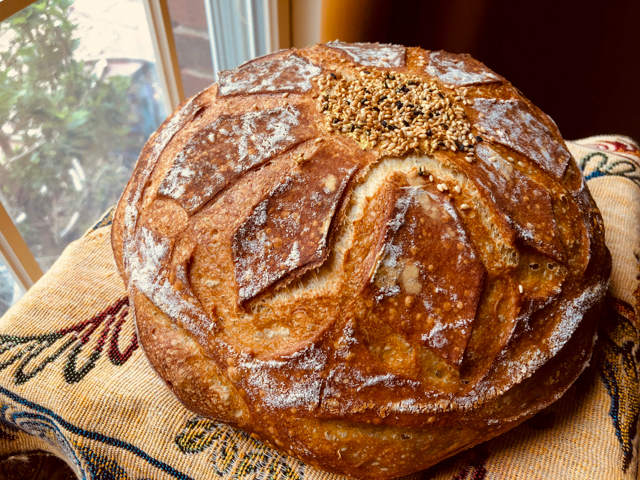
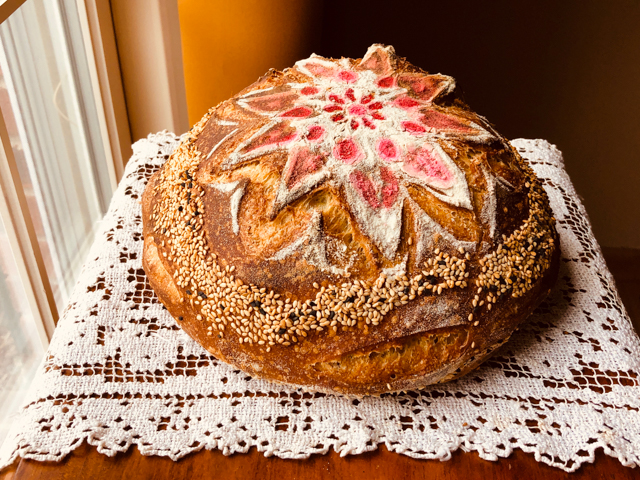
This is just another little departure on my basic formula for sourdough bread, also using my default method of KitchenAid first, folding next. I decided to try a totally different type of scoring, and must say I am pretty happy with the way it turned out.

SUNDRIED TOMATO SPELT SOURDOUGH
(from the Bewitching Kitchen)

480g bread flour
20g spelt flour
50g sundried tomatoes, chopped in pieces
10g salt
370g water
80g sourdough starter at 100% hydration

Make the levain mixture about 6 hours before you plan to mix the dough. It should be very bubbly and active.

When you are ready to make the final dough, place the water in the bowl of a KitchenAid type mixer and dissolve the starter in it, mixing with a spatula briefly, then add the two types of flour, and the salt. Turn the mixer on with the hook attachment and knead the dough for 2 minutes at low-speed all the time. Add the sundried tomatoes and knead for 2 more minutes. If the dough is too sticky, add 1/4 cup flour, you want the dough to start clearing the sides of the bowl, but still be sticky at the bottom.

Remove from the machine, and transfer to a container lightly coated with oil, cover lightly with plastic wrap and allow it to ferment for 4 hours, folding every 45 minutes or so. After four hours bulk fermentation, shape the dough as a ball, and place, seam side up, in a lightly floured banetton. Leave at room temperature one hour, and then place in the fridge overnight, from 8 to 12 hours.

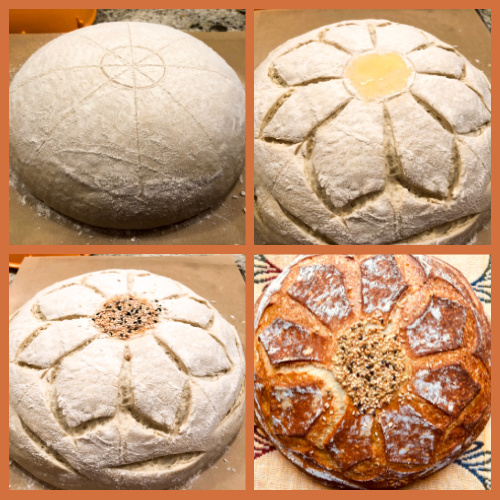
Next morning, heat the oven to 450F. Invert the dough over parchment paper, rub some flour all over the surface, and use a string to lightly score lines forming a grid on the surface. Next, use a brand new razor blade to score those lines, and scissors to form a star pattern at the corners (see picture below).

Bake at 450F for 45 minutes, preferably covered for the first 30 minutes to retain steam. Cool completely over a rack before slicing.

ENJOY!

to print the recipe, click here

Comments: To score the bread you’ll need a string, so that you can very lightly mark the pattern. I don’t have enough confidence with a razor blade in my hand to go at it without these markings, but you might not need it. After scoring with the blade, make the details with the scissors. I now visualize a next bread in which the grid won’t be squared, but tilted in some way. Not sure exactly how I’m going to do it, but I will definitely play with it.

The sundried tomatoes I used were soft and moist, I got them from our grocery store in their salad bar, they were lightly marinated with herbs. I would avoid using super dry tomatoes, but if that’s the only kind you have, maybe softening a bit in warm water can be a good idea.

It is really a totally different look from what I’m used to. I like the way it allowed the bread to rise very uniformly, which is not always the case for some patterns. Contrary to cookies, which I have a venue to donate, I only bake bread for us, so it becomes a “once-a-month” kind of project. I have quite a few things to try, but they tend to materialize more slowly. Maybe I should start giving bread to neighbors? Departmental colleagues? Graduate students?

ONE YEAR AGO: A Duet of Chocolate Bonbons

TWO YEARS AGO: Chocolate Tartlets with Honey-Caramel Filling

THREE YEAR AGO: Zucchini Soup with Tahini

FOUR YEARS AGO: Black Sesame Macarons

FIVE YEARS AGO: Fine Tuning Thomas Keller

SIX YEARS AGO: Cauliflower Tortillas

SEVEN YEARS AGO: Majestic Sedona, Take Two

EIGHT YEARS AGO: Secret Ingredient Turkey Meatballs

NINE YEARS AGO: Swedish Meatballs and Egg Noodles

TEN YEARS AGO: Italian Easter Pie

ELEVEN YEARS AGO: Black Olive Bialy

OAT AND SESAME SEED SOURDOUGH

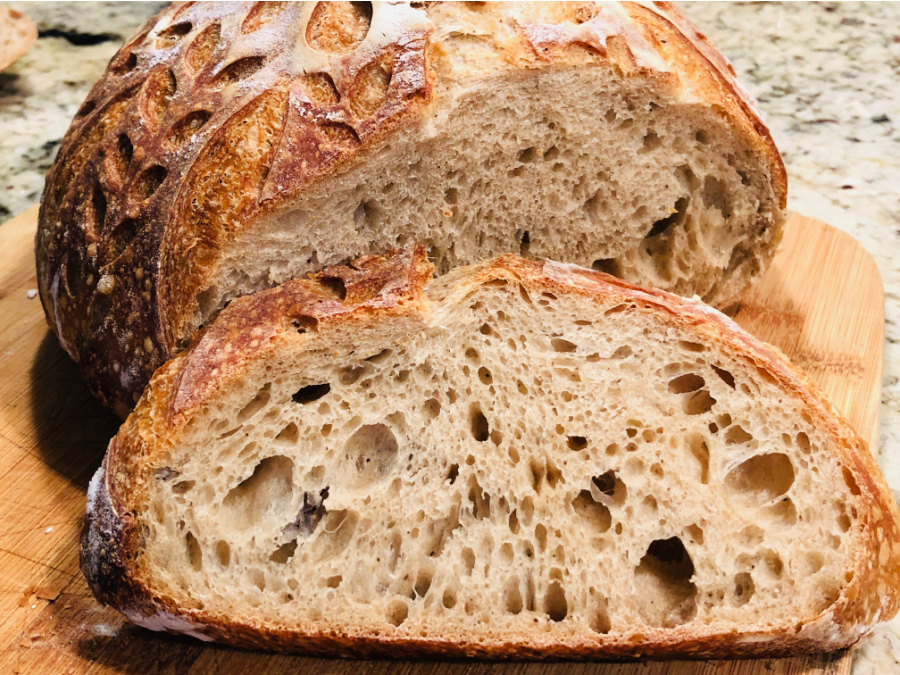
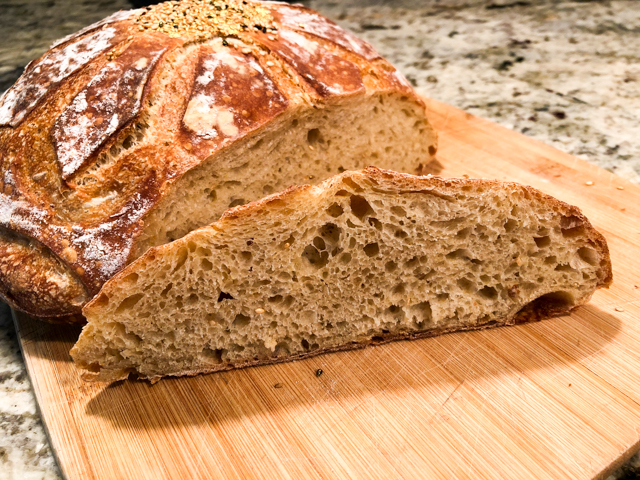
Some people find sourdough bread to be a bit “harsh” as far as texture goes. I am not part of that team, but I can understand where they are coming from. This bread retains the basic sourness of the classic, but the texture is so mellow that it reminded me of soft sandwich breads I enjoyed as a kid. It is the soaked oats and seeds that perform the magic. Absolutely delicious, I hope you’ll give it a try.

OAT AND SESAME SEED SOURDOUGH
(from The Bewitching Kitchen)

375g white bread flour (+ more to adjust consistency)
25g spelt flour
220g water
100g starter at 100% hydration
40g steel-cut oats
10g white sesame seeds
10g black sesame seeds (or 20g all one type)
10g salt

When you refresh your starter, maybe 6 hours before starting the bread, make the soaker: mix the oats and sesame seeds, and add enough water to just cover them. Cover the bowl with plastic wrap and leave at room temperature until it is time to mix the dough.

Add the soaked seeds ad all other components of the dough to the bowl of a Kitchen Aid mixer fitted with the dough hook. If there is too much water not absorbed by the seeds, leave it behind, but keep in mind that a lot of the moisture of the water in the formula should come from the soaker. Knead for about 4 minutes, paying attention to the texture of the dough. It should just start to clean the sides of the bowl. If necessary, add more flour at this point. I had to add about 1/4 cup flour to mine.

Remove the dough from the Kitchen Aid, transfer to any appropriate container lightly oiled and perform a series of stretch and folds every 45 minutes. Do it four to five times, which will take you up to 4 and half hours from initial bulk fermentation. Even if you fold it only 4 times, leave it fermenting until you reach 4 and a half hours.

Shape as a round ball and place in a floured banneton, seam side up. Leave 45 to 60 minutes at room temperature, then place in the fridge overnight.

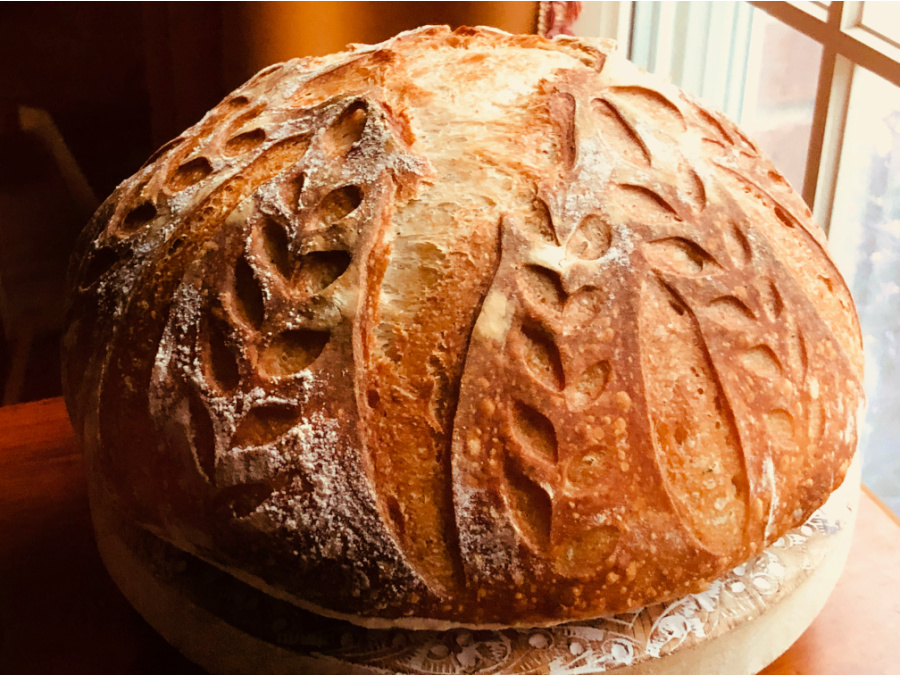
Remove the dough by inverting it on parchment paper, dust the surface with rice or white flour and slash any pattern you like. I used scissors coupled with a razor blade to get the leaf pattern.

Bake at 450F in a Dutch Oven, covered for 30 minutes, then remove the lid to brown the crust. Allow it to cool completely before slicing.

ENJOY!

to print the recipe, click here

Comments: I have included sesame seeds in my sourdough breads many times in the past, but don’t remember their flavor being as evident as in this loaf. I suppose the soaking step helps with it, which surprises me. Roasting them I could understand but just the soaking? Interesting. The texture of this bread is also remarkable, so I must repeat myself and tell you to try it and serve even to those who are a little uncomfortable with a rustic sourdough loaf in all its full glory.

ONE YEAR AGO: Moroccan Turkey Pie with Olive Oil Crust

TWO YEARS AGO: Another Twisted Sister of the Shepherd’s Pie 

THREE YEARS AGO: Cashew Chicken, My Way

FOUR YEARS AGO: Two Deliciously Simple Salads

FIVE YEARS AGO: In My Kitchen, April 2016

SIX YEARS AGO: Spring has Sprung with Suzanne Goin

SEVEN YEARS AGO: Chai Brownies

EIGHT YEARS AGO: Pomegranate-Molasses Glazed Carrots

NINE YEARS AGO: Braised Brisket with Bourbon-Peach Glaze

TEN YEARS AGO: The Real Vodka Sauce

ELEVEN YEARS AGO: Spring Rolls on a Spring Day


TANGZHONG HAMBURGER BUNS

There are hamburger buns, and hamburger buns with Zen. These will Zen you out. Tanzhong is a method of Japanese baking in which part of the flour is cooked before being incorporated into the dough. What that does is create quite a unique crumb, with more moisture and tenderness. Perfect for hamburger and hot dog buns in which the crust is secondary. All you want is pillowy bread. You will need about 30 minutes of extra time before mixing the dough, but the outcome it totally worth it.

TANGZHONG HAMBURGER BUNS
(slightly modified from Domestic Gothess)

for tangzhong:
20 g (2tbsp) strong white bread flour
100 ml water

for the dough:
350 g strong white bread flour
7 g (2 tsp) fast-acting dry yeast (or regular instant yeast, but expect longer rising times)
1 tsp salt
50 g (1/4 cup) sugar
125 ml (1/2 cup) full fat milk
1 large egg
35 g softened butter

to glaze:
1 egg, beaten with a splash of milk
sesame seeds

To make the tangzhong, place the flour in a small saucepan and gradually whisk in the water. Place over a medium heat and cook, whisking constantly until it has thickened to a wallpaper paste-like consistency. Remove from the heat, scrape into a bowl and cover with clingfilm directly on the surface, set aside to cool.

Place the flour, yeast, salt and sugar in the bowl of a stand mixer fitted with the dough hook, lightly stir together and make a well in the center. Add the egg, milk and tangzhong to the well and mix on a low speed until it comes together into a dough.

Add the butter and mix on medium-high speed until the dough is very stretchy and comes away from the sides of the bowl, about 10 minutes. Transfer the dough to a lightly greased bowl, cover with clingfilm and either place somewhere warm to rise until doubled in size, about 1-2 hours (dough can be refrigerated overnight at this point if you prefer).

Line a baking sheet with baking parchment. Divide the risen dough into 8 equal pieces (or fewer if you like bigger buns) and shape each piece into a ball on a lightly floured surface. Spread the balls out well spaced apart on the baking sheet and loosely cover with oiled clingfilm. Leave to rise for about 1 hour until puffy.

Heat the oven to 400F. Brush the risen buns with the beaten egg and sprinkle with sesame seeds. Bake for 20 to 25 minutes until deep golden. Transfer the buns to a wire rack to cool. They are good for couple of days stored in an airtight container, or for a few months frozen.

ENJOY!


to print the recipe, click
here

Comments: Mitsuo Ayano was the person who first came up with the idea of making a water roux (yu-dane) and use it to bake bread. Later the process was simplified by a baker from Taiwan. In the US and Europe it is more widely known by its Chinese name, Tangzhong. At any rate, it is a nice technique to have in your repertoire, and pretty much all kinds of breads can be adapted to take some cooked flour in the formula. Check out this great version, made a few years ago by my friend Karen.


The crumb is so tender and flavorful! I’ve been making this recipe regularly, the moment we have 2 buns left in the freezer, another batch gets started. They can be shaped of course as regular buns or oblongs for hotdogs. I now settled on shaping each bun with around 110g dough, because the husband likes to slice each large roll in four thin slices crosswise, so it’s easier if the buns start big. I get about 6 large buns from one batch buy doing so.

ONE YEAR AGO: Potato Soup with Spicy Shrimp

TWO YEARS AGO: Rose-Harissa Chicken Thighs

THREE YEARS AGO: Caramel-Chocolate Tartlets

FOUR YEARS AGO: Chicken Korma-ish

FIVE YEARS AGO: Sunday Gravy with Braciola

SIX YEAR AGO: In My Kitchen, February 2015

SEVEN YEARS AGO: Avocado and Orange Salad with Charred Jalapeno Dressing

EIGHT YEARS AGO: Green Olive, Walnuts and Pomegranate Salad

NINE YEARS AGO: Romanian Flatbreads

TEN YEARS AGO: Ziti with Artichokes and Meyer Lemon Sauce

ELEVEN YEARS AGO: Blasted Broccoli, Stove-top version

SMOKED PAPRIKA SOURDOUGH

My sister Norma back in Brazil jokes that she would add smoked paprika to her toothpaste if at all possible… If you are in her team, this bread is for you. I did not add a lot, and feel that the bread could stand even more, as you will see in the comments. The scoring style, “Multiple Leaves”, was inspired by the one and only Morgi, from Israel. Check his quick video tutorial here.

SMOKED PAPRIKA SOURDOUGH
(from the Bewitching Kitchen)

370g water
110g sourdough starter at 100% hydration
470g white bread flour
30g spelt flour
2 tsp smoked paprika
10g salt

Make the levain mixture about 6 hours before you plan to mix the dough. It should be very bubbly and active.

When you are ready to make the final dough, place the water in the bowl of a KitchenAid type mixer and dissolve the starter in it, mixing with a spatula briefly, then add the two types of flour, paprika, and salt.  Turn the mixer on with the hook attachment and knead the dough for 4 minutes at low-speed all the time. You will notice the dough will gain quite a bit of structure even with just 4 minutes in the mixer. Remove from the machine, and transfer to a container lightly coated with oil, cover lightly with plastic wrap and allow it to ferment for 4 hours, folding every 45 minutes or so. Because the dough is already a bit developed from the initial time in the mixer, you should get very good structure after 3 and a half hours, or even sooner than that.

After four hours bulk fermentation, shape the dough as a ball, and place, seam side up, in a lightly floured banetton. Leave at room temperature one hour, and then place in the fridge overnight, from 8 to 12 hours.

Next morning, heat the oven to 450F.

Invert the dough on a piece of parchment paper and score with a new razor blade, if so desired, or simply make a cut on the surface in the shape of a cross with a very sharp knife. 

Bake at 450F for 45 minutes, preferably covered for the first 30 minutes to retain steam. You can generate additional steam by spraying the inside of the lid with water before closing the pan.  Cool completely over a rack before slicing.

ENJOY!

to print the recipe, click here

Comments: If you are into sourdough baking, I urge you to follow Morgi’s instagram page. His talent with artistic scoring is something! For many of his styles, he includes not only a photo of the finished bread, but a short video of the slashing, start to finish. It goes a little fast, but you can pause and even draw a sketch on paper as he goes, if necessary. For the multiple leaves, you can pretty much do whatever you like as far as spacing the leaves or keeping them close. I liked this scoring a lot because since the edges of the leaves are cut more deeply, and the veins very lightly, the bread will not ruin the design as it bakes: it will naturally open around the edges of the leaves. Very clever.

The smoked paprika gave a delicate pink hue to the crumb and crust, next time I might add three teaspoons instead of two, to intensify the flavor.

This bread was once again made with my basic method, which starts with a 4 minute kneading in the KitchenAid. The only modification I’ve incorporated was leaving it at room temperature for one hour before placing it in the fridge overnight. I notice a slightly more open crumb and more oven spring when I do that.

ONE YEAR AGO: A Cake to say I Love You, from Kim-Joy’s cookbook

TWO YEARS AGO: Lemon-Almond Cake with Cranberry Glaze

THREE YEARS AGO: The Iron (Uptake) Chef Challenge

FOUR YEARS AGO: Thank you!

FIVE YEARS AGO: Salmon Rillettes, a Classy Appetizer

SIX YEARS AGO: Linzer Cookies

SEVEN YEARS AGO: Baked Ricotta, Take Two

EIGHT YEARS AGO: Pumpkin Uncanned

NINE YEARS AGO: Pork Ragu

TEN YEARS AGO: Friendly Kuri Squash

ELEVEN YEARS AGO: Celery and Apple Salad

PAIN DE MIE DRESSED UP TO PARTY

The idea for this bread came from a cookbook called “Le Grand Livre de la Boulangerie” which I recently impulse-bought.  I fell in love with one of the recipes and in less than 24 hours was trying it in our kitchen. It is a simple pain de mie (I modified a King Arthur recipe for it), but with bread dough decorations placed on top right before baking. Imagine the possibilities!

PAIN DE MIE WITH DECORATIONS
(inspired by Le Grand Livre de la Boulangerie)
basic Pain de Mie formula from King Arthur Flour)

175 g milk
260 g water
97 g butter
2 + 1/2 tsp salt
32 g dry milk
40 g potato flour
40 g sugar
650 g all-purpose flour
2 + 1/8 tsp instant yeast
fine charcoal powder (about 1/2 tablespoon)

Combine all of the ingredients, except the charcoal powder into the bowl of a KitchenAid type mixer and knead until fully smooth and with good gluten development (about 8  minutes).  Adjust with flour if the dough seems too loose.  The dough will be soft and pliable.

FOR THE BLACK DECORATIONS:  Remove 180 g of the dough and transfer to a small bowl. Knead by hand into it the charcoal powder (gloves are a very good idea!).  When the dough it nice and black, roll it out to about the dimension of a 9 x 13 pan (no need to be exact, the dough will be about 2mm in thickness). Place between two sheets of parchment paper or Silpat, and bake in a 450F oven for a couple of minutes, you just want to set it a bit.  Immediately remove from the oven and place in the fridge while you continue proofing the main dough.

Bulk proofing: transfer the main, white dough to a lightly greased bowl  and allow the dough to rise until puffy though not necessarily doubled in bulk, about 1 + 1/2 hours, depending on the warmth of your kitchen.

Lightly grease a 13″ pain de mie pan. Gently deflate the dough, transfer it to a lightly greased work surface, shape it into a 13″ log, and fit it into the pan. Cover the pan with lightly greased plastic wrap, and allow the dough to rise until it’s just below the lip of the pan, 45 minutes to 1 hour.

Towards the end of the rising time, preheat the oven to 350°F, and work on the decorations. Take the sheet of black dough out of the fridge, cut it in any shapes you want, keeping in mind the dimensions of the top of the loaf.

When the dough is ready to bake, carefully place the decorations on top, close the lid and place in the oven. Bake for 25 minutes, open the lid, and bake for 20 minutes more, until internal temperature is at least 190F (mine reached 200F).

Remove from the oven, take the bread out of the pan and allow it to cool over a rack before attempting to slice it.

ENJOY!

to print the recipe, click here

Comments: First of all, let me tell you about the book. It is in French and in the words of one of the authors, Chef Jean-Marie Lanio, it is geared towards professionals and “home bakers with skills.” Don’t expect detailed instructions, it is basically a series of formulas with one word (yes, one word) to describe expected dough texture, one word to describe shaping, and a general expected timing for proofing. Truth is, you need to be very comfortable with baking in general (the book is not only on bread) to put it to use. But the recipes are stunning,  always some little twist to make each production unique and special. Come to think of it, baking from this book is like setting yourself up for a technical challenge. But with a huge advantage: no cameras around! Pretty much a win-win situation…


In their recipe, they use a pâte fermentée viennoise as one component and I did not have that around. Being the impatient being I am, I wanted to try the recipe right away. I also don’t have the Pullman loaf pan with the exact dimensions they recommend. So I went to King Arthur site, and from their basic recipe adjusted amounts, hoping for the best.  I am thrilled that it worked so well on  my first attempt. Trust me, that almost never happens in the Bewitching Kitchen.

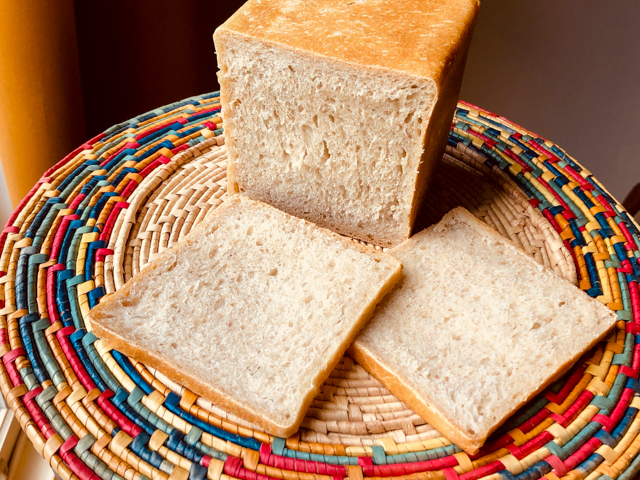
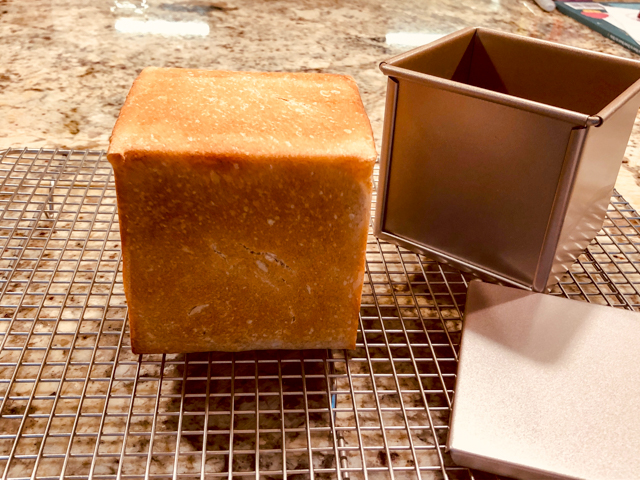
Making the recipe exactly as described, and using the same pan I did (PADERNO 41750), you will be a bit unsure if it will work, because the dough will be pretty low in the pan as you shape it and place it inside. Don’t worry, in a little over one hour it will rise substantially and in fact I had to push down a little bit the top to make sure I could add the decorations and have some space between the top of the dough and the lid.  It worked perfectly well. The crumb is exactly what you expect from this type of bread, soft, a tad on the sweet side, and a bit buttery.

In the book, they gilded the lily a step further, by adding a line of white flour on top of the black decorations. I just could not make that work, no matter how I tried to deal with the flour (piping bags, piping tips, straws), my lines were never smooth and beautiful, so I skipped that part. I now wonder if rice flour would have worked, as it has a different texture. Anyway, I am super happy with the way it turned out, it’s a nice technique to play with. Imagine how many designs and even colors you can come up with…

As I hit publish and look at the date on my calendar, I realize that exactly one year ago I was being eliminated from a certain show in a certain tent. It is hard not to feel that sadness trying to hit me again, but this too shall pass… and a good bake definitely helps exorcize certain demons….

ONE YEAR AGO: Five-Stranded Bread

TWO YEARS AGO: Green Olive Salad

THREE YEARS AGO: Coffee Macarons Dressed up to Party

FOUR YEARS AGO: Blogging Hiatus

FIVE YEARS AGO: Tomato Tatin

SIX YEARS AGO: Headed to Colorado!   

SEVEN YEARS AGO: Farofa Brasileira

EIGHT  YEARS AGO: Thai-Inspired Pork Tenderloin

NINE YEARS AGO: A yummy Brazilian cake: Bolo de Fuba’

TEN YEARS AGO:  Summer’s Tomatoes

ELEVEN YEARS AGO: Leaving on a jet plane…