ANTIBIOTICS AND FOOD

If I were to define myself professionally, I’d say I am equal parts microbiologist, molecular biologist, and biochemist.  I obtained my doctorate in biochemistry in 1986, working on the genetic instability and antibiotic resistance of bacteria. Since then, I’ve studied bacterial pathogenesis, vaccine biotechnology, and more recently, the biochemistry of iron uptake by Escherichia coli and Listeria monocytogenes, two potentially lethal bacterial contaminants of food. As a result of these experiences, I have strong opinions about the use of antibiotics in food production.

Watching the news this week, I saw a pig farmer from my home state (Oklahoma) defending the practice of feeding pigs antibiotics to improve their health and weight.   I’d love nothing better than to invite that man over for a cup of coffee and a conversation, so I could ask him what exactly he knows about the use of antibiotics.  For example, has he ever heard of the term “plasmid?”  What about you?  If you care to read about it, then follow me to the next page….

Continue reading

PAIN DE MIE AU LEVAIN

Just for a change, here’s a bread that’s not part of the BBA Challenge…  😉

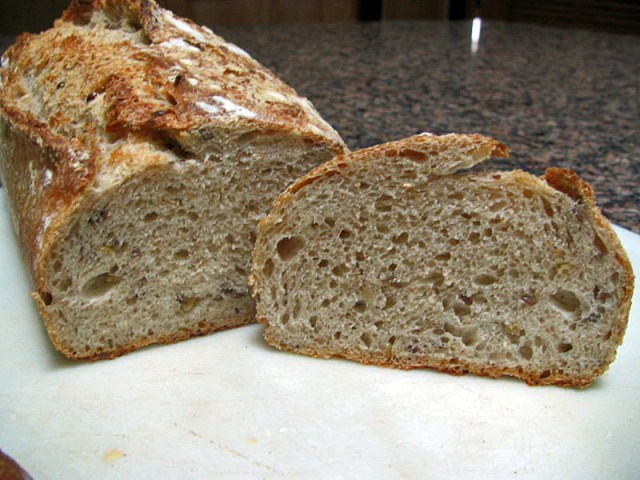
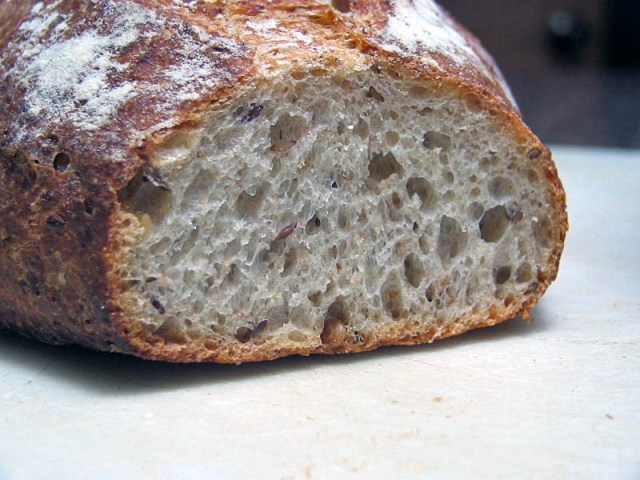
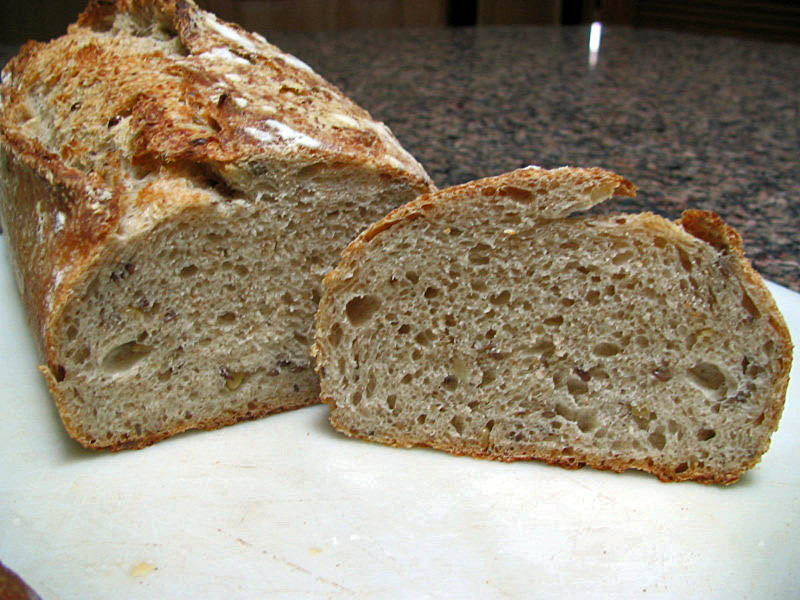
Who doesn’t love a good bread? But, while some people prefer a hearty crust, uneven holes and an assertive taste, others like a tight, smooth crumb enveloped in a soft crust.  This  “pain de mie” joins the best of both worlds: it’s leavened with sourdough starter, but it’s moderate hydration produces a surprisingly closed crumb, especially if you bake it contained in a loaf pan. It’s a perfect sandwich bread, with more “pizzazz” than anything you’ll find at the grocery store.

I discovered this recipe in a wonderful French blog called Makanai: Bio, Bon, Simple. When a French woman (who has superb boulangeries on every corner) bakes bread at home, then I pay attention: she must be an outstanding baker! You can read Flo’s detailed description here.

PAIN DE MIE AU LEVAIN
(adapted from Makanai’s blog)

210 g  sourdough starter (mine was at 80% hydration)
420 g water
500 g bread flour
130 g rye flour
11.5 g fine sea salt (13 g if using unsalted seeds)
30-35 g seeds of your choice
(I used flax seeds and roasted, salted sunflower seeds)

Mix the flours, water, and sourdough starter until they form a shaggy mass.  Let it stand at room temperature, covered, for 30-45 minutes (autolyse).  Add the salt and mix it with either using a Kitchen Aid-type mixer for a few minutes, or by hand.  Add the seeds and knead with the machine for about 7 minutes at low speed.  Alternatively, mix gently by hand to incorporate the seeds and knead the dough by folding 4 times during the first hour, at 15 minute intervals.  Let the dough rise undisturbed for another full hour, in a warm place, covered.

Refrigerate the dough for 12 to 24 hours (very important step!), misting the surface lightly with olive oil, and covering with a plastic wrap.

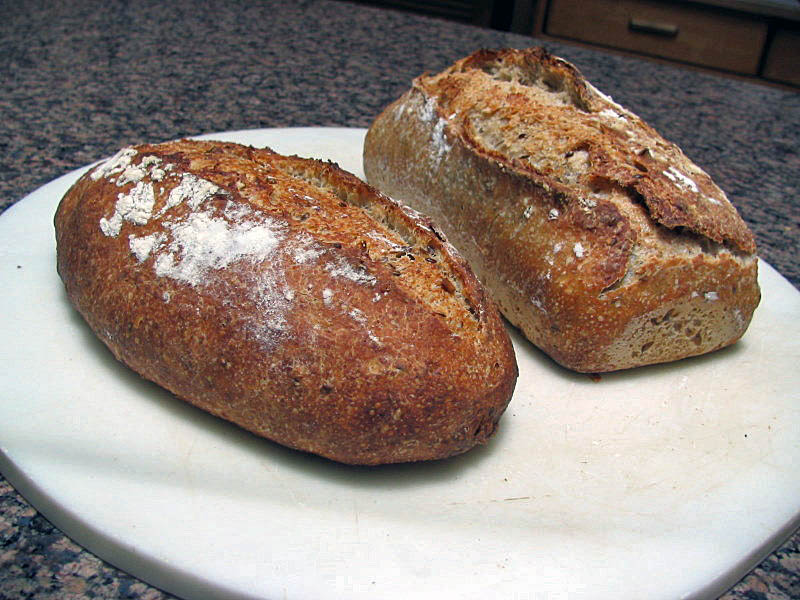
The next morning remove the dough from the fridge, remove the plastic and cover it with a towel, to rest at room temperature for 2 hours before shaping.  Meanwhile, prepare a loaf pan by lightly coating it with olive oil and sprinkling flour, especially in the corners. You can make a single large loaf or divide it half depending on the size of your pan.  Mine was a 9×5 loaf pan, so I divided the dough in uneven pieces, placed the larger one in the loaf pan, and shaped the smaller one as a “batard“.   Ideally, the dough should fill 2/3 of the height of your pan.

Allow the shaped bread to rise 2 hours at room temperature, slash it with a blade, sprinkle some flour on top and bake it in a 435F oven for about 45 minutes, with an initial burst of steam.  Check the internal temperature: the bread will be done when it reaches at least 200F.

If you are patient enough, let the bread cool for a couple of hours before slicing it. Good luck with that… 😉

ENJOY!

to print the recipe, click here

Comments: This was a fun bread recipe. If you’re a novice baker, then incorporating the seeds and folding by hand might be a little intimidating, so use a mixer instead. If you are experienced with minimal kneading and folding, then by all means use the technique here.

For the sandwich bread, I slashed the dough slightly off-center, as Flo did in her blog.

The same dough, baked in the loaf or free form, produced breads with different characteristics. The “batard” browned more, and the crumb was more open, reminiscent of a levain bread with a heartier crust.

My favorite method to create steam is to fill a large roasting pan (like this one) with hot water, and empty it before inverting it on top of the bread.  These affordable roasting pans, sold for cooking outdoors, effectively mimic a “steam oven.” Bake the bread covered in this way for the first 30 minutes, then remove the cover to promote full browning of the crust.  I used this method for both the breads in this post.
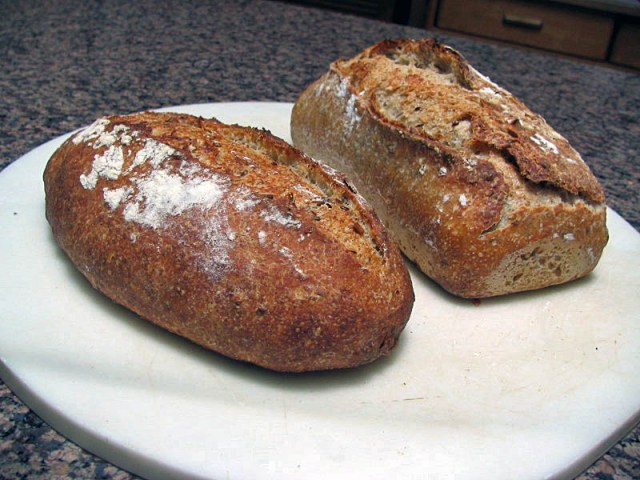
The textures and flavors of this bread were outstanding! Its slices stood out in ham and cheese sandwiches, and were hearty with a thin spread of fig jam. I normally don’t even care for bread with jam, but my husband twisted my arm and I’m glad that he did!

I am submitting this post to this week’s Yeastspotting, to join Susan’s fun on Friday….

BBA #40: WHITE BREAD

The Bread Baker’s Apprentice Challenge brings us to White Bread, offered in three variations – I picked number 2, just because I like even numbers (they are never lonely…)

It is a very simple dough to prepare: buttermilk, flour, yeast, oil, one egg. I halved the recipe (our freezer is already overflowing with bread), and folded the dough instead of kneading it. You can shape the bread in many ways, take a look at the gorgeous dinner rolls made by Oggi (click here . )   I opted to make hamburger-style buns, brushing them with egg wash and sprinkling sesame seeds on top.

They turned out pretty nice, and tasted delicious!

Coming up next:  Whole Wheat…   I am looking forward to making it and comparing with my favorite sandwich bread, Light Whole Wheat, number 18.    Stay tuned…

CHICKEN SOUP on a CHILLY EVENING

While rummaging through the 2,675 loose recipes around my house, I found one from 2006 that was whispering my name: a simple soup from the Mean Chef collection, which was perfect for one of last week’s chilly evenings.

YUCATAN-STYLE CHICKEN SOUP WITH ORZO AND LIME
(adapted from Mean Chef’s recipe)

3/4 cup orzo pasta
1 T olive oil
1/2 onion, diced
2 cloves of garlic, minced
1 serrano pepper, finely minced
2 chicken skinless chicken breasts, sliced into matchstick pieces
5 cups chicken broth (preferably home-made)
1/4 cup fresh lime juice
3/4 cup of diced tomatoes (I used organic, fire-roasted Muir)
1/4 cup chopped cilantro
salt and pepper to taste

Cook the orzo until al dente (do not overcook).  Drain well and reserve.

Heat the oil in a large saucepan and saute the onion and serrano pepper for a few minutes, until the onion is translucent.  Add the garlic and chicken pieces, and saute for a couple of minutes longer.

Add the chicken broth, lime juice, and tomato.   Bring to a boil and simmer gently until the chicken is cooked through.  Mix in the cooked orzo, season with salt and pepper, then add cilantro just before serving.

ENJOY!

to print the recipe, click here

Comments: I’d love to say that I always use homemade chicken stock, but it’s not true.  In a pinch I may use packaged stock, because it makes life easier.  But, in two instances I stay with my precious homemade version:  when making soups or risotto.   The flavor of the broth is powerful in these dishes, and your taste buds will appreciate the high road, as illustrated by this soup.

Orzo is my favorite pasta shape, but the same soup also shines with cooked rice. In Brazil we call that version “canja.”   It’s a soup with firm roots in Portugal, and my mom’s basic strategy to fight almost any kind of illness. I guess some things are the same all over the world… 😉

Please don’t skip the lime or the pepper, because without them this simple soup will be bland.  We like the flavor of cilantro, but members of the Cilantro Haters Association may skip it.   I never understood the advice to substitute parsley for cilantro, because apart from color, they have little in common.   But, I suppose a little parsley won’t hurt anything in this soup.

receita em portugues na proxima pagina

BLASTED BROCCOLI, STOVE-TOP VERSION

I love roasted vegetables, whether it’s cauliflower or butternut squash,  carrots or mushrooms, and especially  broccoli.  For reasons that I can’t explain, when broccoli is being roasted it’s become fashionable to call it  “blasted broccoli“.

I recently encountered a method for ‘blasted broccoli‘ that literally only took minutes to prepare.  We enjoyed it so much that I made it twice in the same week!  The strangest thing happened, though: now that I want to write about it, the link is gone.    I tried and tried to retrieve it, but without success.   All I can find are the usual recipes that call for roasting in a high oven. So, my apologies for failing to give proper credit, but here’s the method that we liked.

BLASTED BROCCOLI
(adapted from unknown source)

broccoli florets (enough for you and a lucky guest)
1 T olive oil
salt to taste
red pepper flakes
freshly squeezed lemon juice

Heat the olive oil until very hot, almost smoking, in a large skillet that will hold the broccoli in a single layer, with little or no overlapping.   Add the broccoli florets, sprinkle with salt, add red pepper flakes, shake the pan, and immediately cover it.

Leave it covered for exactly two minutes.

Open the pan and spritz lemon juice all over.  Check  the broccoli to see if it’s cooked to your taste (I like mine with a lot of bite).  If you want it softer,  then cover the pan  and cook again for another 30 seconds.

Serve immediately…

ENJOY!

to print the recipe, click here


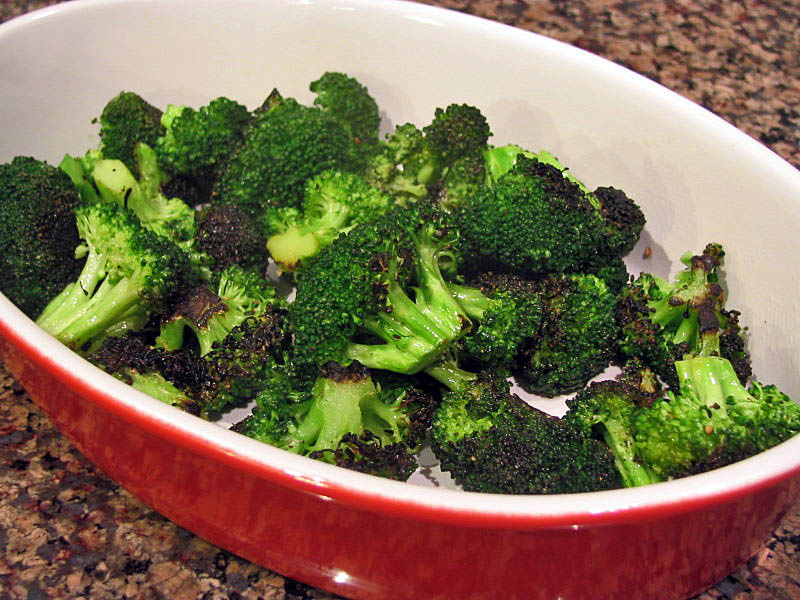
Comments:  This recipe won me over because it’s lightening-quick, and leaves the broccoli exactly as I like it:  firm with a fresh and smoky flavor, from its intensely seared florets.  My stainless steel skillet was not in great shape afterward, but I suspect I over-heated the oil a bit.  The secret lies in closing the pan and allowing the broccoli to cook undisturbed, to create a little char at the bottom, and enough steam to begin cooking the florets.  I’m 99% sure that the original recipe asked to finish it with butter, but I opted for fresh lemon juice instead.  Feel free to improvise, as broccoli matches with balsamic vinegar, or grated parmiggiano cheese, or a little nutmeg…. just use your imagination.

When prepared this way the broccoli  has the quality of a classic roasted veggie, but with a “brighter”  flavor;  I couldn’t stop nibbling on it.    This one goes into my regular repertoire!

On a side note, this method reminded me of a recipe for Brussels sprouts that I made  long  ago from 101 Cookbooks.  It’s delicious,  producing the same kind of flavor in a veggie that’s a little challenging for lots of folks.  Give it a try even if you’re  Brussels-sprouts-challenged.