SOBA NOODLES: LIGHT AND HEALTHY

My two previous posts featured substantial pasta dishes, one loaded with meat, one packed with cheese. Very naughty of me!  To compensate, here is a recipe that should bring my polls a little higher with the health-conscious, as these noodles won’t make you feel guilty once the meal is over. Soba noodles are one of my favorite types of “pasta,”  I love the hearty taste of buckwheat, its toothsome texture, and the way soba pairs so well with veggies and soy-based dressings. The recipe, called otsu, comes from Heidi Swanson’s Supernatural Cooking, a cookbook I use so much that I bought three more as gifts for (very special) friends! If that’s not a huge endorsement, I don’t know what would be… 😉

OTSU
(adapted from Heidi Swanson’s Supernatural Cooking)

For the dressing:
zest of 1 lemon
1 Tbs fresh ginger, grated
1 tablespoon honey
3/4 teaspoon cayenne
3/4 teaspoon salt
2 Tbs freshly squeezed lemon juice
1/4 cup rice vinegar
1/3 cup soy sauce
2 tablespoons extra-virgin olive oil
2 tablespoons toasted sesame oil

for the noodles:
12 ounces soba noodles
1/4 cup chopped fresh cilantro
3 green onions, thinly sliced
1/2 cucumber, peeled, cut in half lengthwise, seeded and thinly sliced
1/4 cup toasted sesame seeds

Make the dressing by combining the lemon zest, ginger, honey, cayenne and salt in a small bowl, mixing very hard with a whisk (you can use a small food processor, if available). Add the lemon juice, rice vinegar, and soy sauce, and continue mixing (or processing) until smooth. Drizzle the olive oil and the sesame as you mix, to form an emulsion. Reserve.

Cook the noodles in boiling salted water for 3 to 4 minutes (do not overcook), drain, and rinse briefly in cold water. Transfer to a bowl, add 3/4 cup of the prepared dressing, then add the cilantro, green onions, cucumber, and combine. Sprinkle with toasted sesame seeds, and serve. Add more fresh cilantro if you like.

ENJOY!

to print the recipe, click here

Comments: Heidi adds sauteed tofu to the noodles, I kept them simple, serving some grilled shrimp alongside. Leftovers are AWESOME served cold. Remove from the fridge, leave standing at room temperature for an hour or so, and amaze your taste buds at how delicious these noodles can be. The cucumber offers a pleasant crunch, the sesame/soy flavor always makes me feel healthy. A very “zen” dish… Make it, and you will be making it again, and again!

ONE YEAR AGO: Potato-Rosemary Bread

Add to FacebookAdd to DiggAdd to Del.icio.usAdd to StumbleuponAdd to RedditAdd to BlinklistAdd to TwitterAdd to TechnoratiAdd to Yahoo BuzzAdd to Newsvine

WHITE HOUSE MACARONI AND CHEESE

It’s been a while,  but today I bring back my favorite guest blogger, my husband, to talk about his version of macaroni and cheese.   It was one of the first meals he cooked for me when we were dating, and we’ve made it together countless times in the past 12 years… So, without further ado, here he is:

This is not a dish for the faint of heart. It takes a lot of guts to face the excesses of this delicacy.  But, macaroni and cheese is a uniquely American concoction, that, unfortunately, is seldom prepared in a way that justifies it.   It has a long,  glorious history.  OK, the Italians mixed pasta and cheese years beforehand, but  Thomas Jefferson introduced America to macaroni and cheese at a White House dinner in 1802, and the rest IS history.  When the flavors of this dish saturate your taste buds, any concerns about caloric excess will fade away, lost in your enjoyment of the pasta!  Probably a significant amount of  American obesity derives from the decadence of macaroni noodles baked into that matrix of cheese, eggs and milk.  Besides cakes, pies and cookies, it was one of the only things that elicited an enthusiastic “Oh boy!” when my mom announced its presence on the menu.  We recently made it for some visiting European friends who “oooohed and aaaaahed “ their way through several servings each.

However, too often macaroni and cheese appears in a lunch buffet in some almost unrecognizable,  bland and bloated form.  And let’s not talk about the boxed varieties.  But this recipe is different.  I admit it,  I took some liberties with my version, that I invented as a starving college student.  It’s different from Mr. Jefferson’s, and even my mother’s original recipe:  I added celery and mushrooms.  I suspect, though, that you’ll agree the new ingredients bring it to a  higher level.   Scoff if you must (I’m sure that Mr. Jefferson would not), or even skip (don’t do it!) an additional crucial ingredient, Velveeta “cheese,” another appropriately American original that imparts inexplicably  unforgettable flavor to the mix.

WHITE HOUSE MACARONI AND CHEESE
(from the Bewitching Kitchen)

1 box of macaroni noodles (elbows, or another short shape)
4-5 large celery stalks
8-12 oz of white or cremini mushrooms
½ pound or more of high-end cheeses [emmental, mozzarella, manchego, roquefort, camembert – choose two of your favorite(s)]
½ pound or more of Velveeta “cheese”
3 eggs
1 + 1/2 cups of milk
½ tsp smoked paprika
1 tsp salt
½ tsp pepper
1/8 tsp cayenne pepper
Bread crumbs

Preheat the oven to 450 F.  Cook  and drain the macaroni.  Rinse the vegetables and dice them and the cheeses into macaroni-sized pieces.  Rub a large casserole dish with butter and fill it with layers of the  ingredients.  Put pasta, celery and mushrooms in each layer, and an amount of cheese to your taste.  Don’t skimp on the cheese! Cover the top with breadcrumbs.

Beat the eggs with a fork, then add the milk and spices and beat a bit more.  Pour the liquid mixture over the casserole and put it in the oven; reduce the heat to 400 F and bake until you observe the sauce bubbling up to the top, 45 min to an hour.

ENJOY! (and don’t feel guilty!)

to print the recipe, click here

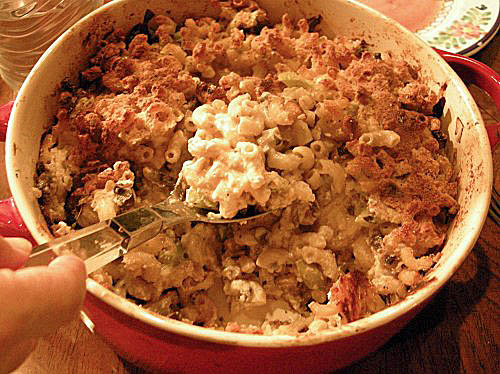
Comments: Make sure to cook enough macaroni.  I always prepare a full  bag or box, and save any extra for lunch another time.   The amount of milk and eggs somewhat depends on the size of your baking dish, and it might take a little trial and error to perfect your own amounts.  I’ve given amounts that work for about a 10″ deep casserole, like the one in the picture.   I want to see the liquids bubbling up to the top of the pasta just at the end of the cooking time.

ONE YEAR AGO: For the love of bread

Add to FacebookAdd to DiggAdd to Del.icio.usAdd to StumbleuponAdd to RedditAdd to BlinklistAdd to TwitterAdd to TechnoratiAdd to Yahoo BuzzAdd to Newsvine

receita em portugues na proxima pagina

SHOW-STOPPING SPAGHETTI AND MEATBALLS

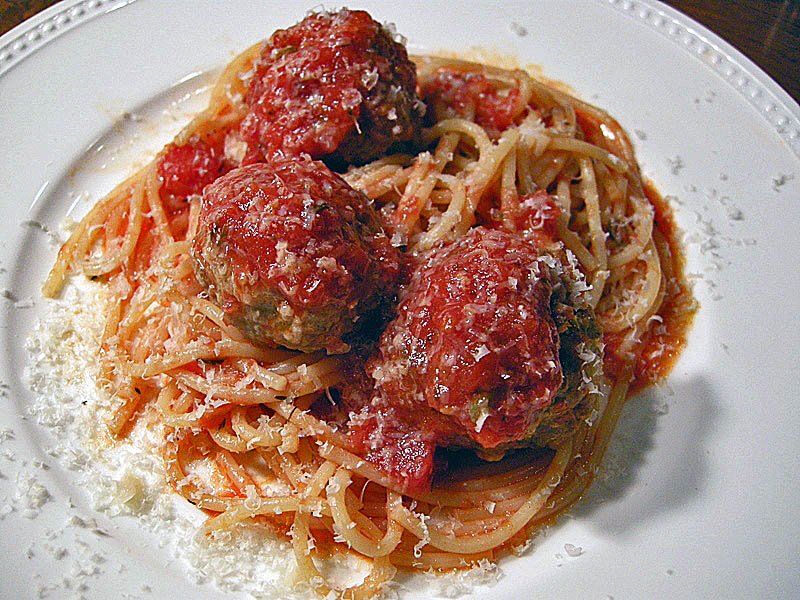
If you’re tempted to skip  this post because spaghetti and meatballs are too pedestrian, don’t do it!   This was the best dinner I’ve cooked in weeks!   The first bite took me back to a small Italian trattoria where I had this dish years ago.  These meatballs are tender, moist, flavorful, and the tomato sauce (note: contains neither onion nor garlic) gets a lift from the addition of capers. It’s so simple  that you’ll be shocked at how flavorful it is! The recipe comes from the latest issue of Food and Wine, with small modifications that,  modesty aside,  worked quite well.  It was a perfect dinner-date recipe for Saturday night.  Uncork the chianti and let the music play

SPAGHETTI AND ITALIAN MEATBALLS IN TOMATO CAPER SAUCE
(adapted from Food and Wine, original recipe from Massimiliano Alajmo)

for the sauce:
1 can of whole, peeled tomatoes (28 oz)
2 Tbs olive oil
1 Tbs capers, drained and chopped
1 tsp dried oregano
salt and pepper

for the meatballs:
1/2 cup white bread, crust removed, roughly diced
3-5 Tbs milk
1/2 pound ground pork
1/2 pound ground beef
1 egg, beaten
8 pitted kalamata olives, diced
1/8 cup freshly grated Parmiggiano cheese
2 Tbs fresh parsley leaves, minced
1 tsp salt

Puree the tomatoes in a blender or food processor.  Heat the olive oil in a large skillet, add the tomatoes and bring to a boil. Simmer for 5 minutes, add the capers and oregano.  Simmer for a couple more minutes, season with salt and pepper and keep warm while you prepare the meatballs.

Cover the bread with milk: soak it well.  Drain any excess and reserve the bread.  In a large bowl, mix both types of meat, add the softened bread, egg, olives, cheese, parsley, and salt.  Wet your hands with cold water and very gently form the mixture into 1.5 inch diameter meatballs.  You can prepare the meatballs  hours in advance.

Line a baking sheet with parchment paper (or aluminum foil) and bake the meatballs in a 400F oven for 20 minutes, turning them once during baking.  Remove them from the oven, and transfer to the skillet with the tomato sauce.  Gently simmer the meatballs and sauce together for 10 to 15 minutes over gentle heat.

Meanwhile, boil some spaghetti, drain, place back in the pan and add some of the tomato sauce. Place back on top of the stove to heat pasta and sauce together for a couple of minutes. Transfer to a serving dish, add the meatballs, and serve with fresh Parmiggiano cheese.

(makes 15 meatballs, 3-4 servings, depending on who is eating…  😉

ENJOY!

to print the recipe, click here

Comments: My modifications involved baking, instead of frying the meatballs, and simmering them in tomato sauce afterward.   This is my secret to great meatballs, without the harsh outer surface often associated with the fried version.   I’ve seen (and tried) recipes in which the meatballs are cooked in the sauce from beginning to end, but the   oven-roasting in my version intensifies their flavor and color.

I also increased the amount of black olives in the meatball mixture.  The original recipe called for two olives (!!!!).   Sorry, but two diced olives in a pound of meat doesn’t do it for us, Kalamata-lovers that we are.  Feel free to adapt to your own tastes.

Chef Alajmo has two other recipes that made my mouth water in this issue of Food and Wine: Risotto with Capers and Espresso, and Pappardelle with Smoked Butter and Herbs.  Makes me want to catch a plane to Italy and reserve a table for two at his restaurant, Le Calandre.

ONE YEAR AGO:  Korean-Style Pork with Cabbage Slaw

Add to FacebookAdd to DiggAdd to Del.icio.usAdd to StumbleuponAdd to RedditAdd to BlinklistAdd to TwitterAdd to TechnoratiAdd to Yahoo BuzzAdd to Newsvine

CIABATTA, A CLASSIC ITALIAN BREAD

I’ve made it before during the Bread Baker’s Apprentice Challenge, but was not very happy with the way it turned out.   Hard to believe that it took me 17 months to bake another batch, but time tends to fly by me.   November?  Are we in November already?  What happened to 2010, that started just the other day?   😉

Ciabatta, take two: the recipe from  “The Italian Baker” calls for a mixture of flour, water, and yeast made the day before (the “biga“), and used as part of the final dough.  A total fermentation time of 3 hours allowed us to have the bread in time for lunch, as it bakes very quickly, less than 25 minutes.   I am quite pleased with this recipe, I suppose that it would work even better in a real oven, but my Breville rose to the challenge!

CIABATTA
(from The Italian Baker)

for biga:
1/8 tsp active dry yeast
1 cup + 1 Tbs water at room temperature
1 + 1/4 cup all purpose flour (165 g)

Dissolve yeast in water, add the flour and form a sticky dough.  Leave it covered at room temperature for 16 to 24 hours.

for the final dough:
2.5 Tbs milk
1/2 tsp active dry yeast
5.5 ounces water (1/2 cup + 1.5 Tbs)
1/2 T olive oil
1 cup biga (250 g)
250 g all purpose flour
1/2 Tbs salt (7.5 g)

If kneading in a mixer, stir the yeast in the milk  and let it stand for  a  couple of minutes in the bowl.  Add the water, oil, the biga, and mix to incorporate, dissolving the biga in the liquid. Add the flour and salt, and mix at low speed for a couple of minutes.   Change to the dough hook and knead 2 minutes at low speed, and 2 minutes at medium speed.  Finish kneading by hand on a well-floured surface, but adding as little extra flour as possible.

Place the dough in an oiled bowl, cover, and leave at room temperature for 1 hour and 15 minutes.  Divide the dough, which will be very soft and bubbly, in two equal pieces.  Place each half on a well floured piece of parchment paper, and shape each as a cylinder, keeping the seam side down.  Stretch it gently to give the ciabatta overall shape (a rectangle of 10 x 4 inches), and use the tip of your fingers to make deep dimples all over the dough. Cover with a damp towel and let them rise for 1.5 to 2 hours.

Bake in a pre-heated 425 F oven, spraying the bread with water three times in the first 10 minutes.   Total baking time should be 20 to 25 minutes.   Cool the loaves on a rack, and…

ENJOY!

to print the recipe, click here

Comments:  Carol Field advises against kneading this dough by hand, because it is very hard not to add more flour to prevent it from sticking.  However, if you are familiar with the way a high hydration dough behaves,  go ahead and give it a try.  Keep in mind that the less extra flour you add, the better.   She also keeps the seam side up during rising, which forces her to invert the dough on the baking sheet (or stone).  I prefer to shape them seam-side down, then transfer them gently to the oven with the parchment paper still underneath. I think that this method minimizes deflating the dough.

We enjoyed our ciabatta with mozarella and ham for lunch, and at dinner it complemented spaghetti with meatballs that shall be the subject of a post in the very near future (they were AWESOME!)…

I am submitting this post to Susan’s Yeastspotting event…

ONE YEAR AGO: Lamb Stew with Parsnips, Prunes and Chickpeas

Add to FacebookAdd to DiggAdd to Del.icio.usAdd to StumbleuponAdd to RedditAdd to BlinklistAdd to TwitterAdd to TechnoratiAdd to Yahoo BuzzAdd to Newsvine

A PERFECT SATURDAY

Sleeping in?  No, thanks…    For us, Saturday starts early with a run, while most people are asleep and the empty streets are ours.  Next, it’s a well-deserved and needed double cappuccino,  to get some caffeine  flowing.   Maybe we’ll find a reasonable croissant or pain au chocolat (it’s not easy, even in LA).  Most of our meals are home-cooked, but on the weekend we kick back with some shortcuts.  Here in LA take-out sushi  is a fine option!  We found a Japanese market a few miles from home that sells absolutely perfect sushi.   No one speaks any English in there, as the staff and customers are Japanese, and usually the only exceptions are  us!  ;-).      We love their spicy salmon roll, it’s fresh and delicious!

I’m reasonably daring as far as cooking goes, but I’ve never tried to make sushi at home.  Perhaps while we’re living here,  surrounded by  excellent fish, I’ll give it a try…

If you live in the area and want to visit Granada Market, it is located at 1820 Sawtelle Blvd in West LA.  They carry every imaginable ingredient for Japanese cooking, including fresh produce (Kobe beef included).  It’s a great, reasonably priced store.