REVISITING SPRING

I am fully aware that Spring is long finished, and that every year I commit the exact same sin: buying asparagus from a far away place, just because I can’t resist their charm at the grocery store. Locavores, forgive us. We love asparagus too much to wait for several months…

This is a very simple way to prepare them, but looks elegant enough to make a weeknight dinner special.

ASPARAGUS BUNDLES WITH PROSCIUTTO AND PARMIGGIANO
(from the Bewitching Kitchen)

asparagus
prosciutto slices
olive oil
salt and pepper to taste
Parmiggiano Reggiano cheese, shaved

Make a bundle with a single-serving amount of asparagus.  Cut 2 slices of prosciutto in half or thirds lengthwise, forming small ribbons.  Wrap them around each bundle and place on a baking sheet lined with aluminum foil.   Drizzle a little olive oil over it, rubbing it around the surface with your fingers or with a silicone brush. Season lightly with salt and pepper (prosciutto is salty, go easy on the salt).

Bake in a 400F oven until the asparagus are starting to brown on the edges – 20 to 25 minutes.  Add shaved parmiggiano and bake for a couple of minutes.  Sprinkle extra black pepper right before serving.

ENJOY!

to print the recipe, click here

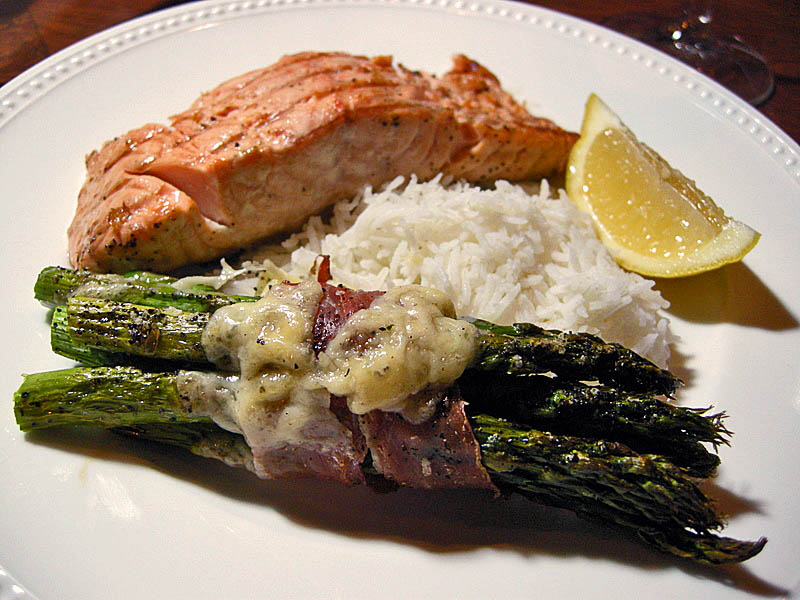
Comments:  Roasted asparagus are always showing up as a side dish in our home, the addition of prosciutto is a nice variation.  We enjoyed it with a delicious grilled salmon and white rice.   I did not give credit to a particular source for this recipe, because I’ve been making it for years, I probably saw it in some publication long time ago.  However, it’s so simple that it hardly qualifies as a real recipe…   I’ve made it with regular ham  and it works well too, but I prefer the extra-bite the prosciutto provides.

ONE YEAR AGO: Basic Sourdough Bread

Add to FacebookAdd to DiggAdd to Del.icio.usAdd to StumbleuponAdd to RedditAdd to BlinklistAdd to TwitterAdd to TechnoratiAdd to Yahoo BuzzAdd to Newsvine

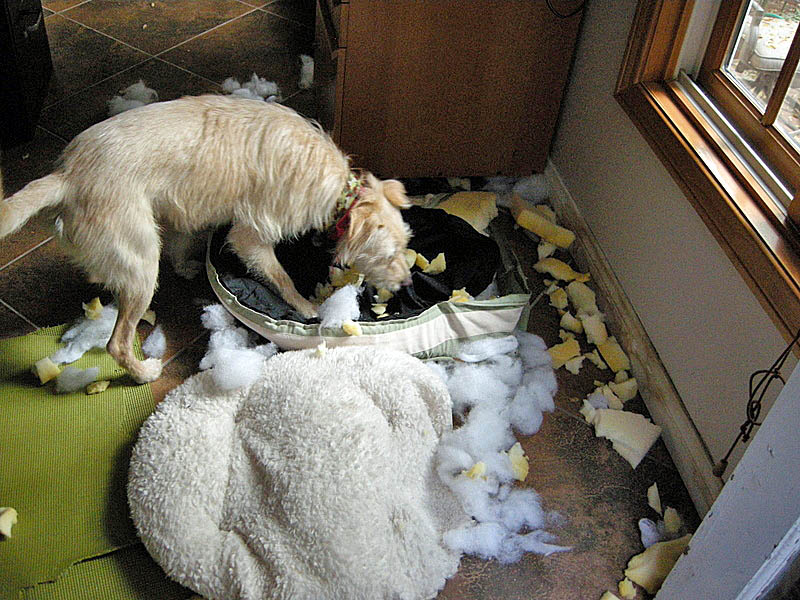
ENTROPY IN ACTION


A new dog bed, ca. September 2010

The same dog bed, December 2010

The criminal returns to the scene of the crime.

Add to FacebookAdd to DiggAdd to Del.icio.usAdd to StumbleuponAdd to RedditAdd to BlinklistAdd to TwitterAdd to TechnoratiAdd to Yahoo BuzzAdd to Newsvine

INTO THE LIGHT

Thanksgiving officially marks the beginning of gastronomic over-indulgence. With the end of the year approaching, the celebrations start: departmental parties, lab parties, neighborhood parties, family get-togethers… every one of them loaded with caloric temptations…    This Thanksgiving we took a back seat in the kitchen, as we were guests at a fantastic dinner thrown by our dear friends (and neighbors).   Our hostess, knowing how much I love to cook, asked if I’d prepare  an appetizer for the Thanksgiving party, a question that I answered with the most enthusiastic yes!   I opted for something light and refreshing, to provide a counterpoint to the substantial meal ahead, that included a turkey with chestnut dressing that we won’t soon forget!

MEDITERRANEAN SKEWERS
(from the Bewitching Kitchen)

50 skewers
mozzarella mini-balls (like these)
3 mini-cucumbers
30 grape or cherry tomatoes
30 black Kalamata olives, pitted

for the dressing:
2 Tbs olive oil
2 tsp lemon juice
1/4 tsp ground fennel
salt and pepper to taste

When you are ready to start prepping your ingredients, put some music on and go to work: slice the mini-cucumbers 1/8 inch thick, cut the tomatoes and black olives in half.  If some olives are too small, leave them whole. Reserve.

Assemble each skewer starting with one small mozzarella ball, half a black olive, another mozzarella ball, a cucumber slice, and finish with half the tomato.  Arrange the skewers on a nice serving platter.

Make the dressing by whisking all the ingredients in a small bowl, drizzle over the skewers half an hour before serving.

ENJOY!

to print the recipe, click here

Comments:  The inspiration for this recipe came from two different sources:  “Greek Salad Skewers” from Fine Cooking, and a dressing found in “Small Bites,” but  I modified them enough to make it “bewitching.”  😉  One of my changes was to use mozzarella instead of feta cheese because feta tends to crumble and I am forced to eat all the cheese that disintegrates as I stab it.  If you don’t find mini-cucumbers, use regular ones, but peel them and cut the slices in halves or quarters, depending on the size.

Fennel seed is the secret for the dressing.  I like to use ground and let the dressing sit for a while before using, but next time I’ll use whole fennel seeds and warm them up gently to make an infused oil. Might be even better.

These skewers are very colorful, a nice addition to any cocktail party, but particularly great to open a multi-course dinner. Consider making them for your end-of-the-year festivities.

ONE YEAR AGO: Dundee Cake Bake-Along (and great fun was had by all!)

Add to FacebookAdd to DiggAdd to Del.icio.usAdd to StumbleuponAdd to RedditAdd to BlinklistAdd to TwitterAdd to TechnoratiAdd to Yahoo BuzzAdd to Newsvine

receita em portugues na pagina seguinte

TARTINE BREAD: BASIC COUNTRY LOAF

Since Tartine arrived in the mail weeks ago in the nano-house, I’ve counted the days to Thanksgiving week, knowing we would be in Oklahoma for a little while, where Arthur, my youngest sourdough starter, awaited me in the freezer since our last visit.  We arrived from the airport close to midnight, but before I went to bed I woke Arthur up and fed it with warm filtered water, and a nice helping of flour.  Two more days of tender loving care, and he was ready, all bubbly and active…

For the Basic Country Loaf, the starter must be prepared with a 50/50 proportion of white and whole wheat flour.  When we left for Los Angeles, all my flour went into the garage freezer for long term storage, and to my despair, here’s what I found: garbanzo, teff, barley, potato, corn, spelt, and  three kinds of white flour, but no regular whole wheat!  Undeterred, I decided that spelt would be a good substitute.  The bread turned out as one of the best loaves ever baked in the Bewitching Kitchen (those are my husband’s words, not mine…), so trust me: spelt flour rocks.

BASIC COUNTRY LOAF
(adapted from Chad Robertson’s Tartine Bread)

For the starter:
50g  spelt flour
50g white flour
100g/ml water at 78-80F
1 Tbs active sourdough starter

For the dough:
375g/ml water at approximately 80F (divided in 350g + 25g)
100 g starter (you won’t use the full amount made)
450g white flour (good quality all purpose is fine)
50g spelt flour
10g salt

In a large bowl, mix 350g of warm water with the starter (100g of it), and mix to dissolve. Add both types of flour, mix until all flour is mixed with water, without large dry bits present.  Let the dough rest for 25 to 40 minutes.

Add the salt and the rest of the water (25g), and incorporate by pressing the dough with your fingers. Fold the dough a few times, until if forms a homogeneous mass, but don’t try to knead it.  Leave it in the bowl, folding it again a few times – no need to remove it from the bowl – every 30 minutes, for the first two hours (you will be making 4 series of folds during this period).  After the last folding cycle, let the dough rest undisturbed for another full hour, for a total of 3 hours of “bulk fermentation.”

Remove the dough from the bowl and shape it gently as a ball, trying to create some surface tension (for a tutorial, click here).  Let it rest for 20 minutes, then do a final shaping, by folding the dough on itself and rotating it.  If you have a banneton, rub it with rice flour, line it with a soft cloth sprinkled with rice flour, and place the dough inside it with the seam-side up. If you don’t have a banneton, any round container – like a colander – will do. Let it rise for 3 to 4 hours at room temperature.  Twenty minutes before baking time, heat the oven to 450F.

Cut a piece of parchment paper that will completely cover a pie baking dish and place it on top of the banneton containing the bread dough.   Carefully invert the banneton  over the parchment paper, using the pie plate to support the dough.  The cloth will probably be sticking to the dough, so carefully peel it off.  Score the bread, and place the pie pan over baking tiles in the pre-heated oven.

Bake for about 45 minutes, covered during the first 20 minutes, remove the cover for the final 25 minutes.

Let the loaf cool completely on a rack before devouring it, and pay close attention to its music as it cools…  It will sing for you…

ENJOY!

to print the recipe, click here


Comments:   I gave you a very summarized version of the recipe. In the book, the instructions cover 11 pages, and every word is worth reading.   Plus, there are step by step photos that will guide you through the kneading and shaping of the loaf, and an extensive description on how to generate steam in a home oven.  His method of choice is what I’ve been using for months, but thanks to discussions over at The Fresh Loaf Forum, I went down a daring route and tried something a little unusual:   I placed my dough, after the final rise, over a COLD non-stick pie baking pan, lined with parchment paper.   The cold pan made it very easy to score the bread, without worrying about the 450-500F oven environment. Once the dough was scored, I transferred the pan to the oven,  over pre-heated tiles, and immediately covered it with a large roasting pan that had been previously filled with hot water.   I dump the water and invert the roasting pan, still moist, over the pie pan + dough, covering them completely.    Twenty minutes later, I removed the roasting pan, and finished baking the bread uncovered until it turned a deep golden brown.

The main advantage of the pie pan, is that it provides some support for the bread to rise up, and the fact that it works without pre-heating makes life a lot easier.   I have quite a few burn scars on my arms and hands in the quest for the perfect loaf of bread… 😉      The crust developed as nicely as any of my breads baked on a pre-heated pan, and the oven-spring of this “boule” was exceptional, as I barely had to touch it to place it inside the oven. Minimal handling = maximal preservation of gas in the dough = great oven spring.

This is all you will need to use my method for baking the bread (plus a sheet of parchment paper):

Very few things in the kitchen bring me as much happiness as baking a nice loaf of sourdough bread. The Country Loaf from Tartine Bread was my best welcome home ever!  We fly back to LA tomorrow, but I’m already looking forward to my next “homecoming bread.”  The Olive variation, maybe?   Sesame?  Country Rye?   Stay tuned: March is not too far away…  😉

I am thrilled to submit this bread to Susan’s  Yeastspotting.

ONE YEAR AGO: Pugliese Bread

Add to FacebookAdd to DiggAdd to Del.icio.usAdd to StumbleuponAdd to RedditAdd to BlinklistAdd to TwitterAdd to TechnoratiAdd to Yahoo BuzzAdd to Newsvine

THE ULTIMATE APPLE CAKE

Cover of "Around My French Table: More Th...

Cover via Amazon

For someone who’d rather go to the dentist than bake a cake, making the same cake two weeks in a row means:

– the cake is fool-proof;

– the cake is awesome.

Awesome indeed! It’s a bunch of diced apples surrounded by a few dollops of cake batter, that puffs and gently envelopes each piece of fruit, resulting in a dessert that’s a cross between cake and clafoutis.  Very French, very elegant, just enough decadence to turn your afternoon tea into a four-star event.

The recipe comes from a cookbook that’s been on my wish list at amazon.com since it’s released: Dorie Greenspan‘s Around my French Table.   It’s just a matter of time until I move the book to my shopping cart, the reviews are stellar!

MARIE HELENE’s APPLE CAKE
(from Dorie Greenspan)

3/4 cup all-purpose flour (110g)
3/4 tsp baking powder (about 3.75 g)
pinch of salt
4 large apples (any kind you like, mix and match)
2 large eggs
3/4 cup sugar (145g)
3 Tbs rum (or apple schnapps, or Calvados)
1/2 tsp vanilla extract
1 stick butter, melted and cooled (115g)

Heat the oven to 350F.  Butter a 8-inch springform type pan with butter and set aside.

Peel and core the apples, cut them roughly in 1 inch chunks. Reserve.

In a small bowl, mix the flour, baking powder, and salt.   In a large bowl, beat the eggs with a whisker until frothy, add the sugar and whisk until smooth.
Add the rum, vanilla extract, and mix well.  Add half of the flour mixture, mix until fully incorporated, pour half of the butter and whisk to combine.   Add the rest of the flour, then the rest of the butter.

Pour the thick batter over the apples, and use a silicone or plastic spatula to mix them gently, trying to cover each piece with some of the batter.   The mixture will seem too thick, and you will be tempted to use less apples.  Do not.  Trust Dorie. Pour the mixture in the prepared pan, use a fork to level the apples as much as possible, but don’t worry too much about it.

Bake for 50 to 60 minutes, until golden and a cake tester comes out clean when inserted at the center of the cake.  Remove the pan to a rack and let it cool for 5 minutes before opening the sides.

ENJOY!

to print the recipe, click here

Comments: The first time I baked this cake, I didn’t use all the apples because it seemed impossible to coat them all with the batter.  I realized my mistake when I witnessed how much the batter puffed up during baking.  On my second attempt, I used all the apples, and substituted apple schnapps for rum. We both liked the schnapps version better.  A friend of mine used Calvados and also preferred it to rum.  Either of those liquors reinforce the apple flavor. Next time I might add a little cinnamon to the batter, but this cake is pretty close to perfection as it is.

ONE YEAR AGO: Trouble-free Pizza Dough

Add to FacebookAdd to DiggAdd to Del.icio.usAdd to StumbleuponAdd to RedditAdd to BlinklistAdd to TwitterAdd to TechnoratiAdd to Yahoo BuzzAdd to Newsvine