SOFT SPOT FOR CHEVRE

Phil and I influence each other’s gastronomic likes and dislikes.  Before we met I wasn’t fond of sushi,  couldn’t understand all the passion for guacamole, and twisted my nose at maple syrup.  Now I’m addicted to sushi (with no intentions of rehab), I’ll eat guacamole any time,  and I can’t imagine a blueberry pancake without the heavenly nectar drizzled on top.

Phil, on the other hand,  wouldn’t touch a raw tomato, felt queasy around foie gras, and didn’t like the smell of goat cheese.  Those days are over, which is  great, because I didn’t want to skip this pasta, with creamy goat cheese enveloping cremini mushrooms and arugula.   You can use any pasta shape you prefer,  but pick a mild goat cheese that will quickly melt in the hot pasta.

CREMINI MUSHROOM PASTA WITH GOAT CHEESE AND ARUGULA
(adapted from The Essential New York Times Cookbook)
receita em portugues na pagina seguinte

1 pound spaghetti (or another shape of your choice)
2 pounds cremini mushrooms, thinly sliced
2 Tbs olive oil
1 Tbs butter
1 clove garlic, minced
salt and black pepper to taste
2-3 cups baby arugula
3/4 pound soft goat cheese, crumbled (room temperature)
freshly minced parsley

Bring a large pot of salted water to a boil, and cook the pasta until al dente.  Heat the olive oil and butter on a non-stick skillet, add the garlic and saute for a couple of minutes.  Add the sliced mushrooms, season lightly with salt and pepper. Cook the mushrooms until they release liquid and it almost completely evaporates.  Reserve, keeping warm.

When the pasta’s ready, reserve about 1/2 cup of the cooking water, drain the pasta, return to the pot and add the cremini mushrooms, arugula, goat cheese, and parsley. Gently toss everything to wilt the arugula, add some of the pasta water to get a smooth consistency, adjust the seasoning, and serve.

(makes 4 substantial servings)

ENJOY!

to print the recipe, click here

Comments: If you don’t like goat cheese, then this pasta is not for you, just skip it, because the “flavor of the barnyard”  (as Phil calls it) is pronounced in the sauce.  The original recipe called for regular arugula, but instead I used baby arugula because the sharpness of the goat cheese pairs better with a milder green.  If you want to tone it down even more then use baby spinach, or even Swiss chard, although you’ll have to saute it first.  My other adaptation was to skip the 1/2 cup of olive oil that was intended as its  “finishing touch.”  Despite my love for olive oil, I’d never add 955 calories of fat to a pasta that’s perfectly fine without it.  I am not a fat-o-phobe, but have my limits.

We like to go vegetarian one day during the week, and this is a great option if you’re trying to skip meat whether occasionally or permanently.   It’s delicious!

Note to self: to make it even faster, saute the mushrooms in advance, and  re-warm them right before adding to the pasta.

ONE YEAR AGO: Seared Tuna is my Private Idaho

Add to FacebookAdd to DiggAdd to Del.icio.usAdd to StumbleuponAdd to RedditAdd to BlinklistAdd to TwitterAdd to TechnoratiAdd to Yahoo BuzzAdd to Newsvine

receita em portugues na proxima pagina

ROASTED LEMON VINAIGRETTE

The rind of a lemon is exceptionally bitter, w...

Image via Wikipedia

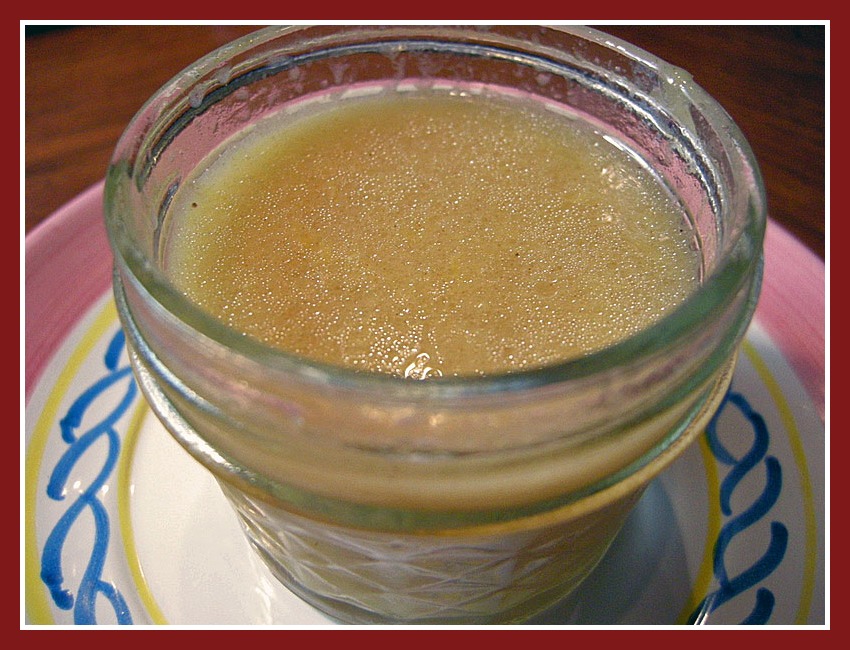
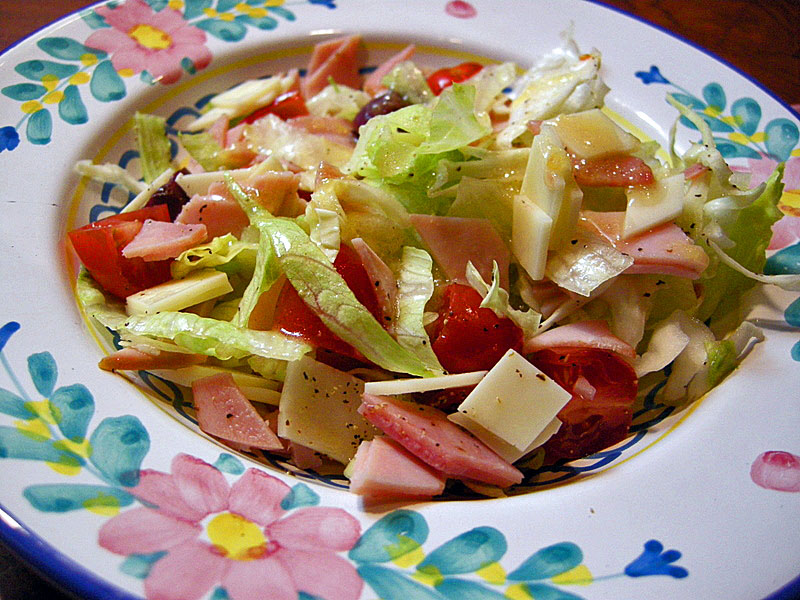
I had this recipe filed in my computer for 13 months.  All I can say is “better late than never.”  Please, make this dressing as soon as you can possibly gather the ingredients and spare half an hour of your time.   My friend Gretchen urged me to try it a long time ago,  but only the constant influx of Meyer lemons in our fridge set my wheels in motion. Consider making a double batch, as you will find many uses for this liquid gold: I drizzled over our salad, and next thing I knew, my grilled halibut was under its shiny coating too.

ROASTED LEMON VINAIGRETTE
(from Gretchen’s kitchen)

1 lemon (Meyer, if available)
1 tsp + 3 Tbs olive oil (divided)
1 clove garlic, unpeeled
1 tsp Dijon mustard
2 tsp honey
1/4 tsp salt
freshly ground black pepper to taste

Wash the lemon, cut it in half, remove the seeds with the tip of a knife. Rub the lemon halves and the garlic clove with 1 tsp of olive oil, place in a small baking dish and roast in a 400F oven for 25-30 minutes, until the lemon starts to get brown at the edges. Remove from the oven, and as soon as it’s cold enough to handle, squeeze the juice and the pulp in a small bowl.

Add the mustard, honey, salt, and pepper, and use a whisk to mix it all well. Remove any large bits of white pulp, if present. Add the remaining 3 Tbs. of olive oil, slowly at first, then drizzle it as you continue to whisk, forming an emulsion. Adjust the seasoning.

Serve over salads, steamed veggies, roasted veggies, grilled fish, chicken, or pork. Have fun with it, and…

ENJOY!

to print the recipe, click here

Comments: I cannot recommend this recipe strongly enough. It is simply perfect if you are into citric flavors. We usually make a big salad on Friday evenings, using any greens and other goodies left in the fridge. This dressing turned the “everything but the kitchen sink salad” into something special.  Next day, I used what was left in a farro concoction very similar to this one, except that I omitted the raw asparagus and added diced cucumber and fennel instead.  Farro and roasted lemon vinaigrette:  another example of a match made in heaven,  I hope you’ll give it a try.

ONE YEAR AGO: Torta di Zuchini

Add to FacebookAdd to DiggAdd to Del.icio.usAdd to StumbleuponAdd to RedditAdd to BlinklistAdd to TwitterAdd to TechnoratiAdd to Yahoo BuzzAdd to Newsvine

receita em portugues na proxima pagina
proxima pagina

SOPHIE GRIGSON’s PARMESAN CAKE

This year’s Super Bow was low-key for us.  We’ve been hard at work, so what we wanted on that quiet Sunday was to recharge our batteries and reload for  another busy week.  Since it was just the two of us, we kept it simple:  Phil made his killer guacamole, and I prepared a recipe from my newest acquisition, the mammoth  “Essential New York Times Cookbook.”   The way it’s going, our pickup truck may not hold all our belongings (cookbooks!) on the trip home.  I’ve bought more cooking literature than I can possibly use here, and this one will add considerable weight to our load!    😉

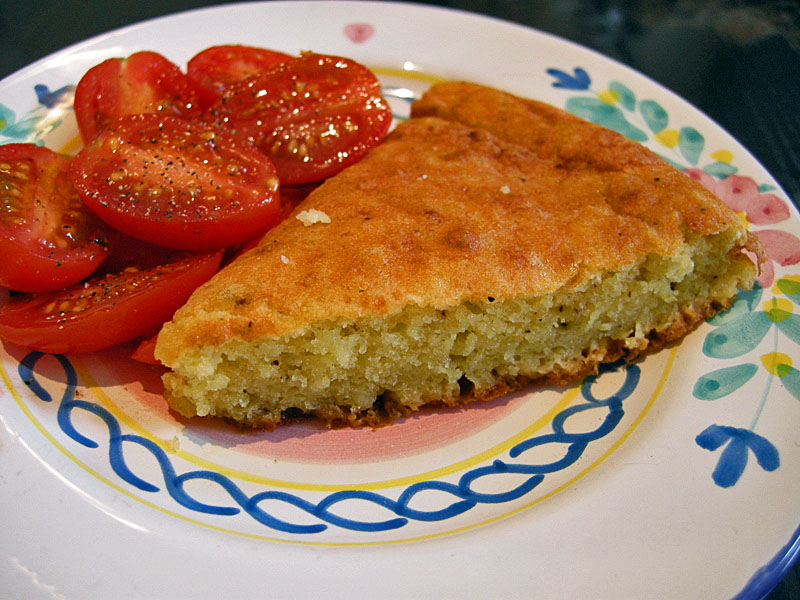
This savory cake resembles corn bread in its looks and texture, smells terrific while baking, and does not disappoint in taste either warm or at room temperature.  We had a couple of slices on Sunday, and enjoyed the rest for lunch in the Gonda-McDonald courtyard at UCLA, on the sunny patio outside our building.  In the 75 degree sun it was hard to believe that the rest of the country was battling snowstorms…

Is it Summer yet?

SOPHIE GRIGSON’S PARMESAN CAKE
(from The Essential New York Times Cookbook)

1 cup flour
1+1/2 tsp baking powder
1/2 tsp salt
2 oz parmiggiano cheese, finely grated
1/4 cup semolina flour
freshly ground black pepper
6 Tbs. unsalted butter, melted and cooled
3 large eggs, yolks and whites separated
3/4 cup whole milk

Heat the oven to 375 F. Grease an 8-inch round cake pan with butter and reserve.  Sift the flour, baking powder, and salt in a bowl, then add the grated cheese, semolina flour, and black pepper to your taste.   Mix well to combine.

Make a well in the center, pour the butter, egg yolks, and milk, and mix until thoroughly combined. Beat the egg whites in a clean bowl until stiff, then fold delicately into the cheese mixture.  Spoon everything in the prepared pan, and bake for 25 to 30 minutes, until golden brown and the surface feels firm to the touch.  Serve warm or cold, cut in wedges.

ENJOY!

to print the recipe, click here

Comments:  One word about the New York Times book:  awesome!  I have no idea how anyone could gather the energy and commitment to create such a masterpiece, but I’m sure glad that Amanda Hesser did it.   I haven’t yet finished  browsing its 932 pages, but I already have a long list of things to make.

Hesser suggests serving this cake in small wedges for cocktail parties with a glass of red wine, or with soup or salad for a light meal.   A hot bowl of tomato bisque (with a touch of basil, of course) is another great match. My only problem with the recipe was the name:  ‘parmesan’ suggests the use of cheap versions of this excellent cheese, with which I strongly disagree.  Instead, buy the best parmiggiano reggiano available, because that’s a taste that you’ll remember.

ONE YEAR AGO: Antibiotics and Food (something I’m very concerned about)

Add to FacebookAdd to DiggAdd to Del.icio.usAdd to StumbleuponAdd to RedditAdd to BlinklistAdd to TwitterAdd to TechnoratiAdd to Yahoo BuzzAdd to Newsvine

WHEN LIFE GIVES YOU (MEYER) LEMONS

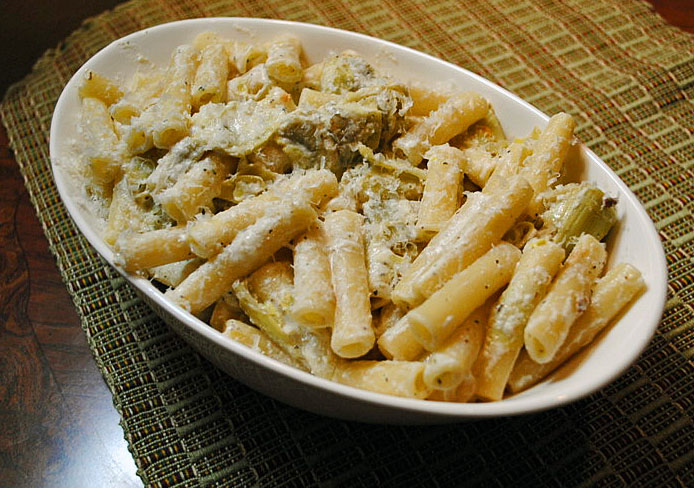
Hundreds of years ago the Chinese developed a new fruit by crossing a lemon and either a mandarin or an orange tree, no one knows for sure. PCR and DNA sequencing could definitely solve this  puzzle, but as far as I know, this research hasn’t materialized yet. The fruit, introduced in the USA in 1908, is the Meyer lemon, and once you try it, you understand why people go crazy when they show up  in farmers’ markets and grocery stores. I’ve been using them often these days, absolutely in love with their flavor, which is often described (quite accurately) as floral.   This pasta came together quickly for a delicious weeknight dinner.  My inspiration was a recipe published in a recent Fine Cooking issue (number 108, the one with the beautiful croquembuche on the cover).

ZITI WITH ARTICHOKES AND MEYER LEMON SAUCE
(loosely adapted from Fine Cooking #108)

10 ounces ziti
1 Tbs olive oil
1/2 Tbs butter
1 small size leek, white and light green part only, diced
8 ounces frozen artichoke hearts, cut in large chunks
1/4 tsp red pepper flakes
salt and pepper
zest and juice of 1 Meyer lemon (will be used separately)
1 cube of Dorot frozen basil (or 2 Tbs fresh leaves, minced)
1/2 cup ricotta cheese
1/4 cup mascarpone cheese
freshly grated Parmiggiano

Heat the olive oil and the butter in a large skillet in medium heat.  Add the minced leeks, cook until softened, season lightly with salt and pepper.  Increase the heat to high and add the artichoke pieces (no need to defrost if frozen), and the red pepper flakes. Cook without moving them too often, so that a nice golden brown color develops.  Remove from the heat, add the lemon zest and reserve.

In a small bowl, mix the ricotta, mascarpone cheese, the basil, and the lemon juice.  Season lightly with salt and pepper.

Cook the pasta in plenty of salted boiling water, reserve 1/4 cup of the cooking liquid, drain the pasta and place back in the pan.  Add the ricotta mixture, stir very well to combine.  If too thick, add some of the pasta water.  Finally, gently incorporate the artichokes, and serve, with Parmiggiano cheese grated on top.

ENJOY!

to print the recipe, click here

Comments: The original recipe called for 4 different types of cheese and several herbs.  I wanted a dish a little lighter and simpler, so that the Meyer lemon had a better chance to shine.  It worked quite well, I am already a bit sad that their season won’t last forever.  Carpe diem, my friends.  Carpe diem.

ONE YEAR AGO: Blasted Broccoli, Stove-top version

Add to FacebookAdd to DiggAdd to Del.icio.usAdd to StumbleuponAdd to RedditAdd to BlinklistAdd to TwitterAdd to TechnoratiAdd to Yahoo BuzzAdd to Newsvine

MOGO MOJO

A few weeks ago a reader left a comment on my post about “mandioca frita.” He told me about “mogo,” a common dish in Indian restaurants in the UK, that also starts from cooked manioc root, but instead of frying, the root is seasoned with a mixture of spices and roasted.   I was intrigued, and put google to work, searching for an authentic recipe.  Very quickly I realized there is no consensus about it.   The only common denominator in mogo recipes is that you start with cooked roots, prepared as I described in this post.  After that, some recipes call for roasting, some for frying  then roasting, others for gently cooking on the stove.   Some recipes use tomatoes, some only peppers, others add coconut milk.  Spices also vary a lot.   With all that complexity facing me,  I shutdown my computer and improvised.  So, here is my version of mogo, a delicious, hearty dish that will be showing up at our table on a regular basis.  Well, as regularly as I can find manioc root at the store…  😉

MOGO
(from the Bewitching Kitchen)

10-12 pieces of cooked manioc root
1 Tbs olive oil
1 shallot, finely diced
1 garlic clove, minced
1/4 tsp red pepper flakes (or more)
1/2 tsp curry powder
salt and black pepper
1 can diced tomatoes with their juices (14.5 oz, about 1 + 3/4 cups)
1/2 cup coconut milk
chopped cilantro leaves

Cook the manioc root until tender. Cut in serving pieces and reserve (cooked manioc can sit in the fridge for a few days, or be frozen for months).

Heat the oil in a saute pan, add the shallots, cook until soft and starting to develop some color.  Add the minced garlic and the red pepper flakes, cooking for a minute or two. Season with salt and pepper, add the tomato with the juices, cook on gentle heat for 5 minutes, stirring a few times.  Add the coconut milk, curry powder, cook for a couple of minutes, add the cilantro leaves, taste the seasoning and adjust to your taste.  You can add some hot pepper sauce if you like it really hot.

Spread the cooked manioc on a baking dish, pour the tomato-coconut sauce on top, cover with aluminum foil and bake at 375 F for 45 minutes.  Remove the foil, and serve or, if you prefer less sauce and some browning on the cassava root, increase the heat to 400 F to finish roasting.

ENJOY!

to print the recipe, click here

Comments: I will be forever in debt with Jack for the heads up about this recipe.  We enjoyed it with roast chicken, but next day it was a meal in itself re-heated in the microwave and served over Israeli couscous.  Wonderful!   Change this basic recipe around by adding roasted bell peppers to the sauce, increasing the heat level with a hot sauce, maybe some smoked hot paprika.

I hope my Brazilian readers will give mogo a try, as they have access to excellent quality manioc root in farmers markets and grocery stores everywhere. Manioc root is not a very popular item in the US, but hopefully that will soon change!   😉

ONE YEAR AGO: Slow-roasted chicken thighs

Add to FacebookAdd to DiggAdd to Del.icio.usAdd to StumbleuponAdd to RedditAdd to BlinklistAdd to TwitterAdd to TechnoratiAdd to Yahoo BuzzAdd to Newsvine