SECRET RECIPE CLUB: SUNDAY GRAVY WITH BRACIOLE

New Year, New Life, New Secret Recipe Group!

Those who follow my blog might be used to my Secret Recipe Club participation on the fourth Monday of each month. However, I’ve been a member for so long that it seemed like a good idea to move to a new group in the club. So, I switched to Group A, and my SRC posts will fall instead on the first Monday of each month.  Of course it is a bit sad to leave the comfort of my old group, where so many ties were made, but I know they won’t be broken. Actually, if I may share something special, take a look at this post written by our wonderful moderator, Sarah Ellis. What a nice surprise it was! She does that type of Gold Member post on a regular basis, but it was my first time in her spotlight… Felt great!

Obviously, I was anxious to get my first assignment of the year, and was overjoyed when I got the email. Why? Because I was assigned to Sid’s site, a blog I’ve been following for a long time, so it felt like the warmest possible welcome for me…  Sid has been blogging since June 2011 (see her first post here), although in fact she used to have another blog earlier, dedicated to pictures and crafts. Then she decided to start Sid Sea’s Palm Cooking to concentrate on food blogging. Well, I am thrilled she did it!  One of the things  I love the most about her site is her energy, upbeat mood, and wit. Every post gives me a big smile. Plus, she cooks amazing stuff all the time. Two features are quite interesting in her site, the “Tapas” and “Boat Club” posts, organized together in a page you can access here.  Those are monthly events she participates (in real life), and then shares with her readers. If you need inspiration for a tapas or cocktail type party, look no further! I had quite a few recipes selected as possibilities for this assignment like her Yorkshire puddings, her Sweet Potato Samosas, her Sweet and Sour Chicken Meatballs, her elegant Leek Pancakes, but ended up settling for the Sunday Gravy with Braciole because it seemed perfect for the weather: luscious, filling, very complex flavors.  Of course, brown food is not very camera-friendly, but it is fantastic for the taste buds. So there!
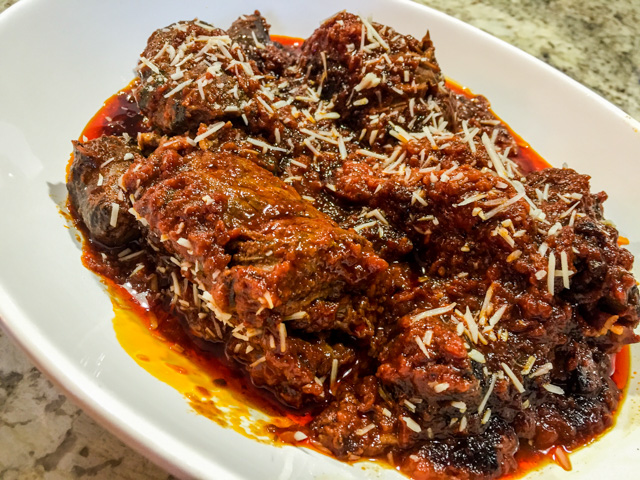
Braciole with Sunday Gravy


SUNDAY GRAVY WITH BRACIOLE
(slightly modified from Sid’s Sea Palm Cooking)

for Sunday Gravy:
1/4 cup olive oil
6 mild Italian Sausages, cut in thirds
1/2 large onion, finely chopped
2 cloves garlic, minced
1 (5 oz) can of tomato paste
1/2 cup dry red wine
3 (28 oz.) cans Italian Plum Tomatoes (San Marzano if possible)
2-3 Tbsp. of equal parts of dried basil, thyme, sage and oregano
1/4 cup rye whiskey (optional, I used regular whiskey)
 .
for Braciole: 
4 slices of round steak 1/2 inch thick pounded to about 1/4 inch thick
4 slices of bacon
2 tbsp chopped parsley
2 tbsp bread crumbs
1 clove finely minced garlic
salt and pepper to taste.
olive oil for browning
.
Make the gravy: Heat olive oil in a heavy-bottomed 6 quart pot, preferably non-stick, brown sausages on all sides.  Add onion and garlic and saute until just soft.    Don’t burn the garlic.   Stir in tomato paste and cook gently 15 minutes being careful not to burn or have mixture stick to pot. Deglaze pot with the red wine and reduce out alcohol.Process in blender the tomatoes with their liquid until slightly chunky and puree like.   Add tomatoes to the pot and bring to a simmer.    Stir in seasonings and herbs.  Adjust to taste, especially the salt.  Add whiskey if using. This will cut acidity and make a slightly sweeter sauce.  Simmer partially covered for about 3 hours, stirring occasionally. Sauce can be made in advance.
.
Make the braciole: Mix the parsley, bread crumbs, cheese, garlic, salt and pepper in a small bowl. Lay 1 strip bacon on each braciole, sprinkle cheese mixture evenly over braciole, roll up and tie securely with string.   Heat oil in skillet and brown meat evenly on all sides.   Transfer to the simmering ‘gravy’ and cook at least 2 hours.
.
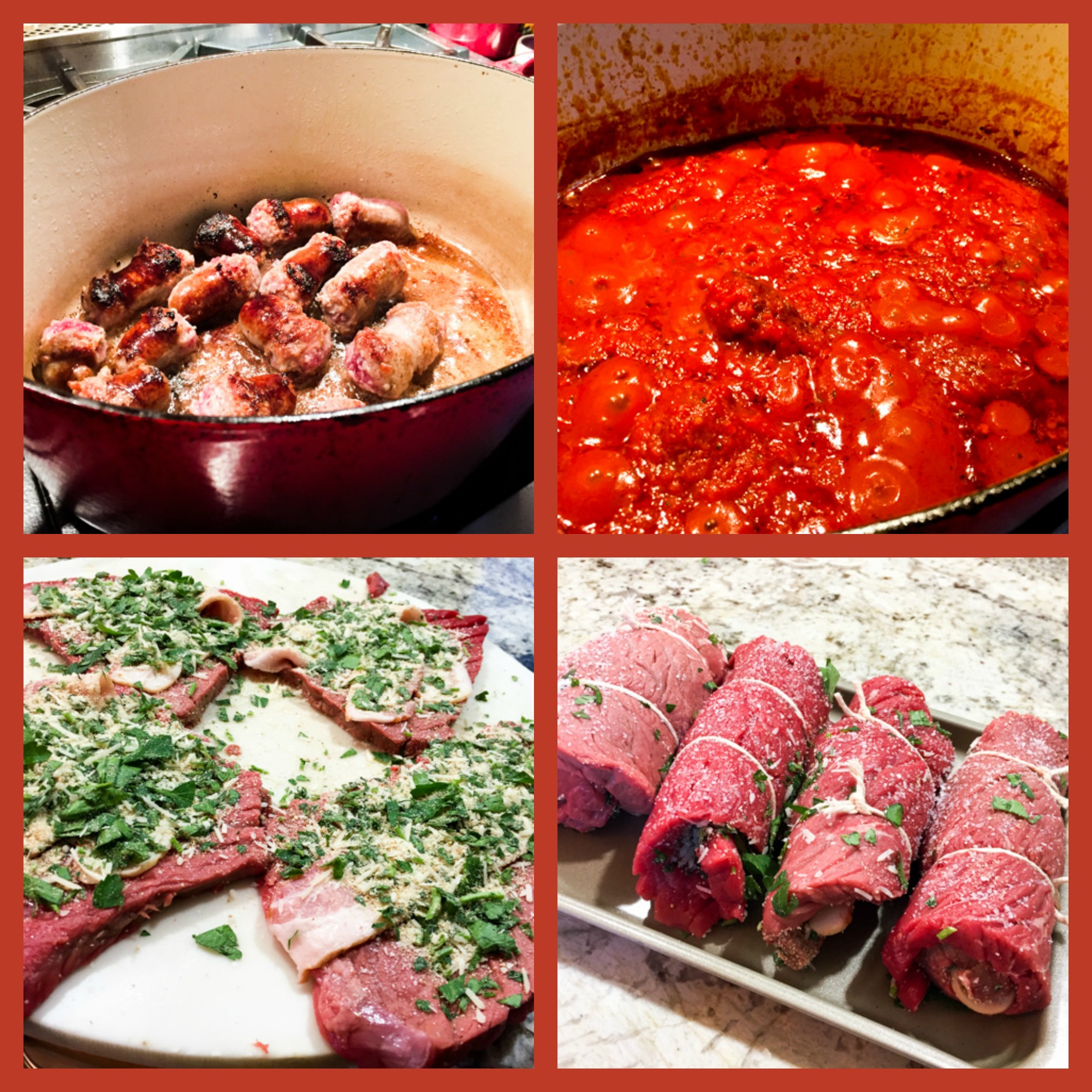
My modification: I simmered the gravy for 2.5 hours.  Used 1/3 of it to cook the braciole under pressure for 35 minutes, after browning them. Froze the leftover gravy for later, in two portions.  Sprinkled grated Parmesan cheese over the braciole when serving.
 .
ENJOY!
to print the recipe, click here

braciolecomposite

Comments: I’ve always wanted to make Sunday Gravy. The name promises something delicious, don’t you think? Something that cooks slowly for hours… But, I confess I messed it up really bad. Sorry, Sid, I did. I made it on a Saturday. I know, I know, what was I thinking?

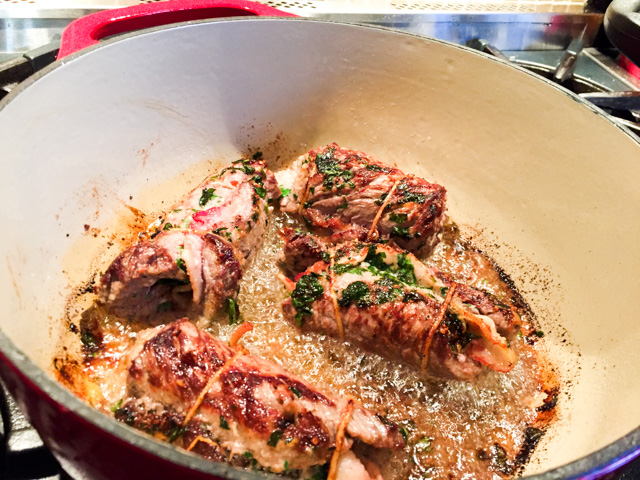
Apart from that, I followed the recipe to a T, and loved the outcome! The change in the sauce as it simmered down for 3 hours was a pleasure to witness. I made the gravy on Saturday, saved it in the fridge, removed the congealed fat from the surface on Sunday, and made the braciole that afternoon. Most important step? Browning them well before simmering with the sauce. A process that should not be rushed, allow the browning to take place and it will reward you with amazing flavor later. I promise.
braciole3


Another small change I made was to cook the braciole in the pressure cooker. I had the gravy ready, so after browning the little rolls of meat I transferred them to the pressure cooker, added the sauce and cooked under pressure for 35 minutes. After cooking I tasted the sauce and adjusted seasoning just lightly with a bit of salt and pepper.

There you have it, a fantastic meal, meat falling apart tender, a sauce that tastes almost sweet from the long simmering. Comfort food, all the way…

Braciole with Gravy Served


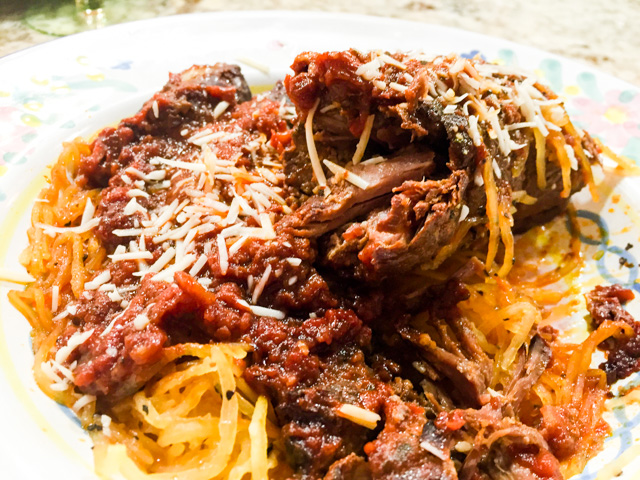
I enjoyed it with some spaghetti squash, but of course you can go the more authentic route of polenta, mashed potatoes, pasta, risotto…  I prefer to balance a heavy dish with a lighter side. Do what feels right for you.
closeup

Dinner is served! You won’t even need a knife….


Sid, I had a great time stalking your site, it was a thrill to get your blog as my first assignment with the new group… I hope you had as much fun as I did this month!
To see what my new friends cooked up this month, click on the blue frog at the end of this post.


ONE YEAR AGO: In My Kitchen, February 2015

TWO YEARS AGO: Avocado and Orange Salad with Charred Jalapeno Dressing

THREE YEARS AGO: Green Olive, Walnuts and Pomegranate Salad

FOUR YEARS AGO: Romanian Flatbreads

FIVE YEARS AGO: Ziti with Artichokes and Meyer Lemon Sauce

SIX YEARS AGO: Blasted Broccoli, Stove-top version


FAST AND FURIOUS BISON CHILI

Thanks to the wonders of pressure cooking, this chili can be on your table in 20 minutes, and I promise you it will taste as complex as one that simmered on the stove for hours. I used ground bison because we love it and it’s always available in our grocery store, but of course you can use ground beef or a mixture of  beef and pork.  I don’t think turkey will work well without some major adjustments because the meat needs to have some fat to stand the high pressure cooking without drying up.  If you want to make this in a regular pan, simply increase the cooking time, use the method you normally do for chili.  I adapted this recipe from several sources, using tips from cookbooks such as Hip Pressure Cooking and Pressure Cooker Perfection. For those interested, this recipe is Paleo-friendly. Not exactly low-carb due to the amount of tomatoes, but I’d say not that heavy in the carb department either.

Bison Chili

BISON CHILI
(from the Bewitching Kitchen)

2 tablespoons grapeseed oil
1 shallot, diced
salt and pepper
1 to 2 tablespoons chili powder (to taste)
1 teaspoon cumin
1 pound ground bison
1/4 pound Italian sausage, mild
1 can crushed tomatoes (28 ounces)
1 cup water

Heat the oil in a large skillet, saute the shallots seasoned lightly with salt. When they pieces are translucent and fragrant, add the chili powder and cumin, mixing constantly for a minute or so. You can do this initial step in the pressure cooker itself, but I prefer to use a pan with a larger surface.

Add the ground bison and sausage, increasing the heat to high. Cook them until they are no longer pink, but do not let them get brown. Stir the tomatoes and water, transfer everything to the pressure cooker.

Close the pan, bring the pressure up and cook under pressure for 12 minutes. Release the pressure quickly by running the pan under cold water in the sink or using another method available for your pan.  Open the pan, if the chili is too liquid simmer for a few minutes until it reaches the consistency you like. If too thick, add a little more water.   Taste for seasoning and adjust if necessary.

ENJOY!

to print the recipe, click here

Bison Chili served

Comments:  We both loved this recipe, but I decided I loved it more than Phil,  so leftovers were all mine, and enjoyed several days in a row for lunch. I don’t know about you, but we like to have variety at dinner time. We never repeat the same meal two days in a row. But I can have the exact same lunch for five consecutive days and see absolutely nothing wrong or boring with it.  Go figure…

Chili in general is quite  substantial, and this one is no different. I normally serve it with slices of avocado, a little grated cheese and call it a day. But of course, a piece or two of cornbread could go well too.  As usual with chili, you can make it furiously fiery by adding more chili, cayenne, maybe shake some Sriracha on top.  Particularly with meat as flavorful as bison, we prefer to use a lighter hand with the seasoning, and added only one tablespoon of chili powder. It does get better with each passing day, I can vouch for that!

ONE YEAR AGO: In My Kitchen, December 2014

TWO YEARS AGO: Braised Fennel with Saffron and Tomato

THREE YEARS AGO: Revenge of the Two Derelicts

FOUR YEARS AGO: Grilling Ribbons

FIVE YEARS AGO: Peppery Cashew Crunch

SIX YEARS AGO: Baked Shrimp and Feta Pasta


ALL-AMERICAN POT ROAST FROM THE FOOD LAB

If you like a scientific approach to cooking, this new cookbook is a must-have:  The Food Lab, by J. Kenji López-Alt. I am quite fond of his blog Serious Eats, so of course I had the book pre-ordered and was anxiously waiting for its electronic delivery. Since I have no space in any bookshelf at home to store cookbooks, Kindle became my helpful friend.  The book is delightful to read, as the amount of “dry” information associated with perfecting a recipe is well-balanced by jokes and short stories.  In one of my favorite chapters (Soups, Stews and the Science of Stock) he shares a great recipe for Creamy Mushroom Soup.  In that recipe, Kenji tackles the persistent WRONG statement that they should not be washed under running water because “mushrooms are like sponges.”  I swear, every time I hear a reputable chef spitting this non-sense I scream at the screen. Who on Earth came up with that idea, and why, oh why it gets repeated over and over?  Kenji patiently goes over his experiments washing mushrooms and weighing them. Actually, you can soak them and after draining they will retain between 1 and 2% water, all on the surface. If you are paranoid about watering down your mushroom saute (keep in mind you don’t water down anything with 2% water), dry them slightly with a paper towel, or cook them 10 seconds longer…. Wash your mushrooms, folks! Toss that silly mushroom brush, it’s one big gadget scam. Ok, I feel better now.  So  much better that I will step off my soap box and share with you a great recipe for All-American Pot Roast, perfected in The Food Lab.

All American Pot Roast

ALL-AMERICAN POT ROAST WITH GRAVY
(from The Food Lab, published with permission from J. Kenji López-Alt)

1 boneless chuck roast (about 5 pounds), pulled apart at the seam into 2 large chunks
Kosher salt and freshly ground black pepper
2 tablespoons vegetable oil
4 anchovy fillets
2 medium cloves garlic, finely minced or grated on a Microplane (about 2 teaspoons)
1 teaspoon Marmite
1 tablespoon soy sauce
2 tablespoons tomato paste
2 large carrots, peeled and cut into 1- to 2-inch chunks
2 stalks celery, cut into 1-inch chunks
2 large onions, finely sliced (about 4 cups)
2 tablespoons all-purpose flour
1 bottle (750-ml) dry red wine
4 cups homemade or low-sodium canned chicken stock
¼-ounce (1 packet) unflavored gelatin
2 bay leaves
4 sprigs fresh thyme
1 pound russet baking potatoes (about 2 large), peeled and cut into 1- to 2-inch chunks

Adjust an oven rack to the lower-middle position and preheat the oven to 275 ° F. Pat the chuck roast dry and season it with salt and pepper. Tie kitchen twine tightly around each piece at 1-inch intervals to help it retain its shape. Heat the oil in a large Dutch oven over high heat until lightly smoking. Add the chuck and cook, turning occasionally, until well browned on all sides, about 8 to 10 minutes. Transfer the beef to a large bowl.

Meanwhile, combine the anchovy fillets, garlic, Marmite, soy sauce, and tomato paste in a small bowl and mash with the back of a fork until a smooth, homogeneous paste is formed. Return the pot to medium-high heat, add the carrots and celery, and cook, stirring frequently, until the vegetables begin to brown around the edges, about 5 minutes. Add the onions and cook, stirring frequently, until very soft and light golden brown, about 5 minutes. Add the anchovy mixture and cook, stirring, until fragrant, about 1 minute. Add the flour and cook, stirring, until no dry flour remains, about 1 minute. Increase the heat to high and, whisking constantly, slowly add the wine. Bring to a simmer and cook until the wine is reduced by half, about 15 minutes.

Pour the chicken stock into a large liquid measuring cup or a bowl and sprinkle the gelatin on top. Allow it to hydrate for 10 minutes. Add the gelatin and chicken stock, bay leaves, and thyme to the Dutch oven, return the beef to the pot, and bring the liquid to a simmer. Cover, place in the oven, and cook until the beef is completely tender (it should offer little to no resistance when you poke it with a cake tester or thin knife), about 3 hours; add the potatoes to the pot about 45 minutes before the beef is done. Remove the pot from the oven and allow to cool for 1 hour.

Transfer the whole pot to the refrigerator and let rest at least overnight, or up to 5 nights. When ready to serve, carefully remove the hardened layer of fat from the top of the cooking liquid and discard. Transfer the meat to a cutting board. Discard the bay leaves and thyme sprigs. Bring the liquid to a boil over high heat and reduce it until coats the back of a spoon but doesn’t taste heavy. Season to taste with salt and pepper.

Meanwhile, remove the twine from the beef and slice it against the grain into ½-inch-thick pieces. Place the pieces in overlapping layers in a 12-inch skillet and add a few ladles of sauce to moisten them. Cover the skillet and set over medium-low heat, shaking occasionally, until the meat is heated through, about 15 minutes. Transfer the meat to warmed serving plates or a large platter and top with the cooked vegetables and more sauce. Serve immediately.

ENJOY!

compositeflavor

Comments: The whole idea behind this recipe is to boost the amount of glutamates, creating what he calls a ‘umami flavor bomb.”  Kenji noticed that components that bring umami to a dish act in fact synergistically, so by adding several of them to the dish, you’ll get a real boost in flavor.  In this version, two very unexpected items are included: anchovies and Marmite, the “love it or hate it” ingredient more commonly found in light smears over buttered toast.

composite2

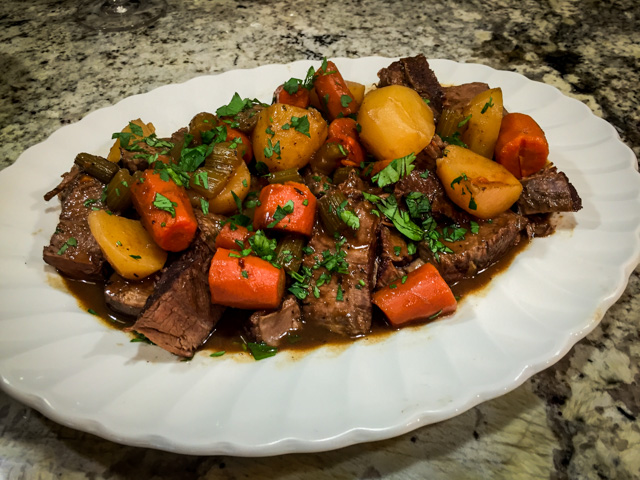
I confess to modifying his basic recipe a little. For starters, I added a lot more carrots because we adore them in our pot roasts. And I used only half a bottle of wine and half the amount of chicken stock/gelatin.  It covered the meat from the beginning and seemed perfect in the reduction stage of the sauce.  I also cooked the roast longer, for a total of 4 hours. By that time the meat was really tender the way we like it. My only other modification was to finish the dish with fresh parsley added right before serving.  It was absolutely wonderful. comfort food at its very very best!

served3

Dinner is served!  Pot Roast with Golden Cauliflower Puree….

 Kenji, thank you so much for giving me permission to blog on this luscious pot roast… I have way too many things I’d like to make from your book, like the Lemon Ricotta Pancakes. They are calling my name super loud! Of course, I will have to follow your instructions to make my own ricotta, which is a project I’ve been flirting with for a long time.

If you want to order the book or read more about it, click here.

ONE YEAR AGO: Chicken Marsala Meatballs with Mushroom Sauce

TWO YEARS AGO: PCR and a Dance in the Mind Field

THREE YEARS AGO: October 16th: World Bread Day!

FOUR YEARS AGO: San Francisco Sourdough

FIVE YEARS AGO:  A Real Oscar Winner   (Oscar joins our home!)

SIX YEARS AGO: Pane Siciliano

PALEO MOUSSAKA

Do I follow a Paleo diet? No, not really.  But I am quite open-minded when it comes to food, and love a recipe that turns something a bit on the heavy side into a lighter but still delicious version.  I have zero interest in lighter food that loses a ton in the flavor department. Or texture.  This is another gem of a recipe I found at Mike’s site, The Iron You, made and loved.  It is amazing how versatile cauliflower can be, in this preparation it doubles as a pseudo-bechamel sauce, and I guarantee you won’t miss the real thing. Plus, instead of having a hard time getting up from your dining chair because your stomach acts as if it’s trying to digest 14 bricks, you’ll be light as a feather slowly dangling through the air. Ok, not quite as light.  But close enough.

Paleo Moussaka

PALEO MOUSSAKA
(slightly adapted from The Iron You)

for the eggplant layers:
2 medium eggplants, peeled and sliced into ½-inch thick rounds
olive oil
lemon juice
sea salt
ground black pepper

for the meat sauce:
1 lb ground beef (or ground lamb, more authentic)
1 tablespoon olive oil
1 medium shallot, finely chopped
1 garlic clove, minced
1 can 28 oz diced tomatoes
1 tablespoon tomato paste
2 handfuls fresh parsley, chopped
2 teaspoons dried oregano
½ teaspoon ground cinnamon
1 tablespoon red vinegar
¼ teaspoon fine grain sea salt
A pinch of ground black pepper

for the Paleo bechamel sauce:
¾ cup almond milk  (I used half milk, half almond milk)
2 cups  (7 oz) cauliflower florets (best to weigh it)
dash of nutmeg
1 teaspoon fine grain sea salt
A pinch of ground black pepper
3 eggs

Heat oven to 400°F.

Whisk a little olive oil with lemon juice. On a baking sheet brush eggplant slices with the oil/lemon mixture and season generously with salt and pepper. Spread in a single layer and roast in the oven until soft and golden about 25 to 30 minutes. While the eggplant is roasting make the meat sauce.

In a large saucepan, heat one tablespoon of olive oil over medium-high heat, add shallots and garlic and saute for 2 to 3 minutes until translucent. Add meat and cook, stirring to prevent sticking, until meat is browned, 5 to 7 minutes. Stir in diced tomatoes, tomato paste, parsley, oregano, cinnamon, vinegar, salt and pepper and simmer for 15 to 20 minutes. Turn off the heat and set aside.

In the meantime make the paleo bechamel sauce. In a saucepan add cauliflower florets, milk, salt and pepper. Bring to a boil, reduce to a simmer, cover with a lid and cook for 15 minutes. Add a pinch of nutmeg. Remove from the heat and with an immersion blender, blend until smooth, or use a food processor.  Whisk the eggs in a medium bowl, add a little of the warm sauce to temper them, then slowly add them to the sauce.

To assemble the moussaka, lightly grease baking dish large appropriate to make two layers of eggplant slices. I used a round, 10-inch diameter baking dish. Arrange eggplant slices to form a uniform layer. Cover the eggplant evenly with half of the meat mixture. Repeat to make a second layer. Carefully spoon the cauliflower bechamel sauce over the meat mixture and spread evenly to the edges.  Try not to disturb the meat mixture too much.
.
Bake uncovered for about 25 minutes, until the top is nicely puffed and browned. Let rest 10 minutes, and serve warm.

ENJOY!

to print the recipe, click here

moussakacomposite

Comments: I like to peel my eggplant slices after roasting, but if you prefer to peel before, or to leave the slices  unpeeled, go for it.  I am not too fond of the bitter taste of the peel and find its texture unappealing, so I definitely remove it before assembling the moussaka.  For dishes such as this one, I am happy to remove the peel on my plate, as the presentation is nicer with the intact Solanum melongena.

I love the meat sauce with its touch of cinnamon. The smell as it simmered was to die for!  And I must share this picture, because it’s a rare occasion: I managed to catch a photo of steam rising from the pan… how sexy is that?   I was impressed by Karen’s achievement in her post a while ago, and managed to get there too….

MeatSauce


Since it was my first time making pseudo-bechamel with cauliflower,  I decided to be precise and weighed the florets. I suppose eyeballing 2 cups would work too, but I felt like playing safe. The best part of the dish? Leftovers were even better than on the first day. In fact, I would almost advise you to make this dish a couple of days before showtime. The flavors mingled together perfectly, the dish had a more wholesome feel. Awesome.

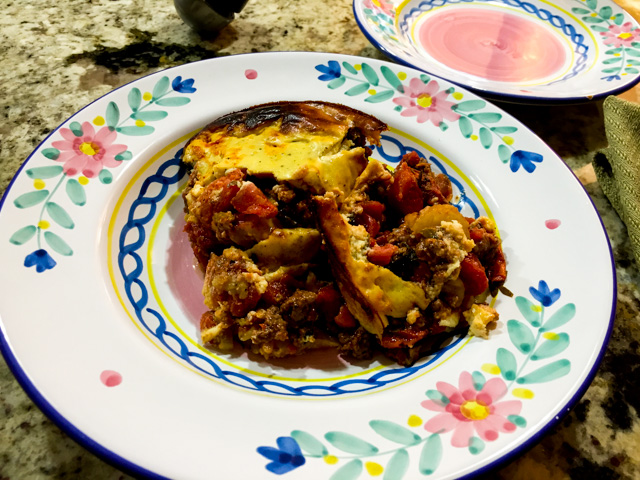
When I served this moussaka, I did not tell Phil the modifications to make it Paleo.  He could hardly believe when I divulged the dirty secret to involve cauliflower. It works so well, it’s kind of surprising. Don’t be put off by it, give this method a try, it is so much lighter than the real thing, but it still feels like comfort food. A gastronomic win-win situation.

Mike, thanks again for the great recipe, your blog is a constant source of inspiration!

served

Dinner is served!


ONE YEAR AGO: Zucchini “Hummus”

TWO YEARS AGO: In My Kitchen – October 2013

THREE YEARS AGO: Bourbon and Molasses Glazed Pork Tenderloin

FOUR YEARS AGO: Crimson and Cream Turkey Chili

FIVE YEARS AGO: Taking a break from the nano-kitchen

SIX YEARS AGO: Chocolate Chip Cookies

HOW ABOUT SOME COFFEE WITH YOUR STEAK?

Have you missed the 6th anniversary of my blog?
Only a few days left to enter my giveaway!
Click here to join…

If you’ve never used coffee in marinades or dry rubs for meat, you are missing a great opportunity to enjoy its mysterious flavor added to usual suspects such as herbs, peppers, and spices.  I’ve blogged before on a take on pork tenderloin that I still think is one of the best recipes I have in the blog, and that uses coffee as one of the ingredients.  But today I’ll switch gears and apply a coffee-based dry rub to beef. The recipe, published by The New York Times,  was recommended by our very dear friend, Marijo, who happens to be a great cook, so when she raves about something, I am all ears. And taste buds. It did not take me too long to jump on it, although it is taking me a long time to share it here.  What else is new?  That’s the way Sally rolls…

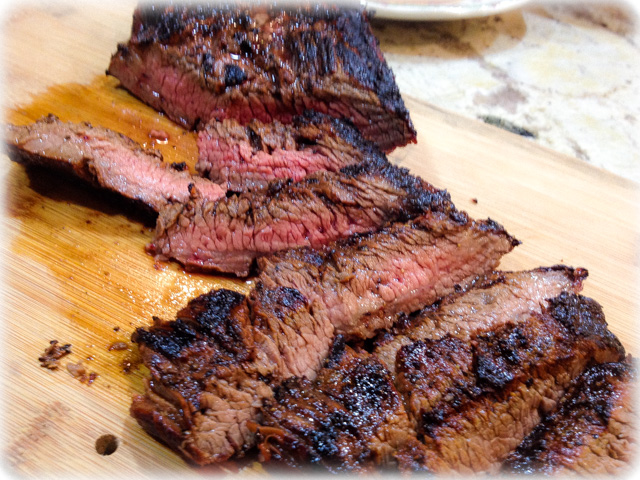
Steak_Coffee

ALL-PURPOSE CALIFORNIA BEEF RUB
(as published in The New York Times)

2 tablespoons finely ground coffee
1 ½ tablespoons kosher salt
1 ½ tablespoons granulated garlic
1 heaping teaspoon black pepper
1 tablespoon brown sugar
¼ teaspoon cayenne pepper
¼ teaspoon ground cloves
¼ teaspoon cinnamon

Combine all ingredients and store in an airtight container.

Rub on the meat you intend to grill and leave it for at least one hour, overnight works too.

Grill to medium-rare, or to the level of your choice (hopefully not well-done!)

Allow the meat to rest for 10 minutes before slicing.

ENJOY!

to print the recipe click here

Comments: I’ve made this recipe quite a few times, with flank steak, flatiron steak, tri-tip, and even bison rib eye steaks. For the bison rib eye, I adapted it to sous-vide and it turned out spectacular, but the photos not so much, so I won’t dedicate a special blog article for it.

SOUS-VIDE METHOD: Apply the rub, and seal the meat in a plastic bag (vacuum is fine, water replacement method will work too). Leave the meat in the fridge for one hour or more, whatever is convenient with your schedule.   Place the bag in the water-bath set for 134 F (medium-rare) for a minimum of 3 hours.  I left mine for almost 6 hours, as I started cooking it at lunch time and we enjoyed the meat at dinner time that evening.  Once the meat is cooked, open the bag, discard the liquid accumulated inside, pat-dry the surface with the meat with paper towels.  Sear on a blazing hot grill or cast iron pan.

To our taste, the sous-vide was by far the best method for bison steaks. Same applies to flatiron. For flank and skirt steak, we think there is not much improvement by going the sous-vide route, both cuts of meat cook perfectly fine on the grill. Whatever your method of cooking, this rub is money!  Give it a try…

Marijo, thanks for sending this recipe our way,
looking forward to many more!

ONE YEAR AGO: Celebrate Wednesday with a Spiral Kick!

TWO YEARS AGO: Carrot Flan with Greens and Lemon Vinaigrette

THREE YEARS AGO: Granola Bars

FOUR YEARS AGO: Awesome Broccolini

FIVE YEARS AGO:  A Twist on Pesto

SIX YEARS AGO: Ciabatta: Judging a bread by its holes