FIVE GRAIN SOURDOUGH BREAD

Before I even start talking about last weekend’s bread, I urge you to visit Joanna’s blog to see her wonderful article about one of my favorite bread baking books, Bread.  Her post is a  must-read for anyone who might feel intimidated by  Hamelman’s masterpiece.  Great job, Joanna!

After the cracked wheat sandwich bread, our cravings for bread with grains incorporated in the dough only intensified.  As usual, on Thursday evenings I start considering the possibilities for baking in the weekend, so I grabbed Hamelman’s book, and opened it at random.  To my delight, the recipe on that particular page read: Five Grain Levain.  Seemed too fitting to ignore.  Plus, for a sourdough bread, the recipe could not be much simpler, the secret behind its simplicity lying in the use of commercial yeast to speed up fermentation.   All I had to do the day before was soak the grains, and give a final feeding to my starter.

FIVE GRAIN LEVAIN
(adapted from Hamelman’s Bread)

for the liquid levain
4 oz bread flour
5 oz water
2 Tbs mature sourdough starter

for the grains mixture
1.5 oz cracked rye
1.5 oz flaxseeds
1.2 oz sunflower seeds
1.2 oz oats
6.5 oz boiling water
1/2 tsp salt

for the final dough
8 oz bread flour
4 oz whole-wheat flour
4.2 oz water
1/2 Tbs salt
1/2 tsp instant yeast
all soaker prepared
all liquid starter prepared

Prepare the liquid levain 12 to 16 hours before you plan to start the dough.  Let it stand at room temperature, preferably around 70 F.  When you make the levain, prepare the grains too, by pouring boiling water over the grains and the salt in a small bowl.  Leave at room temperature.

Make the dough by adding all the ingredients into the bowl of a KitchenAid type mixer, knead on first speed for 3 minutes, then increase the speed to the second level and mix for 5 minutes.  Place the dough in a slightly oiled bowl, cover, and let it ferment for 1.5 hs, folding the dough on itself three times after 45 minutes to increase elasticity.

Shape the dough as a boule or batard, place in a banetton or appropriate container of your choice, and let it rise for 1 hour.

Bake at 460 F for 40 to 45 minutes, generating steam in the beginning, by either covering the dough with an inverted roasting pan, or adding ice cubes to an empty pan at the bottom of your oven.   Allow it to cool completely before slicing.

ENJOY!

to print the recipe, click here
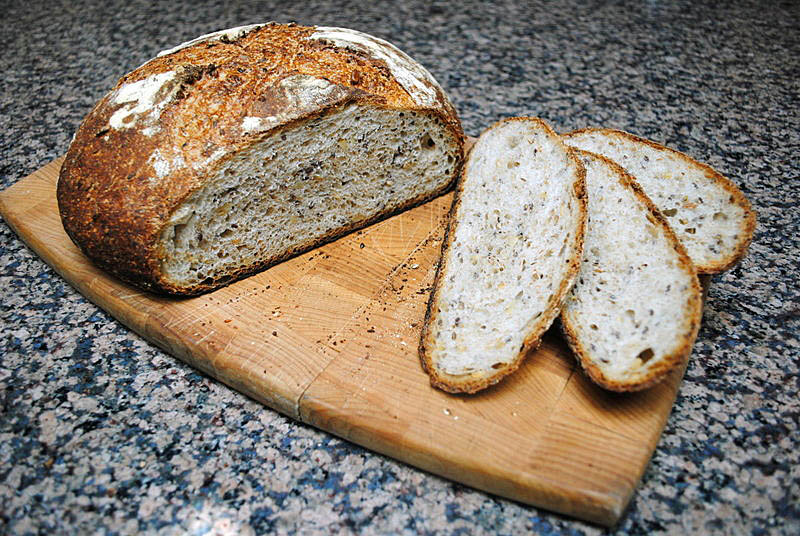
Comments:   This loaf of bread lasted 5 days, and held up pretty well up to its end.  Usually, after the second day we opt for toasting, but this particular loaf was good enough with a very brief warming in our electric oven.  We kept it at room temperature over the cutting board with the cut side down, and sliced only what we were going to consume right away.  It goes well with pretty much anything, from ham to turkey, jam to peanut butter, or butter with paper thin slices of radishes and a little sea salt… delicious!

I am submitting this post to Susan’s Yeastspotting event…

ONE YEAR AGO: The Nano-Kitchen

TWO YEARS AGO:  Kaiser Rolls

Add to FacebookAdd to DiggAdd to Del.icio.usAdd to StumbleuponAdd to RedditAdd to BlinklistAdd to TwitterAdd to TechnoratiAdd to Yahoo BuzzAdd to Newsvine

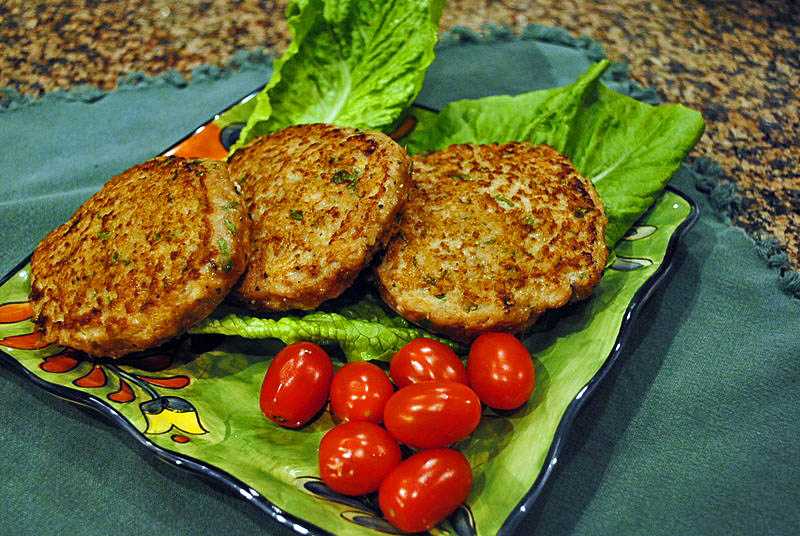
ORIENTAL-STYLE TURKEY PATTIES

I got the inspiration for this recipe from two sources: this blog post over at Kalyn’s Kitchen, and a recent Anne Burrel show on Food TV, in which she featured turkey burgers.  Ground turkey is a great basic ingredient to play with because it’s naturally low in fat, but exactly what makes it good has the potential of creating trouble.  As Anne herself said in the show, she’s had plenty of bad turkey burgers in he lifetime, and so have I.  The trick is to season the meat well, and increase its overall moisture.

ORIENTAL-STYLE TURKEY PATTIES
(from the Bewitching Kitchen)

1 + 1/2 pounds ground turkey
1/8 cup soy sauce
1/2 Tbs Sriracha sauce
2 tsp grated ginger
1/4 cup cilantro leaves, chopped fine
1 egg, beaten
2 green onions, white and light green parts, minced
about 2 Tbs water
a few Tbs bread crumbs, if needed
salt and pepper

In a large bowl, mix all the ingredients except the bread crumbs, try not to overwork the mixture or the patties will be too tough.  This won’t be like a regular beef hamburger type mixture, the goal is to end up with more moisture.  Once all is combined, if the mixture is too loose to form as a patty, sprinkle breadcrumbs and mix again.   Form 4 patties, and place them over parchment paper on a baking sheet, place them in the fridge for 30 minutes to firm up slightly.

Cook them on a hot griddle smeared with a little olive oil until golden brown and completely cooked through.

ENJOY!

to print the recipe, click here

Comments:  I doubled the recipe to have enough patties to freeze for lunches during the week,  but I’m giving you the amounts for 4 patties only.  These cannot be made on a grill, they are too delicate and work much better on a griddle or a non-stick frying pan.

They are very flavorful and moist, the ginger is a prominent flavor, I thought the Sriracha could be increased, but Phil has less fondness for it than myself, so I decided to use a light hand with it.  Feel free to add more.  They can be enjoyed by themselves, with a salad, or as a regular burger with toppings of your choice.  I made some sauteed mushrooms that were a great match, and we added juicy tomato and avocado slices.   A substantial, but not over-the-top weeknight dinner.  😉

ONE YEAR AGO: Sourdough English Muffins

TWO YEARS AGO: Kaiser Rolls

Add to FacebookAdd to DiggAdd to Del.icio.usAdd to StumbleuponAdd to RedditAdd to BlinklistAdd to TwitterAdd to TechnoratiAdd to Yahoo BuzzAdd to Newsvine

WHEN THREE IS BETTER THAN TWO

Last October we brought young Oscar to our home in L.A.   From a scared, insecure dog, he slowly changed into an amazing companion, sweet, playful, obedient, and with more energy than the Energizer Bunny on caffeine.  That energy poses a small problem: Chief, our aging Jack Russell, simply cannot keep up with him.  We discussed the possibility of getting a  third, young dog to be playmate with Oscar.  It happened a little sooner than we thought.  Meet Bucky, a 4 year old Jack Russell with a lot of personality, but quite a bit of sweetness mixed in.

Buck is another rescue dog, who was living under pretty bad conditions, kept outside without much human contact or affection.  We thought he was a different type of Jack Russel, with a tan color, but after his first bath, we discovered he is in fact snowy white, and the previous “color” was just Oklahoman dirt ingrained in his fur for years!    Because he had never been inside a home, he was afraid of everything:  doors, appliances noises, TV, but got better each day.  We’ve had him for almost 3 months now, but unfortunately the journey has not been bump-free.  Chief won’t accept the newcomer, and we’ve had to deal with some intense fighting, some quite scary.
Do you think I look like my brother Chief?  Well, that’s because we are half brothers, same Mom, different Dad!

We are committed to keeping this family together, and hope that with time they will learn to co-exist.  Buck (aka Bucky)  is a very calm Jack Russel, and the only dog we’ve been able to take with us golfing.  He sits in the cart, patiently waiting while we are on the green, and rides along with us through great shots and bad shots (those, for the most part, are mine… ;-))

But, bring on a hose into the equation, and off he goes!

How could we possibly let this dog find another loving home?   No way!

ONE YEAR AGO:  Grating Tomatoes (and loving it!)

TWO YEARS AGO:  Peach Pie

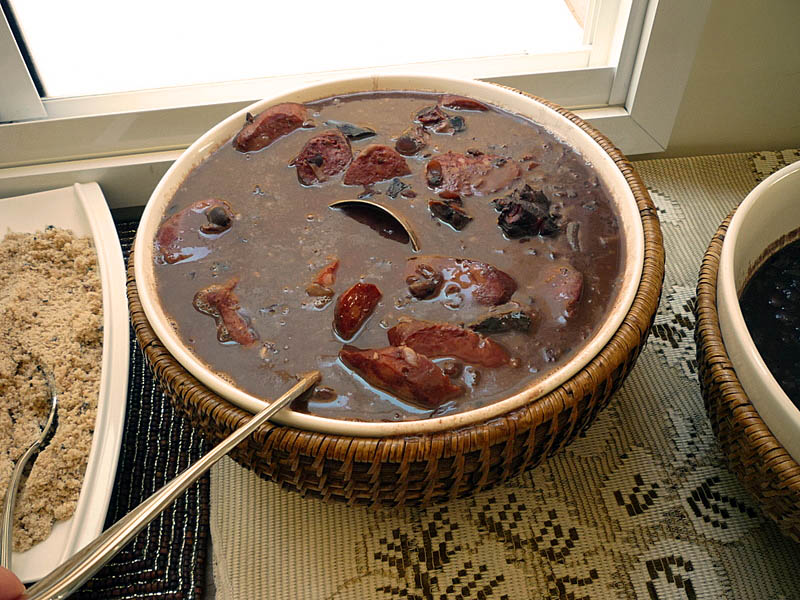
FEIJOADA, THE ULTIMATE BRAZILIAN FEAST

The day was September 28th.  The year was 2009.  On that day I posted a recipe for Brazilian black beans, and promised a subsequent recipe for feijoada.  It took me almost 2 years, but here it is!  Be aware that any recipe for this great Brazilian dish will be controversial, just as a Bolognese sauce is for Italian cooks. Every family has their own favorite, and noses will twist at any deviations from their norm.  It’s also tricky to find the authentic ingredients in the US, which my recipe takes into account by adapting to what’s available here. For instance, “carne seca”  (dry meat, a delicacy NOT to be confused with the American beef jerky), and some parts of the pig that are sold salted and/or smoked (pig’s feet, ears, tail) are basic components of the Brazilian dish, but I can’t find them at American markets. Because they are so salty and some are also quite fatty, most recipes ask to soak these meats overnight (discarding the water) and cooking them separately from the beans until almost tender.  I am substituting corned beef and other types of pork, easily available.  I also omitted using a pressure cooker, to make the recipe feasible for those who do not own one.  By the way, feijoada is a dish to be enjoyed at lunchtime, traditionally on Wednesdays or Saturdays.  It’s such hearty dish that enjoying a plate of feijoada at dinner could be risky…   😉

FEIJOADA 
(a family recipe)

2 pounds black beans
4 quarts water
2 pounds pork shoulder, cut in large cubes
1 cup orange juice
2 bay leaves
1 pound fresh spicy sausage (linguica)
3/4 pound corned beef
1 pound smoked pork chops
1/2 pound chorizo
2 Tbs vegetable oil
1/2 pound slab bacon, diced
2 onions, diced
2 garlic cloves, minced
2 Serrano peppers, minced
salt and pepper to taste

Cover the black beans with water and let them soaking overnight.  Next day, discard all the water, place them in a very large pan, add water to cover them by an inch, bring to a boil and simmer for 45 minutes, without any salt.

Meanwhile, prepare the pork butt by placing the cubed meat in a large pan with 1 cup of orange juice, water to almost cover the meat, seasoning lightly with salt and pepper.  Bring to a boil, simmer for 45 minutes, covered.  Discard the cooking liquid, reserve the meat, and add it to the black beans after they simmered for 45 minutes.   Add the brisket in one piece and the bay leaves.  Simmer everything together for 1 hour.

Add the smoked pork chops and both types of sausage, continue simmering for another 2 hours, keeping an eye on the water level, adding more if necessary.  At this point, the meats should be tender enough to cut into pieces. Remove them, cut the brisket, the sausages, and add them back to the pan.

Heat the olive oil in a large saute pan, add the bacon cut in pieces, the onion, garlic, season with salt and pepper, and cook until the onion starts to get golden brown.  Add the serrano pepper, saute for a minute, add the whole mixture to the black beans, holding back some of the fat in case the bacon released too much oil.  Remove 1/2 cup beans with a slotted spoon (draining the liquid), add them to a small bowl and mash gently with a fork, forming a puree. Return the mashed beans to the pan.

Simmer everything for another 30 minutes or until the meats are completely tender.  Adjust seasoning with salt and pepper, remove bay leaves.  Serve over white rice, with fresh oranges, cut in large chunks.

ENJOY!

to print the recipe, click here

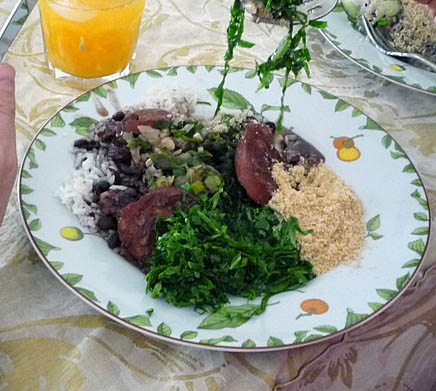
These photos were taken at my youngest niece’s home, she and her husband hosted an unforgettable Saturday lunch for the whole family.  The table was beautifully set, with the green/yellow colors of Brazil, fitting the menu to a T.

Feijoada is always served with fresh chunks of oranges, sauteed and shredded “couve” (similar to collard greens), farofa, and white rice.   The  best way to serve it is to assemble all the goodies in a buffet type setting, so that each guest can make their own plate.  In my family, we also provide an assortment of salads, especially now that we have two vegetarians in our crowd.

It is easy to understand why this meal suits lunchtime a lot better than dinner!  😉

What to drink with feijoada?  If you want to remain authentic, go for capirinhas: either the traditional drink made with limes, or some of the many new departures on this classic. At any rate, my brother–in-law Celso is a pro at making capirinhas, one glass and one huge smile at a time…

and once the feijoada is over,  only a good hammock will do!

ONE YEAR AGO: Vegetable Milhojas

TWO YEARS AGO: A Peachy Salad for a Sunny day!

Add to FacebookAdd to DiggAdd to Del.icio.usAdd to StumbleuponAdd to RedditAdd to BlinklistAdd to TwitterAdd to TechnoratiAdd to Yahoo BuzzAdd to Newsvine


IN MY KITCHEN – AUGUST 2011

…. a Brazilian extravaganza!

Celia, from Fig Jam and Lime Cordial, is the inspiration behind “In My Kitchen”, as she started this type of post in her blog many moons ago, and now many bloggers are doing the same.   😉

These are just some of the goodies we brought home with us from our trip, and most of it brings back memories of my childhood.  You ‘ll notice that I definitely had more appreciation for sweets then.

To start off… Bombons Sonho de Valsa (A Dreamy Waltz).   These (in the pink wrappers) are by far the  most popular chocolate concoction in Brazil. They were created in 1938 by Lacta, and the label hasn’t changed much since then.  Kraft Foods later acquired Lacta, and the new company came up with a few variations, but none as popular as the original.  It has a center of cashew nut cream, surrounded by a thin layer of waffle crust,  and the whole thing covered in milk chocolate.  I grew up savoring these, and my favorite part was the creamy center, so if no one was around I’d carefully nibble the chocolate and the waffle, to enjoy the cashew nut filling all by itself!

Later, much much later, the same company created “Ouro Branco”  (White Gold), the exact opposite of Sonho de Valsa, in that white chocolate forms the outside layer, with a dark chocolate/nutty cream lays inside.  Ouro Branco  arose in the mid 70’s, and die-hard fans of Sonho de Valsa (me included) would not touch one.  But, one day I happened to try it, and concluded that they have their well-deserved spot on Earth!  With their older brother they make a great yin-yang pair… 😉

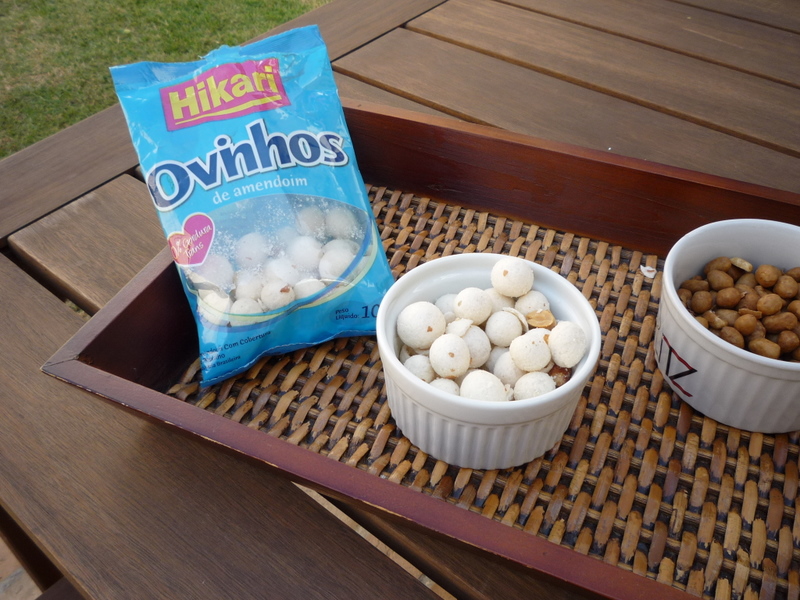
Ovinhos de Amendoim
(little peanut eggs).  You can’t give these little delicacies enough praise.  It’s impossible to eat just one.  They are addictive and incredibly delicious!  But don’t just take my word for it,  here’s what an American traveling for the first time in Brazil had to say about them…  😉

They were a mandatory snack at my parents’ home to nibble before a Sunday  lunch, or when friends came to visit.  Japanese immigrants deserve all the credit for these little jewels.  The outside layer is made of manioc (cassava) flour, which crumbles in your mouth and dissolves with a salty/sweet taste that’s perfect for the roasted peanut inside. They bring me memories of my Dad, because we’d sit down to watch TV and share a bag, fighting hard for the last ones.  😉

BANANA-PASSA (Raisin Banana) – Or, as Phil calls them “bananinhas.”   Don’t hold their look against them. Ugly? …maybe, but sooooo tasty!  Each one is a full grown banana, dried down (with or without additional sugar, depending on the brand), until they are about 1/5 of their size, and each packs a ton of banana flavor.  They’re perfect for a hiking trip, but don’t forget each one you wolf down is an entire piece of fruit.  Imagine what will happen if you eat 6 bananas!  So, pace yourself, and stay with a maximum of two of these.

BALAS DE LEITE KOPENHAGEN.  I have very few addictions. NutellaHaagen Dazs Dulce de Leche ice cream, and Balas de Leite (milk candy)  from Kopenhagen.  When I was young all the products from Kopenhagen were too expensive, and not a good match for my allowance.  But when I had a little bit of extra cash, I’d indulge myself and buy a small bag of these candies, which put me in personal heaven for a while.  Every time we now land in Brazil my sister gives me several bags to bring home!
The outer shell is hard; you can either bite it right away or let it slowly dissolve in your mouth until it breaks and releases its treasure: sweetened, condensed milk!  I’m partial to the second protocol, but sometimes I’ll devour one just to get that mixture of crunchy shell with the condensed milk… aaahhh the simple pleasures…

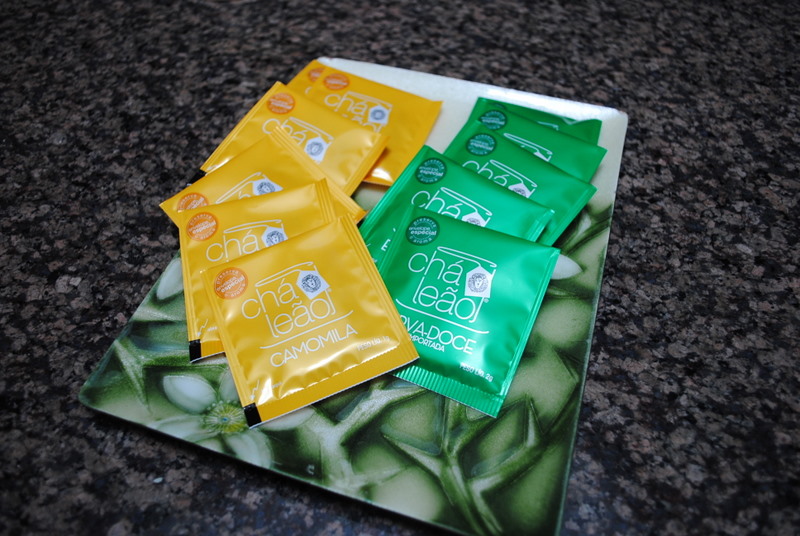
CHA’  de CAMOMILA & ERVA DOCE.  My Mom’s evening tea is a new found love.     When I tried it I thought it was the best I’d ever had, but I could not figure out what kind it was.  She finally told me her “secret recipe” – a mix of two herbal teas, chamomile and fennel,  brewed together.   Their flavors combine into something else, something  soothing and smooth, a perfect way to end the day.   I’ve been making it before going to bed, so me and my Mom share a similar routine, only a few thousand miles apart from each other…

and, finally, also in our kitchen, precious gifts from loved ones….
A painting of a Brazilian flag, which was a gift from my niece and her daughter.  The center of the flag shows a flowering tree called “quaresmeira“, typical of Brazil, that is thought to bring everlasting happiness…

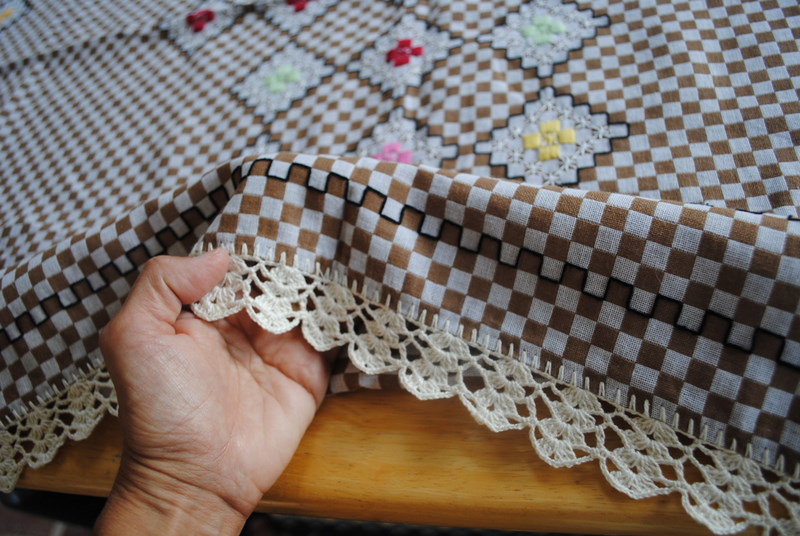
A beautiful tablecloth made by our friend Alice….

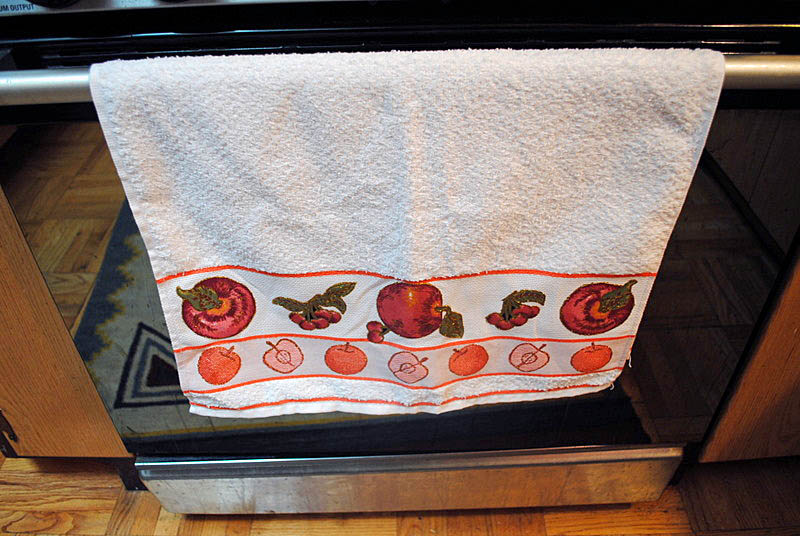
A nice kitchen towel made by my Aunt….

Wooden items, salad servers, lime mashers for caipirinhas, drink stirrers, all sitting on a beautiful wooden tray, a gift from my sister.

I hope you enjoyed the glimpse into our kitchen this month…

ONE YEAR AGO: A Journey to a New Home

TWO YEARS AGO:  Pork medallions in mustard-caper sauce

Add to FacebookAdd to DiggAdd to Del.icio.usAdd to StumbleuponAdd to RedditAdd to BlinklistAdd to TwitterAdd to TechnoratiAdd to Yahoo BuzzAdd to Newsvine