INCREDIBLY SIMPLE TIMES THREE: MAY 2020

Staying safe in Corona virus time: read the guest blog post by Phillip Klebba here.

During social isolation we have more time to devote to meal preparation, things that take hours to materialize at the table don’t need to be reserved to the weekend. But I always welcome simple things with a smile. The first one comes from Nadiya’s show Time to Eat, which I binge watched from first to last episode, enjoying every second of it. The second would be breakfast for most people, but my first meal of the day is lunch, so that’s when I’ve been enjoying it (often). Lastly, the third is a tribute to a UK ingredient that can be not only hard to find, but quite pricey for us Americans, clotted cream. I finally made it from scratch, and if you are into that sort of ingredient, I have one word for you: WOW.

INCREDIBLY SIMPLE #1

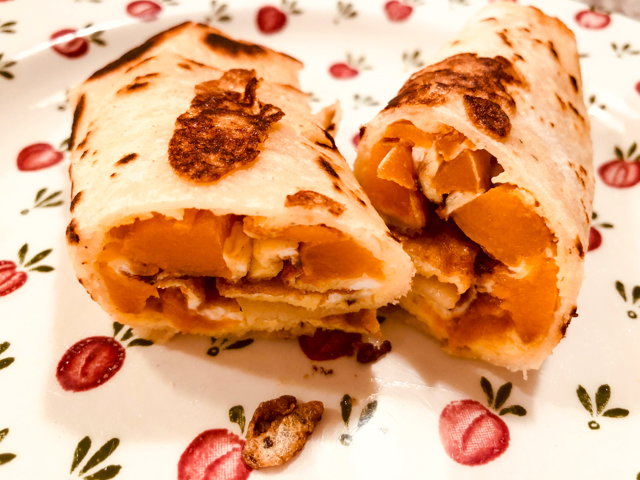
TORTILLA EGG ROLLS

TORTILLA EGG ROLLS
(adapted from Nadiya’s Time to Eat)

for one person….

1 egg
salt, pepper, spices to taste
1 tortilla (I used corn, she used flour)
olive oil
goodies to taste (I used leftover roasted butternut squash)

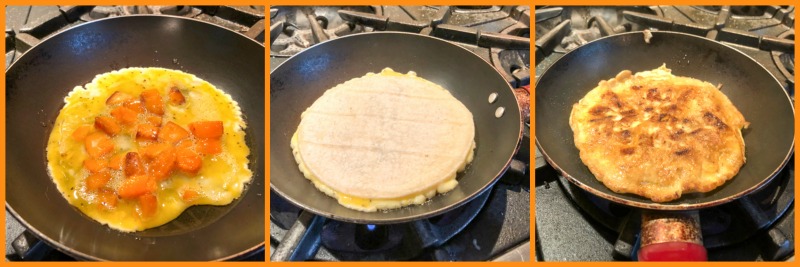
Crack the egg into a bowl, season with salt pepper and any spices you feel like. Whisk well.  Put a small frying pan over a medium heat, and drizzle in two teaspoons of oil.  Pour the egg  mixture into the hot oil, making sure it is hot enough to sear it quickly.

Scatter your goodies over the egg, put the tortilla on top, pressing it gently with a spatula to glue nicely to the egg mixture underneath it. Cook for 30 seconds, then flip it all gently and cook on the other side (tortilla down) for another 30 seconds.

Take the pan off the heat and put the tortilla/egg on a plate. Roll the whole thing when it is cool enough to touch, slice and….

ENJOY!

to print the recipe, click here


Corn tortillas are a little harder to roll, but I prefer them because they are lighter and in my opinion more flavorful.  I sometimes warm it up for a couple of seconds in the microwave before adding on top of the egg to make it slightly more pliable, but it’s not mandatory. Nothing wrong keeping it simple… You can add mushrooms, olives, peppers, sliced leftover meat, and make them a little bigger by using a larger flour tortilla. The method is simple and so easy to adapt to your needs, I hope you’ll give it a try.

INCREDIBLY SIMPLE #2

Orange – Yogurt – Tahini Bowl

Cut orange in segments. I used blood oranges for this version, but any juicy orange will work. Place fruit in a serving bowl.  Top with a nice dollop of yogurt, drizzle tahini all over it. A touch of maple syrup, and your favorite granola.  Close your eyes as you eat it. It is dreamy. I called it lunch many times in the recent past. Tahini and yogurt. Who could tell? I used bananas instead of oranges and also a mixture of oranges and strawberries. Everything works. Refreshing, light but satisfying because tahini packs quite a bit of energy.

INCREDIBLY SIMPLE #3

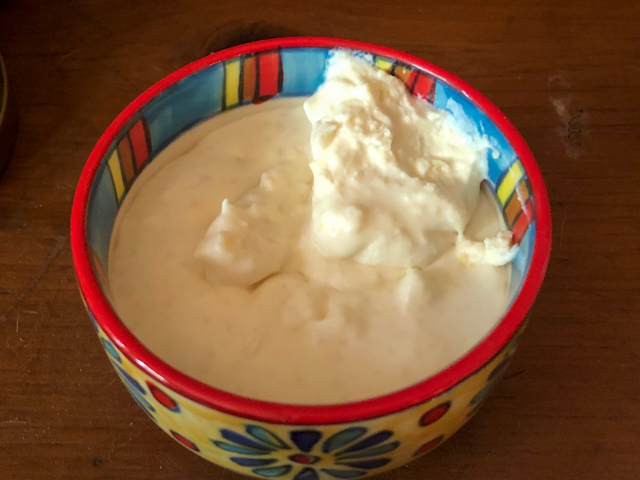
CLOTTED CREAM

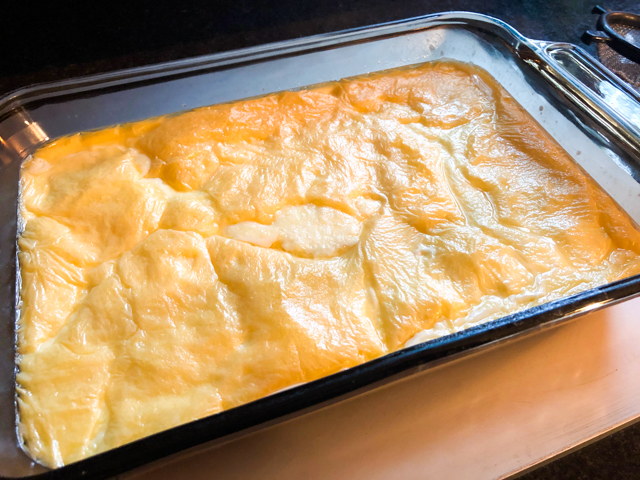
Hardest part of this “recipe?” Finding non-ultra-pasteurized heavy cream. I was lucky to find ONE little container at the grocery store and jumped on it with so much enthusiasm I almost lost my mask. Once you find that, follow this super simple procedure: pour it in a baking dish so that the level is not higher than 1 inch. Place carefully inside a low oven (mine was set at 170 F and I confirmed with oven thermometer to be pretty stable).  Leave it there for 12 hours.  Come back to this view….

Let it come to room temperature, and place it in the fridge for 12 to 24 hours. Carefully scoop out the clotted cream and transfer to a container for storage. If you like it softer, add a bit of the liquid left underneath. That liquid, by the way,  will work as milk in any type of baking, or as a nice addition to your coffee or tea.

Clotted cream is pure culinary gold, and so easy to make, essentially no hands-on work. Perfect over scones, pancakes, waffles. You will find plenty of ways to enjoy it, I’m sure. Even as a simple spread over bread or crackers. With a touch of jam if you are so inclined.

I heard that clotted cream can also be prepared in a crock pot. I intend to try that next time I score some of the appropriate heavy cream. The preparation sous-vide is also available in many sites in the internet, but I found the method a bit too convoluted and potentially messy. This was super easy and I highly recommend you give it a try.

ONE YEAR AGO: Ispahan Macarons

TWO YEAR AGO: Smokin’ Hot Meatloaf and Homemade Ketchup

THREE YEARS AGO: Banana Bread with Espresso Glaze

FOUR YEARS AGO: Slow-Cooker Carnitas & Paleo Planet Cookbook Review

FIVE YEARS AGO: The Making of a Nobel Reception

SIX YEARS AGO: Fennel Soup with Almonds and Mint 

SEVEN YEARS AGO: Green Curry Pork Tenderloin

EIGHT YEARS AGO: Farfalle with Zucchini and Ricotta

NINE YEARS AGO: Slow-baked Salmon with Lemon and Thyme

TEN YEARS AGO: Hoisin Explosion Chicken


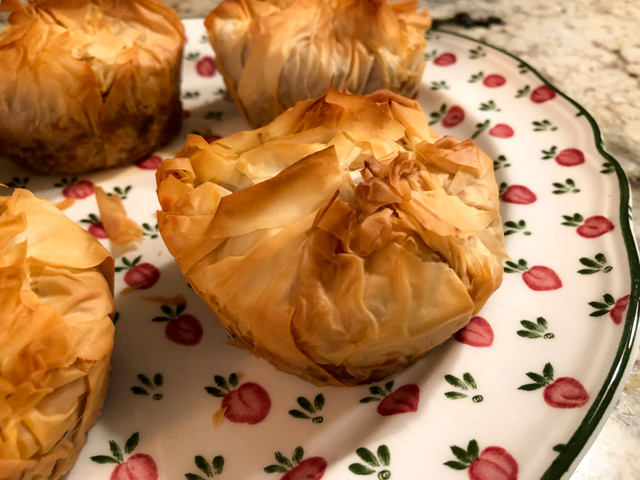
PHYLLO PARCELS WITH MOROCCAN TURKEY

Staying safe in Corona virus time: read the guest blog post by Phillip Klebba here.

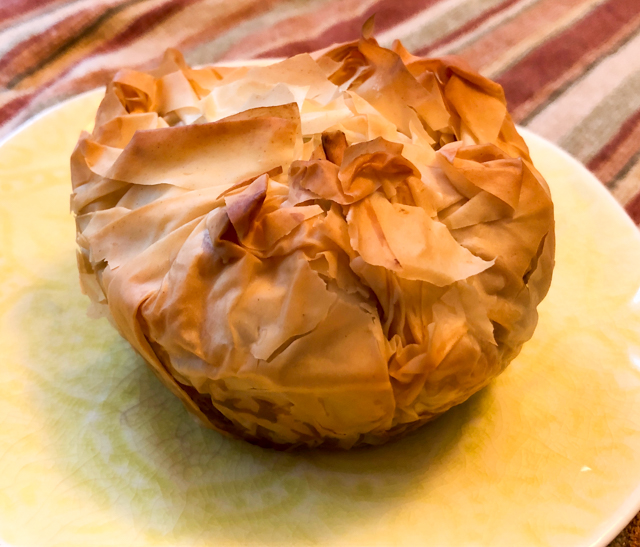
Not too long ago I blogged about a savory pie made with olive oil crust and ground turkey. It was delicious, and I knew I wanted to re-visit it shortly after. Today I share a departure on that recipe, using a very similar filling but wrapped with phyllo dough. It is considerably lighter, especially because I use a light hand with the olive oil spray in between the layers. Works great and is a lot kinder on the waistline.

PHYLLO PARCELS WITH MOROCCAN TURKEY
(from the Bewitching Kitchen)

large or jumbo size muffin pan, makes about 5 parcels

for the parcels:
1 box of phyllo dough, thawed in fridge overnight
olive oil spray

for the filling:
3 tablespoons olive oil, divided
1 + 1/2 pounds ground turkey
2 large carrots, cut in pieces
8 oz mushrooms cut in pieces
2 celery ribs, minced
1 + 1/2 tsp salt
1 shallot, minced
1/2 tsp ground ginger
1/2 tsp ground cinnamon
1/4 tsp ground turmeric
1/4 tsp ground cumin
1 tablespoon harissa, or to taste

Brown the ground turkey in a large skillet using 2 tablespoons of olive oil, and seasoning with 1 tsp salt. Once the meat is brown, transfer to a bowl. Add one more tablespoon of olive oil and saute the carrots, shallot and mushrooms, sprinkling all the spices and the final 1/2 tsp salt over the veggies as they cook. Once the veggies start to get some color, add the harissa, the ground turkey reserved, and mix everything gently. Reduce the heat, cover and simmer 5 minutes. Transfer to a bowl and cool it completely.

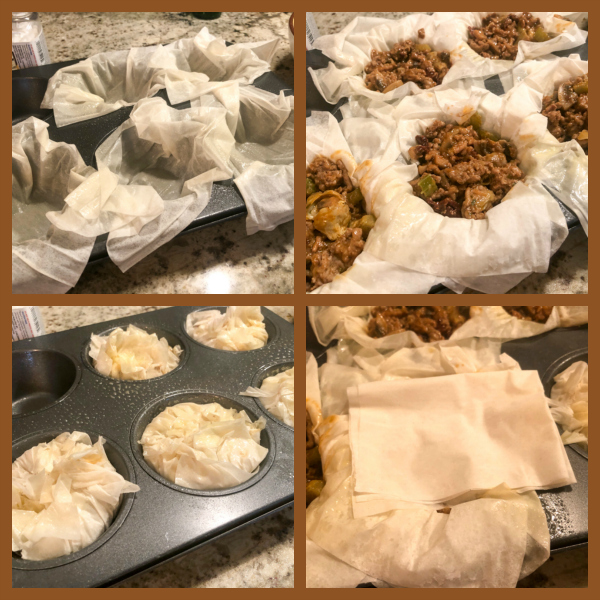
Lay your phyllo sheets and cut squares large enough to cover the whole inner surface of the muffin pan. Lay 3 sheets of phyllo over each hole, each slightly  twisted in relation to the previous one, and spray a very light amount of olive oil as you lay them. Add the cold filling, get one square and fold it in four, so that you are left with a small amount of pastry that can sit right on top of the filling (see photo on the composite below).  Crunch all the phyllo from the base layers over the top, spray olive oil.

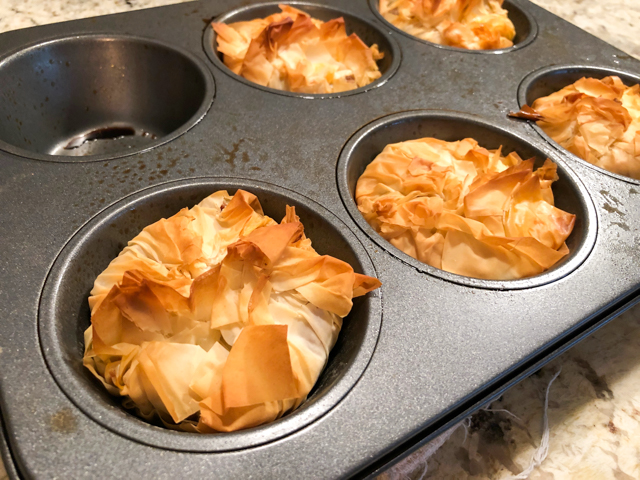
Bake at 375F for about 25 minutes, or until golden. Let it cool for 10 minutes before removing from the pan. They should un-mold very easily and neatly.

ENJOY!

to print the recipe, click here

Comments: The idea for these little parcels came from the new cooking show by Nadiya Hussein, “Time to Eat.” She used this method to make little apple pies but I really liked the way she handled the phyllo and wanted to adapt for a savory meal. Instead of fiddling with one sheet of phyllo at a time, it is a lot easier to just grab several sheets, cut them all at the same time in squares and then peel them off to place in the tin. Brilliant. I highly recommend the show, available on Netflix. A recipe from it should be on the blog soon.

The filling is already cooked, so you are basically just browning the phyllo and making it all crunchy and delicious. Super easy to assemble, this would be absolutely perfect for guests, and of course you could make it vegetarian-friendly. I imagine a filling with butternut squash and mushrooms, or eggplant and sweet peppers, lots of tasty ideas. You can also go for a hearty lamb filling, but with warmer weather on the horizon, lighter is definitely better.

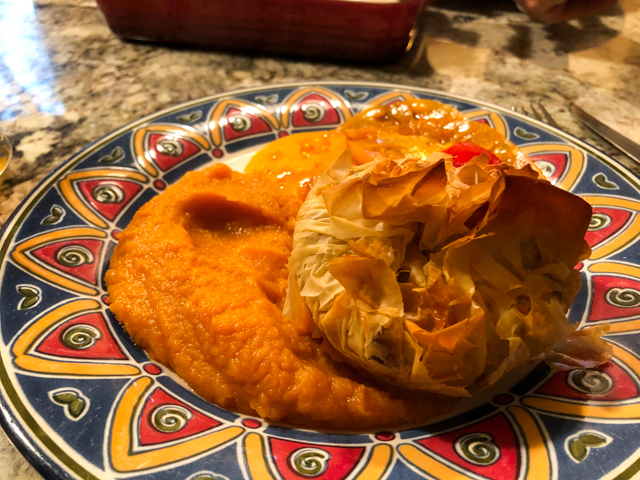
We enjoyed it with mashed sweet potatoes, made sous-vide, but I need to tweak that recipe before sharing, there were a few “issues.”

Depending on the size of your muffin tin, you might be able to get 6 little parcels. They hold well in the fridge and to warm up what I like to do is run them in the microwave for 1 minute (yes, 60 seconds) and then transfer them to a hot oven for 10 more minutes. They turn out perfectly warm all the way through and the phyllo retains its nice texture.

ONE YEAR AGO: Roasted Corn and Zucchini Salad

TWO YEAR AGO: Fraisier Cake, A Celebration of Spring

THREE YEARS AGO: Zucchini Frittata with Roasted Tomatoes and Goat Cheese

FOUR YEARS AGO: Playing with Pectinase

FIVE YEARS AGO: Poached White Asparagus with Lemon and Pistachios

SIX YEARS AGO: Dan Lepard’s Saffron Bloomer

SEVEN YEARS AGO: Fesenjan & The New Persian Kitchen

EIGHT YEARS AGO: Quinoa Salad with Roasted Beets

NINE YEARS AGO: Pasta Puttanesca

TEN YEARS AGO: Miche Point-a-Calliere

COVID-19 UPDATE: STAYIN’ ALIVE

It’s been a couple of months since I published an article  that was written my husband, on tips to stay safe during the viral pandemic that hit our planet.  In our day jobs we study the biochemistry of infectious diseases.   A lot of what was written then can be updated to reflect new findings, new research, as physicians and scientists learn more about the virus and its transmission.  I am publishing today his update on the previous post.  I would also like to share a very good article that debunks a damaging video (Plandemics) that unfortunately has gone viral.

Without further ado, here is Dr. Phillip Klebba….

Let’s reassess.  On March 16, 2020 I advised on how to avoid COVID-19.  In the ensuing eight weeks 73 US deaths exploded to 81,000;  6500 deaths in China became 285,000 deaths worldwide.  More than a quarter million people already perished, but we are not free of COVID-19 yet. Nevertheless, in many countries, including the US, officials are underestimating and/or misrepresenting the severity of this pandemic.  All 50 states plan to relax virus containment measures, in essence relegating health behind the economy.   The federal government is not promoting policies that protect us from the virus.   In that sense, we are mostly on our own to protect ourselves.  Make no mistake, COVID-19 is all around us, much more widely distributed than 2 months ago, and it hasn’t lost any of its lethality.  Fortunately, we’ve learned a lot about COVID-19, which I summarize below along with a list of protections, that is modified from these insights.   Besides the precautions I previously recommended, some additional actions are needed as COVID-19 spreads and multiplies in places near you.  From lessons learned during other viral pandemics (Spanish Flu, Polio, Asian Flu, Hong Kong Flu, Ebola), and what is now known about COVID-19, I updated the advisories on how to protect yourself from infection.  The most important realization is that the virus appears transmissible through the air.  What follows is a summary of what’s known about COVID-19.

A. It’s highly contagious. The Rof COVID-19 was initially estimated as 2.2 – 2.7, but other projections put it  higher (R0= 5.7; Sanche et al., 2020).  In other words, on average a single person may infect 5-6 other people.

B. It’s deadly. As of May 11, its mortality rate worldwide is 6.9%; in the US it is 5.96%. In other words, approximately 6% of people who contracted it are dead. The 2019 seasonal flu had mortality of 0.1%; the 1918 Spanish flu had mortality of 2.5%.

C. It’s unusually hardy. It survives for a day on cardboard and several days on surfaces like plastic and stainless steel.  It is less durable in the air (3-4 h) or in sunlight (at 85oF,  only a few minutes).

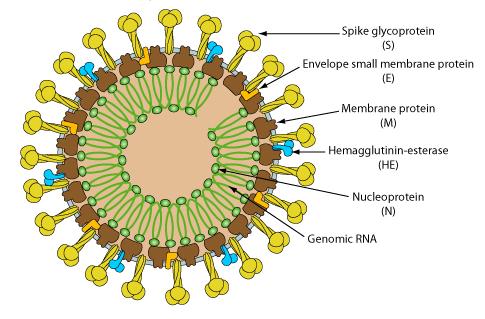
D.  Transmission on surfaces and through the air. The most significant news is that COVID-19 is transmissible through the air. Its diameter of 100 nanometers (nm) is similar to or slightly smaller than that of other airborne viruses, like measles (100-300 nm), chickenpox (150-200 nm), influenza (80-120 nm), norovirus (23-40 nm), adenovirus (90-100 nm).  Although viruses are most commonly transmitted on contaminated surfaces (fomites), several scientific reports also show airborne transmission of COVID-19.

  1. Contaminated surfaces.  A study of Huoshenshan Hospital in Wuhan, that was filled with COVID-19 patients, took swabs of surfaces in the intensive care unit (ICU) and general ward (GW) (Guo et al., 2020). They tested for viral RNA, including on hand rails, bed posts, sinks, toilets, cell phones, computer keyboards, mice, screens, and floors. All ICU surfaces  were heavily contaminated (~75% positive); GW surfaces less so (~25% positive).  Notably, every swab from the floor of the adjacent pharmacy, that did not house any patients, was contaminated, indicating that nurses and physicians were tracking COVID-19 from the ICU/GW to the pharmacy on their shoes.  Air samples from the ICU also contained viral particles (~35% positive)
  2. Respiratory droplets from coughing and sneezing.  Transmission by virus floating in the air is a complicated combination of the density of airborne viral particles, the length of time someone breathes them in, and the infectious dose of the virus.   For a detailed discussion see this link.  Airborne transmission does occur, especially during protracted exposure to aerosolized virus in closed spaces. Another study measured COVID-19 RNA in the air of Renmin and Fancang  hospitals in Wuhan (Liu et al., 2020).  Well ventilated areas had little evidence of the virus, but the air in poorly ventilated, small spaces (e.g., mobile toilets) was heavily contaminated.  A third study of virus shedding by patients at the University of Nebraska Medical Center (Santarpia et al., 2020) confirmed that COVID-19 was shed during respiration, toilet, and as fomites, indicating that infection may occur by both direct and indirect contact, including by airborne transmission.

E. Trajectory of the COVID-19 pandemic. To see the data I use this site.  The situation is shocking: after 3 months, 4.2M people were infected worldwide, resulting 280K deaths; 1.37M people were infected in the US, resulting in 81K deaths.  Graphs of these trends show both infections and mortality leveling off, but still increasing.

Worldwide (Fig. 1), the Jan – Mar data came from China; later data show COVID-19 spreading around the world where it is still not controlled.

In the US (Fig. 2) the deviation of blue and orange lines from the red lines shows the positive impact of social distancing.  Yet, at present (i.e., the past few weeks) we are still adding >25K new infections and >2000 deaths per day.  Without a vaccine or anti-viral drug, if we abandon social distancing the virus will resume its spread to new places and people.  The slope of both curves will rise again, as occurred worldwide when COVID-19 moved from China to other nations.  The upshot is that, relative to March 1, 2020 (75 cases), COVID-19 has infected thousands of new venues across the US (1.3M cases), and is poised to return to rapid growth in our population.  It’s a threatening situation, especially  for people in a  risk group: the elderly, immunosuppressed, diabetic, cardiovascular, cancer patients.

SUMMARY OF PROTECTIVE PROCEDURES
(Added to the previously suggested practices, not replacing them)

  1. Shoes. Select an old pair of shoes to wear on shopping trips or other excursions. Keep them in the garage, change into them when you depart the house, take them off when you return home, and then disinfect the soles with 10% bleach when you remove them.
  2. Face covering. Cover your nose and mouth in public.  Masks and scarves are uncomfortable and embarrassing; get over it. Once you put it on, do not touch it until you return home. Sterilize your hands with 70% alcohol or 10% bleach before removing your mask.   Covering your face reduces your risk of infection, the risk of unknowingly passing COVID-19 to someone else, and shows solidarity with federal CDC guidelines, which is good for everyone.  If businesses are to open, then we need to do it as safely as possible, and that means with face coverings.
  3. Hands. Keep your hands below your shoulders; regularly sanitize them; never touch your face.
  4. Social distance.   Stay 6-feet away from everyone you encounter.  This takes thought and practice, because we have a habit of standing close to people we talk to.  Keep your distance and do not engage in long conversations with anyone.
  5. The outside world.  Consider everything outside of your home contaminated and contagious; protect your home by disinfecting everything that enters it. Go out as infrequently as possible, and when you go carry disinfectants with you, to sanitize your steering wheel, your shopping carts and your hands after touching anything questionable.
  6. Home-sweet-home. When you return home, carefully and meticulously disinfect your hands with alcohol or bleach, and then thoroughly wash them with warm soap and water.  Change your clothes.  Frequently wash  your hands, especially before eating.

Scientific References:

  1. van Doremalenet al. 2020. Aerosol and Surface Stability of SARS-CoV-2 as Compared with SARS-CoV-1.N. Engl. J. Med. 382: 16
  2. Sanche et al., 2020. High Contagiousness and Rapid Spread of Severe Acute Respiratory Syndrome Coronavirus 2.  Emerging Infectious Diseases  26 (7): July 2020.
  3. Guo et al., 2020. Aerosol and Surface Distribution of Severe Acute Respiratory Syndrome Coronavirus 2 in Hospital Wards, Wuhan, China.  Emerging Infectious Diseases  26 (7): July 2020
  4. Liu et al. 2020. Aerodynamic analysis of SARS-CoV-2 in two Wuhan hospitals. Naturehttps://doi.org/10.1038/s41586-020-2271-3
  5. Santarpia et al. 2020. Transmission Potential of SARS-CoV-2 in Viral Shedding Observed at the University of Nebraska Medical  Center. medRxiv  doi: https://doi.org/10.1101/2020.03.23.20039446


CHOCOLATE CRUSTED PASSION FRUIT TART AND A COOKBOOK REVIEW

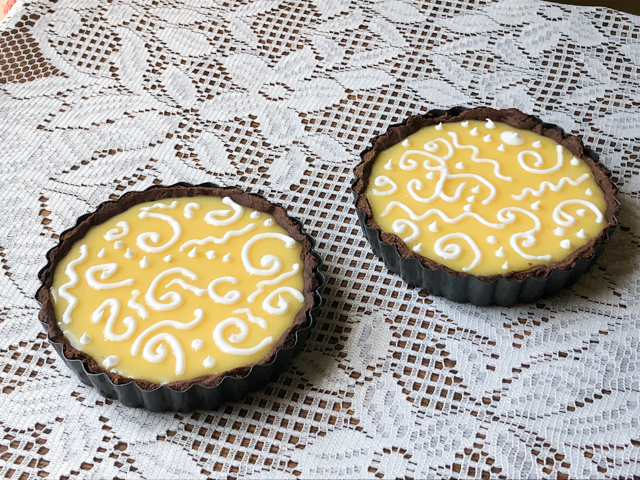
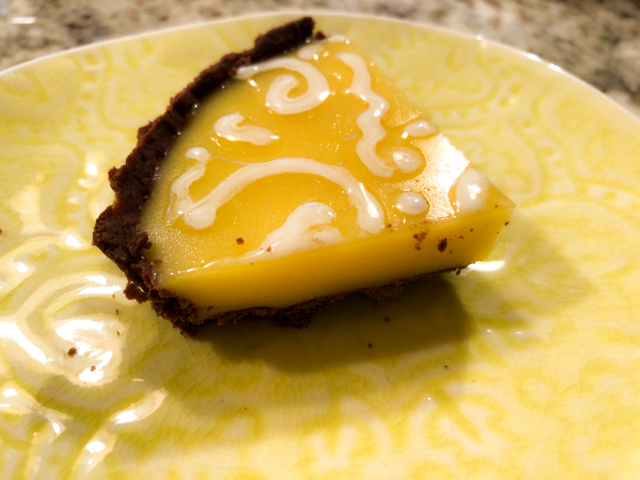
This review is long overdue. I first contacted Nancy Birtwhistle to ask permission to blog on a recipe from her first cookbook, Sizzle and Drizzle, in December last year.  But a lot happened to all of us. Life turned upside down, and it will quite likely never go back to what it used to be. To that normal I suppose we all took for granted. Better late than never, I am sharing today a recipe that feels very special to me. Nancy made it in a certain tent during the Great British Bake Off and I remember falling in love with it the first time I watched that episode. How could I not? It joined chocolate and passion fruit. And she decorated it in a simple yet very elegant way. Instead of making a single, larger tart, I made two individual portions. In isolation times, we have no one to share this type of dessert with, so a smaller portion was the ticket.
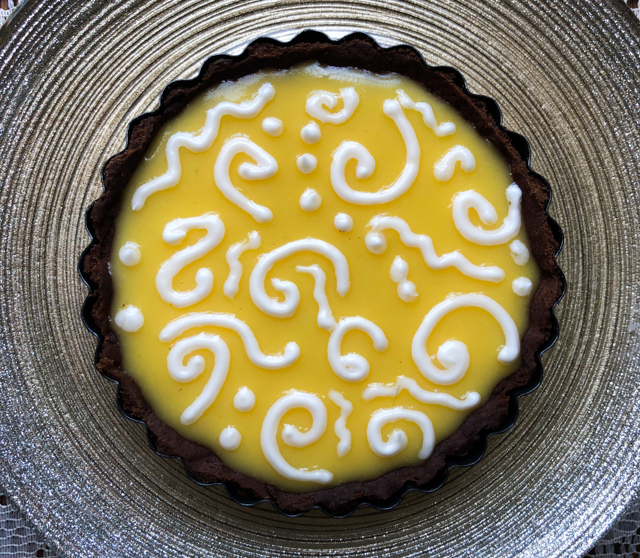
CHOCOLATE CRUSTED PASSION FRUIT TART
(from Nancy Birtwhistle’s Sizzle and Drizzle)

1 tart pan, 9 inch (23 cm) in diamater, preferably fluted edges, loose bottom

for the crust:
125g flour
20g cocoa powder
90g salted butter, cold, cut in small dice
30g powdered sugar
1/2 tsp Chinese five-spice mixture (optional)
2 Tablespoons egg yolks, beaten

for the filling:
(use half if making two individual size tarts)
6 eggs
200g granulated sugar
100g softened butter cut into dice
200mL passion fruit juice
5 gelatin leaves (I used Platinum)

for the decoration:
1 egg white
100g powdered sugar, sifted

Heat oven to 400F.

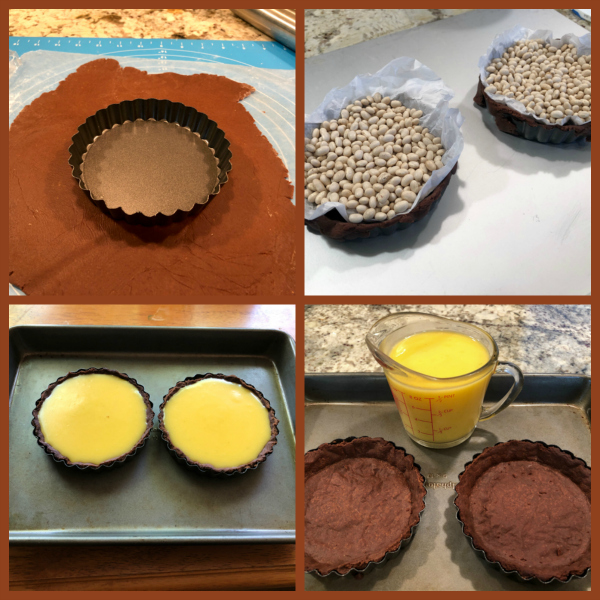
Make the tart crust. Place the flour, cocoa, sugar and spice in the food process and blitz to mix. Add the cold butter and process until everything is combined, this will take just a few pulses. With the motor running, pour the egg yolks and process until it starts to come together. Stop and gather everything over a plastic wrap. Press into a flat disk and refrigerate for 30 minutes.

Roll the pastry very thin (I like to do it over wax paper and with a plastic wrap on top), then use it to cover your tart pan. Freeze for 10 minutes. Cover the bottom with parchment paper and fill with pie weights, beans or rice. Blind bake for 10 minutes, remove the beans and bake for 5 minutes more. Trim the edges with a serrated knife, and allow to cool completely.

Make the filling. Soak the gelatin leaves in cold water. Mix the sugar and passion fruit juice in a sauce pan, heating it gently until it fully dissolved. In a bowl, whisk the egg yolks vigorously, then add the warm juice slowly, whisking non-stop. Put the mixture back in the sauce pan and heat to 185 F (85 Celsius). Be careful and keep whisking, remove from heat if needed for a few seconds to make sure no curdling of egg yolks happen.

Remove from heat, add the drained gelatin sheets, pass it through a sieve. Add the butter, whisk very well to emulsify. Allow the curd to cool slightly then pour into the pastry case all the way to the top. It is better to do this already in the fridge so you don’t have to move the tart around.

When the tart is set, decorate with the Royal icing mixture that you make by whisking the sugar and egg white together for about 4 minutes in a KitchenAid type mixture.  Adjust the consistency to make it right for piping. Serve at room temperature.

ENJOY!

to print the recipe, click here

Comments: I used the full amount of dough but made smaller tarts, I find it easier to work with larger amounts and not get into pie dough anxiety as I’m rolling it out and trying to make sure it covers the whole surface of the pan. I halved the amount of filling, so if you are considering making just two small tarts, pay attention to that. Of course, the passion fruit curd is delicious and having some extra hanging around in the fridge is not a bad idea.


Nancy gives two important tips: roll the pastry thin, as thin as you can do it. And transfer the empty blind-baked shells to the fridge to fill them. That ensures you can fill them to the top and not spill over the side as you try to carry them to the fridge. Small details matter. As I was piping the swirls, I transported my mind back to the tent, and imagined Nancy grabbing the piping bag with the Royal icing, taking a deep breath and knowing she had to do as perfect a job as possible, with the cameras on her, and the shiny surface of the passion fruit curd ready and waiting. She did such a beautiful job! No wonder she went on to win the whole thing!

This was absolutely delicious, and I urge you to make it if you have access to passion fruit (you will need 8 to 9 fruits to make the full amount of filling). I have still quite a bit of frozen passion fruit pulp, and it worked well for this purpose.

And now a small overview of Nancy’s book, Sizzle and Drizzle.

If I had to define the book with a simple statement, I would summarize it as “superb baking instruction and tips with Nancy’s personality shinning through the whole book.”  One of the things that was evident from her performance in the show, is that she has  a ton of self-confidence and knowledge. She tested her recipes and was not afraid to stand up to Paul. Just one small example, she defended her method to speed up proofing of an enriched dough using the microwave. To Paul, of all people, the Bread King… And I loved when she was proved right (sorry for the lousy pun).  In the book, she mentioned that her first show-stopping challenge in the Great British Bake Off was making 36 mini-cakes. Everybody had butter over their counters (remember, the recipes are all submitted in advance and they set up the ingredients). Nancy was THE ONLY ONE with margarine. She felt a little “wobble in her confidence” but then said to herself – my cake tastes good. I have nothing to worry about. Guess what? She was Star Baker that week. We should all keep her experience in mind when that inner voice starts nagging us with self-doubt.
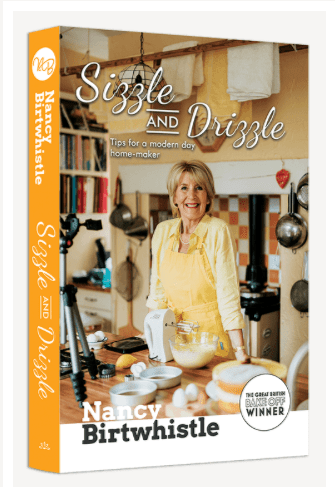
Her cookbook was entirely conceived, written, photographed, and published by her. And it has a very nice feature (she calls it “Let me show you”): you get access to videos in which she demonstrates parts of her recipes, by using your smartphone to decode a little bar printed on the pages. Very VERY cool. Here is an overview chapter by chapter with a few examples from each. Every chapter starts with her top tips for success.

BISCUITS AND SCONES. I pretty much would like to bake every single item of this chapter. Her approach is to use less sugar than most recipes would call for, and also keep the dough a bit on the dry side, rolling always in between plastic sheets.  My favorites would be Lemon Shortbread, Spiced Christmas Shortbreads, Brandy Snaps, Rose and Chocolate Macarons (how can I resist those?), Rye and Fennel Thins, Cherry Bakewell Scones,  and Cheese Scones. Every single recipe has the “Let me show you” link available so you can watch her making it. Just amazing!

BREADS. “It is better to over bake than under bake bread.”  Music to my ears. I see so many pictures that people share online of breads that clearly needed another 10 to 15 minutes in a hot oven to really shine. From this chapter, I want to bake her Crusty Topped Bloomer (remember Tiger Rolls? this is similar), her Hot Cross Buns, Stromboli, and Yorkshire Teacakes (adorable).

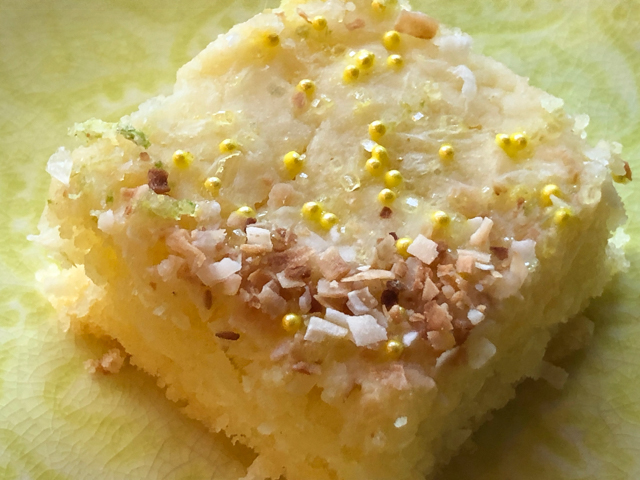
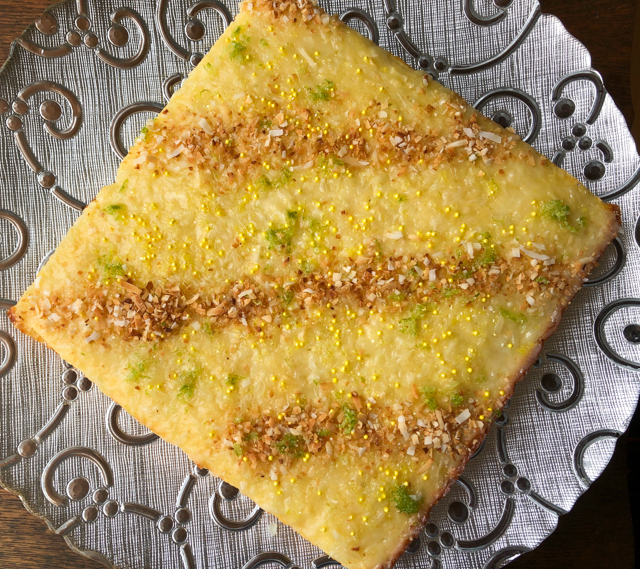
CAKES. “An over baked sponge will have a dark crust on its sides, bottom, and maybe even the top. The perfect sponge should be the same color all over.”  Yes, yes, and YES! Might be my favorite chapter.  Chocolate Fudge Cake (with tips on what to do if your fudge separates), the classic Lemon Drizzle Cake, Pistachio and Raspberry Ripple Swiss Roll, Simnel Cake (on my list to do!), Raspberry Ripple Cupcakes, Gluten-Free Coffee and Walnut Cake (she swears you cannot tell it’s gluten-free), Vegan Lemon Cake. But let me tell you that I baked one of her cakes and will include it here as a teaser. A Coconut and Lime Traybake.  Absolutely delicious!
PASTRY. I lied. This is my favorite chapter. Nancy learned pastry from her Grandma, a huge influence in her life. Her initial description on how to make the perfect shortcrust pastry is worth the whole book, in my opinion. The featured recipe was from this chapter. My other favorites: School Dinners Meat Pie (gorgeous), Courgette Quiche (stunning presentation), Single Serve Whole Apple and Blackberry Pies, Rich Chocolate Tart, Luxury Mince Pies (plenty of tips on how to pull perfect ones, plus her great video tutorial),  Choux Pastry, Puff Pastry, Eclairs, Sausage Rolls

PUDDINGS AND DESSERTS.  This chapter stretched my horizons a bit, as I am not too familiar with some of the UK classics. I am very intrigued by Steamed Treacle Sponge (it does look great), Nancy’s Christmas Pudding, Eve’s Pudding, and obviously at some point I need to make the Queen of Puddings, as it was a technical I missed because a gingerbread sculpture collapsed and I was shown the exit door of a beloved tent (insert discreet tears). Half Sugar Almond Meringues are also calling my name, as well as Summer Lemon and Elderflower Cheesecake, and a stunning Raspberry and White Chocolate Bundt Cake.

HOME TIME. In this closing chapter, she goes over her way of life, growing a lot of the things she eats, preserving things, coming up with clever systems for cleaning that avoid strong chemicals or store-bought products. Everything with the videos ready and waiting for you.

I hope you enjoyed this little review. Her cookbook was clearly a labor of love form page 1 to page 416. Nancy is an author who wants you to succeed in the kitchen, she wants to make sure you can bake every single one of those recipes without issues. I will never forget her last showstopper challenge in the tent, in which she made a Moulin Rouge sculpture with sugar work. To conceive that was amazing, but to pull it all IN THE TENT, with the “male judge” hovering nearby,  just blows my mind.  So I am thrilled that a person with so much talent decided to share it in a cookbook, and we can all profit from it.

Thank you, Nancy, for giving me permission to share the Passion Fruit Tart recipe, and for your support….

ONE YEAR AGO: Lemony Shredded Brussels Sprouts with Almonds

TWO YEAR AGO: Savory Oatmeal with Bacon and Cheddar

THREE YEARS AGO: Air-Fried Carrots, Two Ways (most popular post on my blog!)

FOUR YEARS AGO: Five Minutes in L.I.T (a tour of our laboratory!)

FIVE YEARS AGO: Chicken Thighs with Artichokes and Capers

SIX YEARS AGO: Pea Pancakes with Herbed Yogurt

SEVEN YEARS AGO: Mushroom Stroganoff

EIGHT YEARS AGO: Tomato Sourdough

NINE YEARS AGO: Gamberetti con rucola e pomodori

TEN YEARS AGO: Flirting with Orzo


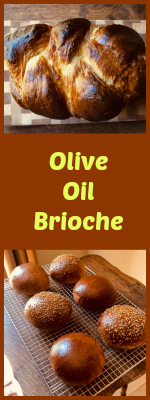
OLIVE OIL BRIOCHE

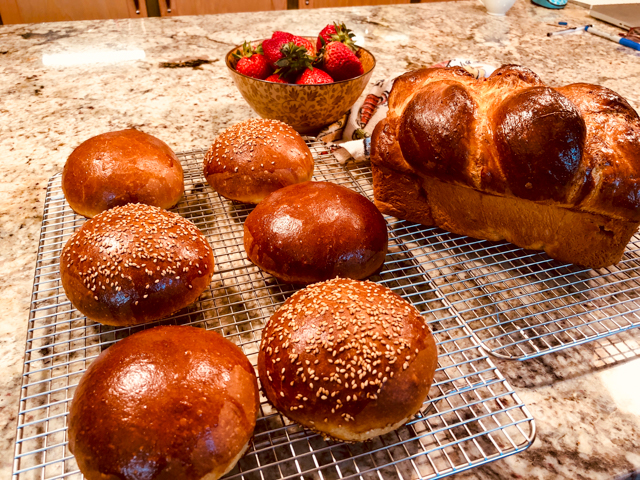
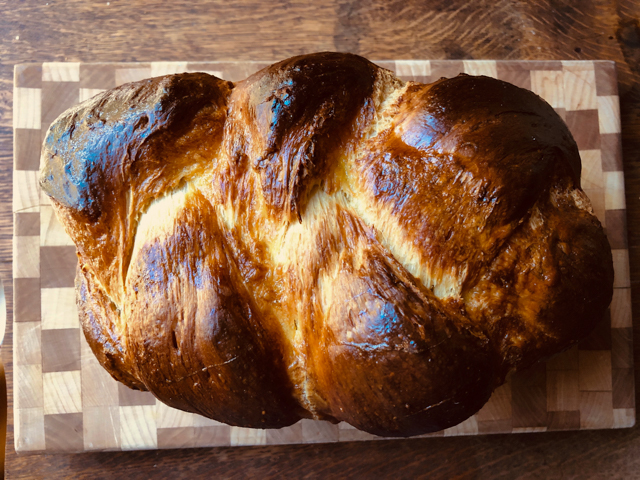
Karen from Karen’s Kitchen Stories is a source of endless inspiration for me. Particularly on anything related to bread, she finds the most unusual, exotic, unique recipes, and then bakes them like it’s no big deal at all.  Just to give you a recent example, look at this incredible concoction for which she used 12-ounce empty soda cans wrapped with foil as a baking “pan.”  Amazing, isn’t it? Today I share with you my adventure with her Olive Oil Brioche. I made only half the recipe and still had a ton of dough to play with. Enough for a large loaf and 6 buns. For reasons that will be discussed in the comments, if you make it, be ready to have one loaf and 8 buns. The amount for the loaf pan was a tad too much.

OLIVE OIL BRIOCHE
(slightly modified from Karen’s Kitchen Stories)

for the poolish:
100 grams all purpose flour
100 grams water
1.5 grams instant yeast

Mix the ingredients, cover with plastic wrap, and place in the refrigerator over night.

for the levain (Sourdough)
1 tablespoon starter
110 grams all purpose flour
110 grams water

Mix the ingredients, cover with plastic wrap, and let sit overnight at room temperature until bubbly.

for the final dough: 
200 grams poolish
150 grams levain
500 grams bread flour
12 grams salt
7.5 grams instant yeast
250 grams eggs
120 grams milk
80 grams honey
Zest of one Meyer lemon (optional)
25 grams water
220 grams extra virgin olive oil
For the egg wash: 1 egg plus one tablespoon milk

In a stand mixer, combine the flour, salt, yeast, eggs, milk, levain, poolish, honey, lemon zest, and water and mix on low for about 5 minutes. Cover and let rest for about 20 minutes.

Mix the dough with the spiral hook on medium to high speed for 8 minutes.
With the mixer running on medium,  add the oil slowly, pausing so that the oil is absorbed. I did it in three additions. Incorporation of the oil will take time, so exercise patience.  Add a sprinkle of bread flour to speed incorporation if you so desire, but do it only in the second and third addition. The dough should end up very smooth and not tear when  you stretch it.

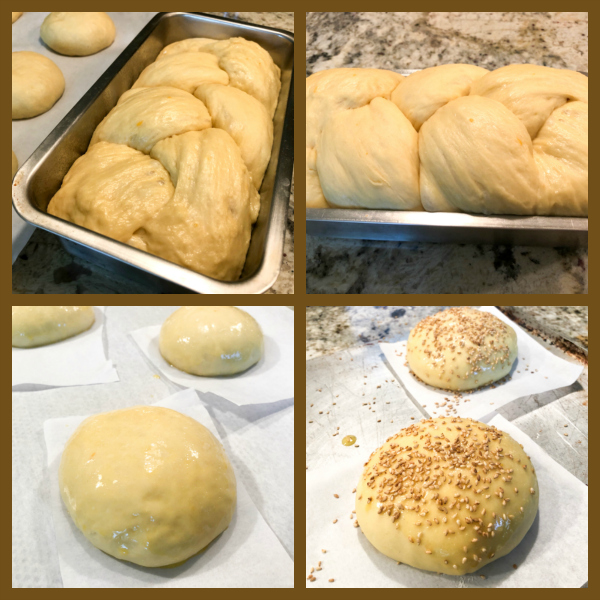
Allow the dough to bulk ferment (in a large bowl covered in plastic wrap) for 2 hours at 70 degrees F. Do three stretch and folds during the first 90 minutes, one every thirty minutes.  When the dough is ready, remove three pieces of about 250g each and braid them. Place in a slightly oiled 9 x 5 loaf pan for final proofing. Divide the rest of the dough in 8 portions, shape as buns, and proof.

Heat the oven to 425 degrees F.  After the bread has been proofing for 1 and a half to 2 hours (until doubled), brush with egg wash and bake until golden brown, 30 to 40 minutes, until internal temperature is 200 F. You can sprinkle sesame seeds on the buns if you so desire.

Un-mold the large loaf and cool on a wire rack together with the buns.

ENJOY!

to print the recipe, click here

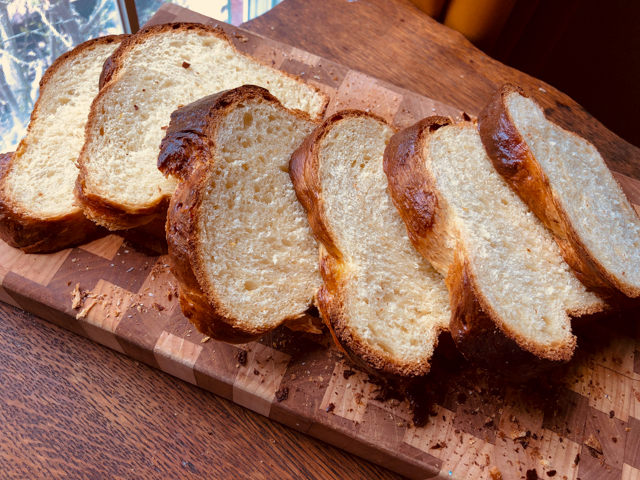
Comments: I will not lie to you, this is a project. The bread requires a sourdough starter, a poolish (fermented flour using small amount of commercial yeast and prepared the day before), and commercial yeast in the final dough. But it is a total pleasure to work with, rises like a rocket and the texture and taste? You will not miss the butter, that’s for sure. As Karen said, it keeps a lot better than the traditional version. And freezes beautifully too.

When you start adding the olive oil, you will be sure the whole thing is ruined, and might have a few rude thoughts directed at me. It seems impossible for the dough to come together. Have bread faith. And here is a little tip that might help: as you add the olive oil and the mixer is going and going, with a puddle of oil all around and looking hopeless, add just a sprinkle of bread flour on top. It will help things get in shape faster. But just a sprinkle, I say 1 tablespoon or so. If you add the olive oil in three additions, do that in the final two, when the dough will have more trouble incorporating it.

For a 9 x 5 loaf pan, I advise you to make three strands with about 250g of dough in each. Then divide the rest in 8 buns. When you do that, you will be able to let the shaped loaf proof for closer to 2 hours and it will not rip a bit like mine did. I had no choice but to bake after 1 hour and 10 minutes, the dough wanted to leave the pan and explore the kitchen. No bueno. That’s because I used 300g per strand, a bit too much. Don’t be put off by the complexity of this recipe, once you have the starter and the poolish prepared the day before, it is just a matter of weighing all other ingredients and having some fun.

Karen, thank you for the inspiration, I know I tell you this all the time but it’s so true… Your blog is a pleasure to follow!

ONE YEAR AGO: Coconut and Lime Macarons

TWO YEAR AGO: Flank Steak Carnitas

THREE YEARS AGO: Sesame and Poppy Seed Sourdough

FOUR YEARS AGO: Pecan-Crusted Chicken from Southern at Heart

FIVE YEARS AGO: Lamb Shanks en Papillote with Cauliflower-Celeriac Purée

SIX YEARS AGO: Chestnut Brownies and a Blog Award!

SEVEN YEARS AGO: Quinoa with Cider-Glazed Carrots

EIGHT YEARS AGO: Celebrate Wednesday: Heirloom Tomatoes Steal the Show

NINE YEARS AGO: Pain de Provence

TEN YEARS AGO: Golspie Loaf, from the Scottish Highlands