BICOLOR RAVIOLI

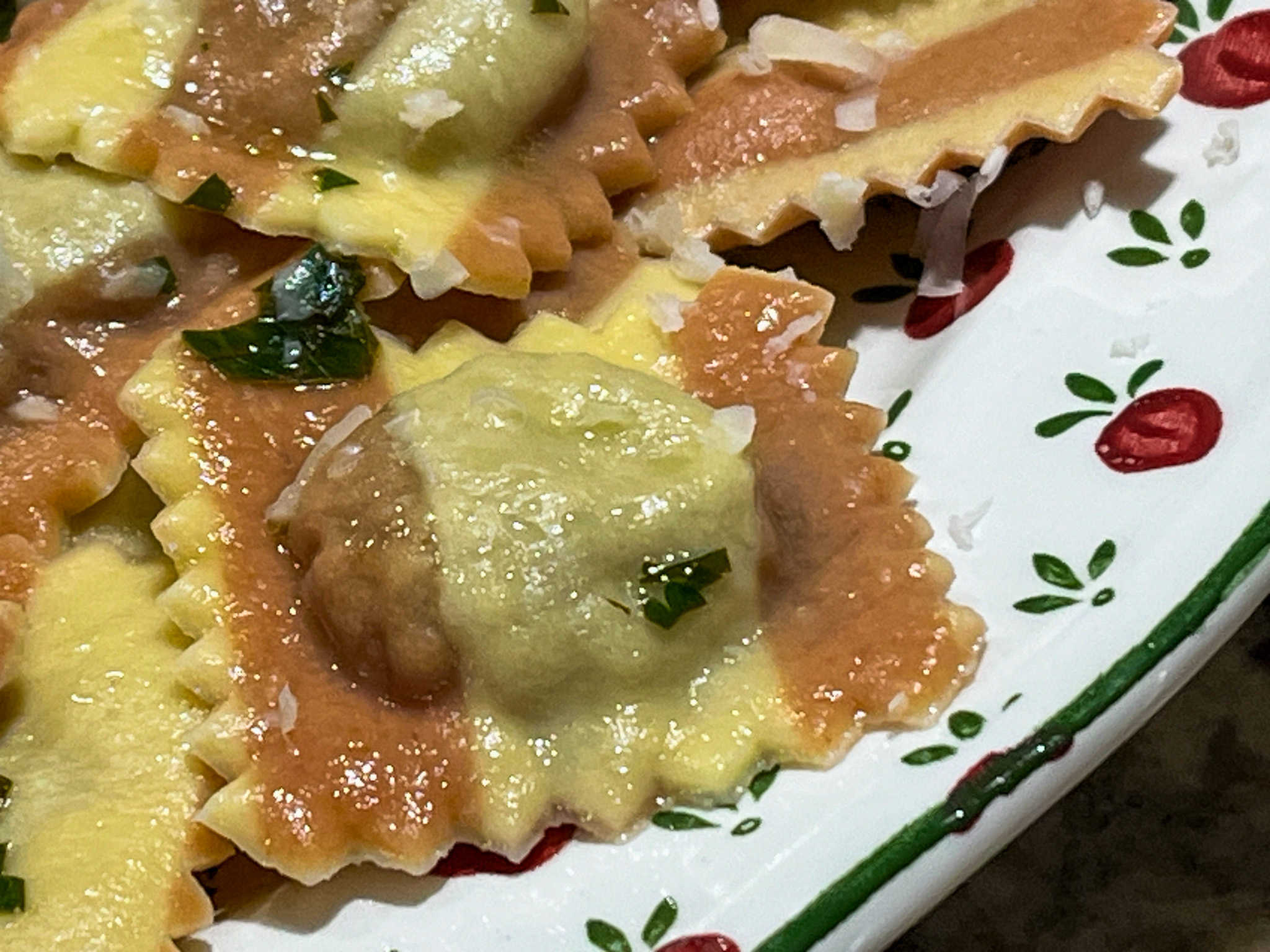
My cookie ravioli fiasco left me staring at the mold and wondering if that impulse buy was going to sit in a drawer neglected for eternity months. No, that could not possibly happen. To counteract the bad taste in my mouth, I jumped on another crazy adventure right away: making ravioli from scratch, but adding a little twist to the whole thing. The pasta dough would have two colors. I’ve made pasta from scratch a few times, it is a messy process but quite gratifying. I am overjoyed to report that my mental sanity was not badly affected and we had a very delicious dinner that Saturday night…


BICOLOR RAVIOLI WITH MUSHROOM-ALMOND FILLING
(from The Bewitching Kitchen, filling inspired by this post)

white dough:
125g all-purpose flour
75g semolina flour
2 eggs
pinch of salt

red dough:
125g all-purpose flour
75g semolina flour
50g cooked beets (I used canned, slivered)
2 tsp paprika
2 eggs

for the filling:
8 ounces (226g) mushrooms, finely chopped
2 tablespoons olive oil
1 cup (142g) almonds
½ cup (112g) water
1 teaspoon (6g) sea salt
1 teaspoon lemon juice

The day before you want to make ravioli, prepare the filling.

Fill a medium sized saucepan with 1 cup (142g) of almonds and enough water to cover the almonds. Turn the heat to high. Once it starts to boil, turn the heat down, boil the almonds for 15 minutes, then pour the almonds and water into a colander. Rinse them well. Sauté chopped mushrooms in 1-2 tablespoons of olive oil until all the liquid has cooked out. 

Blend the boiled almonds, salt, lemon juice and water in a blender or food processor until a paste forms. Add the mushrooms and blend a few more times so that they are in very small pieces. Transfer the filling to a colander sitting on a bowl and let it drain for several hours in the fridge, then cover and store it in the fridge until needed. You can do this a couple of days in advance. 

Make the white pasta. Add both flours and salt to the food processor, mix for a few seconds. Add the 2 eggs and process until a dough ball forms. If too dry, add water. If too loose, add flour. Remove the dough from the processor, form into a disc, wrap in plastic and let it rest at room temperature for 1 hour.

Make the red dough. Add the eggs, beets and paprika to the food processor and process until smooth. Add the flours and salt, process until a dough ball forms. You will probably need to add more flour to this dough. Reserve at room temperature like you did for the white dough.

Cut the pasta dough in three equal parts, and roll them several times in the widest setting of your roller. Try to go for a nice rectangle shape. Do the same for the colored dough. Cut stripes in both colors or just one if you prefer to use the second method. Carefully roll the bicolor dough to the desired level, I stopped at setting #3. Lay the pasta on the mold, add the filling and close the ravioli. Once they are made, sprinkle a little flour and freeze until cooking time.

Simmer them gently for about 4 minutes then add the sauce of your choice to serve. I used just a little olive oil, lemon, parsley and water from cooking the ravioli. Serve immediately.

ENJOY!

to print the recipe, click here
Comments: These are the tips I consider most important. First, make the filling one day before, so that it is super cold and you do take the time to cook most of the moisture out. That will avoid minimize risks of failure when you form and cook the ravioli. Second, be ready to either cook the ravioli right after you make it, or freeze them right away with a light coating of flour. Considering that making pasta from scratch it is a bit of a messy process, I rather make them earlier in the day, clean the kitchen, and cook them later.


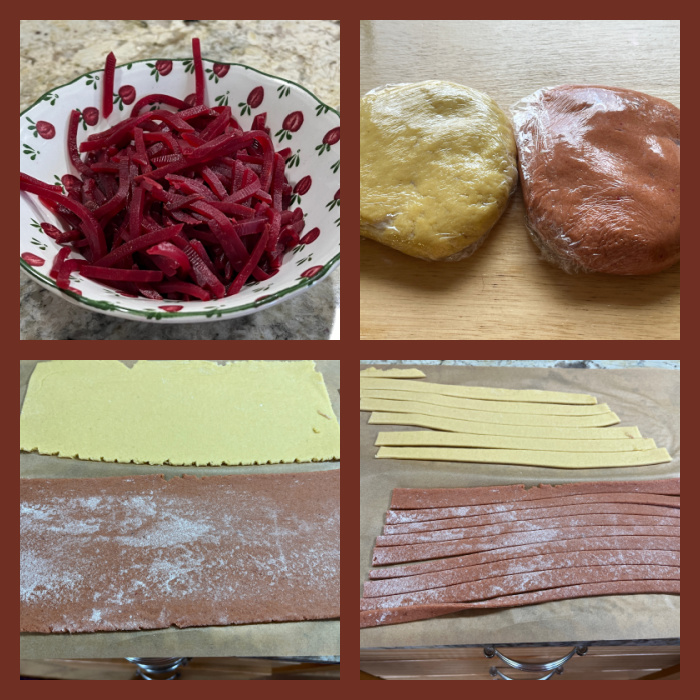
There are two different ways to make the striped pattern. You can roll the pasta through the widest setting of your roller, then cut strips and join them side by side. That is shown in the photo below, to the left. The problem with that method, is that sometimes the strands will not join tightly enough and when you pass the sheet through the roller to make it thinner, they will separate. It is maddening. It worked well on the first set I made, but the second one was almost totally ruined. I had enough pasta dough to try one more time, and used the second method. In this case, one sheet of pasta is kept whole, and the other used to make stripes, that are laid on top of the first. It is shown below, on the right side of the panel.


I really favor the second method, which is also nice to make other patterns. Think polka dots, stars, squares… So many possibilities! Once you have the striped sheet ready, it will go through the thinner settings of the roller. You should end up with a beautiful concoction waiting for the filling… I was afraid to roll it too thin and have it burst with the filling, maybe next time I can take it through one more setting.


The mold worked super well to fill and form the ravioli…

The ravioli must be cooked in water that is brought to a full boil but kept simmering because fresh pasta is so delicate…
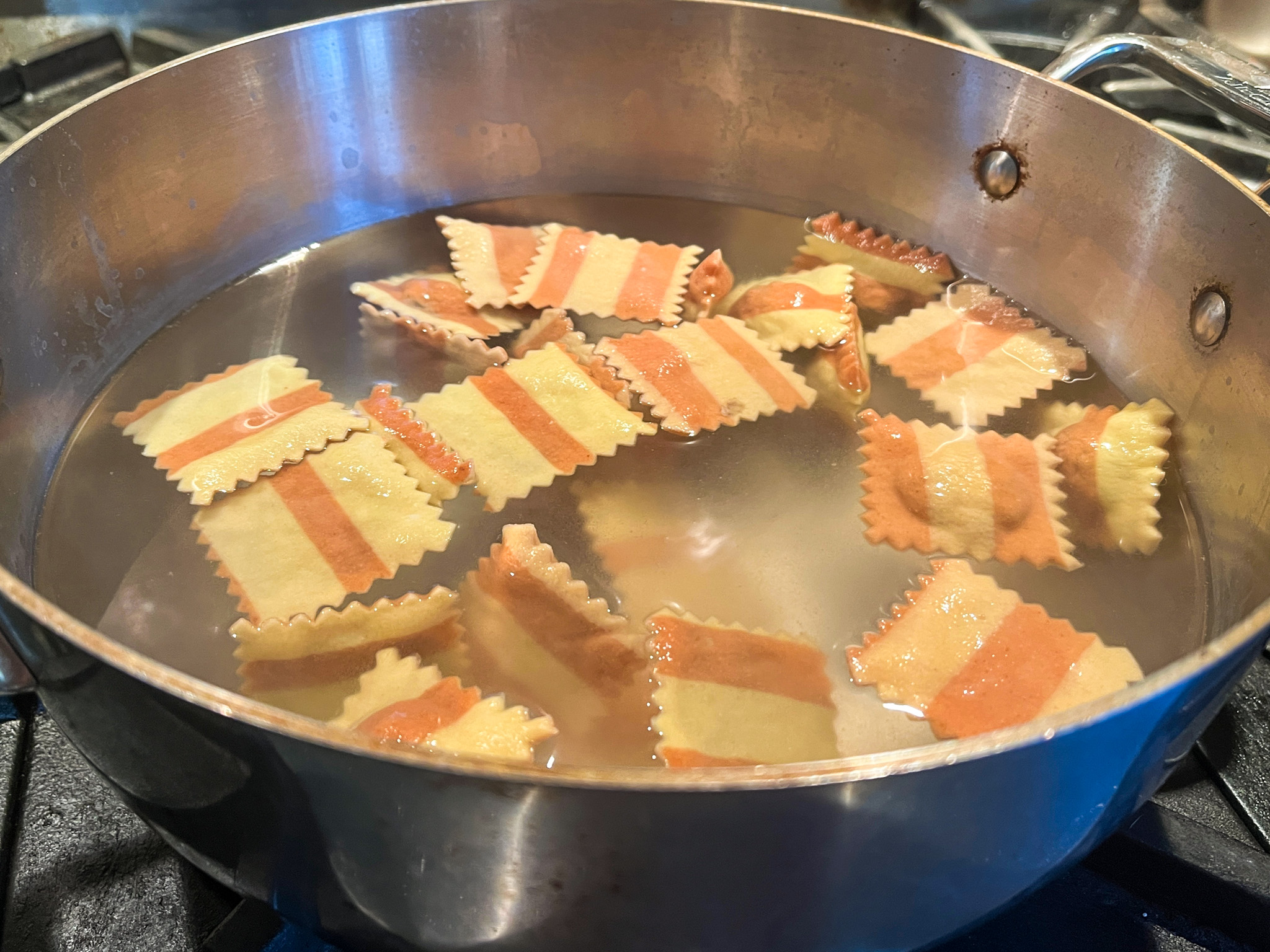
For my next adventure, my goal is to get a darker red pasta, so I will use more beets and maybe also add beet powder. Or maybe I will go for green with spinach, black with charcoal powder. Whatever color combination, I intend to make the strips thinner so that I will have more stripes per ravioli. Stay tuned! 
ONE YEAR AGO: Crispy Asparagus Salad with Toasted Bread Crumbs

TWO YEARS AGO: Low-Carb Super Fast Chicken Parmigiana

THREE YEARS AGO: Sundried Tomato Spelt Sourdough

FOUR YEARS AGO: A Duet of Chocolate Bonbons

FIVE YEARS AGO: Chocolate Tartlets with Honey-Caramel Filling

SIX YEAR AGO: Zucchini Soup with Tahini

SEVEN YEARS AGO: Black Sesame Macarons

EIGHT YEARS AGO: Fine Tuning Thomas Keller

NINE YEARS AGO: Cauliflower Tortillas

TEN YEARS AGO: Majestic Sedona, Take Two

ELEVEN YEARS AGO: Secret Ingredient Turkey Meatballs

TWELVE YEARS AGO: Swedish Meatballs and Egg Noodles

THIRTEEN YEARS AGO: Italian Easter Pie

FOURTEEN YEARS AGO: Black Olive Bialy


RAVIOLI COOKIE, THE SHORTEST PATH TO INSANITY


The path is not only short, but also pretty messy. You’ve been warned. For a very long time I’ve flirted with the idea of making a stuffed cookie in the shape of a ravioli, inspired by a gorgeous version from Helen Fletcher’s book Craving Cookies, the Quintessential American Cookie Book. She cuts hers by hand, after enclosing a square of chocolate between two sheets of dough. I decided I was going to impress her (cough, cough) with a different twist: using a ravioli press. What could possibly go wrong? I was so excited about my project that I had already a blog post shaping up in my mind. So, first things first, I took a nice picture of the weapons used in the crime.


I dreamed about my blog post going viral, even if in almost 15 years of blogging nothing has ever came close to it. In fact, viruses avoid me so much that even Covid stays safely away. Still a unicorn after all these pandemic years. Anyhow, I digress. Here is the full outcome of 420g flour, 340g butter, and a good amount of sugar to boot.

Six. Cookies. Six. Half a dozen.

The composite picture below shows the steps right before chaos. In theory, you roll the cookie dough, lay on the mold, add your filling, close with another cookie sheet, smooth everything with the cute rolling pin provided. For the square ravioli, I used Peppermint Bark, cut in four small pieces. They fit so nicely in the allotted space! But that was the last reason I would have to smile for a while…

From that point, all hell broke loose and broke loose with bangs of profanity. The cookie dough glued to the mold in perverse ways, I used every trick imaginable, including freezing the whole thing for increasing periods of time. The bond between dough and mold was likely approaching triple-covalent level. I also tried gently probing with a tiny spatula. I don’t recommend doing that. Ever.

All I could do was try again with the second mold, the round one, using a heavier hand with the flour. I opted for Nutella for the filling, which was another bad decision, as it squirted everywhere as I tried to roll the ravioli shut. Messy, sticky, horrific. I managed to get six severely abused cookies from the adventure, and thanks to the miracle of Royal icing and sprinkles they were able to make a public appearance. It is a good thing you cannot see their bottoms (enough said).

Sooooo, what did I learn from this fiasco? I firmly believe that this could be a PERFECT Technical Challenge for a certain tent… Here’s how to do it: give a list of ingredients to the poor contestants. The instructions should be kept simple:

Make a cookie dough.
Use the ravioli press to make filled cookies.

As to the filling, they can use their tears and frustration. They shall have plenty to take care of all 10 cookies in the mold. So, there you go, organizers of Great British and Great American Baking Show. Free advice to guarantee great entertainment for your audience…

I shall be back, friends! I lost a battle but this war is NOT over! I shall make Helen proud!

ONE YEAR AGO: Peanut Butter and Jelly Babka and a Cookbook Review

TWO YEARS AGO: Painted Sourdough

THREE YEARS AGO: Over-the-Moon Blueberry Lemon Macarons

FOUR YEARS AGO: Springtime Macarons Bake-Along

FIVE YEARS AGO: Macarons for a Little Princess

SIX YEARS AGO: Gilding the Sourdough Loaf

SEVEN YEARS AGO: Lolita Joins the Bewitching Kitchen

EIGHT YEARS AGO: Cashew Cream Sauce

NINE YEARS AGO: Blood Orange Margaritas

TEN YEARS AGO: Smoked Salmon Appetizer

ELEVEN YEARS AGO: Clementine Cake

TWELVE YEARS AGO: Springtime Spinach Risotto

THIRTEEN YEARS AGO: The end of green bean cruelty

FOURTEEN YEARS AGO: Torta di Limone e Mandorle

HOMEMADE RAVIOLI

If you’re fortunate enough to have friends who love to cook as much as you do, then think about spending an afternoon making pasta together.  My friend Cindy (who had attended a pasta class a few weeks before) came over with her recipe, her notes from class, and a butternut squash puree ready to become ravioli filling.  What can I say?  I happen to have very special friends… 😉

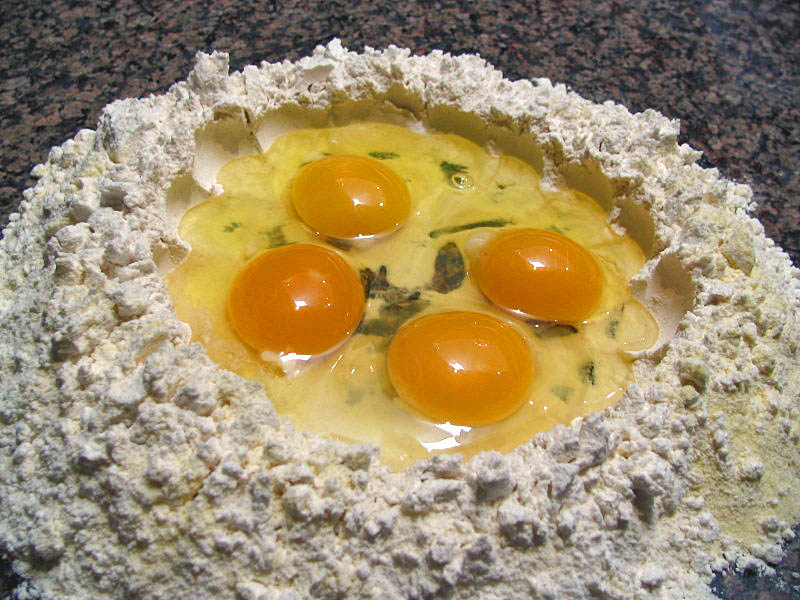
I’d made a pasta dough beforehand, but with the food processor,  and it felt like cheating.  I’ve always been mesmerized by the image of a woman with strong arms and hands breaking eggs over a mound of flour and bringing the dough together. No machines, just elbow grease.  So,  I was thrilled (and a bit intimidated) when Cindy’s recipe started with this:

but just 90 minutes later, we sat down with our hungry husbands to enjoy this:

FRESH EGG PASTA
(adapted from The Fine Art of Italian Cooking, Giuliano Bugialli)

3 cups unbleached all-purpose flour
4 large eggs
1 TB extra virgin olive oil
Large pinch kosher salt

Place flour in a mound on the counter. Make a large well in the center and put the remaining ingredients in the well. With a fork, mix the eggs, oil and salt then begin to incorporate flour from the inner rim of the well. When the dough is too thick for the fork, begin kneading and work as much of the flour into the dough as possible. Cover with a bowl or wrap in plastic to rest the dough for 30 minutes before rolling.

Cut the dough in 8 pieces, and start passing each piece through the rollers of your pasta machine, starting with the largest setting.  Pass each piece of the dough several times, folding it in half and passing it again through the same setting, until it feels slightly “elastic” as you stretch it.  Once you reach that stage (after 6-8 passes), move to the following – thinner – setting.    As the pasta becomes longer, you might want to cut it in half to make it easier to handle.  Stop at the next to last setting.   Lay the pasta sheets over a lightly floured counter top and form the ravioli with the filling  and shape of your choice. Place the raviolis on a  lightly floured cookie sheet as you form them.  Gently cook them in salted, boiling water, add sauce, and serve.

to print the recipe, click here

ROASTED SQUASH RAVIOLI WITH SAGE BROWN BUTTER
(from Cindy’s kitchen; makes 4 light servings)

for the filling:
1 Tbs butter
3 Tbs minced shallots
1 cup roasted butternut squash puree
Salt and pepper
3 tablespoons heavy cream
3 tablespoons grated Parmigiano-Reggiano cheese, plus more for garnish
Pinch of nutmeg
pasta dough, rolled out into wide ribbons
for the butter/sage sauce:
8 Tbs butter
12 fresh sage leaves
1 Tbs finely chopped fresh parsley leaves
salt and pepper to taste

In a large sauté pan, over medium heat, melt 1 tablespoon of the butter. Add the shallots and sauté for 1 minute. Add the squash puree and cook until the mixture is slightly dry, about 2 to 3 minutes. Stir in the cream and continue to cook for 2 minutes. Remove from the heat and stir in 3 tablespoons cheese and nutmeg. Salt and pepper to taste. Cool completely.

Lay the pasta ribbons over a lightly flour counter top,  place 2 teaspoons of the filling spacing the little mounds according to the size of ravioli you want to make. Form the ravioli either as squares or triangles.  Reserve, placing them on a lightly flour cookie sheet.    Place a large pot with salted water to boil, and start preparing the sauce by melting the remaining 8 tablespoons of butter in a large skillet. Add the sage to the butter and continue to cook until the butter starts to brown. Remove from the heat, keep warm.

Cook the ravioli in salted, boiling water until al dente (2 to 3 minutes) or until they float to the surface and turn pale in color.   Remove  from the water and drain well.

Place some of the pasta in the center of each serving plate. Spoon the butter sauce over the pasta. Adjust seasoning with salt and pepper, sprinkle Parmiggiano-reggiano cheese over each plate and garnish with parsley.

ENJOY!

to print the recipe, click here

Comments:  Cindy pointed out that the most important detail about making the dough by hand is starting with a large “volcano opening” in your mound of flour. Like this.  Most people (me included) make the mistake of starting with a tiny little opening, leading to a  deluge of eggs flowing over the counter top, and considerable culinary grievance.  Make the opening a bit more like a meteor crater, and you will be in great shape.  😉

(click to enlarge)
When forming the ravioli it easier to make several at once, by laying the filling over the pasta, folding it over and cutting the individual raviolo once the full extension of the pasta is filled.   It is important to avoid air bubbles, so gently press the upper layer of the pasta, smoothing out the surface.  I like to seal the edges with a little water, and sometimes use the tines of the fork to lock them in place, but we did not do it this time and all went well.

There’s something particularly elegant about home-made  pasta in general, and ravioli in particular.  Keep the sauce and other dishes as simple as you feel like:  your made-from-scratch pasta will lift the meal to a higher level.

ONE YEAR AGO: Feta Cheese and Zucchini Loaf (a must-try French-style savory cake)

Add to FacebookAdd to DiggAdd to Del.icio.usAdd to StumbleuponAdd to RedditAdd to BlinklistAdd to TwitterAdd to TechnoratiAdd to Yahoo BuzzAdd to Newsvine