SLOW-BAKED SALMON

Let’s suppose that you find the flavor of salmon a bit strong, as I used to feel about anchovies and related items of a fishy persuasion. This recipe might just change your mind and begin a new gastronomic love affair.  With salmon, slow-baking until the meat is barely cooked gives the fish an almost mousse-like consistency, and flavor as mild as “salmon-ly” possible.   Plus, the lemon zest and thyme seasoning add a delicious counterpoint!   From the latest issue of Bon Appetit, this one goes into my favorites folder.
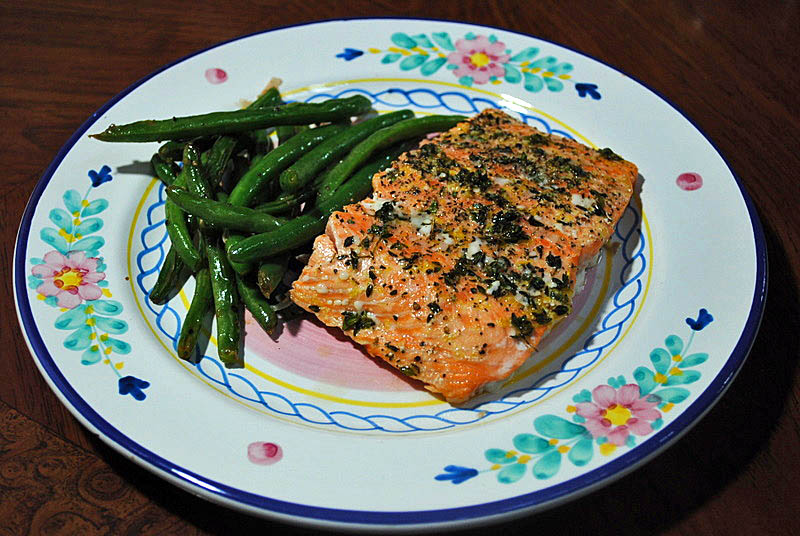
SLOW-BAKED SALMON WITH LEMON AND THYME
(adapted from Bon Appetit, May 2011)

1 + 1/2 Tbs olive oil, divided
4 salmon filets or 1 large piece, skin on
2 Tbs fresh thyme leaves, chopped
zest of 1 large lemon + juice
salt and pepper

Heat the oven to 275 F.  Line a baking dish with aluminum foil, coat it lightly with 1/2 Tbs of olive oil, and place the salmon filet over it, skin side down.

In a small bowl, mix the remaining tablespoon of olive oil with the thyme and lemon zest.  Rub this mixture all over the salmon, season with salt and pepper and squeeze a little lemon juice over it.   Let it rest for 10-15 minutes, then place it in the oven for 18-20 minutes, until the fish is just cooked.

Serve with lemon  wedges, and…

ENJOY!

to print the recipe, click here

Comments:  We eat salmon on a weekly basis, but almost always grilled.  Phil, the expert,  makes it exactly the way I love, with the center still moist, never over-cooked.  The high heat of the grill, however, doesn’t mellow the salmon character at all, quite the contrary. We both love it, but it’s nice to have a change of pace.

This method can be adapted to all sorts of seasonings. In fact, when we move back home next month I’ll grab my Jacques Pepin‘s  “Fast Food My Way“, and re-visit one of my favorite recipes in that book, a salmon filet cooked at an even lower temperature, for about 40 minutes.   If I remember correctly, he coats the filet with breadcrumbs and ground hazelnuts.  It is outstanding, like so many of Pepin’s recipes.

Stay tuned!  😉

ONE YEAR AGO: Farfalle, Farfalle

This slideshow requires JavaScript.

Add to FacebookAdd to DiggAdd to Del.icio.usAdd to StumbleuponAdd to RedditAdd to BlinklistAdd to TwitterAdd to TechnoratiAdd to Yahoo BuzzAdd to Newsvine

GAMBERETTI CON RUCOLA E POMODORI

Nope, this recipe didn’t come from an Italian cookbook.  I hope Martha Stewart won’t mind that I took some liberties with the title for her creation,   but it just sounds too lovely in the language of Dante: “… Gamberetti… Rucola… Pomodori,”  …just beautiful!

This year I insist on “quick and easy dinners,” because life is awfully busy for us here in LA.  It’s now our final month at UCLA, so this type of recipe is a life-saver.  Cook some pasta (we used cappellini, that’s ready in five minutes),  grab some lettuce for a simple salad, and all of a sudden you’ll have a meal from a trattoria by the Mediterranean Sea.

SAUTEED SHRIMP WITH ARUGULA AND TOMATOES
(adapted from Martha Stewart’s Everyday Food, June 2010)

1 Tbs olive oil
1 cup cherry tomatoes
1 garlic clove, lightly smashed
1 pound large shrimp
4 cups baby arugula leaves
salt and pepper
juice of half a lemon

Heat the olive oil in a large skillet, add the garlic and sautee for a couple of minutes in gentle heat, until it gets fragrant and starts to develop some color.  Remove the garlic and discard it.  Add the tomatoes, season with a little salt and pepper, increase the heat, and cook, stirring often, until they blister and release some liquid.

Add the shrimp and cook until opaque, not more than 4 minutes. Add the arugula leaves, a little more salt, and toss until wilted.  Squeeze the lemon juice over the pan, and toss to combine.   Adjust seasoning, and serve over pasta or white rice.

ENJOY!

to print the recipe, click here

Comments:  My preference for arugula or spinach is always changing.  Sometimes I settle on spinach, for its mellowness and delicate taste.   Then, my mood switches and I grab bag after bag of arugula at the store and bring it home.  Its leaves are sturdier, it wilts with dignity.  😉 And the peppery bite, no spinach can match it.  As you might guess, I’m going through the arugula phase right now.

ONE YEAR AGO:  Grissini

Add to FacebookAdd to DiggAdd to Del.icio.usAdd to StumbleuponAdd to RedditAdd to BlinklistAdd to TwitterAdd to TechnoratiAdd to Yahoo BuzzAdd to Newsvine

THAI CHICKEN CURRY

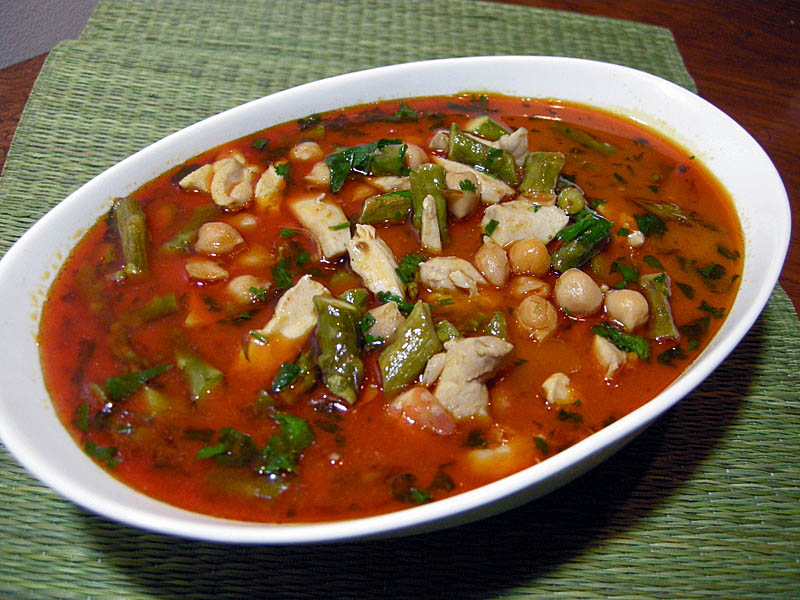
One of the features  I like the most in Fine Cooking magazine is their section called “Cooking without recipes.”   They pick a particular dish, say,  risotto or meatloaf or lasagna, and  dissect it into its basic techniques, helping you devise your own take on it.  A recent issue (number 110) offered an overview of Thai curries,  including poultry, seafood and vegetarian, from spicy to mild, with all sorts of aromatics to round out their flavors.  If you love curries – and who doesn’t? 😉 –  get this issue and start experimenting.   Here I share with you my first interpretation of a chicken version, that ranked high on the yummy-ness scale.

RED CURRY CHICKEN
(from the Bewitching Kitchen, inspired by Fine Cooking)

1 can of coconut milk  (13.5 oz)
1/8 to 1/4 cup red curry paste
1 cup chicken broth (or water)
1 Tbs lemon zest
2 Tbs. light brown sugar
2 tsp. fish sauce
1 Tbs grated fresh ginger
1 lb. boneless chicken thighs  cut into 1/4-thick bite-size strips
3/4 cup canned garbanzo beans, rinsed well
2 cups asparagus, cut in 1-inch pieces
salt to taste
1/2 cup minced cilantro leaves

Shake the can of coconut milk, open it and stir well if not completely smooth.  Transfer 1/2 cup of it to a saucepan and simmer for 5 minutes to thicken it up.  Don’t worry if it starts to separate.  Add the red curry paste, whisk for a minute, then add the broth, brown sugar, fish sauce, and the rest of the coconut milk left in the can. Bring to a simmer over high heat, and add the chicken pieces.  Lower the heat and simmer, stirring occasionally for about 10 minutes.

Add the lemon zest, ginger, asparagus, and garbanzo beans.  Simmer for 5 minutes, adjust seasoning with salt if necessary (fish sauce is salty, you may not need to add additional salt), sprinkle with the fresh cilantro and serve right away over white rice.

ENJOY!

to print the recipe, click here

Comments:  Cooking the chicken in the sauce (instead of sauteing it first) saves a messy step that’s particularly hard to deal with in a tiny kitchen, where I’m working with a two burner hot plate.  Plus, the meat turns out very tender and juicy this way.   Of course, if you prefer chicken breast instead of thighs  then substitute, but something about the velvety texture of chicken thighs makes them more appropriate for this type of recipe.   Once the meat is cooked   add the vegetables that you like (some of which might profit from a previous parboiling: potatoes, butternut squash, carrots);  as long as you pay attention to their cooking times, they’ll be fine.

Keep in mind that different brands of curry paste vary considerably in their spiciness.  If you’re new to this ingredient, then start with a small amount, taste, and add more according to your level of tolerance.

ONE YEAR AGO:  Zen and the Art of Risotto

Add to FacebookAdd to DiggAdd to Del.icio.usAdd to StumbleuponAdd to RedditAdd to BlinklistAdd to TwitterAdd to TechnoratiAdd to Yahoo BuzzAdd to Newsvine

MAHI-MAHI

I fall in love with words quite easily.  Mahi-mahi…. is just one of the many beautiful Hawaiian words.  When we visited Oahu I found it fascinating to  read the street names, which for the most part were quite hard for a foreigner to remember: Kamehameha, Mamalahoa, Kealakehe, Hualalai. They all seemed so…. musical!

It turns out that the Hawaiian alphabet lacks a few consonants:  C, J, Q, and X. It also makes no distinction between K and T.   When the complexity of a language decreases at one level, it often compensates on another.  The fewer consonants probably explains why so many Hawaiian words have duplicated syllables, giving the spoken language a playful component that’s quite pleasing.  But, I digress…  mahi-mahi (by the way, “mahi” means “strong”) is one of my favorite fish, at the top with striped sea bass.  It has a mild, but definitely not bland flavor, and a meaty texture that’s perfect for grilling, as this recipe (another gem I got from my friend Heather) will convince you.

GRILLED MAHI-MAHI WITH CITRUS MARINADE
(from  Heather’s kitchen)

2 filets of mahi-mahi (may substitute other firm-fleshed fish)
for the marinade:
2 T fresh lime juice
3 T rice vinegar
1 T finely chopped ginger
1 T finely chopped scallions
3 T mild vegetable oil (I used grapeseed)
1 T soy sayce
1/2 t Asian chili sauce (optional)
freshly ground black pepper to taste
Prepare a marinade by whisking all ingredients together. Marinate the fish for 30 minutes to 2 hours in the fridge.  Grill until cooked through. 

ENJOY!

to print the recipe, click here

Comments: This was one of the tastiest dinners in the past few weeks.  A fish like mahi-mahi is delicious on its own, so the less you mess with it, the better it is.  This preparation was perfect: a hint of lemon,  a little heat, and nothing else.  No elaborate toppings, crusts, or sauces.  A simple, delicious meal, as healthy as it gets.

We loved it with roasted asparagus, and with a mixture of white rice and wheat berries that, all modesty aside, was a spur of the moment inspiration that had me patting myself on the back.   I spotted some white rice in the fridge and some cooked wheat berries that I was saving for a salad.   I just mixed them and warmed them in the microwave. It was an absolutely delicious combination that will be a regular production in the Bewitching Kitchen.

ONE YEAR AGO: Memories of Pasteis

Add to FacebookAdd to DiggAdd to Del.icio.usAdd to StumbleuponAdd to RedditAdd to BlinklistAdd to TwitterAdd to TechnoratiAdd to Yahoo BuzzAdd to Newsvine

THE REAL VODKA SAUCE

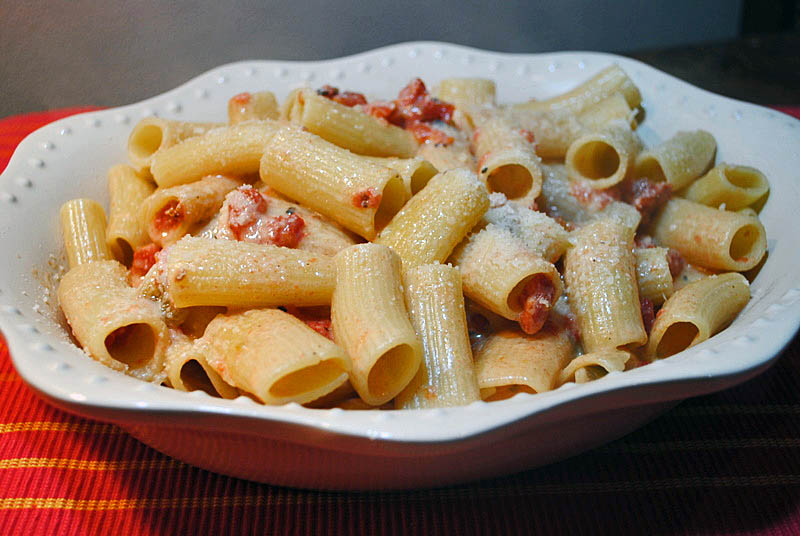
Until recently my only experience with vodka sauce was the bottled stuff in grocery stores, so I had some serious misconceptions about it.   They all tasted like regular tomato sauce, perhaps with a hint of “je ne sais quoi,”  but the real McCoy, made with Russian pepper vodka,  is completely different. Its tomatoes and cream play only a secondary role to its intense vodka punch.  Pepper vodka used to be impossible to find in the US, leading to many improvisations and liberties that turned a great sauce into humble variations. The moment I saw this recipe in the Essential New York Time Cookbook,  I had to give it a try.


PASTA WITH VODKA SAUCE
(adapted from The Essential New York Times Cookbook)

1 pound rotini, penne or your favorite pasta shape
3.5  Tbs butter
1/4 to 1/2  tsp red pepper flakes
1/2 cup vodka
1 cup canned, diced tomatoes with their juices
1/3  cup whipping cream
salt and freshly ground black pepper, to taste
1/2 cup grated parmiggiano regiano cheese

Cook the pasta according to the package instructions. While the pasta cooks, prepare the sauce by melting the butter on a skillet large enough to hold all the pasta. When the butter stops foaming, add the red pepper flakes and the vodka and simmer everything together for 2-3 minutes. Add the tomatoes, cream, cover and simmer gently for 5 minutes. Season with salt and pepper (be gentle on the pepper), keep warm.

When the pasta is al dente, add it to the sauce, heat everything together for a couple of minutes, add the grated parmiggiano cheese and serve, with additional parmiggiano at the table for those who like a little more.

ENJOY!

to print the recipe, click here

Comments: No ‘je ne sais quoi’ in the background of this sauce. On the contrary, its flavor clearly states what it’s all about: the heat of the vodka echoes that of the pepper. I’m fond of spicy food, but Phil prefers it milder, so I wasn’t  quite sure he’d like it as much as I did. To my surprise, he asked me to make it again two days later, to which I happily complied.  😉

My main modification was – as usual – reducing the amount of heavy cream,  in this case in favor of more tomatoes.   Last year I made another pasta sauce with vodka and pepper that’s also excellent, but it’s quite different in that the tomatoes are slow roasted in the oven.  It’s hard to say which one was better, but this version is definitely perfect for a busy weeknight dinner.

ONE YEAR AGO: Pork Tenderloin and Blue Cheese

Add to FacebookAdd to DiggAdd to Del.icio.usAdd to StumbleuponAdd to RedditAdd to BlinklistAdd to TwitterAdd to TechnoratiAdd to Yahoo BuzzAdd to Newsvine