SECRET RECIPE CLUB: AMAZING APRICOT BARS

Here we are. Last Monday of September, which means Summer is gone. Over. Finito. Acabado. I could sit here and whine for hours, filling your screen with paragraph after paragraph describing in detail my despair, frustration, and overall gloom. Telling you how my interactions with human beings are affected as the average daily temperature goes down. You don’t want to be around me in January, even with all that New Year upbeat aura. But, enough with the negativity.

The last Monday of the month brings many reasons to be joyful, as it is Reveal Day for The Secret Recipe Club. This month I got a fantastic blog to stalk and cook from: A Palatable Pastime, hosted by Sue, who lives in Ohio with her husband and two lovely cats. She develops her own recipes – often with a Southern US flair – and not only has won several contests, but her productions have been featured in many top-notch sites like LDS Living, Mrs. Field’s and the Christian Science Monitor’s food section. I was thrilled to stalk her site, although a bit overwhelmed by the number of possibilities bookmarked to pick, cook, and share with my readers today.

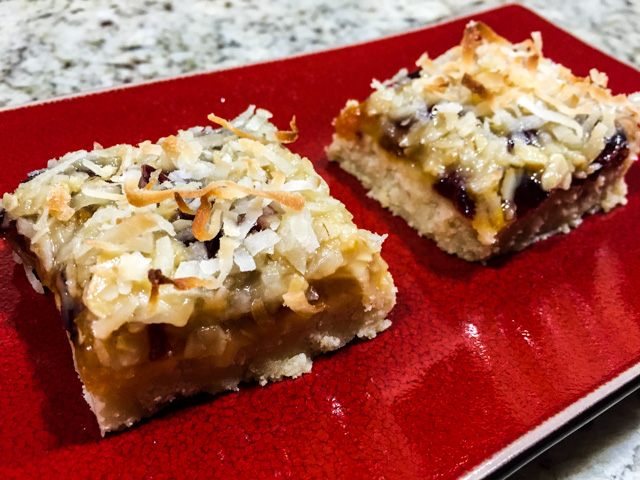
Twelve recipes made the final list, but to keep it manageable, I’ll just mention half of them: Sweet Potato Biscuits (I’ve always wanted to make them… was very close to choosing it for this assignment), Thai Salmon Curry….   Vegan Mushroom Pumpkin Chili (her description tells me it’s a winner of a recipe), Dutch-Baby Pancake (another recipe I’ve always wanted to try), Thai Larb Soft Rolls… and Sue’s Almost Famous Meatballs (great post!). There were so many tasty options to choose from, but in the end I made a batch of her Amazing Apricot Bars. No doubt 2015 is the year of the apricot in the Bewitching Kitchen…  These turned out spectacularly amazing!
Apricot Bars

AMAZING APRICOT BARS
(from A Palatable Pastime)

For shortbread crust:
3/4 cup unsalted butter, softened
1/2 cup granulated sugar
1 teaspoon vanilla extract
1/4 teaspoon salt
1-3/4 cups all-purpose flour (8-1/2 ounces)

For topping:
1/4 cup old-fashioned oats, toasted
1/4 cup sliced almonds, toasted
1/4 cup sweetened flaked coconut
1/4 cup dried cranberries (craisins)
1/4 cup dried apricots, chopped
1/2 cup unsalted butter (1 stick)
1/4 cup granulated sugar
3 tablespoons honey

For finishing:
1/3 cup apricot jam
3 tablespoons sweetened flaked coconut

Heat oven to 350F.

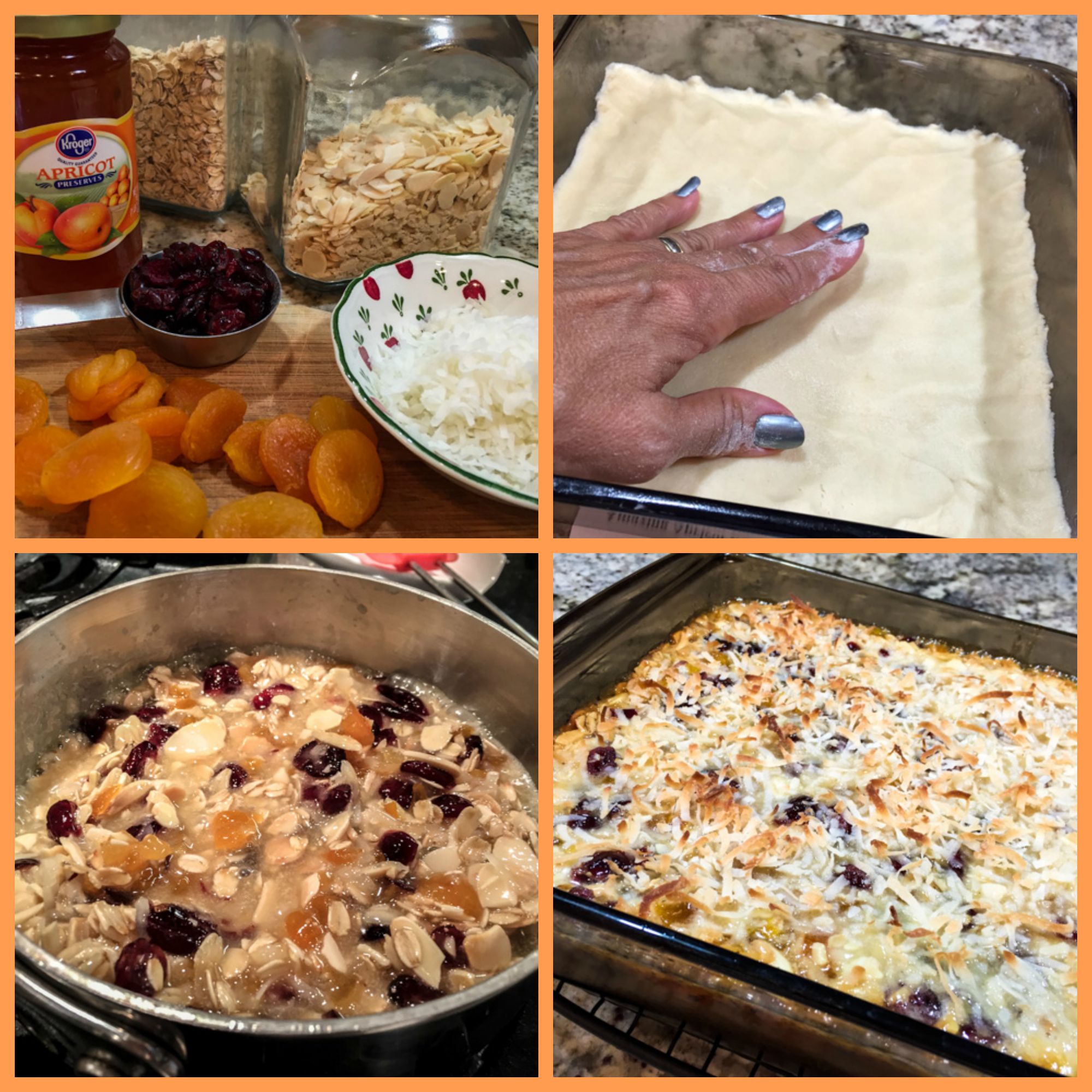
Butter the inside of a glass 8×8-inch square baking pan. Cream together the butter and sugar (thoroughly mix until sugar dissolves). Stir in the vanilla, salt and flour and mix into a dough. Press dough evenly into the bottom of the buttered baking pan, then chill in the refrigerator while you continue.

Mix the dry ingredients for the topping together in a small bowl. In a small saucepan, melt the butter with sugar and honey over low heat. Stir in the dry fruit topping mixture and bring to a boil; boil for 2 minutes then remove from heat. Take out the baking pan, and spread the top of the dough with the simply fruit apricot spread. Top the spread with the cooked fruit mixture.

Sprinkle the topping with an extra 3 tablespoons of sweetened flaked coconut. Bake in a preheated 350F oven for 20 minutes. Allow to cool completely before slicing into squares.

ENJOY!

to print the recipe, click here
ApricotComposite

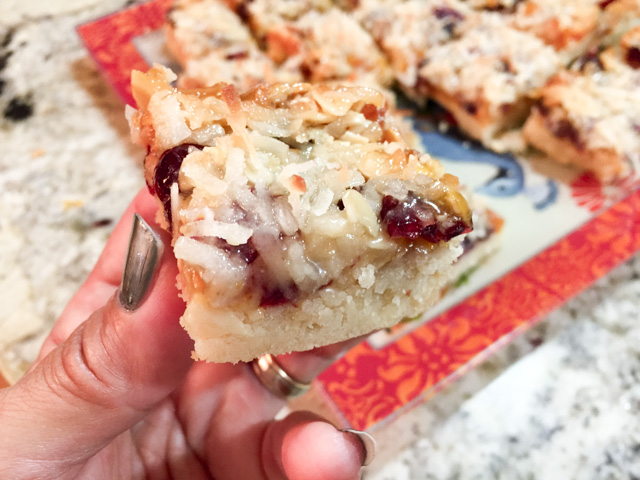
The bars were juicy, sweet, with a slight tang from the cranberries to balance flavors. The crust., which I find the trickiest component of this type of concoction was perfect: not too hard, not too crumbly.  As usual, I brought the whole batch to our department, and by 9:30 am, not a single crumb was left on the platter.  So, I advise that if you intend to share it friends, make sure to grab a square for yourself right away…  They are seriously addictive.
square

Sue, I thoroughly enjoyed stalking your site, I love the way you go the extra mile to explain the technique behind your recipes, so that even a novice cook will be able to make the many tasty things you share on your blog.  I hope you also had fun with your assignment this month. My readers are invited to browse through this month’s collection by poking the cute frog at the end of this post.

Apricot Bars2
ONE YEAR AGO: Spiralizer Fun

TWO YEARS AGO: Linguine with Cauliflower Pesto

THREE YEARS AGO: Carriage House Apple-Walnut Pie

FOUR YEARS AGO: Chicken Marsala

FIVE YEARS AGO:  Home, sweet home

SIX YEARS AGO: Levain Bread with Caramelized Onions

RED WINE SOURDOUGH BREAD WITH CRANBERRIES

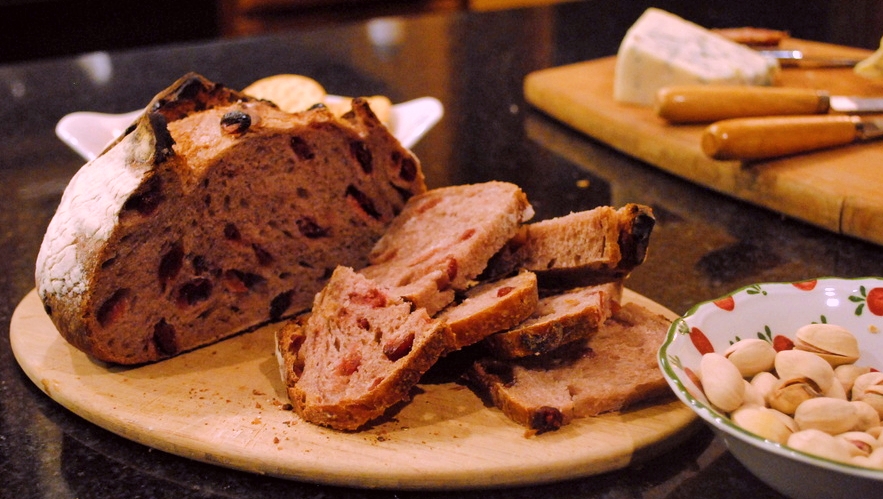
The Fresh Loaf Forum is a virtual paradise for bread bakers, as not only very experienced folks share their best recipes, but you can also get feedback in case problems arise with a recipe.  Last week I stopped by the site and the thread right at the top had the following title: Sourdough Wine Bread. That got my full attention.  I clicked on it, and was blown away by the gorgeous photos, and the unusual color of the bread’s crumb, given by the wine and the dried cranberries.  I revived my starter that same day, and started this bread on a Friday night.  Sometimes you  should not wait to chase a dream.loaf1RED WINE SOURDOUGH BREAD WITH DRIED CRANBERRIES
(adapted from The Fresh Loaf Forum, bread by Yuko)

102 g sourdough starter (at 100% hydration)
288 g  all-purpose flour
80 g water
123 g red wine
6.7 g Salt
80 g dried cranberries

In a bowl, mix flour, wine, and water roughly, cover it with plastic and keep for 12 hours in the fridge (autolyse).

Add sourdough starter and mix by folding dough in the bowl. Add  cranberries and mix by folding dough in the bowl. Add salt and slap & fold for 3 – 4 minutes or until the dough becomes a ball.  Bulk fermentation at room temperature, folding the dough every half and hour until it develops enough strength (I did 4 sets of folds).

Let it rise until the dough starts showing the yeast activity. It takes about 6 hours total depending on the temperature of your kitchen (I used my bread proofing box set at 78 F).  Shape the bread as a boule (or 2 baguettes), place in a banetton or other appropriate container, and let it proof in the fridge for 16 to 18 hours.

Pull it out of the fridge and leave it out for one to three hours (see comments).  Slash the bread and bake in a 450F oven with initial steam for a total of 40 minutes (for a boule), or 20 to 25 minutes for baguettes.

Cool on a rack before slicing.

ENJOY!

to print the recipe, click here

crumb

Comments:  Preparing this bread had me worried up until the point I finally sliced it. Something seemed terribly wrong, as I detected very little fermentation, even though I kept the dough for almost 7 hours at 78 F. The original recipe called for retarding the dough in the fridge and shaping it next day, but my dough seemed so…. slow!  I decided to shape it on the same day, and retard the dough in its final form, ready for the oven.  Ideally, you should remove the bread from the fridge and allow it to almost double in size.  That was not happening, so after a couple of hours I simply had to bake it.

Now, a little tangent.  I usually wake up several times during the night, and tend to think about our experiments while trying to go back to sleep.  Sometimes (unfortunately not that often),  when I wake up again an hour or so later, I have a new idea to solve a problem or at least approach it.  Almost as if during my sleep something goes to work “behind my back”…   😉  That Saturday night, I went to bed thinking about the red wine sourdough and why it seemed so weak.  Exactly at 2am I woke up with one word blinking in my mind: SULFITES!  All wine these days is preserved with sulfites! Maybe some batches have a higher concentration, maybe some of the bacteria or yeast in my starter was particularly sensitive to it.  At any rate, one thing is certain: when you add red wine to make the dough the pH will be lower (higher acidity) so that will affect the efficiency of fermentation.  Add to that the sulfites, and things can get trickier.   Discussing these points in The Fresh Loaf forum, one of the bakers mentioned that when he adds wine to the dough the crumb of his bread gets tighter (indicating lower production of gas). For that reason,  he normally tweaks his recipes to lower the alcohol and increase the water.  Since in this case we are hoping for a nice red tint in the crumb, compromise is in order.  I’d say keep the recipe as it is, and see how your starter behaves with it.  Just for fun, I’ll try to find an organic red wine for my next “experiment”. Organic wines cannot have extra sulfites added,  so the levels of the chemical will be low, ranging from 10 to 20 ppm (parts per million).  Non-organic red wines often reach 125 ppm of sulfites or higher.

Even if the fermentation was not at its peak, this bread was delicious!  I love the slightly sweetness given by the cranberries.  My favorite match for the bread was a Maytag blue cheese, sharp and salty.   Next day, slightly toasted, it seemed even better!

plattercheese

I am submitting this post to Susan’s Yeastspotting

ONE YEAR AGO: Award-Winning Sourdough Baguettes

TWO YEARS AGO: Country Rye (Tartine)

THREE YEARS AGO: Penne a la Vechia Bettola