BUTTERMILK CLUSTER

One of the English expressions that puzzles me the most is “easy as pie.”  That’s because I don’t see anything easy about making the dough,  rolling it out, and mastering the finishing touches that result in a gorgeous pie.  But, I promise  that this bread is  a cinch to make, and much, much easier than pie!  It quickly comes together,  so you can wake up on a sunny Sunday morning and make this bread in time for  brunch.

BUTTERMILK CLUSTER
(adapted from The Fresh Loaf Forum)

Makes 12 to 18 rolls, depending on size

6 to 6 1/2 cups (750 grams) bread  flour
1/2 tablespoon salt
1 envelope (2 1/2 teaspoons)  instant yeast
1 tablespoon warm water
2 cups buttermilk
1 tablespoon honey

Glaze:
1 egg beaten with 1 teaspoon water

Topping:
1-2 tablespoons seeds (poppy, sesame) or grains (cracked wheat, rolled oats)

Combine the flour and salt in a large bowl. Combine the warm water and yeast in a small cup and allow to proof for 5 minutes.

Pour the yeast, buttermilk, and honey into the flour mixture and mix to form a shaggy mass. Let the dough rest for 15 minutes, then do a 10-20 seconds kneading.  Cover the dough with plastic film, and let it rest for 15 minutes. Repeat the minimal kneading two more times, at 30 and 45 minutes, then let the dough rise for another 45 minutes undisturbed or until almost doubled in size (total bulk fermentation will be  about 90 minutes).

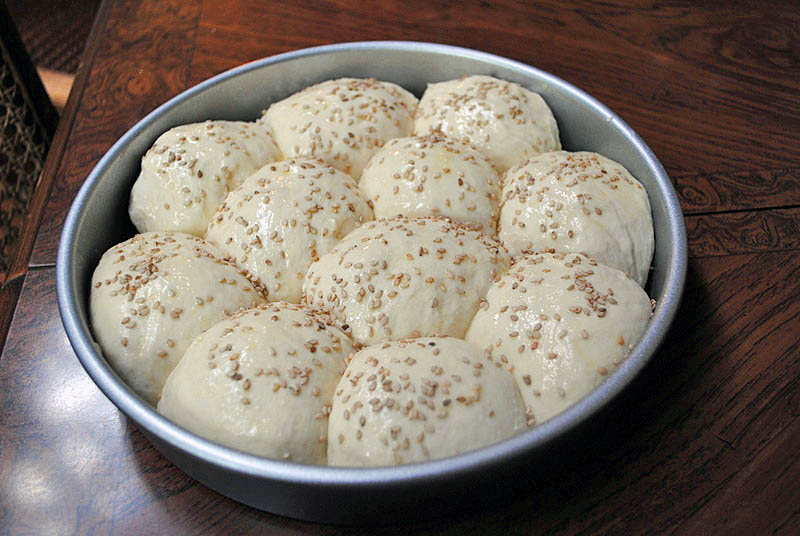
Divide the dough into 12 to 18 pieces. Shape each piece into a neat ball and place in a round dish or spring-form pan close together.

When all of the rolls are in the pan, cover again with plastic and set aside to rise again for 45 minutes to an hour. Meanwhile, preheat the oven to 425.

Uncover the rolls and brush gently with the egg wash. Sprinkle on the grain topping. I used sesame seeds.

Bake for approximately 30 minutes, until the rolls are firm and spring back when tapped.

ENJOY!

to print the recipe, click here

Comments:  I didn’t have a springform pan, and my smaller round cake pan could only fit 11 of the dough balls.   So, I shaped the leftover dough as a small loaf and baked it separately.
            

As I munched on these soft, springy rolls I kept thinking about Thanksgiving dinner :  they are perfect for that occasion, so keep them in mind. Thanksgiving is such a busy cooking day, and this recipe is so easy  that it will be something to give thanks for.  😉

Something strange and unexpected happened to the individual loaf I baked.  I sliced it, then placed on the kitchen counter to wrap in plastic and freeze.  But,  I forgot about it for a couple of hours and when I went to search for it, it was gone!   My beloved husband was not around, and one of the dogs is too short to reach the counter, which left two possibilities:

1. I have a double-personality disorder and the “other me” has no self-control.

2. The “other dog” knows how to get the most of those long skinny legs.

I guess we know which one it was (sigh).

I am sending this to Susan’s Yeastspotting

ONE YEAR AGO:  Grilled Lettuce Salad   (you’ve got to try it!)

Add to FacebookAdd to DiggAdd to Del.icio.usAdd to StumbleuponAdd to RedditAdd to BlinklistAdd to TwitterAdd to TechnoratiAdd to Yahoo BuzzAdd to Newsvine

SLOW-BAKED SALMON

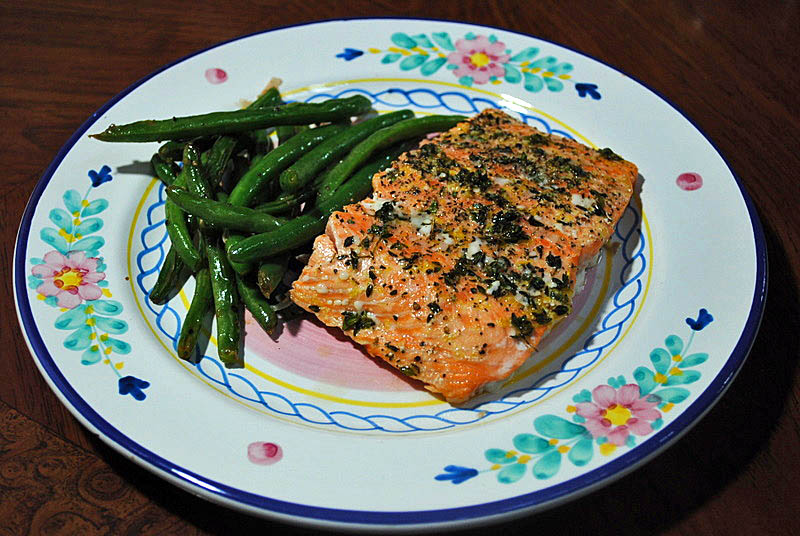
Let’s suppose that you find the flavor of salmon a bit strong, as I used to feel about anchovies and related items of a fishy persuasion. This recipe might just change your mind and begin a new gastronomic love affair.  With salmon, slow-baking until the meat is barely cooked gives the fish an almost mousse-like consistency, and flavor as mild as “salmon-ly” possible.   Plus, the lemon zest and thyme seasoning add a delicious counterpoint!   From the latest issue of Bon Appetit, this one goes into my favorites folder.

SLOW-BAKED SALMON WITH LEMON AND THYME
(adapted from Bon Appetit, May 2011)

1 + 1/2 Tbs olive oil, divided
4 salmon filets or 1 large piece, skin on
2 Tbs fresh thyme leaves, chopped
zest of 1 large lemon + juice
salt and pepper

Heat the oven to 275 F.  Line a baking dish with aluminum foil, coat it lightly with 1/2 Tbs of olive oil, and place the salmon filet over it, skin side down.

In a small bowl, mix the remaining tablespoon of olive oil with the thyme and lemon zest.  Rub this mixture all over the salmon, season with salt and pepper and squeeze a little lemon juice over it.   Let it rest for 10-15 minutes, then place it in the oven for 18-20 minutes, until the fish is just cooked.

Serve with lemon  wedges, and…

ENJOY!

to print the recipe, click here

Comments:  We eat salmon on a weekly basis, but almost always grilled.  Phil, the expert,  makes it exactly the way I love, with the center still moist, never over-cooked.  The high heat of the grill, however, doesn’t mellow the salmon character at all, quite the contrary. We both love it, but it’s nice to have a change of pace.

This method can be adapted to all sorts of seasonings. In fact, when we move back home next month I’ll grab my Jacques Pepin‘s  “Fast Food My Way“, and re-visit one of my favorite recipes in that book, a salmon filet cooked at an even lower temperature, for about 40 minutes.   If I remember correctly, he coats the filet with breadcrumbs and ground hazelnuts.  It is outstanding, like so many of Pepin’s recipes.

Stay tuned!  😉

ONE YEAR AGO: Farfalle, Farfalle

This slideshow requires JavaScript.

Add to FacebookAdd to DiggAdd to Del.icio.usAdd to StumbleuponAdd to RedditAdd to BlinklistAdd to TwitterAdd to TechnoratiAdd to Yahoo BuzzAdd to Newsvine

FOR THE LOVE OF L.A.

Click here

ENJOY THE RIDE!

😉

Add to FacebookAdd to DiggAdd to Del.icio.usAdd to StumbleuponAdd to RedditAdd to BlinklistAdd to TwitterAdd to TechnoratiAdd to Yahoo BuzzAdd to Newsvine

ANCHOVIES, THE FINAL FRONTIER

This is my 300th post!

While growing up I was a picky eater.  The list of things I avoided was huge, including most vegetables (except for tomatoes and potatoes) and all kinds of seafood.   Invitations for dinner at a friend’s home made me worry for days, thinking about what to do if they served such or such an item. When my friends suggested a night out for sushi, I made sure that the restaurant had other choices (and I don’t mean miso soup or tempura!  ;-)).  But, in my twenties the food aversions started to bother me.    Even though I had trouble admitting it, I wanted to be a person who could appreciate any type of food that a host served me, and stop worrying about my humongous list of neurotic restrictions.

Slowly but surely I experimented  with things I disliked: a small bite here, a taste there, and to my surprise, I found that the worst part of the experience was not the food itself, but its anticipation, … the fear of it.  When I was 30 I’d overcome almost all my food aversions, and each one felt like a small victory. Nevertheless, one item stubbornly refused to capitulate: anchovies.  I recently set on a mission to change that.  Following  Jeffrey Steingarten in his great book “The Man Who Ate Everything,”   I’ll slowly  introduce anchovies in my cooking.  This recipe is my first step on the path to  enjoying them.

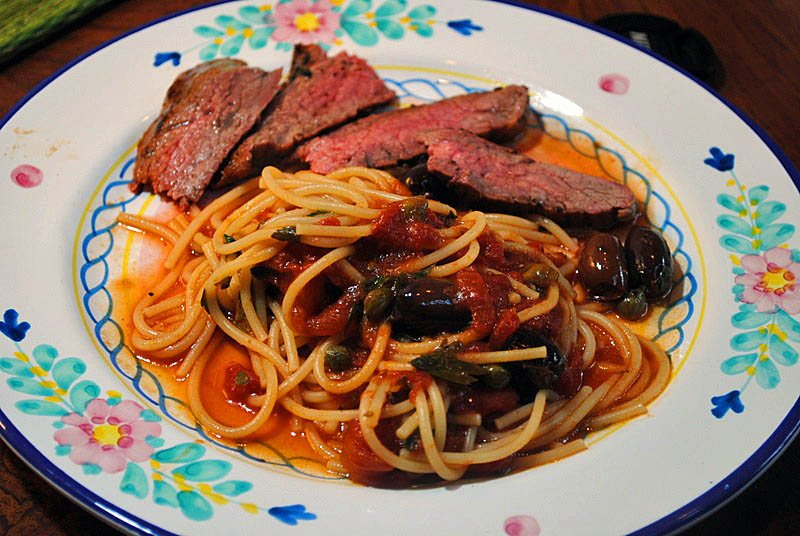
PASTA PUTTANESCA
(adapted from Fine Cooking, October 2010)

salt
3 Tbs. extra-virgin olive oil
2  cloves garlic, minced
2-3 oil-packed anchovy fillets, finely chopped
1/4 tsp. red pepper flakes
One 28-oz. can crushed tomatoes
1 lb. dried spaghetti
1/2 cup pitted brine-cured black olives, such as Kalamata, coarsely chopped
2 Tbs. nonpareil capers, rinsed and drained
1 Tbs. chopped fresh oregano or marjoram
Freshly ground black pepper

Bring a large pot of well-salted water to a boil.

Meanwhile, heat 1 Tbs. of the olive oil with the garlic in a saucepan over medium heat. Cook, stirring frequently, until the garlic is fragrant, but not too dark, about 2 minutes.  Add the anchovies and red pepper flakes and cook for a couple more minutes. Add the tomatoes,  increase the heat to medium high, bring to a boil, and then simmer gently for 10 minutes.

After adding the tomatoes to the pan, add the pasta to the boiling water and cook according to the package directions until al dente.

When the tomato sauce is ready, add the olives, capers, and oregano and stir. Simmer until just heated through, about 2 minutes. Stir in the remaining 2 Tbs. olive oil and season the sauce to taste with salt and pepper.

When the pasta is ready, reserve 1/2 cup of the cooking water and drain well. Return the pasta to the pot, set it over medium-low heat, pour in the sauce, and toss, adding cooking water as needed for the sauce to coat the pasta. Serve immediately.

ENJOY!

to print the recipe, click here

Comments:  Pasta puttanesca was a perfect option for anchovies, because it has so many other flavors in the sauce: capers, black olives and herbs.  I felt a little uneasy opening the can of oil-packed anchovies, took a careful sniff and tried to concentrate on “umami” instead of “impossibly fishy.”  I had no idea that they would splatter so much in the pan, loudly announcing their presence  and making  a mess on the stove.  Next time I’ll be better prepared!

The verdict?  I detected a hint of the salty, smoky flavor of the anchovies, but nothing offensive.  This time I only used two filets, just to be safe, but the next time I’ll  add three.   Some day I want a slice of pizza with one of those small fish laying defiantly on top, but it may take more time!

Puttanesca is a hearty dish that will stand on its own as a meal, but because I wasn’t sure about it, I also prepared plan B: grilled flank steak.   It was really a tasty match!

ONE YEAR AGO:  Hoisin Explosion

Add to FacebookAdd to DiggAdd to Del.icio.usAdd to StumbleuponAdd to RedditAdd to BlinklistAdd to TwitterAdd to TechnoratiAdd to Yahoo BuzzAdd to Newsvine

COUSCOUS SALAD WITH ZUCCHINI AND PINE NUTS

From one of the latest issues of Food and Wine magazine, this recipe was the only bright spot on a day in which everything that could go wrong (in the lab) went wrong.  But, as we were driving through intense Los Angeles traffic that Thursday, I knew that getting home and making dinner would improve my mood.  It always does, actually.  Especially if I already have it all planned and laid out in my mind, which was the case that day.

COUSCOUS SALAD WITH ZUCCHINI AND PINE NUTS
(adapted from Food and Wine, May 2011)

1 cup diced zucchini
2 Tbs olive oil
salt and pepper

1 cup couscous
1 cup boiling water

3/4 cup frozen peas
1/2 cup water
2 Tbs lemon juice
2 Tbs olive oil
1/2 cup pine nuts, lightly toasted
fresh mint and parsley, minced
salt and pepper to taste

Heat the olive oil in a non-stick skillet and sautee the zucchini until golden.  Season lightly with salt and pepper. You can prepare it in advance and keep it in the fridge.

Pour 1 cup of boiling water over the couscous in the bowl you intend to serve the salad. Cover with plastic wrap and let it sit at room temperature for 5-10 minutes as you prepare the rest of the recipe.

Boil the peas for 2 minutes, drain, reserving 1/4 cup of the water.  Add the lemon juice and olive oil, a little salt, to the reserved pea water, and whisk well.  Fluff the couscous with a fork, pour this dressing over it, mixing it well.  Gently mix in the cooked peas, reserved zucchini, toasted pine nuts, and fresh herbs.  Taste, adjust seasoning with salt and pepper, and serve.

ENJOY!

to print the recipe, click here

Comments:  Next time, I will dice the zucchini in slightly larger pieces, because I’d like their presence in the salad to be a little more obvious, not only visually, but also in texture.   I love the popcorn-y taste of pine nuts, but you can use almonds (as in the original Food and Wine version), or walnuts.  Make sure to toast them first.

It is crucial to let the zucchini get some color, so I like to leave it undisturbed in the sautee pan for a couple of minutes, before moving the pieces around.

This could be a nice vegetarian entree, as couscous is very filling, but we enjoyed it next to a juicy, grilled chicken breast.    And that was a perfect antidote for  the “lab-blues.”  😉

ONE YEAR AGO:  A Simple Salad a la Jacques Pepin

Add to FacebookAdd to DiggAdd to Del.icio.usAdd to StumbleuponAdd to RedditAdd to BlinklistAdd to TwitterAdd to TechnoratiAdd to Yahoo BuzzAdd to Newsvine