BEETROOT SOURDOUGH FOR THE HOLIDAYS

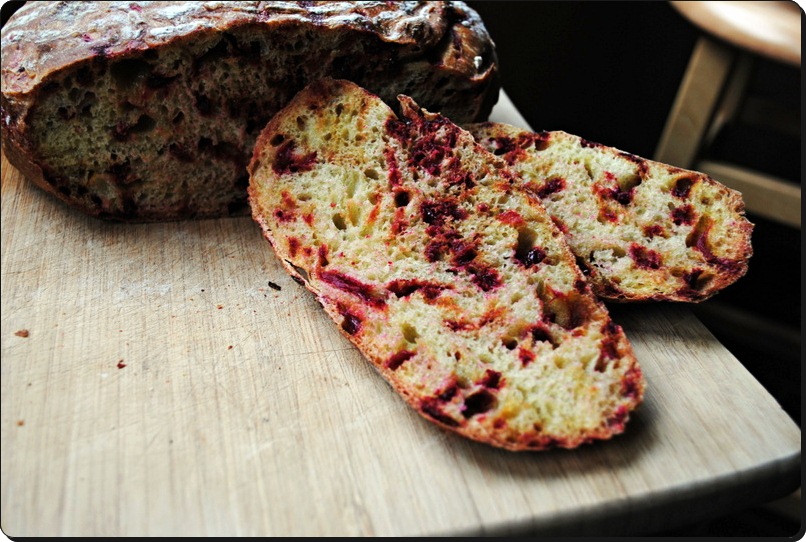
This gem of a recipe comes from one of my favorite bread books, which I reviewed in a not too distant past: How to Make Bread. Such a simple and straightforward title, but it says all that matters.  You will learn how to make great bread following the careful instructions of Emmanuel Hadjiandreou.    This bread is perfect for the holiday season, its crumb decorated with intensely red dots of beets, that are coarsely grated and incorporated raw in the dough.

You may wonder if the bread turns out too sweet or with a strong flavor of beets?  Not really. It is a sourdough still, but with a background of sweetness that is just enough to surprise your palate and act as the perfect supporting actor for a slice of Roquefort cheese.  Sharp cheeses,  eggplant relishes, anything with a nice bite and some saltiness will go extremely well with this bread.  I happen to like it all by itself, slightly toasted.
For this large boule I used two beets, one medium, one small.  One of the things I loved about this dough was the change in color as the dough proofed, starting with a gorgeous, intense purple, and getting more and more subtle as the fermentation went on.
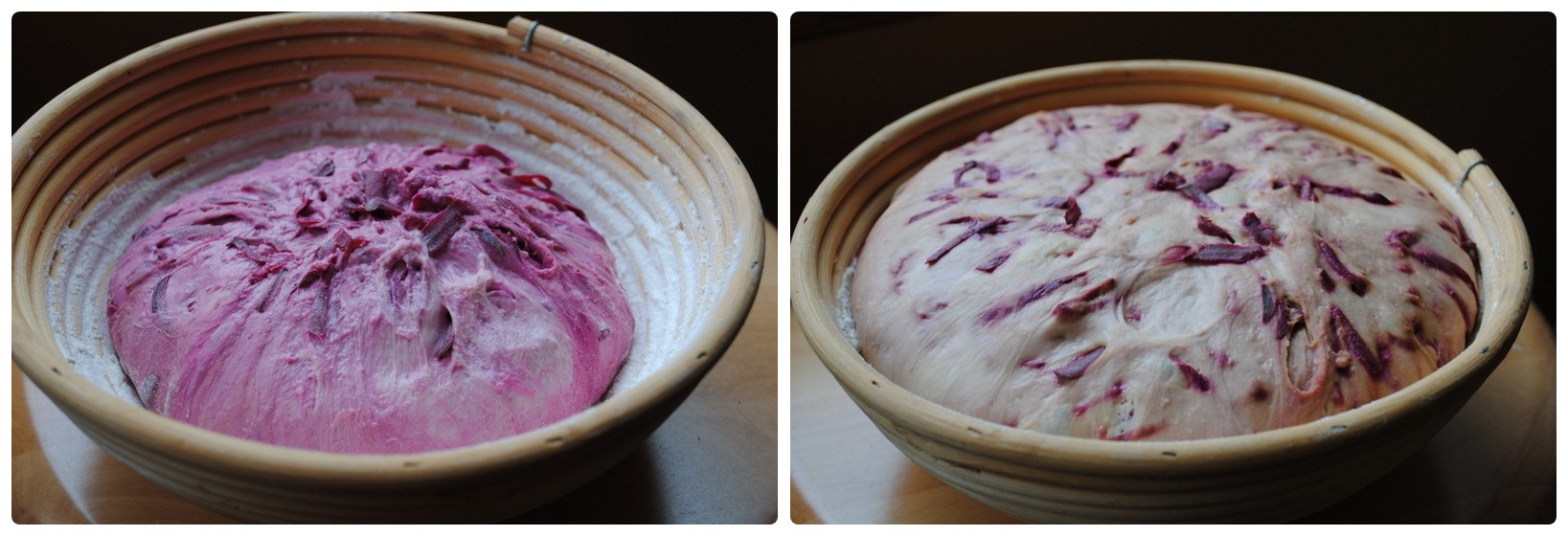
The recipe for beetroot sourdough is very similar to the one I published with Emmanuel’s permission last May, except for the inclusion of grated, raw beets in the dough.  But a more detailed step by step photos of the full process of making this bread can be found with a quick jump to Garlic Buddha blog, a nice virtual spot!

I like a plain and simple sourdough, but every once in a while it is nice to explore different flavors and stretch the horizons a little.  Beets… who would imagine? 😉

I am submitting this post to Susan’s Yeastspotting

ONE YEAR AGO: Cod Filet with Mustard Tarragon Crust

TWO YEARS AGO: Soba Noodles: Light and Healthy

THREE YEARS AGO: Potato-Rosemary Bread

HAPPY THANKSGIVING!

Growing up, I knew nothing about Thanksgiving.   I had no idea one day I would be living here and calling the US my new home.  Of all American holidays, Thanksgiving is my favorite.  It is a time to just be together with family and friends, being grateful for the good things we have.  On that note, I wish Black Fridays did not exist. Or that they could be placed somewhere far apart in time from this special holiday.   Still, what matters the most is that we all have things to be grateful for, and I hope your day will focus on that.

For our first Thanksgiving in the Little Apple, we will have a joint party, two labs together, celebrating with all the graduate students who stayed here working hard during the break from classes.  It will be a fun evening, I am sure!  Phil will be in charge of the turkey, and I’ll be his sous chef.   All I have to do is mashed potatoes… I got the easy job this  year.

And here is a shot taken a couple of days ago in our street.  One would imagine that with Thanksgiving right at the corner, those guys would be a little more careful!  😉

HAPPY THANKSGIVING!

500 POSTS AND THE BEST THING I EVER MADE

Yes, folks, this is my post number 500! Five hundred times that I’ve hit the PUBLISH key, and sent my words and images into the blogosphere! I wanted this post to be special, but at the same time I had to go with life’s flow, which lately has not allowed me to indulge into fancy cooking. But one cannot go wrong with a recipe described as “The best thing I ever made”.  If you are familiar with the FoodTV, you may know they have a show with that exact title, and it’s actually pretty interesting: chefs describe their favorite recipe in a particular category. This was Alton Brown’s best take on chicken. Chicken thighs are de-boned, and roasted with an olive stuffing under the skin, and a smoked paprika rub. They cook over thin slices of Yukon gold potatoes. I could have those potatoes on a daily basis. For breakfast. For lunch. For dinner. For a late night snack. Oh, yes, the chicken was awesome too! 😉

SMOKED PAPRIKA CHICKEN THIGHS WITH POTATO AND ONION
(from Alton Brown’s Best Thing I ever Made)

6 ounces pimento stuffed green olives, chopped
2 teaspoons lemon zest
2 cloves garlic, grated
3 tablespoons smoked paprika
1 tablespoon olive oil
1 + 1/2 teaspoons kosher salt
1/4 teaspoon black pepper, freshly ground
8 bone-in, skin-on chicken thighs
2 pounds Yukon gold potatoes, unpeeled
1 medium yellow onion, cut in small pieces

Heat oven to 375 degrees F.

Combine the olives, lemon zest and garlic in a small bowl, and set aside. Mix the smoked paprika, olive oil, 3/4 teaspoon of the salt and pepper into a paste in a large bowl.

De-bone the chicken thighs using a pair of kitchen shears:  make a cut down the length of the bone to expose it, then cut the meat away from the bone. Discard the bone. Add the boned chicken thighs to the paste and massage well to coat. Let it sit for half an hour or so.

Thinly slice the potatoes on a mandoline, about 1/4-inch thick. Arrange the potato slices and onion pieces in an even layer on a foil-lined half sheet pan and sprinkle with the remaining 3/4 teaspoon salt.

Stuff about 2 tablespoons of the olive mixture under the skin of each chicken thigh. Arrange the chicken thighs, skin-side up, on a cooling rack and set the rack over the potatoes and onion in the half sheet pan. Bake until the skin is crispy and the potatoes are tender, 55 to 60 minutes. If you prefer the potatoes crispy, remove the rack with the chicken and return to the oven for an additional 5 to 10 minutes.

ENJOY!

to print the recipe, click here


Comments:  The only tricky part of this recipe was de-boning the chicken thighs,  but it’s not that hard.  I normally cook chicken thighs on the bone, but there’s something special about cutting through those pieces of meat, all juicy with the stuffing, without having to work around the bone.  It is a technique that could be applied to other types of stuffing.  The liquid that drips during roasting infuses the potatoes with incredibly rich flavor.

In typical Sally fashion,  onion and garlic were omitted, but I gave you the recipe the exact way Alton made it in the show.  I never thought very highly about pimento-stuffed olives, but they are simply perfect in this dish.  Alton Brown had a moment of inspiration when he conceived this recipe, everything works together extremely well.   Since it’s a reasonably heavy dish,  you won’t need anything else to round the meal.

Five hundred posts published and no special celebration?  Well, stay tuned, my friends.  A special milestone is waiting around the corner, and for that one I’ll have a little giveaway to my readers! 😉

ONE YEAR AGO: Back in Los Angeles

TWO YEARS AGO: White House Macaroni and Cheese

THREE YEARS AGO: Korean-Style Pork with Asian Slaw

THE MANY FACES OF KALE

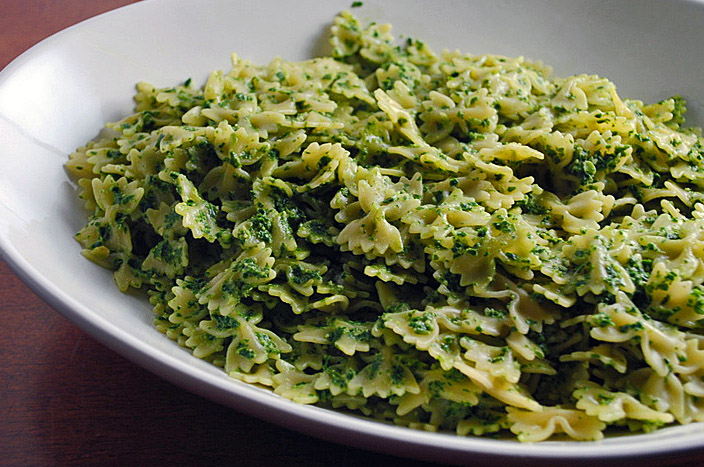
The other day I bought a huge, and I mean HUGE bunch of kale with the firm idea of making a frittata with it. As the afternoon moved along, I changed my mind on our menu, and the kale transmogrified into a light gratin.   But I also  toyed with the idea of simple kale chips (which I love), only to drop that and settle on a salad.  Maybe settle is not quite right.  By the time I jumped on dinner preparation, the kale ended up as pesto. Flip-flopper? Who, me?  😉

FARFALLE WITH KALE PESTO
(from the Bewitching Kitchen)

1 big bunch of kale, stems removed, leaves coarsely chopped
1/4 cup of walnuts, toasted
pinch of red pepper flakes
olive oil
squeeze of lemon juice
salt and pepper
1/4 to 1/3 cup yogurt

Bring a large pot of lightly salted water to boil.  Drop the kale leaves and blanch them for a couple of minutes.  Immediately drain, and rinse briefly in cold water. Drain well, then place in a salad spinner to dry the leaves as much as possible.

Add the toasted walnuts and red pepper flakes to the bowl of a food processor, and process for a few seconds.  Add the blanched kale and process together with the nuts until a paste forms.  Season with salt and pepper.  Squeeze lemon juice all over. Close the processor, and add the olive oil as a stream.  Once the oil is incorporated, stop to scrape the sides of the bowl, add yogurt and process until everything is smooth.   Taste, adjust seasoning, and reserve.

Meanwhile, cook farfalle pasta until al dente, reserving some of the pasta cooking water.  When the pasta is cooked, mix with the pesto, and add the reserved cooking water to thin the sauce, if necessary.   Serve with plenty of parmigiano-reggiano cheese grated on top.

ENJOY!

to print the recipe, click here

Comments:  I’ve seen recipes for kale pesto in which the raw leaves are processed with the usual suspects (garlic and olive oil).  I decided it would be too harsh for our taste, so  I took the extra step of blanching the leaves.  If you are a garlic lover, add a couple of cloves together with the walnuts.   I loved this version of pesto,  and even used some as a spread for a ham sandwich at lunch next day.   All amounts are a bit eye-balled,  if you like the flavor of olive oil to be more pronounced, use more and omit or reduce the yogurt.   Don’t leave the lemon juice out, though – it adds that citric brightness that is a must in this recipe.

For additional kale inspirations, a small sample of recipes from the internet:  

Kale Gratin … A nice recipe from Taste Food,  she used spinach, but I think kale would be great too

Kale Salad with Butternut Squash… from Eats Well with Others

Kale Frittata... from My Kitchen in the Rockies

Golden Chard Pie… from the early days of my blog

Kale Chips… from not so early days of my blog

and for an interesting twist on this great veggie, take a look at these cute Quinoa and Kale Patties

ONE YEAR AGO:  Short and Sweet

TWO YEARS AGO: Ciabatta, a Classic Italian Bread

THREE YEARS AGO: Magical Lamb Stew

YOU ARE ALL INVITED!

Cookies and coffee will be available at 3:45pm…

THE PUZZLES OF FERRIC ENTEROBACTIN TRANSPORT THROUGH FepA

When Gram-negative bacteria acquire iron, the metal crosses both the outer membrane (OM) and the inner membrane (IM). But, existing radioisotopic uptake assays only measure iron passage into the cell as the accumulation of the radionuclide in the cytoplasm. We devised a novel methodology that exclusively observes the OM transport reaction of ferric enterobactin (FeEnt) by Escherichia coli FepA. This technique, called postuptake binding, revealed previously unknown aspects of TonB-dependent ferric siderophore transport reactions. The experiments showed, for the first time, that despite the discrepancy in cell envelope concentrations of FepA and TonB (approximately 35:1), all FepA proteins were active and equivalent in FeEnt uptake, with a maximum turnover number of approximately 5/min.   The accumulation of FeEnt in the periplasm required the binding protein and inner membrane permease components of its overall transport system; postuptake binding assays on strains devoid of FepB, FepD, or FepG did not show uptake of FeEnt through the OM. However, fluorescence labeling data implied that FepA was active in the fepB-minus strain, suggesting that FeEnt entered the periplasm but then leaked out. Further experiments confirmed this futile cycle; cells without FepB transported FeEnt across the OM, but it immediately escaped through TolC.  These ferric siderophore acquisition systems are crucial to the pathogenesis of Gram-negative bacteria, and our results show that cathecolate siderophores, which are transported by OM receptors such as FepA, CirA, FecA and Fiu, play a defining role in colonization of the gut by E.coli.

Anyone who falls asleep will hurt my feelings!   😉