Third post of a series of three on Sugar Cookie Decorating
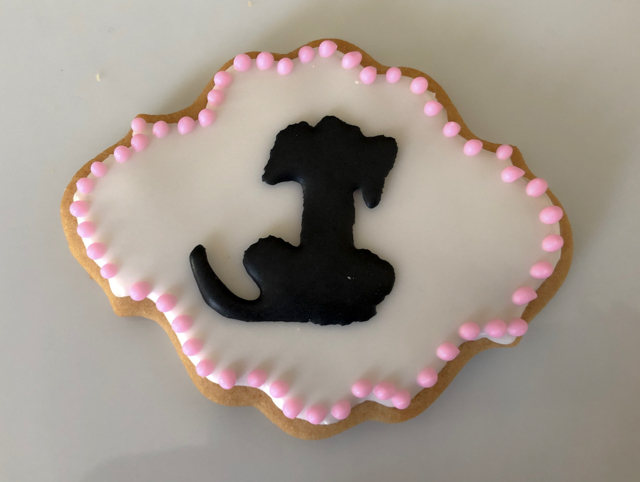
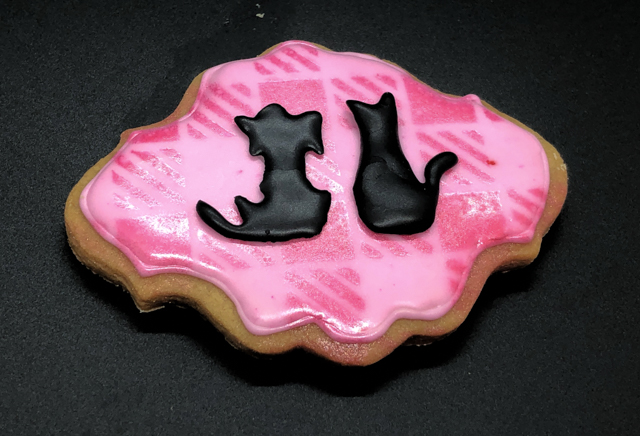
In this post, I won’t share a recipe, as I will be using the exact same one posted yesterday. I made another set of silhouettes because the pups were beyond upset by my use of felines as cookie decoration.
Please do not laugh of my pink dotted border. That is the one technique Tanya demonstrated and I simply could not succeed. She does the beaded border pulling the piping tip and dragging a bit alternating the direction, it looks soooo adorable. I’ve tried in two cookies, and they ended in my belly because I was forced to eat the evidence. So I just went with little dots and even that has plenty of room for improvement.
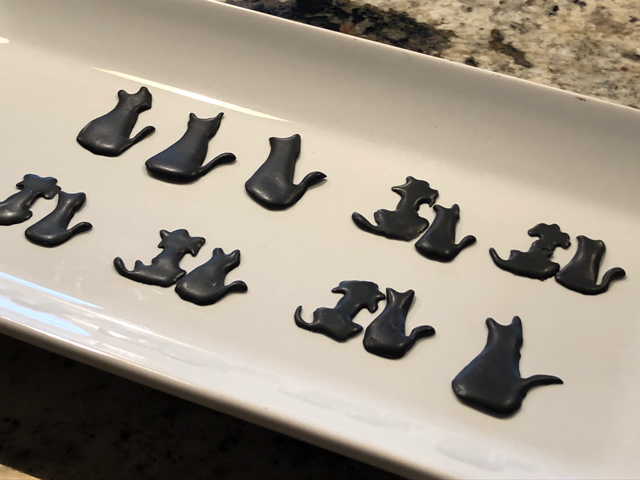
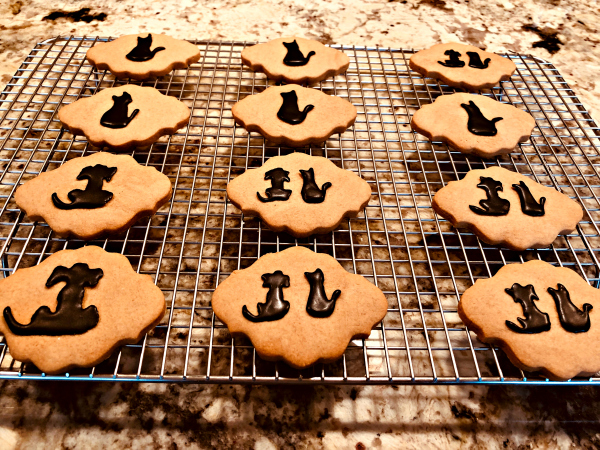
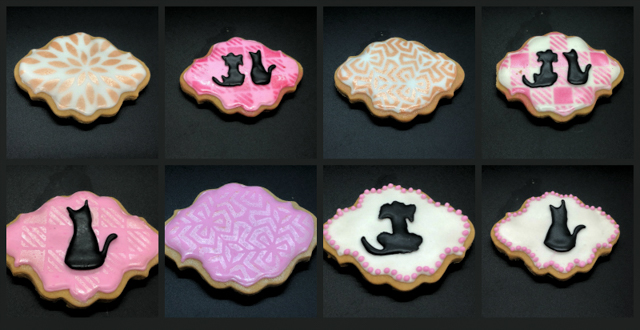
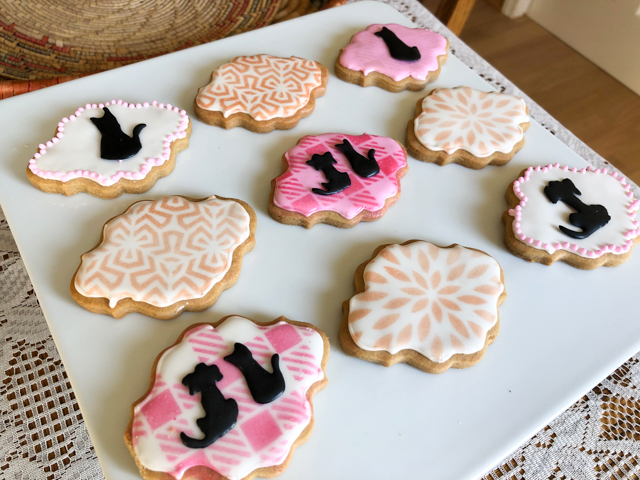
I made dogs and cats of two sizes, to either stand alone in a cookie or side by side as best friends. At least in the cookie world, such relationship is possible.
The planning stage…
In this batch of cookies, I brought my air-brush into play. So I started from the flooding technique, and allowed that to fully dry for 24 hours. Once the surface is truly solid, you can lay a stencil on top and air-brush any color and/or pattern you fancy.
After that, simply glue the silhouette, if using, or any other piping with Royal icing you feel like adding.
If you are new to air-brushing, I highly recommend this one. It has a cup that is bigger than other brands, and can also be used for cocoa butter for spraying bonbon molds (I intend to try that in the near future).
You will also need air-brush dyes, and my favorite brand is Cookie Countess. The most useful colors are the pearl types, white, gold, silver or my favorite: Rose’ Gold (which I used in the cookies without silhouettes in the group picture above).
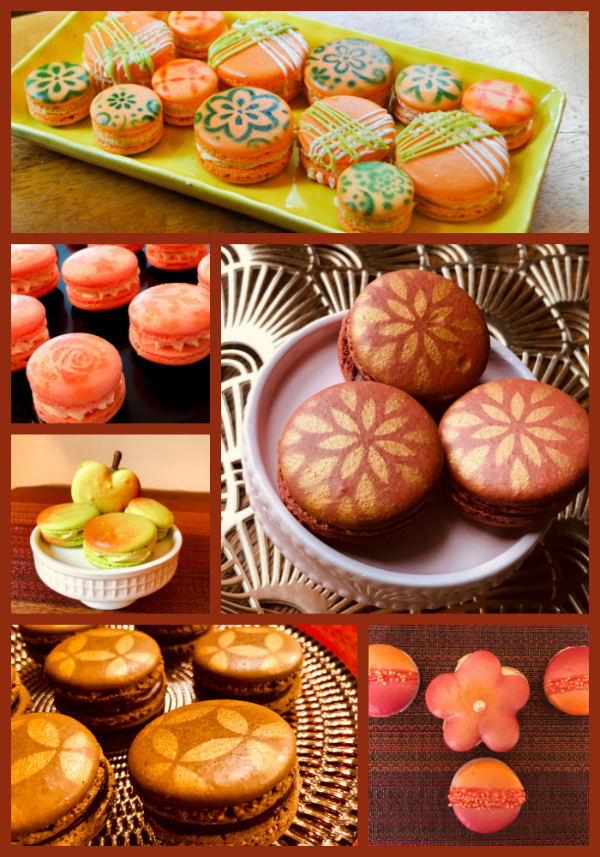
Below a little sampling of bakes from old posts and a few not yet blogged about, all decorated with air-brushing, some with stencils, some without. Speaking of stencils, etsy.com is a great source to get them.
It is really a very nice tool to play with, so if you are over the fence about getting one, consider this post a little encouragement…
I hope you enjoyed this little Trilogy of Sugar Cookies. Sugar Cookies and macarons are almost always part of my weekly bakes for Common Table meals, so I am constantly trying to find new ways to decorate them and new flavors to explore. Stay tuned for more in the near future…
Second post of a series of three on Sugar Cookie Decorating
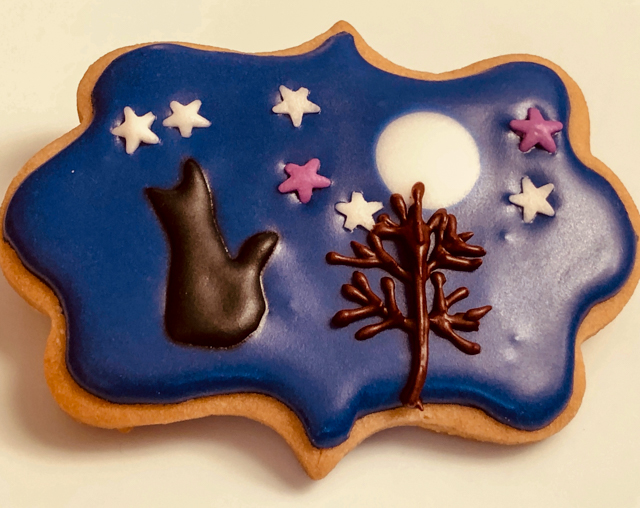
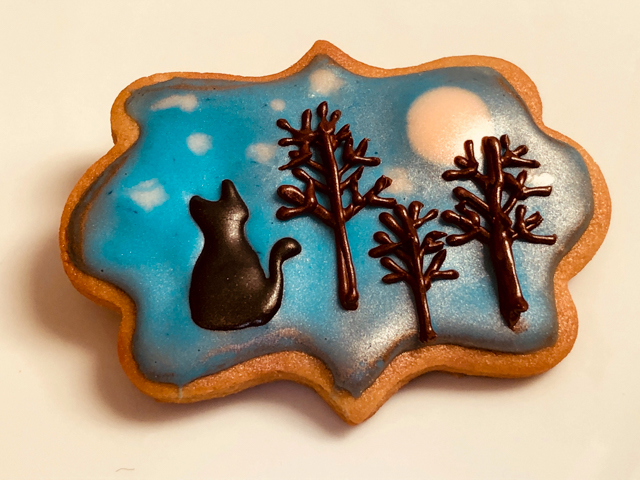
For one of her bake-along tutorials, Tanya showed how to make little silhouette details using Royal icing. They can be made way in advance (pretty much last forever) and saved to add to your cookies previously flooded and fully dry. The possibilites are endless, as you can imagine. And the great thing for us who cannot draw to save their lives, is that you can find clipart to download and print for free, adjust them to the size you want and use them to pipe your little decor. She demonstrated with a gorgeous deer’s head, I went first with a cat. She also demonstrated how to make a winter scene with a full moon and trees, so I joined both techniques in a single cookie.
BROWN SUGAR AND SPICES SUGAR COOKIES (adapted from Bake at 350)
Whisk the flour, baking powder and spices, set aside.
Cream the sugars and butter. Add the egg and salt and mix until well-blended. Gradually add the flour mixture and beat just until combined. Roll on a floured surface to about 1/4″ and cut into shapes. Place on parchment lined baking sheets and freeze for 10 minutes.
Bake for 10-12 minutes, depending on the size of your cutter. Let sit a few minutes on the sheet, then transfer to a cooling rack.
Use Royal icing to decorate, recipe in previous post.
ENJOY!
Comments: There are countless sites that offer free downloadable templates for all sorts of drawings. You can then print them side by side and place a sheet of parchment paper on top of the printout. Using Royal icing with the consistency Tanya demonstrates in her tutorial and a very fine piping tip, carefully outline the drawing. Make more than you need, because they are obviously very fragile. They are best if allowed to dry overnight.
For the stars, in some cookies I used sprinkles… and in others I followed the technique demonstrated by Tanya, pulling small white dots with a needle.
That surface is allowed to dry overnight, and then the silhouette is glued, and the trees piped. In the cookie above, I used some silver air-brushing just for fun.
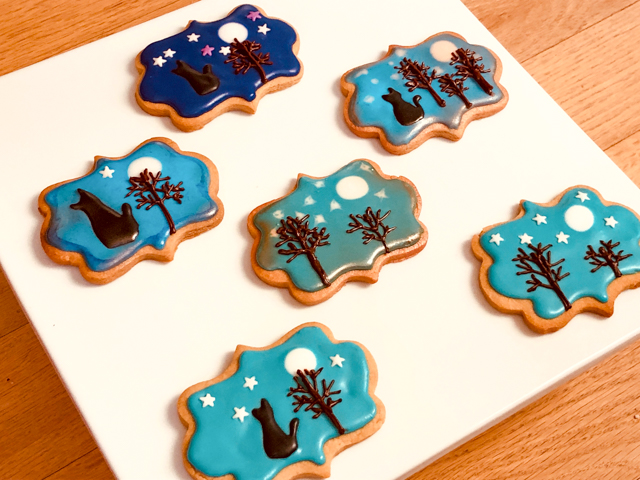
Here they are, all my babies! Before watching Tanya’s tutorials, I would never dream of making cookies with so many little details.
I will be back tomorrow with the final post about sugar cookies, using the same recipe (Brown Sugar and Spices). and a slightly different way to decorate them.
First post of a series of three on Sugar Cookie Decorating
One of the greatest benefits of being part of The Great American Baking Show was getting to know 11 baking addicts with no interest in treating their condition. A year later, we still exchange constant messages that often go beyond what is cooking in our ovens. Each of us has areas in baking we feel reasonably confident about, and areas we feel the need to improve. Tanya is amazing at gingerbread sculptures (insert a discreet tear here), and cookie decorating in general. Recently she made a series of video tutorials and by watching them and working with her favorite Royal icing recipe, I believe I improved my skills a bit. I still have issues with some techniques – those tricky beaded borders come to mind – but I will keep practicing. This is the time of the year that screams for sugar cookies and fun decorations, so visit Tanya’s site and join the spirit!
226 grams unsalted butter, at room temperature 160 grams granulated sugar 1 large egg, at room temperature 1 Tablespoon vanilla extract 2 Tablespoons milk, any kind 375 grams all-purpose flour 42 grams (2 packets) Apple Cider Mix 3/4 teaspoon baking powder 1/2 teaspoon salt
In the bowl of a stand mixer, beat the butter and sugar on medium speed until smooth and creamy. Beat in the egg, vanilla, and milk until well blended.
Combine the flour, apple cider mix powder, baking powder, and salt in a medium bowl. Gradually add to the butter mixture on low speed until combined. Divide the dough in half and wrap in plastic wrap. Chill for 1 hour or for up to 3 days. The dough freezes well also.
Heat the oven to 350F. Roll one piece of dough at a time between two pieces of parchment paper (I did 4mm thickness). Cut dough with floured cookie cutters. Place 1-inch apart on silpat or parchment-lined baking sheets. Freeze for 10 minutes.
Bake until edges begin to brown, 10 to 12 minutes. Cool 2 minutes. Remove to wire rack to cool completely.
ROYAL ICING (from Global Bakes by Tanya)
900 grams (2 pounds) powdered sugar 156 grams pasteurized egg whites 1/4 teaspoon cream of tartar 1 Tablespoon light corn syrup Gel colors of your choice
In the bowl of a stand mixer, add the powdered sugar and cream of tartar and whisk together to combine. Add the egg whites and corn syrup and stir gently with a rubber spatula until the powdered sugar is moistened.
Put the bowl on the stand mixer and, using the paddle attachment, whisk for 1 to 2 minutes until smooth and bright white in color. At this point, you can use the icing to assemble a gingerbread house. To outline shapes for flooding, put about 1 cup of the royal icing in a small bowl and add about ½ teaspoon water. Add another ½ teaspoon if needed to allow smooth piping. Stir until smooth.
To flood cookies inside the dried outline, put about 1 cup of the royal icing in a small bowl and add about 1 teaspoon of water. Add another ½ teaspoon water to allow smooth spreading. Stir until smooth and combined.
Add gel colors as needed for your planned decorations.
Comments: This was the first time I managed to work with different consistencies of Royal icing and get them to behave the way I hoped. Tanya shares quite a few tips to judge the consistency and adjust it, so I highly recommend you to watch her videos, particularly the ones that she made for a Bake Along session last month.
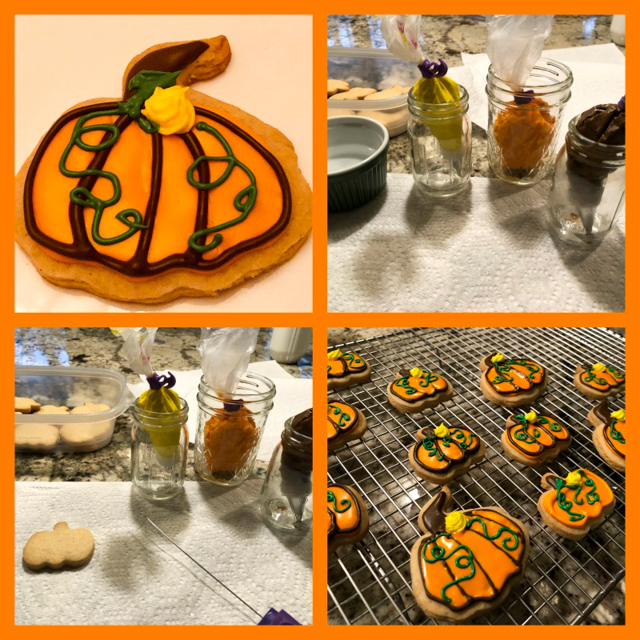
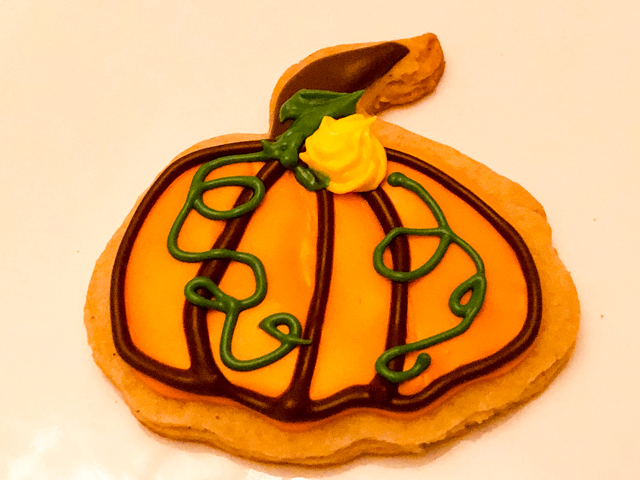
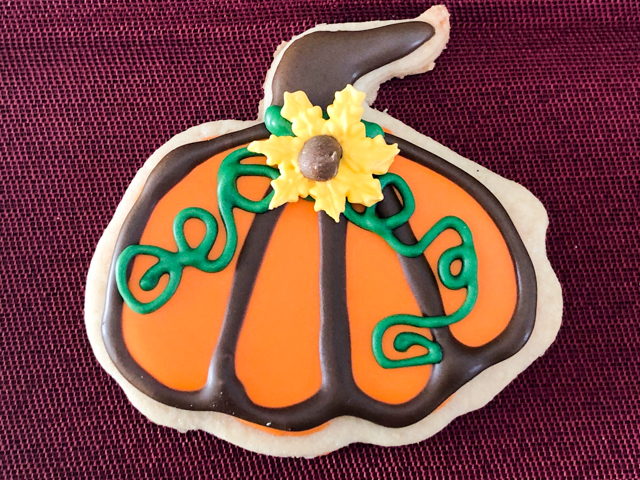
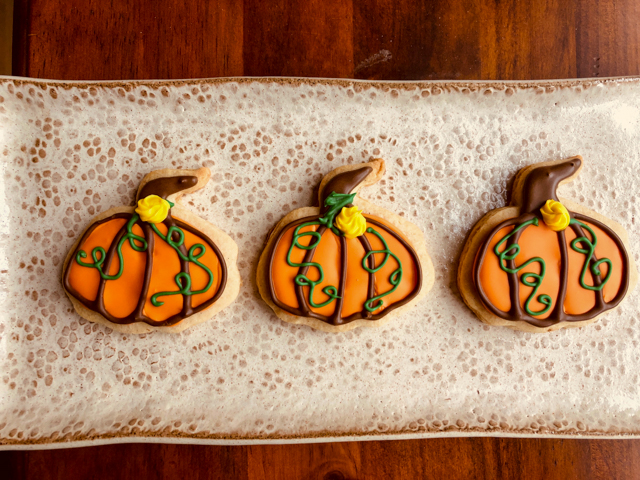
For this pumpkin, the yellow had a stiff consistency so that a rosette piped with a little open star tip would retain the ridges well. The green and brown were just a tad softer, and the orange more fluid (what is usually described as flooding consistency). The segments of the pumpkin are flooded independently so that they don’t join together. So for the example above, there are 4 sections, and just like Tanya demonstrates in her video, the idea is to flood area #1 and #3, wait about 10 minutes and flood regions #2 and #4. Ten minutes more and you will be ready to add the brown and a little later the final details in green and yellow.
You can also make rosettes and let them fully dry, adding them to the cookie with a little drop of royal icing as glue. These rosettes had been made months ago (remember this post?) and I just brought them to play.
In her Bake Along tutorial, Tanya taught a pretty cool alternative style for a pumpkin cookie, and I loved her idea. Start with a white pumpkin, and go with piping dots for the details. How cute is that?
Once again, segments are piped independently (#1 and 3 first, #2 and #4 last) and once that sets a bit, the brown stem and the colorful dots are added.
If you watch Tanya in action and see her finalized cookies, you’ll see I need a lot more practice, but… baby steps are still steps, right?
That’s all for now. Tomorrow I will share two other techniques I learned from Tanya, so stay tuned!
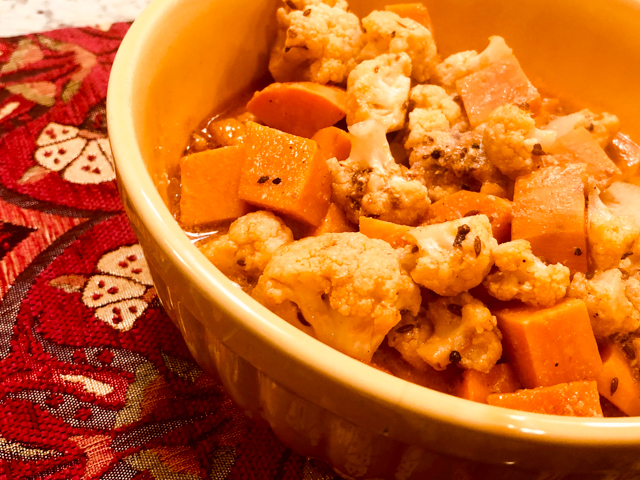
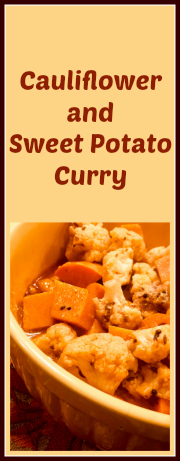
At the risk of being repetitive, I must tell you this was a total winner and yes, it will go into our regular rotation. Other veggies can be used, like potatoes, green beans, butternut squash. The method won’t change. This side dish is rich and light at the same time. Contrary to most curries that rely on heavy cream or coconut milk, the yogurt offers just that amount of creaminess you might crave. Use full-fat yogurt to make sure the sauce won’t separate.
2 tablespoons grapeseed oil, divided 1 medium size cauliflower, florets cut in small pieces 2 to 3 small sweet potatoes, cut in 1/2 inch pieces 1 teaspoon cumin seeds 1/2 inch piece fresh ginger, peeled and minced 1/3 cup tomato purée 1 tablespoon Sambal Oelek 1 tablespoon ground coriander 1 teaspoon salt 1 cup water 3/4 cup full-fat yogurt
Heat 1 tablespoon of grapeseed oil in a pan, add the cauliflower florets and sweet potatoes, a little sprinkle of salt, and cook on a medium-to-high heat until they start to brown. Remove to a bowl.
Add one more tablespoon of oil to the pan, heat and add cumin and ginger. Saute for 30 seconds to 1 minute, just until fragrant. Immediately add the tomato pure, Sambal Oelek, coriander and salt. Stir and keep in medium-heat. Mix the yogurt with water in a small bowl, then add to the pan, together with the reserved veggies.
Cover the pan and and simmer for about 20 minutes. If the sauce is too liquid, remove the lid and reduce it a bit before serving. Taste and adjust seasoning.
Comments: As I mentioned in the beginning, this recipe can be adapted to include many veggies. I would avoid zucchini because it would turn a bit too soft, although it could probably work if you roasted it and added in the very end.
The recipe was inspired by Chetna’s new book. Remember her from one of the greatest seasons of the Great British Bake Off? Chetna was often praised for her intuition with flavors. Her new book proves she is not only a great baker, but a fantastic cook. I got the idea of using yogurt as a base for the curry from one of her recipes. From her book I also recently made a delicious Tomato and Raisin Chutney.
It was my first time making chutney, and using this interesting ingredient called asafoetida. I loved it, and will definitely be making other chutneys in the future. Her book has quite a few options, all pretty unique.
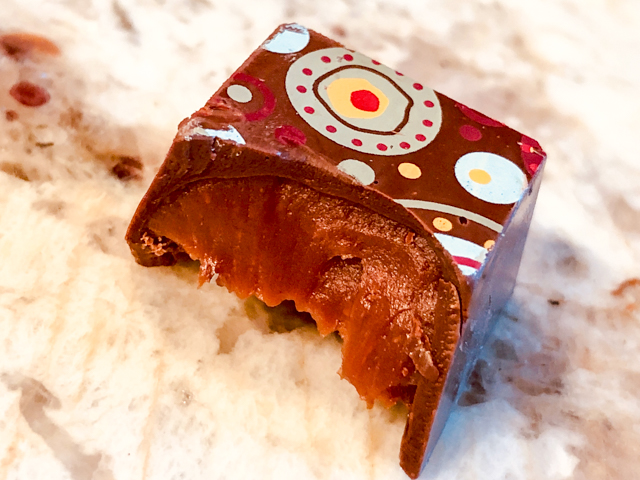
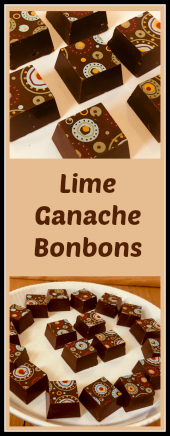
As I suspected, it did not take me too long to go back to making bonbons. This time I tried something new: transfer sheets to add a design to the top of the chocolate. As with anything new I try, there was a bit of trepidation, but I am very happy with the way they turned out, especially since it was my first time.
BONBONS WITH LIME GANACHE FILLING (from the Bewitching Kitchen, inspired by Making Artisan Chocolates)
equipment: magnetic mold with 24 slots (I used this one) chocolate transfer sheet (many available at etsy.com)
for making shells: 300g tempered dark chocolate 150g tempered dark chocolate for sealing
for lime ganache: 180g milk chocolate, chopped 56 g heavy cream juice and zest of 1 small lime 1 tsp corn syrup 7g butter pinch of salt 4 drops of lime oil (I used the one from this set)
Make the shells by coating the mold lined up with the transfer sheet with 300g tempered chocolate. Use any leftover amount to make chocolate decorations or save to re-temper when closing the bonbons. Let the mold sit inverted for a couple of hours while you prepare the ganache.
Place the chopped chocolate in a bowl. Place the cream, lime zest and juice, and corn syrup in a heavy small saucepan and bring to a gentle boil . Immediately pour through a sieve over the chocolate. Let sit for 2 minutes then stir slowly to incorporate. Using a probe thermometer placed in the center of the bowl, check the temperature. Once the ganache has reached 95°F add the butter, and lime oil, and mix to combine. Pour the ganache into a piping bag and pipe into the molded shells, filling each shell three-quarters full. Gently tap the filled shells against the counter or table to release any trapped air bubbles. Let the ganache sit for a couple of hours at room temperature to dry (you can also leave it overnight).
Temper the chocolate for sealing. Right before using, warm up the edges of the open shells with a hair dryer or heat gun. You do that to make it easier for the shells to glue to the bottom. Place the tempered chocolate on top, and a little acetate sheet covering the base. Press the acetate very hard with a scraper as you hold it firmly on the top side, scraping all excess chocolate down. You can again collect it to make decorations, if you work fast. Let the shells sit at room temperature for 1 hour, then place in the freezer for exactly 15 minutes. You can also just leave them at room temperature for 24 hours for full crystallization to take place.
Remove the acetate, open the box, marvel at the design, and bravely invert the mold banging to release each bonbon.
Comments: Magnetic molds are not cheap, I admit. But they are very easy to use and once you invest in one, you can just get different designs for the transfer sheets and have a lot of fun with them. You can match the design with the filling, or go with a seasonal motif. I have a snowflake design that will be perfect for this coming winter. A very nice video on how to use magnetic molds can be found here. It helped me a lot to make this batch.
If you are a seasoned bonbon maker, nothing that I will state now will be a surprise, so feel free to skip it. But if you are new to the technique or a total “bonbon virgin”, here are some tips that I’ve learned so far, through messy mistakes.
#1 Cover the surface of your countertop with plastic wrap. I have a commercial size roll that is very convenient for that. The chocolate that drips can be easily collected from that surface and re-used.
#2 Before you start working, gather EVERYTHING you’ll need. Scraping tools to clean the molds, paper towels, small piping bags or paper cones ready to collect excess tempered chocolate, a surface to pipe chocolate decorations with any tempered chocolate you might have leftover.
#3 Prepare the set up to invert your mold above the surface of your countertop. Ideally, the tops of the shells (which will become the bottoms) should not touch anything, so sitting the tray over a cookie drying rack is not a good idea. Make sure you have the spacers or anything you use to raise up the mold set with the right placement, because once the mold is inverted and the chocolate is done dripping, your life will be much easier if it’s all ready to go.
#4 Tempered chocolate waits for no one. Make sure you won’t be interrupted by anything or anyone once you start working.
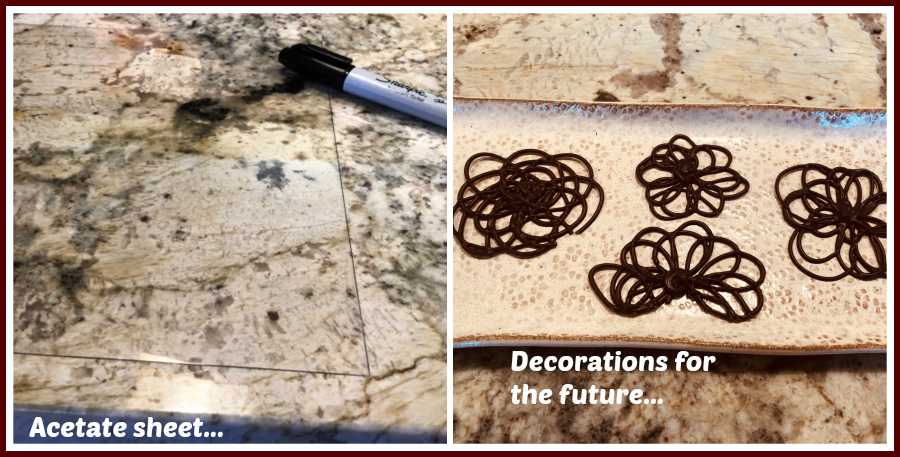
#5 Guitar sheets (acetate) are the best surface to pipe chocolate decorations, but they are hard to see once you set them over a surface. I simply run a black marker on the edges, so that the acetate margin becomes visible. Then I don’t have to worry about where to pipe. Small details help a lot when you are a newbie working with chocolate.
I am thrilled with these bonbons, but as I mentioned, it was a not a fully smooth process. I did not work fast enough with the tempered chocolate and it started to thicken and refused to pour freely from the cavities in the mold. I had to be pretty “assertive” with it, hitting the mold with a wooden spoon like crazy, sending chocolate in many directions, some not exactly over the plastic covering the countertop. I thought that the shell would end up too thick and maybe not even close perfectly, but considering the circumstances, I think it turned out pretty good.
After last year’s adventure in the tent – realizing how Paul Hollywood judges the concoctions – I became a lot more concerned with being able to clearly taste the main flavor. Case in point: if you say a bonbon is lime-flavored, it better taste like lime… I think that’s where the oil is important. It is concentrated and dissolves nicely in the ganache. Lemon extract is nice but not nearly as potent. The lime ganache had a nice citric tone, and perfectly creamy texture. I am looking forward to my next batch of bonbons, hopefully with less trepidation…