MISO IT UP

Green beans show up at our dinner table once a week, most of the time in a quick preparation with slivered, toasted almonds.  It’s nice to have some recipes that you can almost pull on your sleep.  This version from Bon Appetit is almost as simple, but feels a lot more special because it uses miso.  I suppose it’s the funk factor, that umami component that adds extra flavor. Try this recipe, even if you don’t normally use this Japanese gem in your cooking. You’ll love it, I am sure.

GREEN BEANS WITH MISO AND ALMONDS
(adapted from Bon Appetit)

2 + 1/2 pounds green beans
salt
1/4 cup white miso (may use less if you are a miso newbie)
3 tablespoons  rice vinegar
2 tablespoons mustard
2 tablespoons grapeseed oil
1 tablespoon sugar
1/4 cup slivered almonds, toasted

Cut green beans in pieces 1 to 1.5 inches long. Cook them in a large pot of boiling salted water until crisp-tender (less than 5 minutes). Transfer to a large bowl of ice water to cool. Drain well. 

Whisk miso,  vinegar, mustard, oil, and sugar in a small bowl. Season with salt, but very lightly because miso is already salty. Place green beans in a large bowl. Pour dressing over; toss to coat. Garnish with almonds.

ENJOY!

to print the recipe, click here

I always have miso in the fridge. It keeps for a long time, and shows up more and more in recipes everywhere. I often add it to sauteed mushrooms, but green beans match equally well with the sweet-saltiness of miso.  Yin and Yang.  Gotta love it!

This dish is a great side for chicken, salmon, steak, or pork. And leftovers are excellent even at room temperature.

ONE YEAR AGOZiti with Fresh Artichokes and Meyer Lemon Sauce

TWO YEARS AGO: Chicken Soup on a Chilly Evening

Add to FacebookAdd to DiggAdd to Del.icio.usAdd to StumbleuponAdd to RedditAdd to BlinklistAdd to TwitterAdd to TechnoratiAdd to Yahoo BuzzAdd to Newsvine

THE GREEN CHIP ALTERNATIVE

Anne Burrell has a way to get me into the kitchen and make her recipes shortly after watching her show.  Last week she made kale chips, and I was mesmerized. They were very simple to prepare and she munched on them with so much gusto, I could not wait to try some.  Serendipity happened: I arrived at the grocery store for my weekly shopping, and found bunches of organic kale that looked absolutely perfect.   I left the store with a huge smile on my face, hoping that Phil would get as excited about kale as I was (yeah, right ;-)).

KALE CHIPS
(from Anne Burrell)

1 bunch of kale leaves
olive oil
salt and pepper

Wash the kale leaves, dry them well, cut them in half lengthwise, removing the central, thick stem.

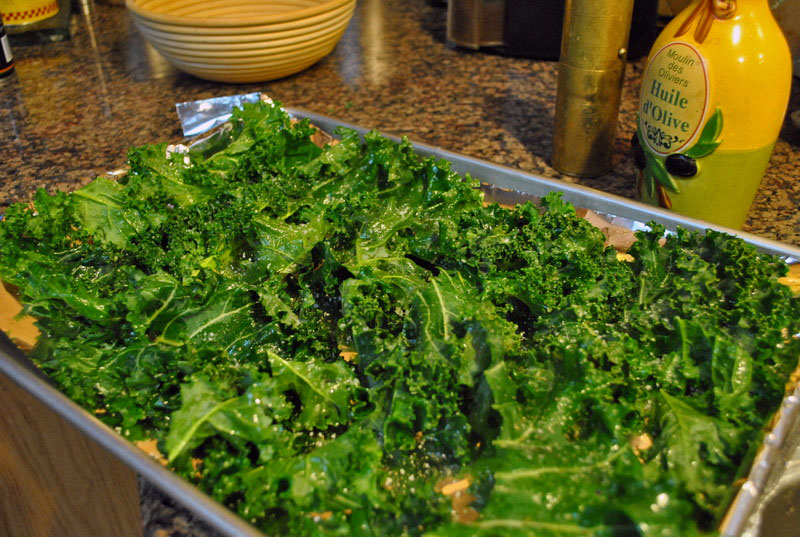
Place them in a single layer over a rimmed baking dish, spray olive oil lightly over the leaves, season with salt and pepper.  Repeat the misting with olive oil on the other side of the leaves.  Gently toss them around, trying to distribute the oil throughout the leaves.

Place them back on the baking dish in a single layer, trying not to overlap them too much.  Bake on a 250 F oven for  30 to 35 minutes.   Keep an eye on them, remove leaves that start to crisp up too much.

ENJOY!

to print the recipe, click here

Before….

and after….

These chips are addictive! I hope you’ll give them a try, even if kale is not your favorite veggie. I kept the small amount that was left inside a bowl covered with plastic wrap, and two days later enjoyed the last pieces, still crispy and delicious.   Add less salt than you think they need (sorry, Anne Burrell): the leaves shrink a lot during baking, and the salt tends to get concentrated on spots.

Husband’s verdict:  Two thumbs up! 

ONE YEAR AGO: Weekend Pita Project

TWO YEARS AGO: Tried and Tasted Roundup

Add to FacebookAdd to DiggAdd to Del.icio.usAdd to StumbleuponAdd to RedditAdd to BlinklistAdd to TwitterAdd to TechnoratiAdd to Yahoo BuzzAdd to Newsvine

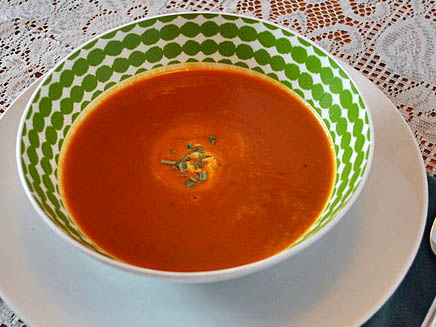
CARAMELIZED CARROT SOUP

Emeril Lagasse had his trademark “BAM!”  Rachael Ray goes with “Yumm-o,”  and Anne Burrell chimes in again and again:  “Brown food tastes good!”   When they are overused these expressions get on my nerves, but I can’t argue with the importance of browning  your food to pump up its flavor.  So, what is happening to the food?  It all reduces to a series of chemical events known as the  “Maillard reactions,”named after the French chemist who discovered them, Louis-Camille Maillard (pronounced “mah-yar”).

Maillard reactions involve proteins and sugars.  These molecules may react with each other if they contain atoms on their surfaces with a net positive or negative charge.  Proteins consist of tens or hundreds of  amino acids linked together, but the constituent amino acids of a native  protein are not very reactive, because they fold into a  stable 3-dimensional structure.  However, subjecting the protein to high energy (heat) or a basic (high pH) environment destabilizes its structure, exposing the charges of many of its amino acids.  If present, a sugar will react with the charged amino acids  to produce all sorts of different compounds, many of which taste great!  Note that boiling water won’t do the trick: the Maillard reactions need much higher heat, like in a skillet with hot oil, or on a grill.  As we all know, these are the best approaches to browning foods.
.
Caramelization and Maillard reactions are often used interchangeably, but this is wrong because the former refer to what happens to a sugar alone upon heating, whereas Maillard reactions always involve proteins and sugars.  The two processes are cosmetically and conceptually similar, in that both produce a brown color, but they arise from different chemistry.
.
and… brown food DOES tastes good!  😉
.
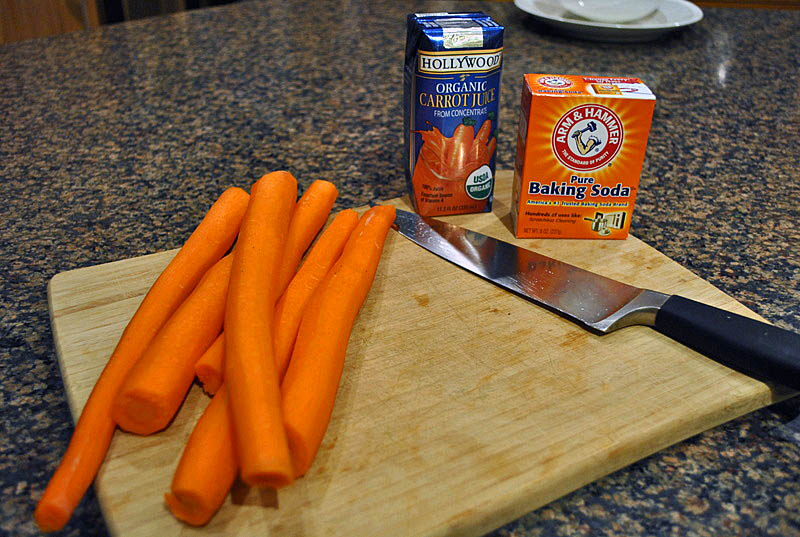
That brings me to a recipe for caramelized carrot soup, in which just a few simple ingredients….
… come together to create an incredible depth of flavor.  Here increasing both the heat (a pressure cooker works its magic), and the pH (baking soda to the rescue) optimizes the Maillard reactions.  Chemistry never tasted so good!
CARAMELIZED CARROT SOUP (adapted from Food and Wine magazine)
.
1/3 cup low fat yogurt
1 teaspoon chopped tarragon
1/4 teaspoon caraway seeds, chopped
salt and pepper
6 tTbs unsalted butter (divided in 4 + 2 Tbs)
1 pound carrots, peeled and cut into 1/2-inch pieces
1/2 teaspoon salt
1/4 teaspoon baking soda
2 cups fresh carrot juice (see notes)
1 tablespoon minced fresh ginger
.
In a small bowl, mix the yogurt with tarragon, caraway seeds, a touch of salt and pepper, and reserve.  In a pressure cooker, combine 4 tablespoons of the butter with the carrots and cook uncovered until the butter is melted. Stir in the salt and baking soda, cover and cook at full pressure  for 10 minutes.Carefully move the pressure cooker to the sink and run cold water over the lid until the temperature drops down and the pressure is equalized  (one minute under cold water will definitely be enough). Open the pressure cooker, add the carrot juice (or a mixture of carrot juice + water), and stir to release caramelized bits stuck to the bottom of the pan.
.
Transfer the contents of the pan to a blender or food processor, add the ginger, the remaining 2 Tbs of butter, and puree until smooth.   Season the soup with pepper and pour into bowls.  Garnish with a small dollop of the reserved yogurt, sprinkle some fresh tarragon, and serve.
.
ENJOY!
.
to print the recipe, click here
.
Comments:  Don’t be alarmed by the look of the carrot/butter mixture once you open the pressure cooker.  The brown bits stuck to the pan will dissolve easily and they give this soup the most intense carrot flavor ever!
.
The box of carrot juice I used had a little less than 2 cups so I completed the volume with water. If you have some V8 juice around the pantry, it could be a nice addition.  This technique won me over, I wonder if other soups could benefit from this treatment. Caramelized broccoli?   Butternut squash?  Only future experiments will tell…  😉  At any rate, this will be my favorite soup recipe for the year 2011.  Hands down!
.
ONE YEAR AGO: Miso-Grilled Shrimp
.

Add to FacebookAdd to DiggAdd to Del.icio.usAdd to StumbleuponAdd to RedditAdd to BlinklistAdd to TwitterAdd to TechnoratiAdd to Yahoo BuzzAdd to Newsvine

GRILLING RIBBONS

We use our outdoor grill pretty much the whole year, as even during the winter we’ll have nice breaks in the weather, with temps reaching the mid 60’s.  Grilling brings a glimpse  of summer into the kitchen, and that is a feeling any Brazilian-American always appreciate!

I found this recipe in a Food and Wine magazine, and the first thing that called my attention was the way it treated the squash:  thinly cut as ribbons, then threaded into skewers.  The photo in the magazine was quite gorgeous, evidently some practice is needed to cut the squash in the perfect thickness and grill them carefully enough to preserve a nice shape.  Let’s say my technique needs to be improved before serving this dish to guests…   But even if you don’t hit the jackpot with your technique, this is a fabulous side dish.  Don’t omit the prosciutto, it is a key component.

GRILLED SQUASH RIBBONS AND PROSCIUTTO WITH MINT DRESSING
(adapted from Food and Wine magazine)

1 teaspoon lime zest
1/4 cup fresh lime juice
1/4 cup chopped mint
1/4 cup extra-virgin olive oil + more for brushing veggies
Salt and freshly ground pepper
2 medium zucchini, very thinly sliced lengthwise
2 medium yellow squash, very thinly sliced lengthwise
6 ounces sliced prosciutto

Prepare a gas or charcoal grill, brushing or spraying the grids with a little olive oil.  In a small bowl, combine the lime zest and juice with the mint, and the   olive oil. Season with salt and pepper.Alternately thread the zucchini, yellow squash and prosciutto onto 4 pairs of 12-inch bamboo or metal skewers (soak the bamboo skewers in water to prevent them from burning).  Lightly spray the vegetables and prosciutto with olive oil and season with salt and pepper.Grill the skewers over high heat until the zucchini and yellow squash are lightly charred, maximum of 2 minutes per side. Serve the mint dressing on the side (it is great for salads too).

ENJOY!

to print the recipe, click here

Comments:   I suppose the same recipe would work without going through the trouble of making the ribbons, but they do add a lot of charm to the dish.  I wasn’t sure about grilling the prosciutto, as it is a bit dry to start with, but it turned out as a great match for the squash ribbons.  Salty and chewy, it gave that extra bite to the veggies, just like croutons on a Caesar salad. We both loved everything about this recipe, a real winner!

Food & Wine suggests using these veggies + dressing as a “sauce” for pasta.  Simply cook the pasta al dente, and slide the veggies off the skewers, mixing with the pasta while it’s still very hot. Add some of the dressing, adjust the consistency if needed with the pasta cooking water, and voila’:  heaven on a plate!

ONE YEAR AGO: Peppery Cashew Crunch
TWO YEARS AGO: Ossobuco Milanese (a GREAT dish!)
.

Add to FacebookAdd to DiggAdd to Del.icio.usAdd to StumbleuponAdd to RedditAdd to BlinklistAdd to TwitterAdd to TechnoratiAdd to Yahoo BuzzAdd to Newsvine

A MUST-MAKE VEGGIE PUREE

Those who are familiar with low-carb diets know that cauliflower is the number one choice as a substitute  for potatoes, and even rice.  Indeed,  I’ve seen recipes in which the florets are grated and used in what it’s called  “cauli-rice.”   I don’t think it would fool me, though, I love rice way too much!  😉  Now, back to puree…

Potatoes have enough starch to produce a creamy and smooth texture when cooked and mashed.  Other veggies like cauliflower, broccoli, even parsnips, end up with a more watery and grainy texture.  For that reason, most recipes will coach you into adding a lot of butter, heavy cream, or some type of cream cheese.   Sally Schneider, author of  “The Improvisational Cook,” came up with a very clever twist: she cooks the veggie in milk (low fat is fine), and adds to the cooking liquid an apple and a little bit of pasta (like angel hair).  The result is amazing.  Never in a million years I expected Phil to urge me to blog about a cauliflower recipe. His exact words were:  “make sure you really pump this recipe up, it’s awesome”!

CAULIFLOWER AND APPLE PUREE
(adapted from “The Improvisational Cook“)

1 medium cauliflower, core and leaves removed
1 small apple, peeled and cored, chopped
1/2 quart low fat milk
1/2 quart water
1/2 ounce angel hair pasta, broken in pieces
1 tsp salt
pinch of sugar
ground white pepper

Cut the cauliflower florets and stems roughly into pieces. Add the pieces to a pan with the milk/water, apple, bring to a gentle boil.  Add the pasta, salt, and sugar.   Cook, stirring every once in a while, until the cauliflower is tender (25 minutes).

Remove 1/4 cup from the cooking liquid and reserve. Strain the vegetables (the rest of the milk/water can be used for soups later), place them in a food processor and puree for a couple of minutes, until completely smooth.  Make sure to stop and scrape down the sides of the bowl once or twice.  If too thick, add some of the reserved cooking liquid.

Return the puree to the pan, place it over very low heat, add white pepper, taste, and adjust the seasoning with more salt and pepper.

ENJOY!

to print the recipe, click here

Schneider’s book is perfect for those who like to use recipes as a starting point instead of a rigid set of rules.  She opens each subject with a section called “Understanding,” explaining the reasoning behind the recipes in that section.  Finally, she offers  suggestions to improvise on your own.
I absolutely love this approach!

This puree is silky-smooth, you won’t taste the apple, but it really does something to “tame” the cauliflower flavor, so even those with “cauliflower issues” will be pleased.   Of course, because there’s a small amount of pasta in it, this dish won’t be as low in carbs as a pure cauliflower version, but it is still  much lighter than mashed potatoes.   Sometimes, it’s exactly what we crave…

ONE YEAR AGO: Vegetarian Lasagna

TWO YEARS AGO:  Brazilian Pao de Queijo (Cheese Breads)  – a classic!

Add to FacebookAdd to DiggAdd to Del.icio.usAdd to StumbleuponAdd to RedditAdd to BlinklistAdd to TwitterAdd to TechnoratiAdd to Yahoo BuzzAdd to Newsvine