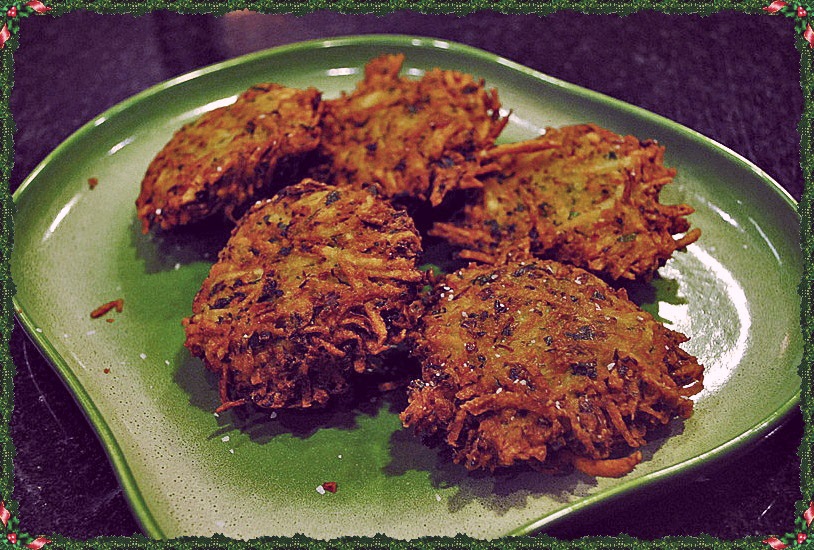
POTATO GALETTES A L’ALSACIENNE & BOOK REVIEW

served2222Right around the time I started this blog, I stumbled upon Pham Fatale’s site, and fell in love with it.  The site’s name is a perfect choice for someone called Pham and who looks as gorgeous as she does… 😉   But what captured me for good was her multi-cultural style of cooking.  Keep in mind that she was born in Paris, with parents who emigrated from Vietnam in the mid-70s. To make things even more interesting, she married a man who is also the son of immigrants,  his parents came from India.  If that does not make for an amazing array of recipes, I don’t know what would.  Check her site and you will also be smitten by it, she is an amazing photographer and her recipes quite creative and unique.  Jackie is a busy bee – she has a young baby, and cooks for a large family that includes teenagers with dietary restrictions – but even with such intense life she managed to publish her first cookbook. I asked her permission to publish a recipe from it, as well as write a little review.  The book is called Haute Potato, and it includes 75 gourmet recipes using this “humble” vegetable.  In Jackie’s hands, the potato is anything but humble!

POTATO GALLETES A L’ALSACIENNE
(reprinted with permission from Jacqueline Pham)

2 pounds Russet potatoes
1 lemon, freshly squeezed
2 Tablespoons parsley, chopped
4 shallots, chopped
1 piece of leek (3 inches), white part only, chopped
2 eggs
1/8 teaspoon cayenne pepper
3 Tablespoons all-purpose flour
1/4 teaspoon nutmeg, freshly grated
1/4 teaspoon baking powder
1 + 1/2 teaspoons salt
1/2 teaspoon black pepper
1 cup canola oil, as needed

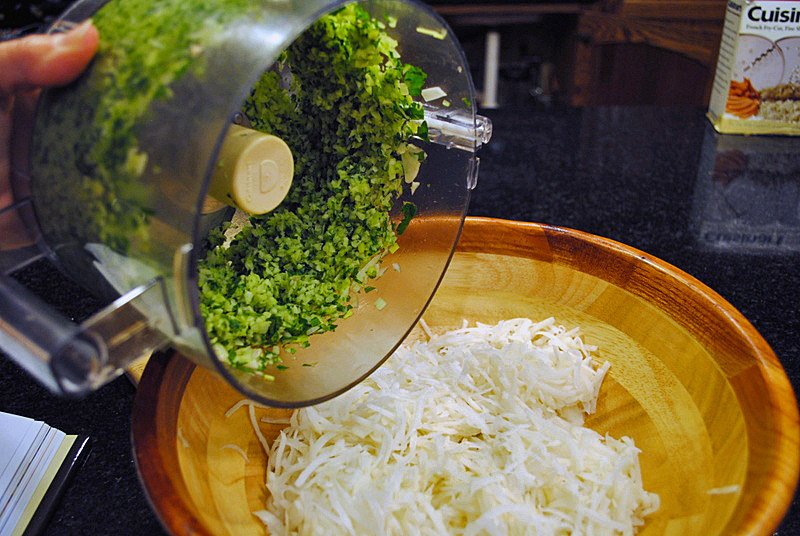
Prepare the potatoes: wash and peel the potatoes.  Shred 2/3 of them and place in a large mixing bow. Add the lemon juice and cover with cold water. Let sit for 5 to 10 minutes. Drain the potatoes and discard the liquid. Place all the shredded potatoes in a cheesecloth and remove as much excess wter as possible, than pat dry with paper towels.  Pace inside a large bowl. Coarsely chop the remaining 1/3 of the potatoes and place them into the bowl of a food processor. Add the parsley, shallots, and leek. Pulse into a smooth raw puree. Add the mixture to the shredded potatoes.

Make the batter: in a mixing bowl, beat the eggs with the cayenne pepper and the flour for 2 to 3 minutes, until slightly thickened. Add the nutmeg and baking powder. Add this egg mixture to the potatoes.   Season with 1 teaspoon of salt and 1/2 teaspoon of pepper.  Stir well to combine.

Fry the galettes: heat the oil over high heat in a large Dutch oven or heavy-bottomed pan.  You should have 1 inch of oil in the pan, so use as much oil as needed for that. Form small flattened patties with the potatoes (if you have disposable gloves, they work well if you grease them lightly with oil). When the oil is very hot, drop the patties into it, making sure they don’t touch each other.  Lower the heat if they seem to brown too fast, and cook them for 5 to 8 minutes, until browned on the first side, then flip them and cook for about 3 more minutes on the second side.  Season them with a little extra salt as you remove them from the pan and place on paper towels to absorb excess oil. You can fry them and keep them warm in a low oven until serving time.

(makes 6 servings, about 12 galettes).

ENJOY!

to print the recipe, click here
prep1

Comments:  I made one small modification to th recipe, and that was to add about 4 times as much parsley as it called for, which explains that my galettes had a bit more of a green aura than Jackie intended to. Let’s not delve too deeply into the issue. Suffice to say that I prepared the parsley to use in two different venues, and some unexpected firing of neuronal cells made me dump the full amount into the food processor.  No harm was done to the galettes as far as taste is concerned.   The key to the great texture of these fritters is the use of potato in two forms: grated and processed into a paste.  It gives the galettes a very creamy and pleasant texture.

photo(71)

ABOUT HAUTE POTATO, THE COOKBOOK…   I love the way the chapters are divided in an unorthodox way.  Each chapter gives one type of “outcome” for the potato. Here is a list of them with one example of a tempting recipe found in it.

Chapter 1: Refreshing…  Vietnamese-Style Shrimp and Potato Salad

Chapter 2: Decadent… Prosciutto-Wrapped Fig and Gnocchi Bites

Chapter 3: Cheesy…. Pine Nut, Chevre, and Potato Cigars with Lemon-Caper Sauce (this one a favorite of Jackie’s family)

Chapter 4: Crispy & Crunchy… Oven Sweet Potato Fries with Pineapple-Mango Aioli

Chapter 5: Creamy…  Brie Cheese and Roasted Garlic Mashed Potatoes (and Sally feels a little faint….)

Chapter 6: Spicy…   Traditional Samosa

Chapter 7:  Sweet…  Sweet Potato and Matcha Green Tea Creme Brulee

I had a hard time deciding on a recipe to blog about, and almost went with her carrot and potato souffle, but since we very rarely make fried foods, I took the opportunity to try her galettes.  I am definitely making the souffle next, and the potato cigars will be on our menu next time we entertain.  Jackie said they disappear quickly whenever she makes them, and are the number 1 request of friends who were lucky enough to try them… 😉

This is a cookbook that will please anyone who likes to make their meals a little more special. However, even a cook without too much experience will be able to make most recipes, as they are very well explained. Some recipes are published in her blog, but most are exclusive to the book.  You can find it at amazon.com, and in bookstores everywhere!  I wish Jackie great success in her first adventure as a cookbook author, and look forward to her next cookbook!  😉

ONE YEAR AGO: Caramelized Carrot Soup

TWO YEARS AGO: Miso-Grilled Shrimp

THREE YEARS AGO: Pain Poilane
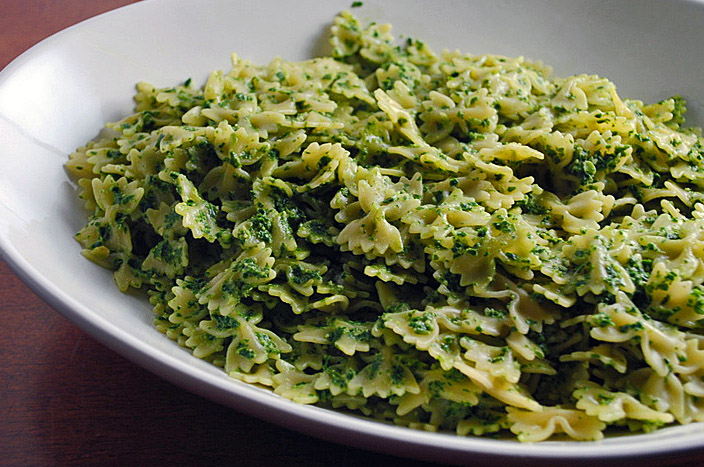
THE MANY FACES OF KALE

The other day I bought a huge, and I mean HUGE bunch of kale with the firm idea of making a frittata with it. As the afternoon moved along, I changed my mind on our menu, and the kale transmogrified into a light gratin.   But I also  toyed with the idea of simple kale chips (which I love), only to drop that and settle on a salad.  Maybe settle is not quite right.  By the time I jumped on dinner preparation, the kale ended up as pesto. Flip-flopper? Who, me?  😉

FARFALLE WITH KALE PESTO
(from the Bewitching Kitchen)

1 big bunch of kale, stems removed, leaves coarsely chopped
1/4 cup of walnuts, toasted
pinch of red pepper flakes
olive oil
squeeze of lemon juice
salt and pepper
1/4 to 1/3 cup yogurt

Bring a large pot of lightly salted water to boil.  Drop the kale leaves and blanch them for a couple of minutes.  Immediately drain, and rinse briefly in cold water. Drain well, then place in a salad spinner to dry the leaves as much as possible.

Add the toasted walnuts and red pepper flakes to the bowl of a food processor, and process for a few seconds.  Add the blanched kale and process together with the nuts until a paste forms.  Season with salt and pepper.  Squeeze lemon juice all over. Close the processor, and add the olive oil as a stream.  Once the oil is incorporated, stop to scrape the sides of the bowl, add yogurt and process until everything is smooth.   Taste, adjust seasoning, and reserve.

Meanwhile, cook farfalle pasta until al dente, reserving some of the pasta cooking water.  When the pasta is cooked, mix with the pesto, and add the reserved cooking water to thin the sauce, if necessary.   Serve with plenty of parmigiano-reggiano cheese grated on top.

ENJOY!

to print the recipe, click here

Comments:  I’ve seen recipes for kale pesto in which the raw leaves are processed with the usual suspects (garlic and olive oil).  I decided it would be too harsh for our taste, so  I took the extra step of blanching the leaves.  If you are a garlic lover, add a couple of cloves together with the walnuts.   I loved this version of pesto,  and even used some as a spread for a ham sandwich at lunch next day.   All amounts are a bit eye-balled,  if you like the flavor of olive oil to be more pronounced, use more and omit or reduce the yogurt.   Don’t leave the lemon juice out, though – it adds that citric brightness that is a must in this recipe.

For additional kale inspirations, a small sample of recipes from the internet:  

Kale Gratin … A nice recipe from Taste Food,  she used spinach, but I think kale would be great too

Kale Salad with Butternut Squash… from Eats Well with Others

Kale Frittata... from My Kitchen in the Rockies

Golden Chard Pie… from the early days of my blog

Kale Chips… from not so early days of my blog

and for an interesting twist on this great veggie, take a look at these cute Quinoa and Kale Patties

ONE YEAR AGO:  Short and Sweet

TWO YEARS AGO: Ciabatta, a Classic Italian Bread

THREE YEARS AGO: Magical Lamb Stew

FAST, FRESH, AND GREEN

As you may remember, 2012 was another year that began with the regrettable, futile  decision to avoid buying any more cookbooks.  But, one of the curious things about New Year’s resolutions is that  you must overcome a certain barrier to break them. This situation is analogous to a biochemical paradigm, the   so-called  “energy of activation,”  to make a reaction go forward.  It’s that little kick an enzyme provides, by binding its substrate,  that causes a normally slow reaction to happen right away.   Two things boosted me  to buy  Fast, Fresh, and Green.  First,  Susie Middleton wrote it.  Having known her  for a long time as the editor of Fine Cooking, I expected a great book.   Then, I read reviews on amazon.com and THAT was the catalyst,  the activation energy, the end of my inner debate.   Reaction CATALYZED,  iTunes contacted, book delivered to My Preciousss  within 2 milliseconds!!  Below I share with you a recipe, a teaser, and my thoughts on the book.

THE RECIPE

VANILLA AND CARDAMON GLAZED ACORN SQUASH RINGS
(reprinted from Fast, Fresh, and Green, with permission from Susie Middleton)

1 small acorn squash (1 + 1/4 pounds maximum)
2 Tablespoons unsalted butter
2 teaspoons maple syrup
1 + 1/2 teaspoon vanilla extract
1/8 teaspoon ground cardamon
kosher salt

Heat your oven to 475 F (or 245 C).  Line a large rimmed sheet pan with parchment paper.  Cut the acorn squase in half lengthwise. Scrape out the seeds and fibery stuff with a spoon. Place each half, with the cut side down on a cutting board, and slice a little less than an inch of both ends. Discard the ends. Slice the squash crosswise into 1/2 inch slices, and place them over the prepared baking sheet.

Melt the butter in a small saucepan. Remove the pan from the heat and add the maple syrup, vanilla, and cardamon. Stir well to combine. Use a brush to lightly brush the slices of squash with the a little less than half the amount of butter. Season lightly with salt and turn the slices over.  Brush the second side with the remaining melted butter, reserving some to brush at the end (optional). Season the second side with salt.

Roast the squash for 12 minutes. Carefully flip the pieces over, and roast until  nicely browned, 10 to 12 minutes more. If you want, brush with a little more butter before serving.

ENJOY!

to print the recipe, click here

I think I am becoming cardamon-obsessed. Cannot have enough of it. Love everything about it, particularly that intense smell that hits me when I first open the spice grinder… heaven!  In this recipe, the combination of maple, vanilla, and cardamon is outstanding and perfect with the acorn squash.  A keeper, and ready so quickly, you can make it for Thanksgiving dinner (as  Susie advised in the book) while the turkey rests after roasting.  Keep that in mind, Thanksgiving is already peeking at us.  😉

THE TEASER

MAHOGANY MUSHROOMS

Baby-bella mushrooms are sauteed in a simple sauce full of flavor and with a few unexpected twists…   They turn out with just the right amount of heat and a sweet and sour hint.  Perfect alongside many main dishes.  We had it with a T-bone steak.

THE REVIEW

Contrary to many cookbooks in which chapters ate divided either by season of the year, or ingredient, Susie Middleton went through a different route, sorting recipes by method of preparation.  I really like that.

The first and second chapters deal with general stuff: what you should have in your pantry as well as cooking equipment (half sheet pans are a must, according to her, and I could not agree more).   All other chapters are centered on cooking methods, as follows:

Quick Roasting: My favorite chapter of the book, as I love roasting veggies but usually my impatient nature prevents me from enjoying them too often.  The acorn squash rings featured in this post is an example found in this chapter.  Some other tempting dishes from the same group:  Quick-Roasted Cauliflower with Zesty Orange-Olive Dressing, Quick-Roasted Beet Slices, Sweet Potato “Mini-Fries” with Limey Dipping Sauce and Spiced Salt,  Caramelized Plum Tomatoes in an Olive Oil Bath, Roasted Turnips and Pears with Rosemary-Honey Drizzle.

Quick Braising:  I think quick braising and stir-frying are two of the most common techniques used in the home-kitchen, and in these categories Susie really shines.  All recipes come with some creative twist, an expected flavoring, or combination of ingredients that makes the most humble veggie take center stage. Some examples:   Quick-Braised Green Beans with Pomegranate-Balsamic Pan Sauce, Cider-Braised Baby Bok Choy and Golden Apples, Braised Carrots with Blood Orange-Fresh Tarragon Pan Sauce, Silky Braised Fennel in Pink Sauce (this will be my next recipe to try from the book).
.
Hands-On Sauteing: These are recipes that require you to stay around the stovetop doing some baby-sitting, but they come together in lightning speed.  The teaser recipe, Mahogany Mushrooms, comes from this group. Other recipes on my list to try:   Corn Saute with Chile and Lime, Sauteed Carrots with Warm Olive and Mint Dressing, Sauteed Savoy Cabbage with Apple Cider Butter (oh, my…),   Brown Butter Summer Squash “Linguine”.

Walk-Away Sauteeing: As the name indicates, once you start cooking, there’s plenty of opportunity to do something else, work on a main dish, play fetch with your dog, or stare at the window admiring the arrival of the Fall.  Some tasty examples include:  Gingery Sweet Potato and Apple Saute with Toasted Almonds, Carmelized Green Beans and Sweet Onions, Sauteed Turnips with Ham and Molasses, Southwestern Butternut Squash Saute, Smoky Spanish Carrots and Fennel with Toasted Hazelnuts.

Two-Stepping:  includes recipes that call for boiling the vegetables and then continuing with another type of preparation, like sauteeing, or inclusion in a salad.   I absolutely MUST make the “Brown Butter Asparagus with Pine Nuts”  from this chapter.  But there’a a lot there to chose from.

No Cooking:  This whole chapter calls my name very loud.  😉  The Double-Lemon Ginger Carrot Salad will be showing up at our table very soon.  But wouldn’t you be happy with a serving or two of Heirloom Tomato, Summer Peach, and Fresh Herb Gazpacho Salad?   I thought so…  😉

Stir-Frying:  A collection of very tasty options for stir-fries, with additions such as black bean sauce and balsamic butter to make them special.

Grilling. Reading this chapter it occurred to me that I only grill two veggies: eggplant and zucchini.  If you are like me, Susie will definitely open your horizons to include mushrooms, asparagus, even potatoes.
.
Baking Gratins:  This is the slow-cooking chapter that closes the book.  I don’t think any book on veggies would be complete without some gratins, the comfort food by default.  Some examples:  Mini-Potato Gratin,  Slow-Roasted Heirloom Tomato Gratin, Christmas Kale Gratin with Sun-Dried Tomatoes, Harvest Gratin of Butternut Squash, Corn, and Leeks.

My verdict: this is a wonderful cookbook, one that will change the way you view your side dishes, especially if you have a busy schedule.  I tend to have more problems figuring out what to cook as a side dish than anything else,  because we usually rotate a few main dishes during the week. There’s the roast chicken, the grilled salmon, the pork tenderloin, the chicken cutlets, the steaks.   But what to serve with them is the million dollar question.  This book helps answer that, big time!  😉

Susie, thanks for allowing me to share a recipe from your book!

ONE YEAR AGO: Speculaas

TWO YEARS AGO: Capital Sauce Pork Ribbons over Pot-Browned Noodles

THREE YEARS AGO: Pain a l’ancienne

BROWN BUTTER TOMATO SALAD

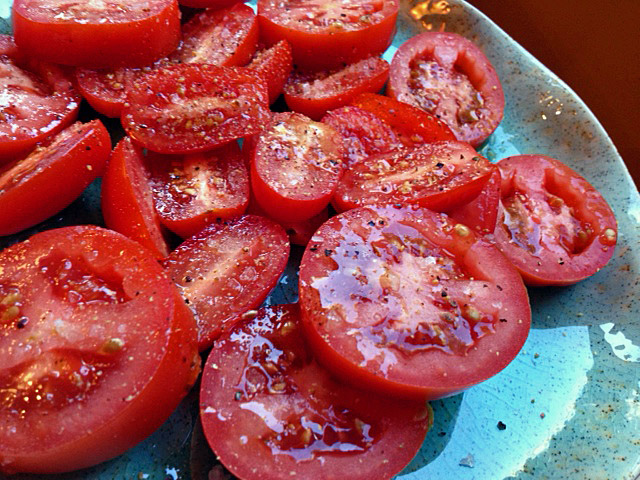
This is the simplest salad you will ever make. If you read Portuguese, or don’t mind the butchering that google translate occasionally causes, jump over to Fer’s blog (Chucrute com Salsicha) to see where I got the idea for this great side dish.  I echo her words, and urge you to use the best possible tomatoes you can find.  They need to be juicy, packed with flavor, and you must cut them in thick slices to stand the warm shower of the brown butter.   You also must enjoy this salad right away.   Am I bossy today or what?  😉  But, once you comply with my demands, you will thank Fer for bringing this to our attention…
Looking for the recipe?  There is no recipe, too simple for that.  Grab the best tomatoes you can find (have I made that clear enough? ;-)). Cut them in thick slices, and arrange them on a plate.

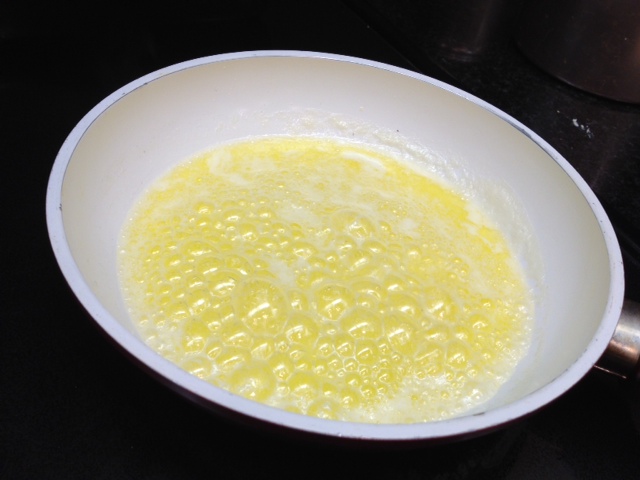
Melt some butter, gently.  On low heat, allow it to get a brownish color, by that time a nutty, wonderful smell should make you smile in anticipation.   Spoon some of the brown butter over the tomatoes, season with Maldon salt (for that added crunch), black pepper, and serve right away.

Leftovers? Toast some rustic sourdough bread, and while the bread is still hot from the toaster (or grill), place a nice slice of brown butter tomato on top…   Take a bite. Then another. And have happy thoughts.

Fer, obrigada pela super receita!  Seu ginger ale esta’ na fila para uma proxima empreitada…

I close this post offering you a  link with NINETY recipes for healthy, no-heat lunches to take to work.  Kalyn, a veteran food blogger recently assembled this collection and I immediately bookmarked it.  A wealth of information!
Click here and ENJOY!

ONE YEAR AGO:  Spelt and Cornmeal Rolls

TWO YEARS AGO: Roasted Potato and Olive Focaccia

THREE YEARS AGO: Multigrain Bread Extraordinaire

THE SECRET RECIPE CLUB: CORN CHOWDA

Last Monday of the month = Reveal Day for The Secret Recipe Club!  I could not be happier with my matching blog for this month:  Beautiful Disasters, hosted by Casey, the coolest girl in the whole blogosphere.  I first got to “meet” her when she made a flourless chocolate cake from my blog,  and that was the most popular recipe of our SRC that month!  How awesome is that?   Casey is a hard working high school student, athletic, witty, and keeps a blog that is always fun to visit.  I was thrilled to cook from her site.   Being a young runner with a high metabolism and all, she’s got a ton of sweets to share, but  I wanted to go for something savory. The weather is cooling down (Sally grabs the box of Kleenex), so I searched for a comforting soup.  My first click on the index was for corn chowder.  She starts her post with “Do you wish you had an accent?”   Casey, you got me right there!  I simply HAD to make your chowda.. 😉

CORN CHOWDER
(adapted from Beautiful Disasters)

2 cups corn kernels
2 Tablespoons butter
1 shallot, finely chopped
1 + 1/2 teaspoons salt

2 teaspoons thyme
3/4 teaspoon black pepper
a few fresh basil leaves
scant 1/4 cup all-purpose flour
4   cups water
8 baby Yukon gold potatoes, cut in pieces
¾   cup half-and-half
1/2 Tablespoon white sugar

Heat the butter in a large pan.  Let it melt, then add the shallots, thyme, salt, and pepper. Cook for about 6-8 minutes, stirring frequently, until the shallot is soft and starting to get some golden color. Add the flour and cook for another couple of minutes, stirring constantly. Gradually add the water, keep stirring. Bring the mixture to a boil, then add the corn kernels and potatoes. Bring the chowder to a simmer, then reduce the heat to medium-low and simmer for about 15 minutes, or until potatoes are tender.

Transfer a little less than 2 cups of the chowder and the basil leaves to a blender and puree until smooth. Stir the puree back into the pan. Add the half-and-half then return the chowder to a simmer.  Season to taste with salt, pepper, and mix in the sugar.

ENJOY! 

to print the recipe, click here

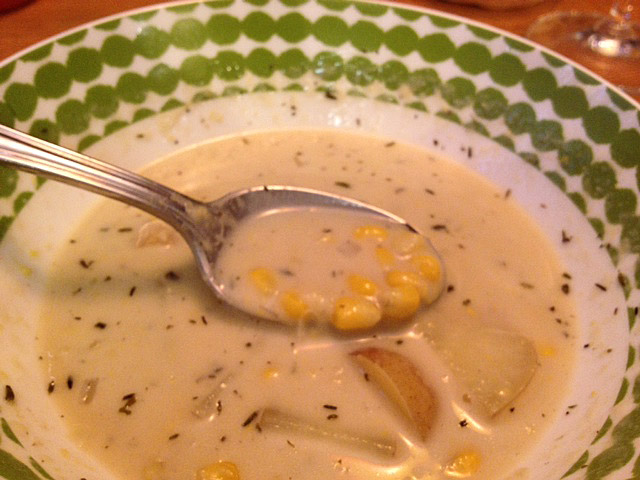
Delicious chowder, creamy, luscious, even if I took a few shortcuts with the recipe.  Full disclosure: Casey did not use frozen corn.  I am sure it would be even better with fresh corn and getting all that juicy corn milk, but I had to simplify the preparation to accommodate my schedule.

Now, back to the fascinating topic of accents.  As any immigrant, I am often reminded that I have an accent.   I don’t mind it that much, but I certainly wish I didn’t get in other types of trouble.

Allow me to share a quick story.  Day one of  lab move: I am running around like a chicken with its head cut off,  asking our secretary, one of the moving guys, and a  student “I need the doily.  Have you seen the doily around?”   All of a sudden, Phil gently grabs grabs my arm,  takes me to the side and whispers “Sally, darling, you are looking for the dolly, not the doily“.  That’s when  I understood their small delay in answering my question with a sheepish “I don’t know where it is”.   (sigh)

Casey, I hope you had a blast with your assignment too!
And for all my readers, don’t forget to click on the blue frog below to see the full list of posts by the members of Group D, the group that closes each month with a golden key!  😉

ONE YEAR AGO:  Oven-broiled Salmon over Saucy Spinach

TWO YEARS AGO: Butterscotch Brownies

THREE YEARS AGO: First Soup of the Year