SECRET RECIPE ENCORE: CHICKPEA SALAD

When I was a child, becoming an orphan was my greatest fear, and I literally lost many nights of sleep worrying about it.  So, when I learned that one member  from the Secret Recipe Club was about to be an orphan this month (the person supposed to pick a recipe from the blog had a problem and could not complete the assignment in time) I decided to perform a virtual adoption… 😉  My “encore” post for this month’s reveal day comes from Without Adornment, and you can visit it clicking here.  Bean, the hostess, has a site loaded with gluten-free recipes, and absolutely gorgeous photography.   Due to the time constraints (I had less than 24 hours to pick a recipe, make it, and write about it), I had to go with a simple dish.  But, it all ended perfectly for me:  I had no idea what to eat for lunch after working out, and her chickpea salad came to the rescue. Delicious, refreshing, light, healthy, but also filling enough to carry me through a busy Sunday afternoon…
CHICKPEA SALAD
(adapted from Without Adornment)

1 can of chickpeas
2 medium carrots, thinly sliced
1 stalk celery, thinly sliced
1 cucumber, peeled, seeded, diced
Grape or Cherry tomatoes to taste
salt and pepper
grapeseed oil
lime juice
white balsamic vinegar

Boil  2 cups of water in a small sauce pan.  Drain the chickpeas from the can, and drop them in the boiling water for 5-10 second.  Quickly drain them and rinse with plenty of cold water.  Reserve until cold.

In a bowl, mix all the ingredients from chickpeas to tomatoes.   Make a simple dressing with oil, a squeeze of lime juice, a little balsamic vinegar, salt and pepper.  Drizzle over the salad and….

ENJOY!

to print the recipe, click here

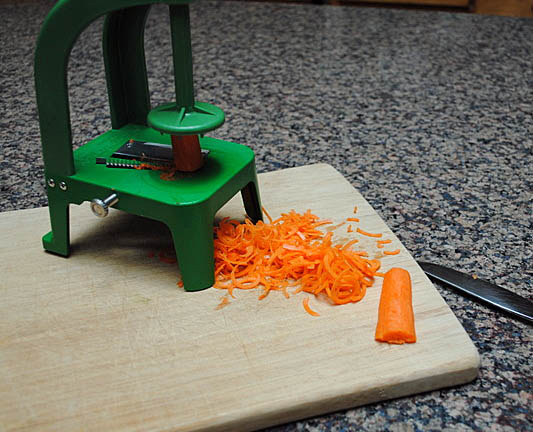
This salad gives me the chance to introduce you to a reasonably recent acquisition from the Bewitching Kitchen… a spiralizer! Or a spiral-cutter… or… whatever you want to call it…
I like raw carrots in salad, but prefer if they are cut paper-thin.  This gadget gave me the exact texture I was hoping for.  The very thin ribbons get perfectly seasoned and retain just a little crunch.

Chickpeas & boiling water: this is a tip I learned from Barbara Tropp, in her book Mastering the Art of Chinese Cooking.  She recommended to rinse all sorts of canned products in boiling water, to remove what she described as the “tin taste”.  The improvement in flavor is quite noticeable.  So I normally do it whenever I use chickpeas, beans, and water chestnuts.

Bean, it was fun to get to know your blog, I wish I’d had more time to devote to it, your Lemon Cupcakes seemed absolutely scrumptious!  😉

ONE YEAR AGO: A Soft Spot for Chevre

TWO YEARS AGO: Seared Tuna, My Own Private Idaho

Add to FacebookAdd to DiggAdd to Del.icio.usAdd to StumbleuponAdd to RedditAdd to BlinklistAdd to TwitterAdd to TechnoratiAdd to Yahoo BuzzAdd to Newsvine


ISRAELI COUSCOUS SALAD

For a long time Israeli couscous was hard to find, and I only enjoyed it in restaurants, or by placing special orders online.  Now it’s available almost everywhere!   Even one store in our small town carries it in bulk, so I buy as little or as much as I want.  Heads up: when you  buy Israeli couscous in bulk, make sure to tie the plastic bag very well, and handle it with loving care.  Those cute little balls of semolina flour travel long distances when spilled on the floor. It’s amazing the lessons a cook learns! 😉

Israeli couscous has an interesting history. It indeed originated in Israel,  in the 50’s,  with the name of “ptitim.”  It was conceived in a time of austerity, as an attempt to deal with the scarcity of food, including the almost complete disappearance of rice.  Back in Israel it remains a popular food item for kids, available in all sorts of cute shapes, like stars and hearts, to please the young audience.  Abroad, Israeli couscous became a trendy gourmet ingredient, as we all know well.  It’s versatile and has less tendency to form lumps than regular couscous. It can be dressed up in countless ways and it’s equally tasty warm or cold, as in this delicious salad, adapted from a recent issue of Food and Wine.

ISRAELI COUSCOUS SALAD WITH ARUGULA PESTO
(adapted from Food and Wine magazine)

6 cups packed arugula (6 ounces)
2 cups Israeli couscous (12 ounces)
2 Tbs extra-virgin olive oil
1/3 cup full fat yoghurt  (or low fat if you prefer)
1/4 cup pine nuts
1 garlic clove, chopped
1/4 cup freshly grated Parmigiano-Reggiano cheese
Salt and freshly ground pepper
1 cup red cherry tomatoes, halved
1 English cucumber, peeled and diced

Bring a large saucepan of salted water to a boil. Add the 6 cups of arugula and blanch for 10 seconds. With a slotted spoon, transfer the arugula to a colander. Rinse under cold water to stop the cooking, drain well and reserve.

Add the couscous to the boiling water and cook over moderately high heat, stirring occasionally, until al dente, 8 to 10 minutes.  Taste to make sure you don’t overcook it.  Drain, and spread on a large baking sheet, drizzling with a very small amount of olive oil (use a spray bottle if you have it) to prevent the little balls from sticking. Let it cool to room temperature.

In a small skillet, toast the pine nuts over moderate heat, tossing, until golden brown, about 2 minutes. Let cool.

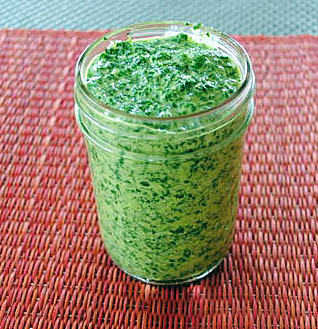
Squeeze the excess water from the arugula, coarsely chop it, and place it in the bowl of a food processor. Transfer the arugula to a food processor. Add the pine nuts, garlic, cheese and the 2 Tbs of olive oil, processing until the arugula and pine nuts are chopped. Immediately add the yogurt, process until smooth, and season with salt and pepper to taste.

Transfer the couscous to a large serving bowl and stir in some of the pesto, using as much or as little as you like.  Gently fold in the tomatoes and cucumber pieces.  Adjust seasoning, and….

ENJOY!

to print the recipe, click here

Comments:  We loved this recipe!   And I’m especially happy about my modifications of the arugula pesto.  Purists may roll their eyes, but I reduced the fat content of this baby to levels previously unknown to mankind!  Imagine my audacity, going from 1/2 cup of olive oil in the original recipe to 2 Tbs  olive oil  + 1/3 cup of yogurt!  That, my friends, is a drop from 954 calories down to 175.   I am not a fat-o-phobe, but I’ve played with yogurt and buttermilk long enough to learn that they often substitute well for oil, as illustrated in this example: the acidity in the yogurt kept the arugula bright and it added an interesting sharpness to the pesto.   Of course, you may also ignore my adaptation and use the full amount of olive oil. As Emeril Lagasse says, “…you won’t hurt  my feelings.”   😉

Olive oil is one of the healthiest options among fats, but any fat packs a huge load of calories.  If you struggle with weight issues (who doesn’t?), then be attentive to the amount of olive oil in your recipes and restaurant foods.  Salads are deceptively high in calories. Consider asking for dressing on the side, and use it sparingly.  Another dangerous option that seems healthy and light:   buffet platters of grilled veggies, such as eggplant and zucchini. They are  prepared with a substantial amount of olive oil, and eggplant in particular soaks it up like a sponge.  Be aware, make the right choices, and exercise portion control.  When you’re cooking at home try my low-cal pesto and see what you think.  It’s good to splurge with the real thing sometimes, but it’s also wonderful to find an alternative that makes you feel good when you leave the table.  😉

ONE YEAR AGO:  Heavenly Home-made Fromage Blanc

TWO YEARS AGO:  Pasta with Fresh Tomato Sauce

Add to FacebookAdd to DiggAdd to Del.icio.usAdd to StumbleuponAdd to RedditAdd to BlinklistAdd to TwitterAdd to TechnoratiAdd to Yahoo BuzzAdd to Newsvine

COUSCOUS SALAD WITH ZUCCHINI AND PINE NUTS

From one of the latest issues of Food and Wine magazine, this recipe was the only bright spot on a day in which everything that could go wrong (in the lab) went wrong.  But, as we were driving through intense Los Angeles traffic that Thursday, I knew that getting home and making dinner would improve my mood.  It always does, actually.  Especially if I already have it all planned and laid out in my mind, which was the case that day.

COUSCOUS SALAD WITH ZUCCHINI AND PINE NUTS
(adapted from Food and Wine, May 2011)

1 cup diced zucchini
2 Tbs olive oil
salt and pepper

1 cup couscous
1 cup boiling water

3/4 cup frozen peas
1/2 cup water
2 Tbs lemon juice
2 Tbs olive oil
1/2 cup pine nuts, lightly toasted
fresh mint and parsley, minced
salt and pepper to taste

Heat the olive oil in a non-stick skillet and sautee the zucchini until golden.  Season lightly with salt and pepper. You can prepare it in advance and keep it in the fridge.

Pour 1 cup of boiling water over the couscous in the bowl you intend to serve the salad. Cover with plastic wrap and let it sit at room temperature for 5-10 minutes as you prepare the rest of the recipe.

Boil the peas for 2 minutes, drain, reserving 1/4 cup of the water.  Add the lemon juice and olive oil, a little salt, to the reserved pea water, and whisk well.  Fluff the couscous with a fork, pour this dressing over it, mixing it well.  Gently mix in the cooked peas, reserved zucchini, toasted pine nuts, and fresh herbs.  Taste, adjust seasoning with salt and pepper, and serve.

ENJOY!

to print the recipe, click here

Comments:  Next time, I will dice the zucchini in slightly larger pieces, because I’d like their presence in the salad to be a little more obvious, not only visually, but also in texture.   I love the popcorn-y taste of pine nuts, but you can use almonds (as in the original Food and Wine version), or walnuts.  Make sure to toast them first.

It is crucial to let the zucchini get some color, so I like to leave it undisturbed in the sautee pan for a couple of minutes, before moving the pieces around.

This could be a nice vegetarian entree, as couscous is very filling, but we enjoyed it next to a juicy, grilled chicken breast.    And that was a perfect antidote for  the “lab-blues.”  😉

ONE YEAR AGO:  A Simple Salad a la Jacques Pepin

Add to FacebookAdd to DiggAdd to Del.icio.usAdd to StumbleuponAdd to RedditAdd to BlinklistAdd to TwitterAdd to TechnoratiAdd to Yahoo BuzzAdd to Newsvine

SPRINGTIME SALAD

The moment I saw this recipe in the latest issue of Fine Cooking, I knew I had to make it right away.  First, because it involves asparagus.  Secondly, because they are prepared in a novel way  – the spears are shaved as ribbons.    I am already quite fond of thinly sliced raw asparagus as in this farro salad, so I looked forward to trying this new (to me, anyway ;-)) method to serve them.

SHAVED ASPARAGUS SALAD
(adapted from Fine Coking magazine)

for the vinaigrette:
3 tablespoons rice vinegar
2 tablespoons lemon juice
2 tablespoons extra-virgin olive oil
2 teaspoons agave nectar  (or 1 Tablespoon honey)
1 tablespoon finely chopped shallots
salt and  black pepper to taste

for the salad:
1/2 lb. thick asparagus, trimmed
2 cups baby arugula
1/3 cup toasted cashew nuts
2 oz. thinly shaved aged Gouda

Make the vinaigrette by whisking together the vinegar, lemon juice, olive oil, agave nectar, shallots in a small bowl. Season with salt and pepper.  Refrigerate if not using right away.

Remove the tips of the asparagus and put them in a large bowl. Using a vegetable peeler, shave a stalk discarding the first shaving, which will contain only the thick outer layer.  When shaving the first side becomes awkward, turn stalk over and repeat. Add all shavings to the bowl with the tips. Repeat with remaining stalks. Toss asparagus with 1/4 cup of vinaigrette and let sit for 10 to 15 minutes.  Add arugula and toss, adding more dressing if needed to coat the leaves.  Top with the shaved cheese and cashews, adjust seasoning and serve right away.

ENJOY!

to print the recipe, click here

Comments:  This salad dressing is very close to perfection.  The original recipe used honey, but I’m so fond of agave nectar that whenever I have the opportunity, I use it instead.  Once you add the dressing to the shaved asparagus, the transformation is quite obvious: within a few minutes the ribbons start to soften up.   Don’t do it too early, or they will get mushy.   For obvious reasons, the salad won’t keep at its best for very long, so if you are serving it at a dinner party, keep that in mind.    The asparagus tips will retain most of their bite, adding a nice texture together with the cashew nuts.

At first, I thought about substituting parmiggiano or ricotta salata for the cheese component of this recipe. Aged Gouda is not a cheese we normally buy, but its slightly smoked taste worked surprisingly well with the arugula and asparagus.  We gave it two thumbs up!

I can see many variations of this recipe during Spring and Summer months.  And, I was not the only one who enjoyed it: browsing through “One Perfect Bite” the other day, I noticed that Mary also loved it.  Check it out by jumping here.

ONE YEAR AGO:  Indonesian Delight

Add to FacebookAdd to DiggAdd to Del.icio.usAdd to StumbleuponAdd to RedditAdd to BlinklistAdd to TwitterAdd to TechnoratiAdd to Yahoo BuzzAdd to Newsvine

ROASTED LEMON VINAIGRETTE

The rind of a lemon is exceptionally bitter, w...

Image via Wikipedia

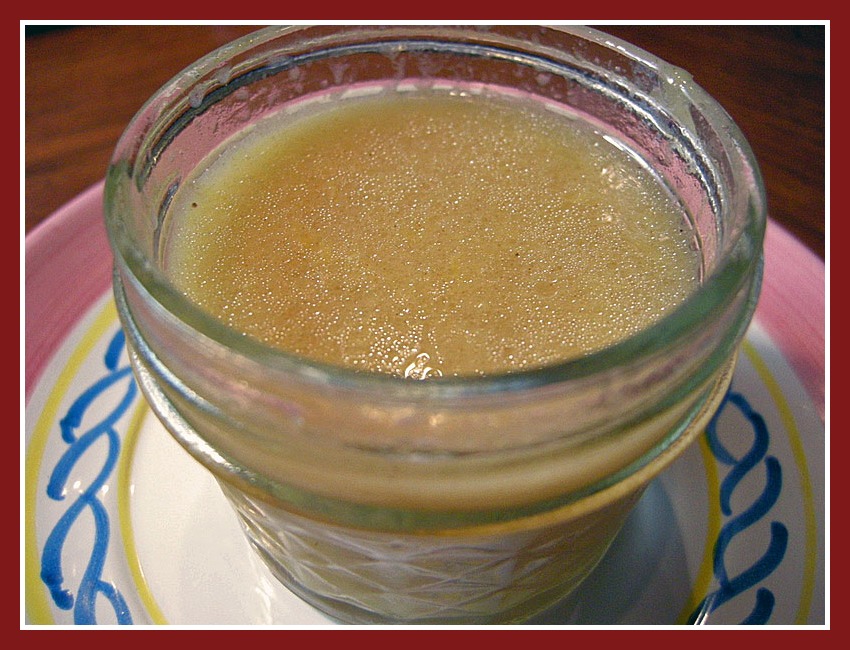
I had this recipe filed in my computer for 13 months.  All I can say is “better late than never.”  Please, make this dressing as soon as you can possibly gather the ingredients and spare half an hour of your time.   My friend Gretchen urged me to try it a long time ago,  but only the constant influx of Meyer lemons in our fridge set my wheels in motion. Consider making a double batch, as you will find many uses for this liquid gold: I drizzled over our salad, and next thing I knew, my grilled halibut was under its shiny coating too.

ROASTED LEMON VINAIGRETTE
(from Gretchen’s kitchen)

1 lemon (Meyer, if available)
1 tsp + 3 Tbs olive oil (divided)
1 clove garlic, unpeeled
1 tsp Dijon mustard
2 tsp honey
1/4 tsp salt
freshly ground black pepper to taste

Wash the lemon, cut it in half, remove the seeds with the tip of a knife. Rub the lemon halves and the garlic clove with 1 tsp of olive oil, place in a small baking dish and roast in a 400F oven for 25-30 minutes, until the lemon starts to get brown at the edges. Remove from the oven, and as soon as it’s cold enough to handle, squeeze the juice and the pulp in a small bowl.

Add the mustard, honey, salt, and pepper, and use a whisk to mix it all well. Remove any large bits of white pulp, if present. Add the remaining 3 Tbs. of olive oil, slowly at first, then drizzle it as you continue to whisk, forming an emulsion. Adjust the seasoning.

Serve over salads, steamed veggies, roasted veggies, grilled fish, chicken, or pork. Have fun with it, and…

ENJOY!

to print the recipe, click here

Comments: I cannot recommend this recipe strongly enough. It is simply perfect if you are into citric flavors. We usually make a big salad on Friday evenings, using any greens and other goodies left in the fridge. This dressing turned the “everything but the kitchen sink salad” into something special.  Next day, I used what was left in a farro concoction very similar to this one, except that I omitted the raw asparagus and added diced cucumber and fennel instead.  Farro and roasted lemon vinaigrette:  another example of a match made in heaven,  I hope you’ll give it a try.

ONE YEAR AGO: Torta di Zuchini

Add to FacebookAdd to DiggAdd to Del.icio.usAdd to StumbleuponAdd to RedditAdd to BlinklistAdd to TwitterAdd to TechnoratiAdd to Yahoo BuzzAdd to Newsvine

receita em portugues na proxima pagina
proxima pagina