A SMIDGEN OF A TART

One of my favorite food blogs is “Just a Smidgen”, from the lovely Barbara, a poet, mother, cellist, great cook, and superb photographer.  Each of her posts is a work of art, with carefully chosen words, and photos that will make you dream.  And, to top it all, everything she cooks makes my mouth water…   Last month she had this tomato tart featured on her blog, and since heirloom tomatoes insist on jumping in my grocery cart,  I immediately added it to my Pinterest cooking board for future reference.   Contrary to what usually happens, I made it right away, it was simply irresistible!

ROASTED HEIRLOOM TOMATO TART
(adapted from Just a Smidgen)

1 package puff pastry, defrosted (use one half for the tart)
5 to 6 heirloom tomatoes
olive oil
salt and cracked black pepper to taste
1 container of bocconcini mozzarella, drained (200g / 7 to 8 ounces)
1/4 cup tomato sauce
1/8 cup Parmigiano-Reggiano cheese, grated
2 tsp Herbes de Provence
1 egg

Heat oven to 400° F.

Roll out one sheet of puff pastry directly on a piece of parchment paper until it is about an 11” x 14” rectangle. Take a fork and poke holes all over the pastry, leaving a one-inch border all around. Using the palm of your hands, gently roll up to form a border of dough.

Within that border, spread the tomato sauce evenly then add the mozarella pearls over the top.

If your tomatoes are too juicy, slice them and place over paper towels to drain the excess moisture. Place them over the tart, overlapping slightly. Use different colors and sizes, it is supposed to be a rustic-looking tart.

Sprinkle with the herbes the Provence. Finish by sprinkling the grated Parmigiano over the surface of the tart.

In a small bowl, whisk the egg with a drizzle of water to make a wash. Brush this egg mixture on the border of the pastry.

Bake for about 30 minutes or until the puff pastry has risen and lightly browned, but start checking the bottom of the tart after 20 minutes, as depending on the moisture of your tomatoes, it could be ready earlier.

Cool slightly and serve warm or at room temperature, cut in squares.

ENJOY!

printable version available soon

Make sure to stop by Smidge’s blog to look at her gorgeous photos of the making of this tart.  The use of bocconcini mozzarella pearls was a nice touch. Although they may seem a bit bulky to lay on the tart,  they’ll melt into a thing of pure beauty and enticing creaminess, in a perfect marriage with the heirloom tomatoes.  Let me remind you once more:  if using overly juicy tomatoes, drain  the slices and pat them dry.  They will release more liquid during baking, so there will be no risk of ending with a dried up topping.

I hope there is no penalty for a blog with too many heirloom tomato recipes.  If there is, I’m in trouble, because there will be more, I’m afraid…  😉

Barbara, thanks for a great recipe!

ONE YEAR AGO:  A Tropical Street Market

TWO YEARS AGO: Groceries

THREE YEARS AGO:  A Souffle to Remember Julia Child

THE SECRET RECIPE CLUB: GRANOLA BARS

I knew the last Monday of this month would arrive at a particularly busy time, when we would be barely moved into our  new home, trying to adjust to the new environment.  I didn’t want to miss the party, so I had my  contribution  to “The Secret Recipe Club” taken care as soon as I got my  assignment.  This month I was matched with the blog  “Life and Kitchen”,  hosted by Lindsay, a super-busy young mom with a full-time job and a master’s thesis under way.  In other words, she struggles with a gazillion commitments, but still finds time to keep a great blog going!   Her writing is quite refreshing, I caught myself smiling all the way through reading many of her posts.  I finally settled on a recipe I’ve always wanted to make: granola bars.  They were a major hit in the Bewitching household, as I married a former-hippie.  Hope you try and like them too!   😉

GRANOLA BARS
(from Life and Kitchen, originally adapted from Ina Garten)

2 cups old-fashioned oatmeal
1 cup whole almonds
1/2 cup toasted wheat germ
3 tablespoons unsalted butter
3/4 cup honey
2 Tbsp brown sugar, lightly packed
1 1/2 teaspoons pure vanilla extract
1/4 teaspoon kosher salt
3/4 cup raisins
3/4 cup dried cranberries

Preheat the oven to 350 degrees. Spray a 8 x 12 inch baking pan with cooking spray.  Toss the oatmeal and almonds together and then toast them on a sheet pan by baking them for about 10 minutes, stirring occasionally.

When you take the toasted mixture out, reduce the oven temperature to 300 degrees.  Transfer the mixture to a large mixing bowl and stir in the toasted wheat germ.  Then add in the honey, brown sugar, vanilla, and salt while it is still warm and mix it all together.   Add the raisins and dried cranberries and stir well.

Pour the mixture into the prepared pan. Wet your fingers and press the mixture evenly into the pan.   Bake for 25 to 30 minutes, until light golden brown. Cool for at least 2 to 3 hours at room temperature before cutting into squares.

ENJOY!

to print the recipe, click here

Comments:  No matter how frantic your life might be, it’s good practice to read a recipe carefully before attacking the preparation.  It’s called common sense. Otherwise, you may set yourself up for trouble, like some people.

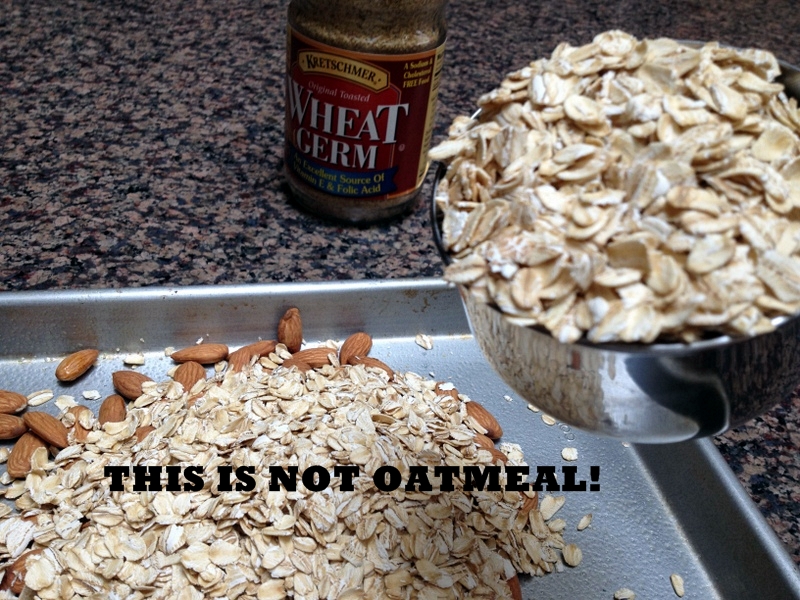
Indeed, I started by toasting 2 cups of rolled oats instead of oatmeal.  Once everything was nicely toasted, I realized my mistake, and did the only sensible thing to do: frantically ran around the house screaming at myself  “I am SUCH an idiot”;  “I am THE QUEEN of the idiots”!   Where’s George Costanza, my long lost brother?

Crucial decisions had to be made.  I had no time to start all over, and found only about one cup of oatmeal in our pantry.  I grabbed the baking sheet and scooped the mixture with one of those handy Chinese type tools, that kept the almonds and allowed the oats to fall back in the baking sheet.  By the way, oats that fly and fall on the kitchen floor will cool enough during their journey so they won’t pose a risk to your pets. Quite the opposite, they will be happy to do the cleaning for you.  

Once I got toasted rolled oats separated from toasted almonds, I saved 1 cup for the recipe, and mixed with 1 cup of oatmeal.  Proceeded without toasting the oatmeal, as the clock was ticking, and we had tickets to go see Prometheus at the IMAX. No way we could miss that.

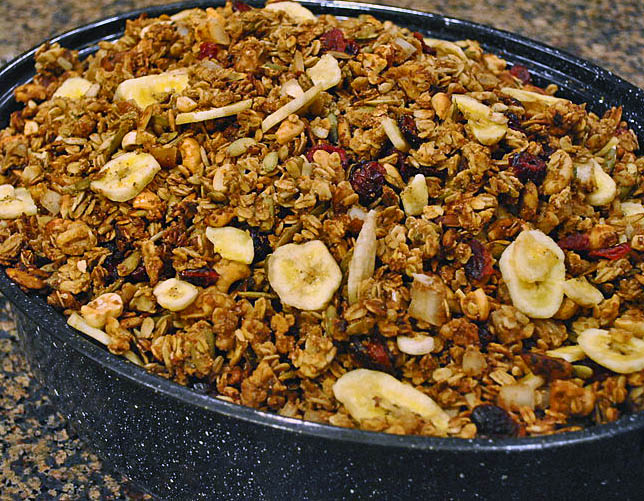
As a result, the bars were a bit more crumbly than they should, as oats don’t bind as well as oatmeal, for obvious reasons.  But, you know what? The crumbled pieces made FANTASTIC granola!

I ended up with enough squares to last us for a while, nicely wrapped (just make sure to let them dry well for a full day before wrapping).

Lindsay, it was great to “meet” you through this month’s Secret Recipe adventure!

And a reminder for my readers:  if you click on the crazy looking frog at the bottom of this post, you’ll see the contributions of all other members of Group D for this reveal day.  Make sure to check them out!

ONE YEAR AGO:  Awesome Broccolini

TWO YEARS AGO:  A Twist on Pesto

THREE YEARS AGO: Ciabatta: Judging a bread by its holes


THE SECRET RECIPE CLUB: ASPARAGUS QUICHE

The last Monday of each month arrives faster and faster, proving that Einstein got it right with his Theory of Relativity of time and space.  How else could we explain that I joined the SRC just a little while ago, blinked my eyes twice, and here I am, on my seventh post?

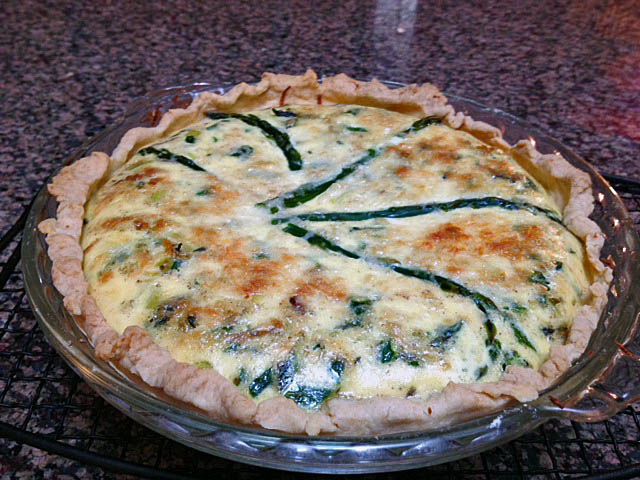
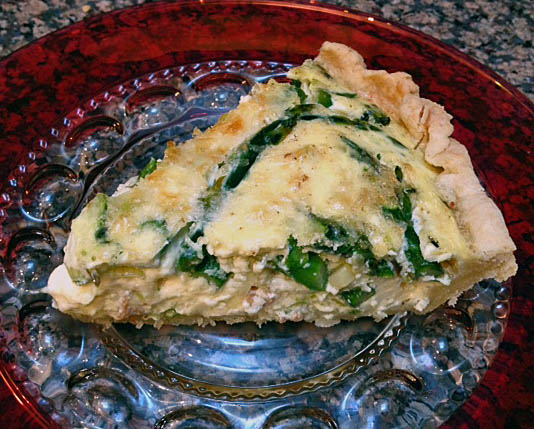
I had a complete blast with this month’s assignment: The Culinary Enthusiast!  A catchy blog name, by the way. Kelley lives in Chicago with her husband and a dog-child called Maddy, who gets to enjoy the many treats she cooks. See similarities between our households?   😉  Kelley has very creative recipes, and it took me a few days of “stalking” before I settled on my choice.   Asparagus Quiche.   Perfect for the season, perfect to remember Paris, perfect for a romantic weekend dinner.

SPRING ASPARAGUS QUICHE
(adapted from The Culinary Enthusiast)

1 recipe for pie crust (I used this one)
1 leek (white and light green parts only), halved and thinly sliced
salt and ground black pepper
1/2 bunch (about 1/2 pound) asparagus, tough ends removed, thinly sliced
3 asparagus stalks, trimmed and left whole (optional)
4 slices bacon, cut in large dice
4 large eggs
1 + 1/4 cups half-and-half
Ground nutmeg
1 cup shredded Parmesan cheese (4 ounces)

Prepare the crust of your quiche, using the recipe of your choice.  Roll it out to cover your pie plate.  Prick the surface with a fork a few times, cover the bottom with aluminum foil, and place dried beans to keep the crust down during pre-baking.   Bake in a 400 F oven for 15 minutes, carefully remove the foil, place it back in the oven for 10 minutes more.   Remove from the oven, and reserve.

Bring the oven temperature down to 325 F, placing a rack in the lowest position.  In a large skillet, cook bacon until crispy.  Set aside on a paper towel lined plate, allow it to cool, and crumble into smaller pieces.  Reserve bacon grease in pan and add the leeks, cook for a few minutes, until softened.  Add the asparagus pieces, season with salt and pepper. Cook until the asparagus is crisp/tender, maximum 6 minutes. Let the mixture cool down.

In a large bowl, whisk together eggs, half-and-half, 1/2 teaspoon salt, teaspoon pepper, and a pinch of nutmeg. Place pie crust on a rimmed baking sheet. Sprinkle with half of the cheese; add the asparagus/leek mixture, top with crumbled bacon. Pour egg mixture on top, add the remainder of the cheese.

If you want to decorate the quiche with asparagus stalks, cook them slightly in a microwave for a minute, then place carefully on top.

Bake until center of quiche is just set, 50 to 60 minutes, rotating sheet halfway through. Let stand 15 minutes before serving.

ENJOY!

to print the recipe, click here

My main modification of the recipe was to pre-bake the crust, because I’ve had problems with the crust getting too soggy when I omitted that step.  I also did not use potatoes in the filling, but I know it would be awesome with them too!

As far as quiche goes, Phil and I had the perfect example at a small, unassuming place in Paris, called “Bistrot du Papa”.  Don’t go through the trouble of googleing it, it no longer exists.  We were in considerable distress when we attempted to go back on our last visit, only to find an Italian restaurant in its place.  Ever since enjoying that masterpiece, I tried to make it at home a couple of times, the traditional quiche Lorraine, but my versions had very little to do with the bistrot’s.

I must say this asparagus quiche was by far the best I’ve made!  Will I ever hit “Bistrot du Papa” level?  Quite unlikely.  They have a different type of cream, a different type of bacon, and then there’s the Parisian aura, hard to duplicate at home.  Oh, well…   We should have stopped there once a week for the duration of that magical sabbatical year!

We’ll always have Paris…
(great scene from Casablanca, 1942)

Kelley, thanks for a great recipe that brought the best gastronomical memories to our table!

Check out the other recipes in this month’s roundup  by clicking on the cute blue frog at the end of this post.

ONE YEAR AGO:  Spring Pasta

TWO YEARS AGO: Ice Cream Melts for Mango


Add to FacebookAdd to DiggAdd to Del.icio.usAdd to StumbleuponAdd to RedditAdd to BlinklistAdd to TwitterAdd to TechnoratiAdd to Yahoo BuzzAdd to Newsvine


THRILLING MOMENTS

June 2006: crossing the finish line in my first (and only) marathon…

March, 2009:  cutting a slice of my first (but not only) successful sourdough loaf,  and marveling at the open, airy crumb…

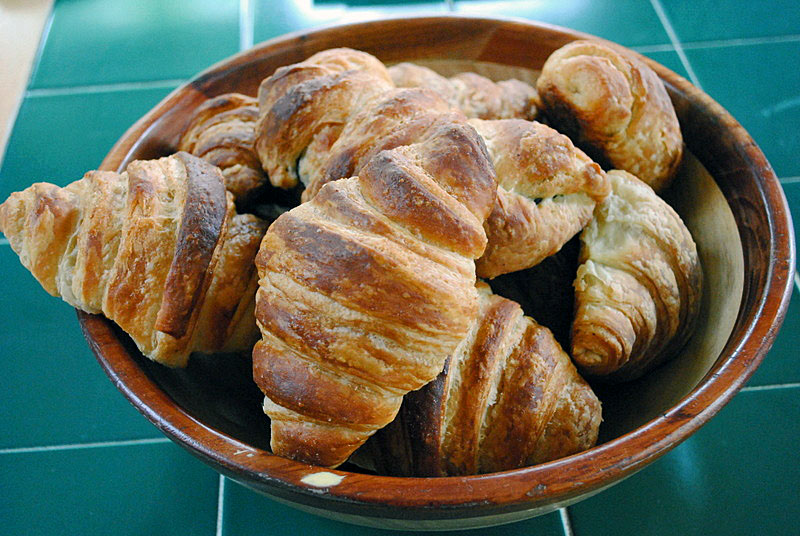
April 2012: making croissants that finally brought an important bit of Paris to our home!
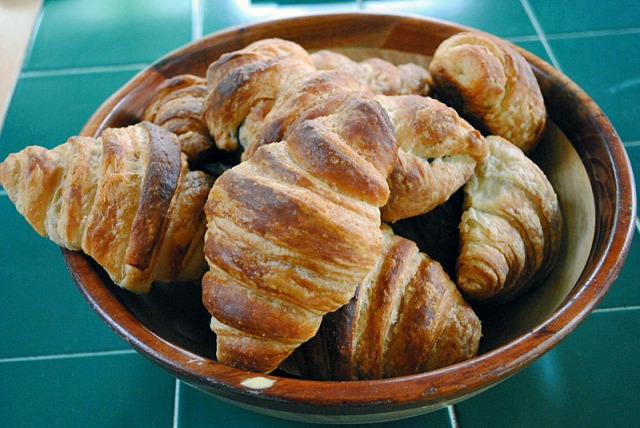
I am not sure how many times I’ve tried to make croissants, perhaps five or six, but each and every occasion left me disappointed and  frustrated.  I didn’t  throw in the towel, though, and you may remember that I included croissants as one of my cooking projects for this year.   Since January,  I assembled all the recipes, tips (thanks once more, Gary!), and blog posts on the subject, finally settling on the recipe from Peter Reinhart‘s Artisan Breads Every Day. I couldn’t be happier, aren’t they cute?

Without further ado, here’s the full recipe, with photos that walk you through  the process.

CROISSANTS
(published with permission from Peter Reinhart,
recipe from  his book Artisan Bread Every Day)

for the “detrempe
4 + 2/3 cup all purpose flour (21 oz / 595 g)
1  + 3/4 tsp. salt (0.4 oz / 11 g)
1/4 cup sugar (2 oz / 56.5 g)
1 Tbs  instant yeast (0.33 oz / 9 g)
3/4 cup + 2 Tbs milk (7 oz / 198 g)
1 cup cool water (8 oz / 227 g)
2 Tbs melted butter (1 oz / 28.5 g)

for the butter block:
1 + 1/2 cups cold butter (12 oz / 340 g)
2 Tbs flour (0.57 oz / 16 g)

Make the dough (detempre) by whisking the flour, salt, sugar and yeast in a mixing bowl. Pour in the milk and water, then add the butter. Mix with the paddle attachment on the lowest speed for about 1 minute, stop, and check that the dough is shaggy.  It should not be too firm as you’d expect from a bread dough.  Adjust with a little water or a little flour if too wet.  Mix again for a couple of minutes, transfer to a board, form into a ball  and refrigerate overnight (or up to 2 days) inside an oiled bowl.

Make the butter block on baking day.  Cut the cold butter in 16 pieces, and place them in the bowl of an electric mixer together with the flour. Use the paddle attachment for 1 minute to incorporate the flour into the butter, without allowing it to melt.  Transfer the butter/flour to a piece of parchment paper (spray the surface of the paper with a little oil), and form into a 6 x 6 in square, about 1/2 inch thick.  Be as precise as you can with the measurement, and try to form it into a neat, straight-edged little package.  Cover the square with a plastic wrap and refrigerate for 10 minutes (or longer, if convenient).

Transfer the dough from the fridge to a floured work surface, sprinkle more flour on top, and roll the dough to a rectangle 12.5 inches wide and 6.5 inches long.  Square off the edges, try to keep it all straight.   The dough should be about 1/2 inch thick.  Place the butter block on the left side of the rolled out dough, check that only a border of 1/4 inch is left between the butter and the edge of the dough.  If necessary, roll the dough out a little more.  Lift the right side of the dough and cover the butter, stretch the dough to cover it all well, and pinch the edges to fully enclose the butter.

Lift each side of the package of dough/butter gently, toss more flour underneath, flour the top again, and gently tap the surface of the package with a rolling pin, to distribute the butter evenly into the four corners.  Roll the dough to a rectangle 16 inches wide and 9 inches long.  Again you should aim for a 1/2 inch thick dough.   Square off the edges as nicely as possible, and fold the dough as a letter in an envelope: fold the right one-third to the left, and the left one-third of the dough to the right.  Transfer the dough to a floured baking sheet, and place in the fridge for 20 minutes.

Place the dough again on a floured surface, with the open seam facing away from you and the closed side facing you.  Gently roll the dough again to the same dimensions (16 x 9 inches).  Fold again in thirds.  Let it rest in the fridge for another 20 minutes, and repeat this exact rolling and folding procedure one more time.  Let the dough rest 20 minutes more, and get ready for the final rolling and cutting of croissants.

If working the full dough at once, you will need to roll it as a rectangle 24 to 28 inches wide, and 9 inches long. If you prefer, cut the dough in half, and roll it to 12 to 14 inches wide, 9 inches long.  Once the dough is fully rolled (about 1/4 inch thick), make marks starting at the left side of the bottom part of the dough, placing a small notch at 4-inch intervals. Repeat the same on the top part of the dough, but start at the 2 inch mark from the left.  Use a pizza cutter to cut a line from the left bottom corner of the dough to first notch on the top part of the dough (at the 2 inch point).  Go on connecting the marks to cut triangles.  When all pieces are separated, cut a 1 inch notch into the bottom center of the triangle base of each piece (that helps the croissant get its curved shape).  Spread the bottom as wide as the notch will allow to create wing-like flaps. Start with the flaps and begin rolling up the dough as you would roll a rug.  Stretch the pointed end of the triangle as you roll, trying to elongate the dough.  Make sure the end of the croissant stretches all the way under it, so that it remains rolled as it rises and bakes.

Place the croissants on a baking sheet lined with parchment paper, and let them rise at room temperature for 2 and a half to 3 hours. Brush the surface with egg wash if desired.  Heat the oven to 450 F F (232 C), place the croissants inside, and reduce the temperature immediately to 375 F (190 C). Bake for 15 minutes, rotate the pans, and bake for an additional 15 to 20 minutes, until golden brown on all sides.

Allow the croissants to cool on a rack for 45 minutes to 1 hour.

ENJOY!

to print the recipe, click here

Now, allow me to show you a few photos of the process, which seems intimidating at first, but if you pay attention to a few details, it will be quite doable.
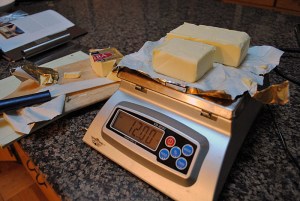
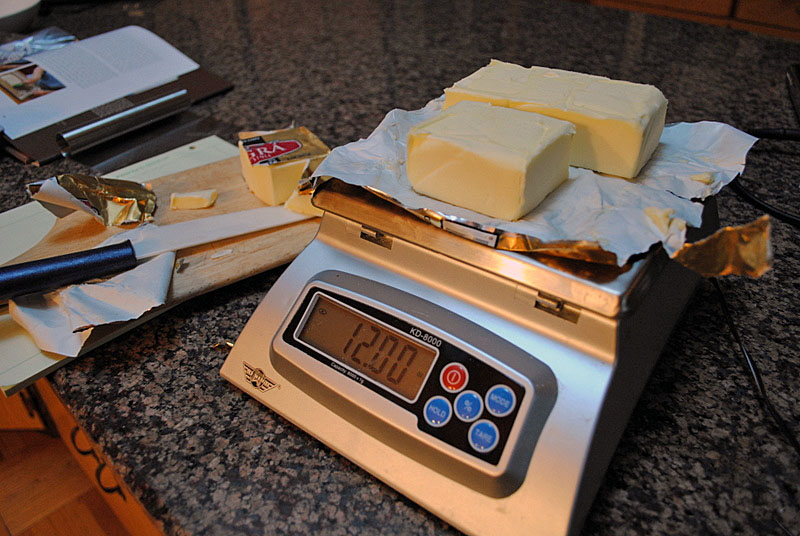
Use good quality butter, I recommend getting Plugra if you can find it, and measure the amount with a scale, no eye-balling here.  We are talking croissants, let’s make them pretty!   😉
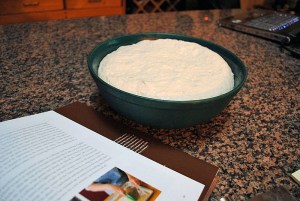
After its rest in the fridge overnight, the dough will have risen quite a bit, and will be all puffy and nice to work with.  Working with it straight from the fridge will make it much easier to handle.

Be as precise as possible with the measurement,  each step matters, a little liberty here, a little liberty there, and your croissants will suffer.  Let’s make them pretty!   😉

The dough is rolled out  and the butter square is placed on one side, then all you have to do is fold the dough over it and pinch the edges, enclosing the butter completely inside the dough.
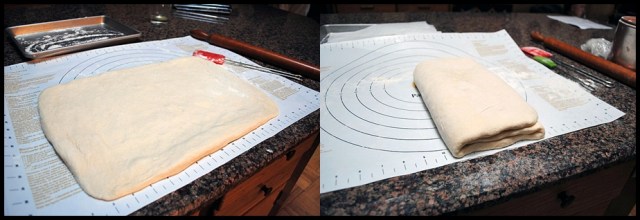
And the fun begins, rolling the dough to the right dimension (16 x 9 inch rectangle), then folding it in three, like a letter to be mailed to a dear  long-distance friend…  The package goes to rest in the fridge for 20 to 30 minutes, and the whole thing is repeated two more times (two additional series of rolling and folding in three).  Please notice my rolling pin, a gift Phil gave me for my Birthday. It is an antique piece that handles any dough extremely well.  Plus, I find it  very beautiful!

If you have a loooooong surface to roll the final dough out, go ahead and do the whole thing in one step.  I found it easier to cut the dough in half,  roll it, mark the spots to cut the triangles, and form the croissants from that half.  Place them on a baking sheet for the final rise, and move to the second portion of the dough.  Easy as pie!  One telling sign of the quality of your dough is how much can you stretch it without tearing it.  In my previous attempts, I could barely stretch it at all, but this recipe made the most elastic and forgiving dough ever!
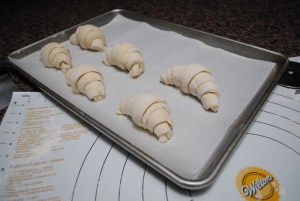
Once they rise for a couple of hours, they will be noticeably bigger and plumper.

Brush them with egg wash (I think it makes for  beautiful croissants, with a nice shinny surface), and place in the oven, resisting the temptation to peek too often.  A little peek every once in a while is ok, particularly if you are a food blogger overly excited by your first good looking batch of croissants and anxious to get just one more photo…
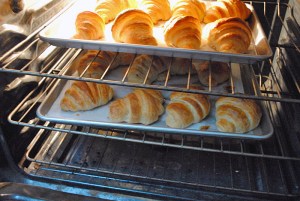
And then, once they are all baked, allow them to cool for 45 minutes minimum. One full hour is even better, so that the butter sets in and gives you the best texture as you bite through the croissant.

In the end, all your hard work will be rewarded, I promise!
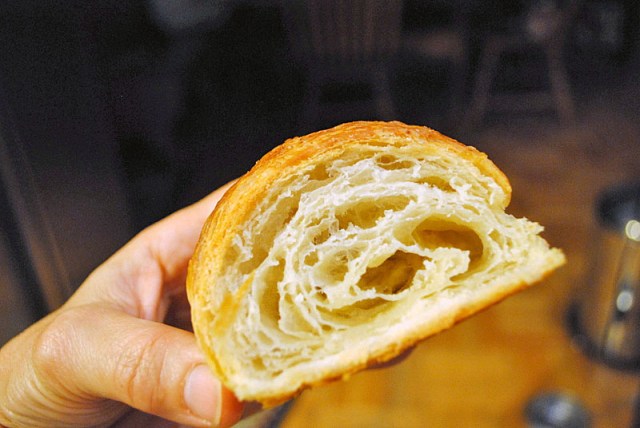
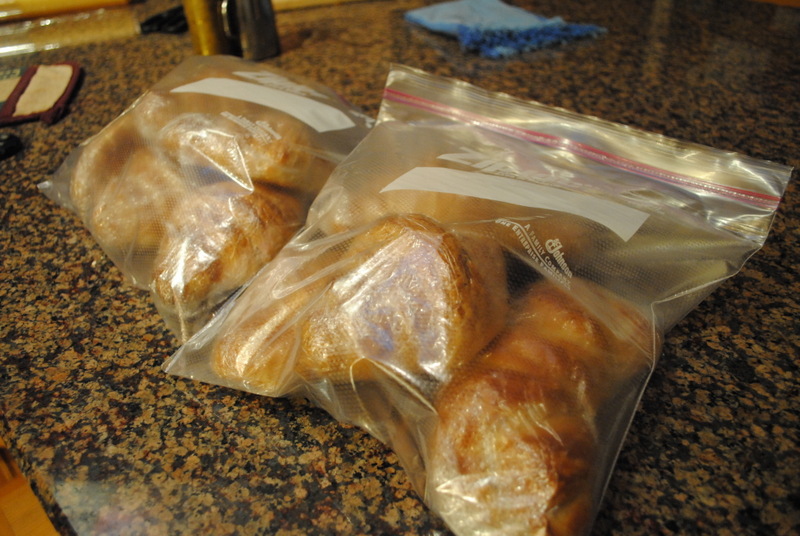
With all that in mind, is it feasible to have freshly baked croissants for breakfast?  Honestly, I find that a bit tricky.  Even if you retard the final proofing in the fridge, you will still have to let them come to room temperature to bake, and that will take about 1 hour, half an hour more to bake, and the gruesome wait of 45 minutes to attack them.  Maybe it would be possible to bake a batch for an 11am brunch,  but other than that, I think it’s much better to bake them, let them cool, and wrap each one individually to freeze.  You can see  here the results of my labor, ready to be enjoyed in the near future. Once you wake up with that unstoppable urge to have a warm-from-the-oven croissant,  simply unwrap them, leave at room temperature 10 minutes, and place in a 300 F oven for 5 minutes.  Voila’, mes amis:  great croissants whenever you feel like it!

I am grateful to Peter Reinhart for writing a great tutorial for croissants in his book, and of course for allowing me to publish his recipe on my blog. Thank you!

I am submitting this post to Susan’s Yeastpotting event…

ONE YEAR AGO: Maple-Oatmeal Sourdough Bread

TWO YEARS AGO: Pork Trinity: Coffee, Mushrooms, and Curry

Add to FacebookAdd to DiggAdd to Del.icio.usAdd to StumbleuponAdd to RedditAdd to BlinklistAdd to TwitterAdd to TechnoratiAdd to Yahoo BuzzAdd to Newsvine

GOLDEN AGE GRANOLA

It’s been a while, but it’s my pleasure to re-introduce my favorite guest blogger, who made a few past appearances in the Bewitching (remember guacamole?).  My beloved husband, who at age 21 was almost as handsome as he is today, shares with you his recipe for the best granola ever!   It pains me to admit it comes from a former girlfriend, but chances are I bake a better bread, and play a much meaner  round of golf. So, there!  😉
.


We spent part of our winter holiday in Sedona, AZ, where we enjoyed one of the local stores, the New Frontiers Natural Marketplace.  Still, I nearly choked on the price of some of their whole grain cereals: $13 or more for a pound of granola. It convinced me to get off my ass and make my own granola, so here’s my recipe from the golden age of peace and love: 1973.

We lived in a big Green House on Capitol Avenue in Lansing, MI, and this recipe became a staple of our diet.  It’s where me and Dave (together in the picture), Jimmy, Al and Joey spent a few years, chasing girls, cooking for each other, and listening to great music on Dave’s JBL speakers. I was 21 and dating Susie, who made the best granola anywhere, from Ann Arbor to Bloomington to Madison.

For us it was a golden age, of optimism, exploration, righteousness, liberation and natural foods.  When  you put together the ingredients for this recipe you’ll understand (and embrace) the meaning of  “grain brain.” Nothing’s better than this kind of natural food.   Once you make it and have a morning bowlful, you may never return to the preposterous prices of commercial granola.  The cost of this recipe has at least tripled in the nearly 4 decades I’ve made it, from about $10-12 to near $40 per batch, but it makes about 15 pounds, bringing the cost to a more realistic $2.50 per pound.   Cost aside, the granola’s flavor is unforgettably nutty and hearty, and the beauty of the recipe is its flexibility: you can change it in whatever way you want to customize the cereal.  Want a gluten-free version?  Then skip the wheat germ and use oat bran instead.  Don’t care for walnuts?  Use pecans instead.  Allergic to peanuts?  Substitute sunflower oil for the peanut oil.  I usually add raisins and chopped dates, which are excellent, to the baked granola, but in this batch I added dried cranberries and banana chips for a change of pace. Or leave out the banana chips and eat a bowl with fresh banana slices.  Mmmmm, that’s good!

Now, this is not a low-fat granola.  It’s a natural, whole-grain mix that gives you a mouthful of rich flavors in every bite.  To control the calories, just eat less (which you may find difficult!).
GOLDEN AGE GRANOLA
(from PEK)

Ingredients

1.  Mix the dry ingredients in a large (huge) pan or bowl:
3 pounds rolled oats
1 pound raw wheat germ
1 pound chopped walnuts
1 pound other chopped nuts (hazelnuts, pecans, cashews, almonds or a mixture)
1 raw, chopped coconut (water drained and reserved)
1 pound sunflower seeds
1 pound pepitas
1 pound brown sugar

2.  Mix the wet ingredients in a large (½ gallon) container:

water from the coconut
2 cups hot water
1 cup peanut oil
1 cup sesame oil
1/3 cup honey
1/3 cup agave nectar
1/3 cup molasses
1/3 cup maple syrup (or, use whichever of these sugars you prefer in the proportion you desire)
2 T vanilla

Heat the oven to 325 F.  Mix the dry ingredients very well in a large roasting pan or a huge bowl.  Whip the wet ingredients with a whisk or fork and pour half of it over the dry ingredients.  Mix well and then pour the remainder of the wet ingredients over the batch.  Mix very well with a large spoon, making certain that all the materials become uniformly moistened.  Spread the cereal on cookie sheets, about 3/4 in thick, and bake for 45 – 60 min, turning with a spatula every 15 min.  Let the granola cool, combine the baked batches and add some dried fruits: raisins, dates, apricots, cranberries, blueberries or banana chips … your choice, about 1.5 pounds.  Store the cereal in a large, airtight tin or vac-pack it in 1-2# pound portions.

ENJOY!

to print the recipe, click here

Some photos of the process (click on the pictures to enlarge)…

The ingredients…

Mixing the dry ingredients…

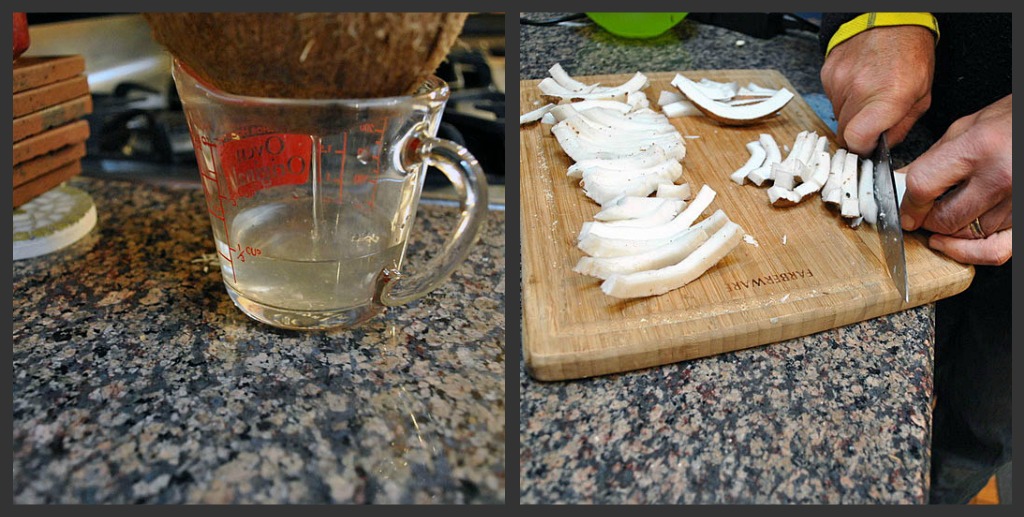
Draining and chopping the coconut…

Chopping the nuts…

Mixing dry and wet ingredients…

Baking, turning, and cooling…  the final stretch!

ONE YEAR AGO: Mushroom Souffle for Two

TWO YEARS AGO: Stollen

Add to FacebookAdd to DiggAdd to Del.icio.usAdd to StumbleuponAdd to RedditAdd to BlinklistAdd to TwitterAdd to TechnoratiAdd to Yahoo BuzzAdd to Newsvine