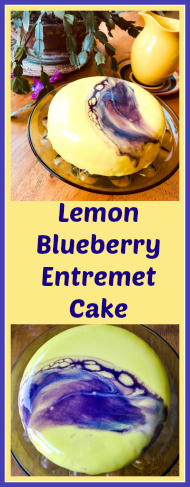
LEMON-BLUEBERRY ENTREMET CAKE: A SHOUT FOR SPRING

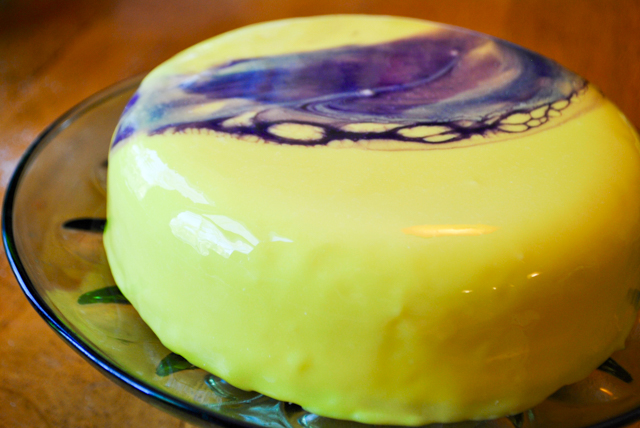
Don’t even get me started on my thoughts about this winter. It drags, it is unbearably cold, snowy, pathetic. You may be reluctant to take the word of a Brazilian about it, but I quote my beloved husband, the Michigander: this is the worst winter we’ve had in 10 years. So there. He said it. I had no choice but to make a cake that brings the colors and brightness of Spring to the table, hoping to coach the weather into following suit. A cookie base, a chocolate genoise layer, a blueberry compote, all surrounded by a smooth lemony mousse. Want to know what makes me very happy? It is my very own recipe. Take THAT, former cake-o-phobe self!
Since there are so many components, I am giving each recipe separately so that if you like to make a single component, it will be easier to follow. Little advice for you:
Make. The. Mousse.  

LEMON-BLUEBERRY ENTREMET CAKE
(from the Bewitching Kitchen)

equipment needed:
Silikomart Universo mold (or a springform type pan with 8 inches in diameter)
round cake ring, around 7 inches (to cut cookie base and freeze the insert)

for the cookie base:
80 g of softened butter
65 g powdered sugar
5 g vanilla sugar
1/8 teaspoon vanilla extract
2 egg yolks
90 g all purpose-flour
10 g almond flour
1/4 teaspoon of baking powder

Heat the oven to 350 F.  In a bowl beat the butter, the powdered sugar and the vanilla sugar until light and fluffy. Add the egg yolks, one by one, constantly beating. In another bowl sift the flour and baking powder and add to the previous mixture. Finally, add the almond flour. Stir very well. The dough does not get too thick or too liquid, the texture must be creamy.

Spread the dough as a circle, about 1/8 inch thick, smooth the surface with a spatula. Bake for about 15 minutes (depending on the oven) or until golden brown. Remove from oven and let cool slightly. Then, cut a circle just slightly smaller than the diameter of your silicone mold. Make sure it fits snuggly into the opening of the mold.

for the chocolate genoise:
113 g unsalted butter
2 tsp vanilla extract
140 g cake flour
55 g Dutch process cocoa powder
8 large eggs
225 g granulated sugar

Heat the oven to 350 F. Line the bottom of two 8″ cake pans with a parchment round.  Melt the butter in a small saucepan, transfer to a bowl and reserve.

Sift together the flour and cocoa, set aside. Put the eggs and sugar in a mixer bowl. Set the bowl over a pan of simmering water and whisk until the eggs are lukewarm. Put the bowl onto the mixer and whisk until the eggs are tripled in volume.

Sift half the flour/cocoa over the egg mixture and use a balloon whisk to fold, repeat with the remaining flour/cocoa. Whisk a little bit of the batter into the melted butter, and add the vanilla extract. Fold the butter mixture into the rest of the batter. Fold gently to avoid deflating the mixture too much. Divide the batter evenly between the pans.

Bake until the cake springs back when pressed in the center, about 30 minutes. Cool in the pan for 10 minutes before turning out onto a cooling rack. Slice the cake in half lengthwise to the thickness you want for your entremet. I cut it a little less than 1 inch thick. Leftover cake can be frozen for a few months, well-wrapped in plastic.

for the blueberry insert:
150 g blueberry puree (blueberries processed in food processor until reasonably smooth)
6 g gelatin (Gold, about 3 sheets)
16 g granulated sugar
2 drops bergamot essence oil (optional)

Add the gelatin sheets into a bowl with very cold water and let it sit for 10 minutes.  In a small sauce pan, cook the blueberry puree with the sugar until the sugar is fully dissolved. Add the bergamot essence, check that the temperature is below 175 F, then add the softened gelatin sheets, well-drained from the water.  Mix well.

Add the puree inside a 7 inch cake ring lined with plastic wrap and placed over a baking sheet and freeze it. You can also use any other type of mold you like, as long as it is smaller than the Silikomart mold used to assemble the entremet later. Also keep in mind that you’ll need to easily un-mold the blueberry compote after it’s frozen solid, so choose your gadget carefully. You can leave it in the freezer for 3 hours or several days.

When the compote is frozen, place a layer of genoise chocolate cake on top of it, press gently to form the final insert of the entremet.

for the lemon mousse:
2 eggs
juice of 2 lemons
100 g granulated sugar
30 g butter, cold
6 g gelatin (Gold, about 3 sheets)
280 g whipping cream

Place the gelatin sheets inside a bowl with cold water and leave it for 10 minutes.

In a sauce pan, preferably non-stick, add the eggs, sugar and lemon juice. Cook stirring often over gently heat, until it thickens slightly . Aim at a temperature of 170 F, do not let it go higher than that, or you will scramble the eggs and ruin it completely.

Remove from the heat, pass it through a sieve into a glass bowl. Once the temperature is below 175 F, add the gelatin and the pieces of cold butter. Mix gently.  Put a plastic over the surface and allow it to cool to room temperature.

Once it is almost cooled, beat the whipping cream to soft consistency. Add it to the lemon curd, folding it gently. Your mousse is ready to use.

for the yellow mirror glaze:
100 g glucose
100 g granulated sugar
100 g white chocolate, cut in small pieces
50 g water
65 g condensed, sweetened milk
6 g gelatin (about 3 sheets)
1/2 tsp titanium oxide (optional, but worth it)
yellow food dye 

Place the gelatin sheets inside a bowl with cold water for 10 minutes as you prepare the other ingredients.

In a sauce pan, heat the glucose, sugar and water until boiling. Make sure the sugar is fully dissolved. Let it cool slightly, and add to a bowl with the white chocolate in small pieces. After a few minutes, use a spatula to dissolve the chocolate. Add the gelatin and the condensed milk, and mix gently, try to avoid incorporating air bubbles. Add the titanium oxide and the yellow food dye. Place the mixture in a tall, plastic container and use an immersion blender to fully emulsify the glaze. At this point, you can either wait for it to cool to the pouring temperature (about 96 F), or place it in the fridge overnight, with plastic film touching the surface.  In both cases, right before glazing the cake, pass the mixture through a fine sieve to burst any small bubbles that might interfere with the mirror effect.

for the spider web effect:
2 tablespoons neutral glaze (store-bought or prepared from scratch, recipe here, omit the cinnamon)
purple food dye

Heat the neutral glaze to 150 F.  Add the purple color. Mix well. Keep hot until needed, with a hot spatula ready to go.

FINAL ASSEMBLY: The dessert is assembled inverted, that is the top will be at the bottom of the Silikomart mold. Start by spreading about 1/3 of the lemon mousse inside the Universo mold. Make sure to use the back of a spoon to smooth the sides of the mousse all around, to avoid large bubbles to stay near the surface.

Remove the blueberry-genoise insert from the freezer and place it gently over the mousse, with the cake facing up. Add a little more mousse all around the sides, then finish with the cookie layer. Use any leftover mousse to fill all gaps, press the cookie gently to make it leveled with the opening of the mold. Wrap it all in plastic and freeze at least 6 hours, preferably overnight.

Have the yellow mirror glaze at 96 F, with bubbles removed by sieving. Have the purple neutral glaze ready at 150 F. Un-mold the frozen cake, place it elevated over a rack so that the glaze can freely drip from the sides. Smooth the surface with your hands, but work quickly to avoid condensation of water on the surface.  Pour the yellow glaze on a circular motion, making sure all cake is covered by glaze. Immediately grab some purple neutral glaze with the hot spatula and smear over the surface, preferably a little off-center.  The effect will depend on many factors, including how much pressure you apply to the spatula, and the temperature differential between the two color glazes.  Once the glaze stops dripping, you can use a knife to clean the bottom, and carefully move it to a serving platter.  Defrost it in the fridge for at least 2 hours before serving.  Use a hot knife to slice into pieces.

ENJOY!

to print the recipe, click here
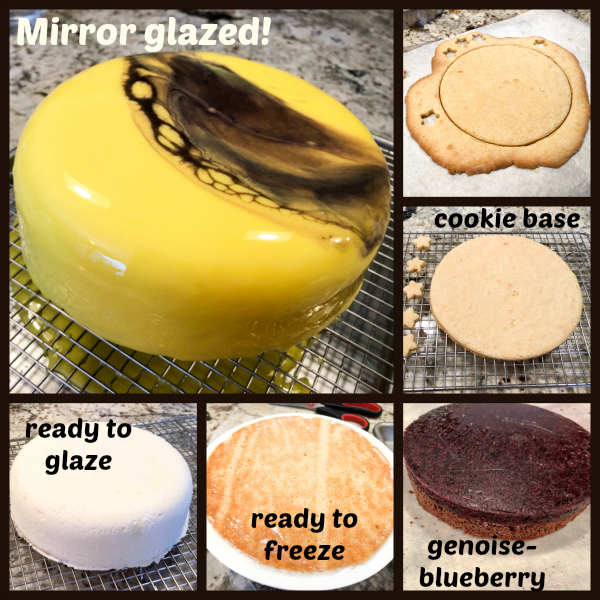
Comments: This dessert was planned in a very unusual way. Instead of choosing cake or mousse flavors, I started with the colors of the glaze. I know, crazy! I wanted bright, contrasting colors in a spider-web style. Yellow and purple popped in my mind. Only then I decided on the flavors of lemon and blueberry. Entremets join several components of contrasting textures, but to simplify it  I opted for a single element with a crunchy nature, the cookie base from this blog post by Miúda. To cut the sharpness of the lemon and add another type of texture, a chocolate genoise was included. Confession: I had it in the freezer from another baking project. With those components in mind, I went to work, using some bits and pieces found online, and some general instructions from “The Pastry Chef’s Little Black Book “ which I highly recommend. It is a very extensive list of basic formulas and variations. If you want to come up with a mousse, a compote, a genoise, you can find all the do’s and don’ts in that book.
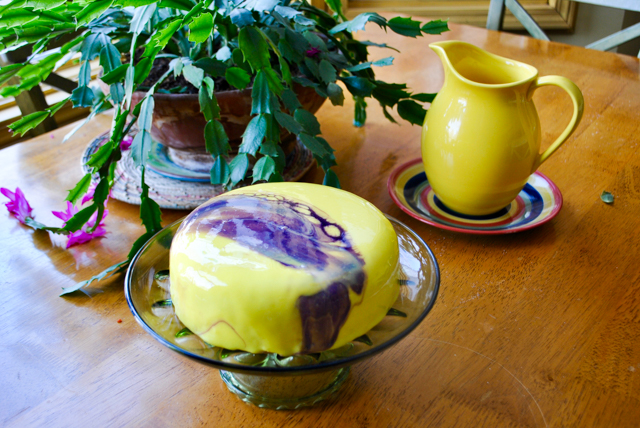
The spider-web effect: I’ve been flirting with the idea of trying it for a long time. In theory, it is quite simple. If you are comfortable mirror-glazing a frozen mousse cake, you are 80% of the way there.  The method was created by Gerald Sattler, and is based on the non-miscibility of water and oil.  Mirror glazes are oil-based (cocoa butter, sometimes condensed milk and other types of dairy) while neutral glaze is water-based. You use the neutral glaze at a higher temperature not only to spread it easily, but because it slows down the gelling of the mirror glaze and the setting of the cocoa butter present in it.  The combination of a water-based environment with the shock of temperatures generates the interesting effect, making each cake unique. The process is absolutely fascinating. Take a look at one of Sattler’s videos here, and be ready to be amazed. The effect can be achieved in ways other than the spatula. Yes, yours truly is already planning her next adventure…
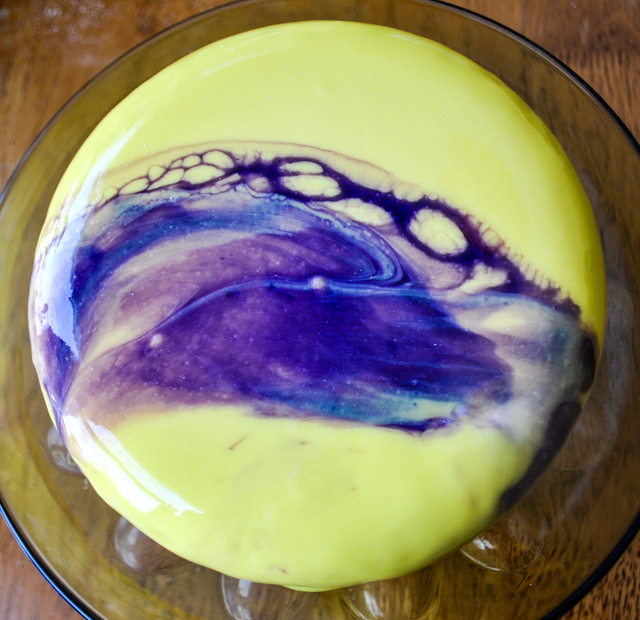
The purple color became more “purple” once the glaze set. If you look at the composite picture, taken right after pouring, you’ll notice a more “brownish” color, which made me at first a bit hysterical worried. But it definitely changed as it cooled, and the real nature of the dye I used came through. Happy ending… always a nice thing.
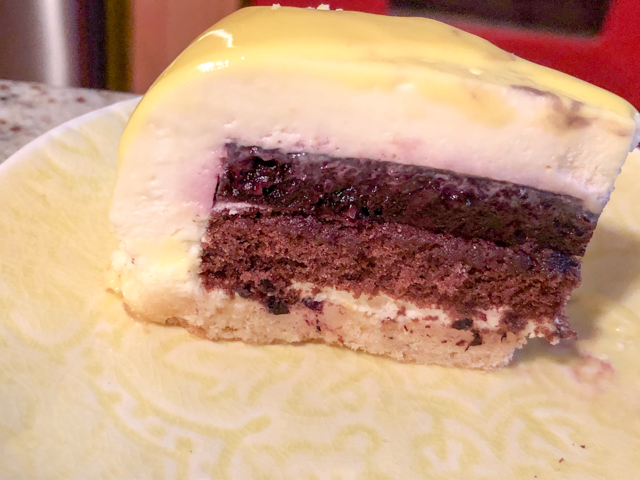
Here you see the slice showing the layers. The cake changed a bit by sitting in the fridge overnight.  I added the glaze around 2pm, and cut a test-slice in the evening. At that point, the cookie base was very crunchy and the cake was more on the dry side. Genoises are usually moistened with some type of syrup, but since this was going to be surrounded by a mousse and a compote, I used it without any added moisture. Next morning I cut the cake to take to the department and it was considerably improved. The cookie base not as tough, very easy to cut through and with a more melt-in-your mouth characteristic. Similarly, the cake was more moist and tender.

All in all, I’m very happy with this dessert. The lemon mousse component was the real winner.  In fact, if you’d like to serve a mousse by itself, maybe with a small cookie as adornment, consider this exact lemon version. Very refreshing, bright in the palate, smooth and with the right amount of sweetness.

I hope you enjoyed my first adventure in Spider Glaze Territory. I wanted a more prominent spider effect, but I was going absolutely crazy and losing my composure it’s hard to figure out what to do on a first time. Details such as how much neutral glaze to add, how hard to press the spatula, the exact temperature of the glaze when spreading it, they all have a huge impact on the final look. It’s such a fun technique, though. I can hardly wait to try it again. Stay tuned…
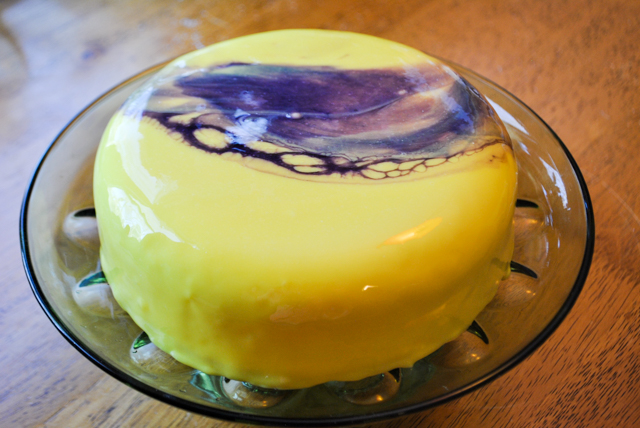

Grab a pin before you leave….


ONE YEAR AGO: Walk Strong3: A review of Jessica Smith’s latest workout program

TWO YEARS AGO: Pork Medallions with Black Berry Compote

THREE YEARS AGO: Indian-Spiced Chicken with Chickpeas and Spinach

FOUR YEARS AGO: Curry Cardamon Cookies

FIVE YEARS AGO: In My Kitchen, March 2014

SIX YEARS AGOBoeuf Bourguignon for a Snowy Evening

SEVEN YEARS AGO: Chickpea Salad

EIGHT YEARS AGO: Soft Spot for Chevre

NINE YEARS AGO: Roasted Onion and Asiago Cheese Miche
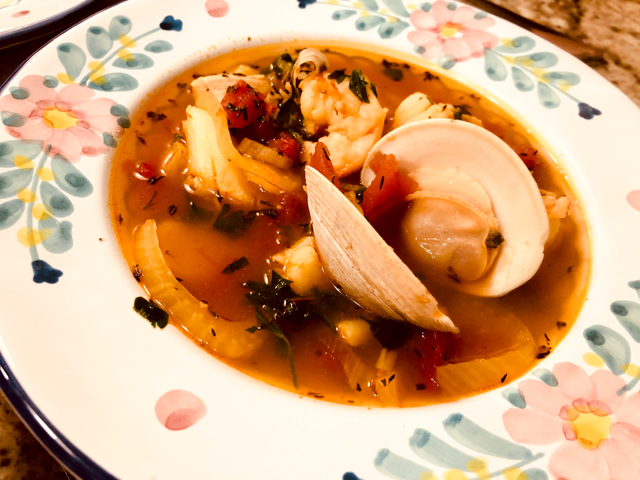
 

BOUILLABAISSE FOR A CHILLY EVENING

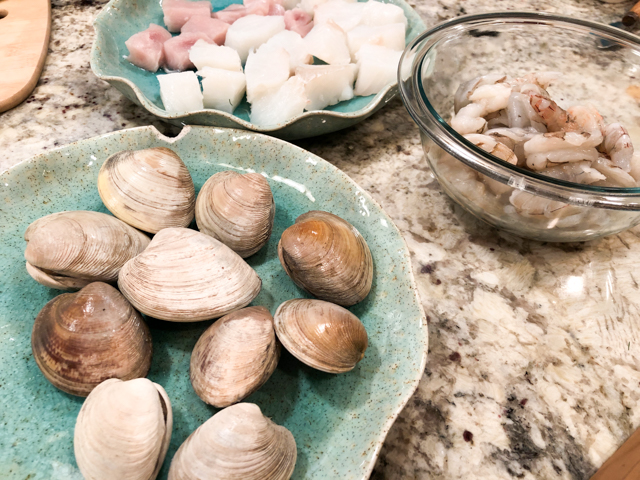
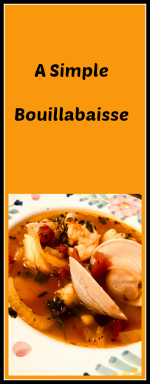
Bouillabaisse is a classic Mediterranean dish. Not to brag or sound like a pain-in-the-butt snob, but I once enjoyed a bowl in a wonderful restaurant in Nice. One of those unforgettable meals in which the setting, the company, the food, all conspired together to make you feel on top of the world. Or close enough. Where we live we have access to the very best beef you can dream of, but seafood? Not so much. So I realize that calling my humble seafood concoction “Bouillabaisse” is a bit of a stretch. The fish was previously frozen, same goes for the shrimp. I know that nowadays the frozen stuff is processed almost immediately upon fishing, but still… Cooking seafood in the middle of the country always seems a bit strange. However, I must say we were very pleased by how tasty it turned out. Not the same as sitting down for a beautiful meal in Nice, but… being at home with the fire-place going, and the three pups all cozy near us has its charm also.

A SIMPLE BOUILLABAISSE
(adapted from several sources)

3 pounds of mild fish, cut into large pieces (I used cod and red snapper)
1 pound large shrimp, peeled and de-veined
1 pound clams
1/4 cup olive oil
1/2 cup thinly sliced onions (I omitted)
1 fennel bulb, very thinly sliced
1 can stewed tomatoes
1 bay leaf
1/2 tsp saffron threads
2 tsp salt or more to taste
1 cup shrimp stock (made with shrimp shells, lemon and onions)
1 cup clam juice (store-bought)
fresh thyme
orange zest and a bit of juice
parsley leaves, minced

Make the shrimp stock.  In a sauce pan, add the shells, cover with water, juice of half a lemon and half an onion. Bring to a boil, then reduce heat and simmer for 30 minutes. Drain, reserve the liquid to use in the bouillabaisse. In a small bowl, mix a couple of tablespoons of the shrimp stock with the strands of saffron, rubbing them between your fingers to release the oils.  Reserve.

Heat the olive oil in a large pot on medium high heat. When the oil is hot, add the onions and fennel. Stir to coat the vegetables with the olive oil. Cook on medium heat until softened and fragrant, about 10 minutes. Do not let it brown. Add the tomatoes, bay leaf, thyme, the saffron infused shrimp stock, salt, orange zest and juice. Simmer gently for 10 more minutes. 

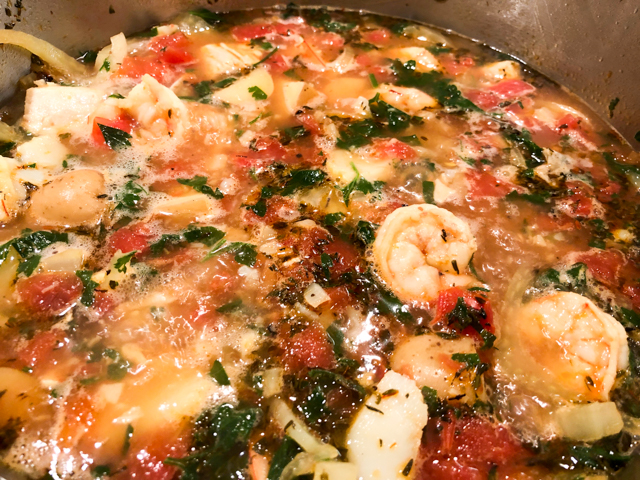
Add the pieces of fish, the shrimp, the reserved shrimp stock and the clam juice. Bring to a gentle boil,  add parsley, simmer covered for 5 minutes. Add the clams, cook for 10 minutes or so until they open and are cooked through. Keep the heat at a very gentle level.  Remove bay leaf before serving, adjust seasoning.  Wonderful with a nice piece of sourdough bread.

ENJOY!

to print the recipe, click here

Comments: Traditionally, Bouillabaisse is served with a rouille on top. Think of a sauce made from hearty bread, olive oil, and other tasty suspects. I omitted, we had a slice of sourdough with it instead. I added a generous squirt of lemon juice to my bowl, it’s something I find myself doing so often, it always seem to make the food shine a bit brighter. If you want to simplify things even further, you can use just clam juice and water as the cooking liquid, but making shrimp stock is so simple, and it does intensify the seafood flavor in the soup. If you can find sea bass, definitely use it. It is the best fish, in my opinion, but as you can imagine, not easy to find in our neck of the woods.  And when we do find it, we must be ready to shell some serious cash for it.


The smell as this soup-stew cooks is something! The main thing to pay attention to is not to overcook the delicate seafood, and keep the heat at a very gentle simmer, because shrimp in particular tends to toughen up easily. I had considered cooking the shrimp sous-vide separately and just add it to the soup when serving, but ended up going the more traditional route. If you have a sous-vide gadget, keep in mind that it makes absolutely perfect shrimp, with a texture you cannot get any other way.

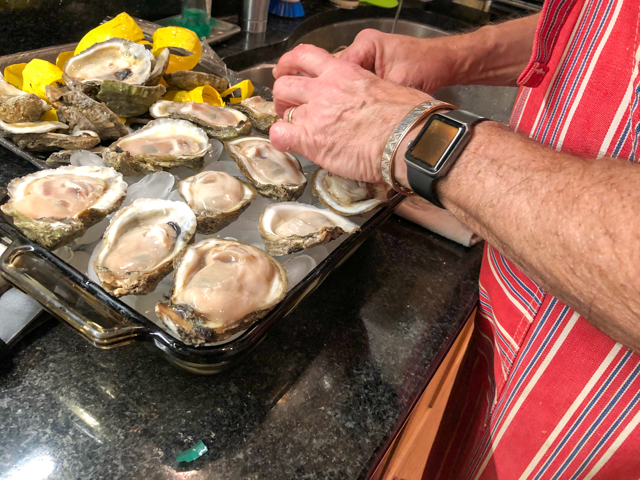
The resident oyster-shucker made sure we have the perfect appetizer to open this meal…

Totally off-topic: today marks my first anniversary of…..  braces!
One year down, one more to go (sigh)

ONE YEAR AGO: Bergamot-Cherry Macarons

TWO YEARS AGO: Roasted Veggies with Queso Cotija Dressing

THREE YEARS AGO: Creamy Broccoli and Mushroom Casserole

FOUR YEARS AGO: Maple Walnut Biscotti

FIVE YEARS AGO: Barley Risotto with Peas

SIX YEARS AGO: Oatmeal Fudge Bars

SEVEN YEARS AGO: Cauliflower Steaks

EIGHT YEARS AGO: Soft Spot for Chevre

NINE YEARS AGO: Quick sun-dried Tomato Crostini


BERRY REBELLION TARTS BY KIRSTEN TIBBALLS

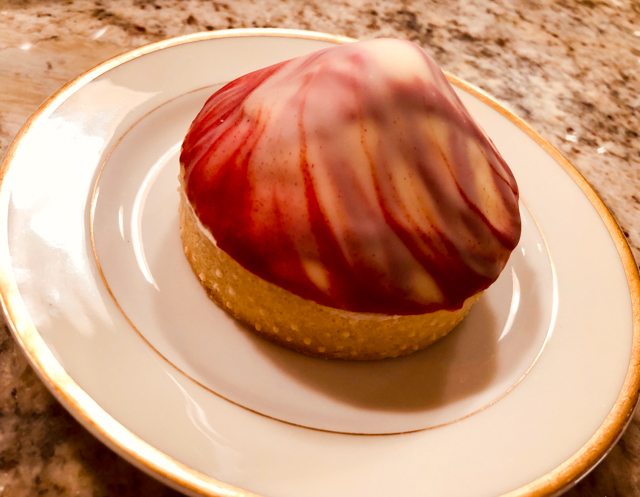
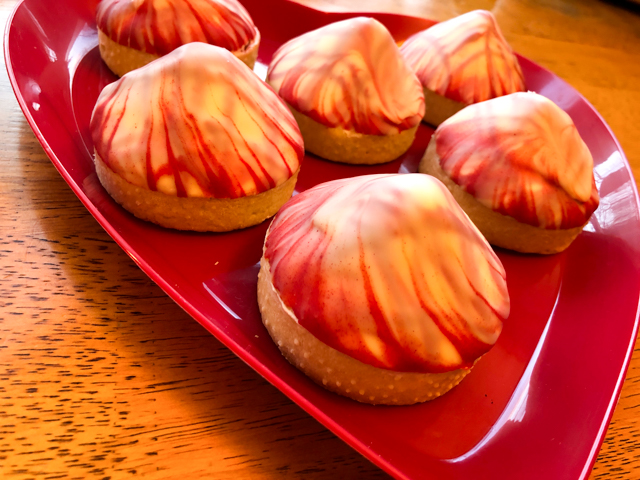
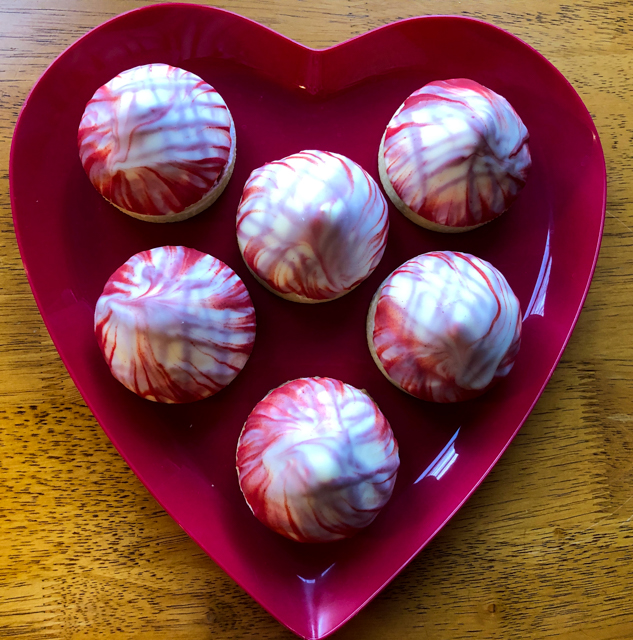
Fantastic, terrific, outstanding, phenomenal, impressive, superb. Those are some of the adjectives I must use to express how I feel about Savour online classes, particularly those taught by the founder of the site, Kirsten Tibballs. I found Savour by accident about 6 months ago, and decided that a monthly subscription to have access to the hundreds of patisserie videos (260 at the present time) was more than worthy it. They add new videos on a regular basis, but in my opinion, even if they did not, the material already available is mind-blowing. Yes, yet another adjective joined my party. Kirsten Tibballs’ CV is quite impressive, you can read about her in this recent interview. Plus, she is a perfect teacher, going over every detail in the recipe, making sure you know what is absolutely important to pay attention to and why. I learn a lot watching her classes. And the icing on the cake? She always has a nice smile and a calm, serene demeanor that makes even the most complex recipes seem doable. Well, except when she performs her magic tricks with tempered chocolate. The doable component goes out of the window, and it goes real fast.  Today I share a recipe she offered on her youtube channel, and show you another tart (without the recipe) that is part of the Savour school. They were both spectacular, but I am particularly thrilled by the first one: Berry Rebellion Tarts. We had them for our Valentine’s dinner dessert, and they closed the evening with a golden key. Maybe it was more a ruby-red key?

VALENTINE’S BERRY REBELLION TARTS
(slightly modified from Kirsten Tibballs youtube channel)

For the pastry shells:
225g all-purpose flour
125g unsalted butter
75g superfine granulated sugar
1 egg (about 60g)
2 teaspoons of water

Heat the oven to 350F. Combine the sifted flour and butter to form a crumb; you can do this either in a stand mixer with the paddle attachment, food processor or rub the butter into the flour by hand. It is important that you do not over mix at this stage and ensure that all the butter is combined without forming a paste.

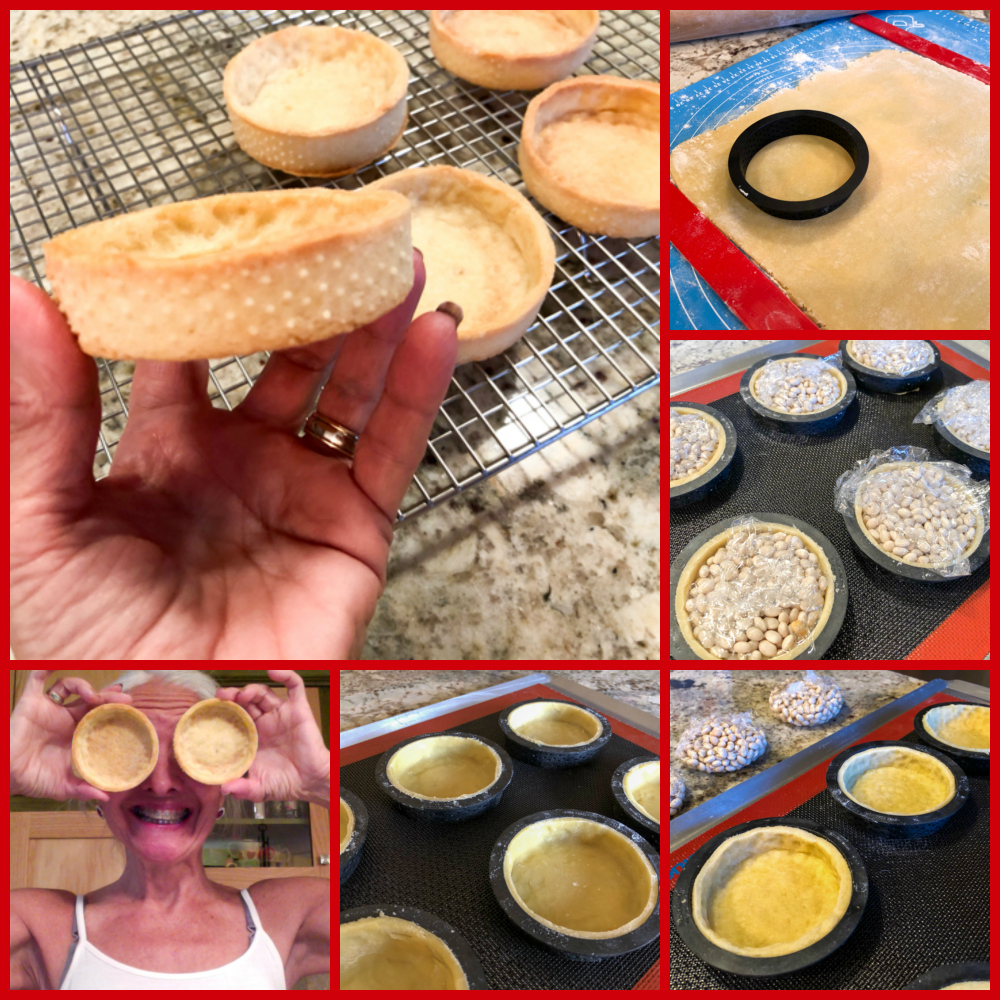
Combine the sugar, water and egg in a bowl, stop the mixer and add this to the crumb mixture. Mix until it just comes together as a dough. Press the dough into a flat square, cover in plastic wrap and rest in the fridge for 1 hour. Once the dough is firm, remove from the fridge and cut in half. Roll the pastry out to 3mm thick on a surface lightly dusted with flour. Cut out discs slightly larger than the tart rings (mine are 8cm in diameter). Place the rings on a lined baking tray and line them with the pastry. Place the tarts in the fridge and repeat the process with the remaining dough.

When the pastry has firmed up, trim the edges with a small sharp knife. Cover the tarts with plastic wrap, fill the tarts with uncooked beans or rice, pressing them into the base firmly to make sure it is filling all the corners. Bake for approximately 10 minutes, remove the rice and plastic lining and bake for a further 4-6 minutes or until a light golden brown colour. Remove the rings while the tarts are warm and allow to cool.

For the crunchy layer:
20g freeze-dried strawberries
13g puffed rice cereal
62g  white chocolate
20g grapeseed oil

Melt the white chocolate in a plastic bowl in the microwave for 30 seconds at a time on high until it is half melted. Stir vigorously to melt all the chocolate and add in the oil. Mix to combine then add the strawberries and rice bubbles and stir. Spoon a thin layer onto the tart shells, followed by a thin layer of compote, made as described below.

For the strawberry compote:
200g strawberries, hulled and cut in pieces
50 g granulated sugar
1 tablespoon cornstarch
1 tablespoon lemon juice
120 mL water (about 1/2 cup)
pinch of salt

Place strawberries in a saucepan with sugar,  lemon juice, and salt. Divide the water into two – pour half with the fruit and combine the other half into the cornstarch.

Heat the fruit on low to medium until sugar is dissolved shaking the pan to cook evenly. Add the well-mixed cornstarch mixture into the bubbling fruit. Continue to cook on low – the mixture will thicken and looks glossy. When thick enough to coat the back of a wooden spoon or spatula it’s ready. Let cool completely. It can be prepared a couple of days in advance.

For the Chantilly topping:
150 ml fresh cream 35% fat (A)
15g liquid glucose
1 teaspoon of vanilla bean paste
105g good quality white chocolate
220 ml fresh cream 35% fat (B)

Boil the cream (A), glucose and vanilla in a saucepan. Pour the boiling mixture over the white chocolate in a bowl and whisk together by hand. Add in the cream (B) and whisk again. Place in the fridge for 6 hours prior to whipping. To whip, whisk it in a stand mixer or by hand to a piping consistency.

Place a generous spoonful of the white chocolate Chantilly cream on top and smooth into a dome shape with a knife. Freeze for 1 hour minimum.  Proceed to make the chocolate coating.

For the chocolate coating:
500g white chocolate
50g grapeseed oil
10g red oil soluble colour (I used only 4g)

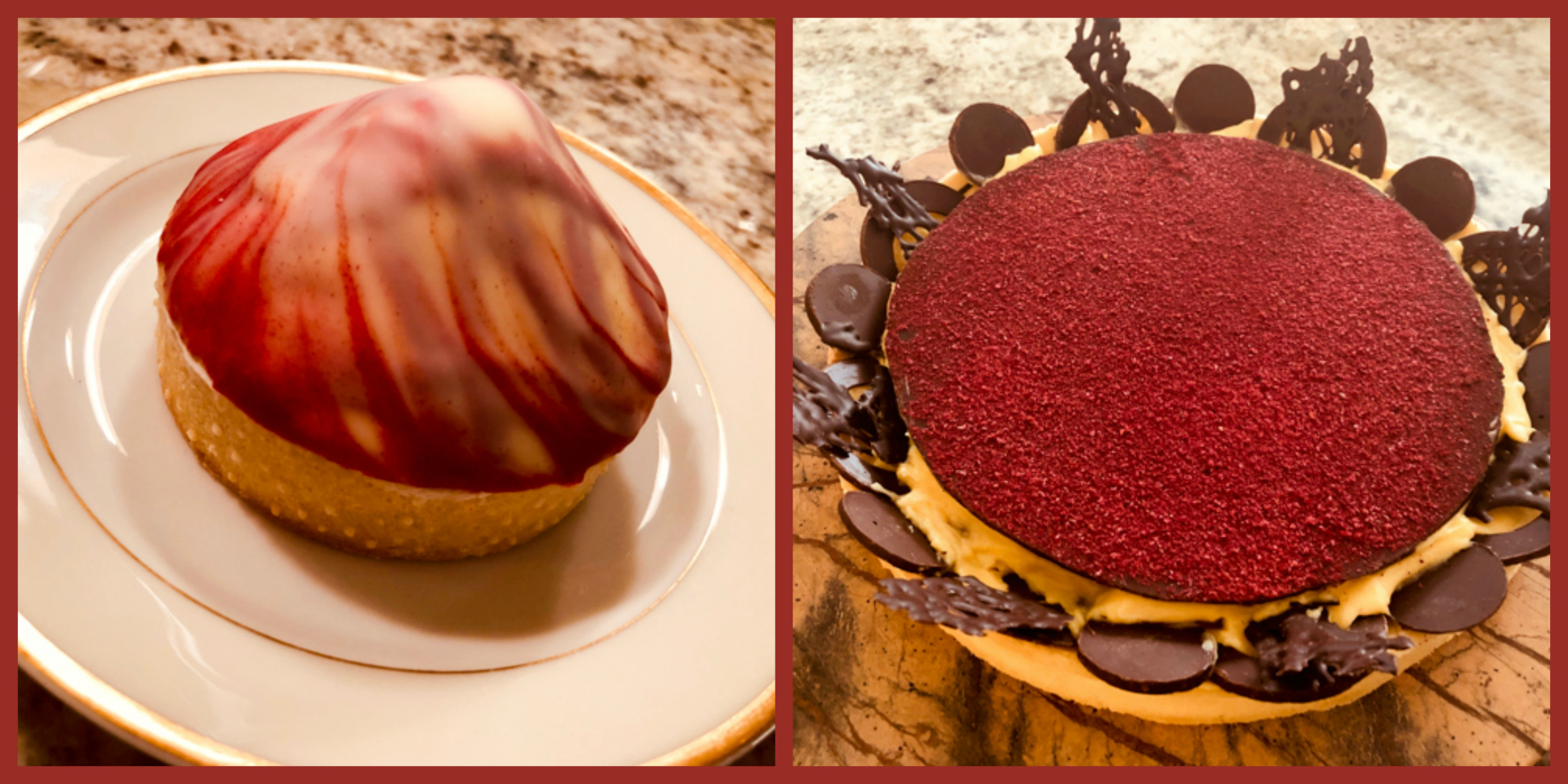
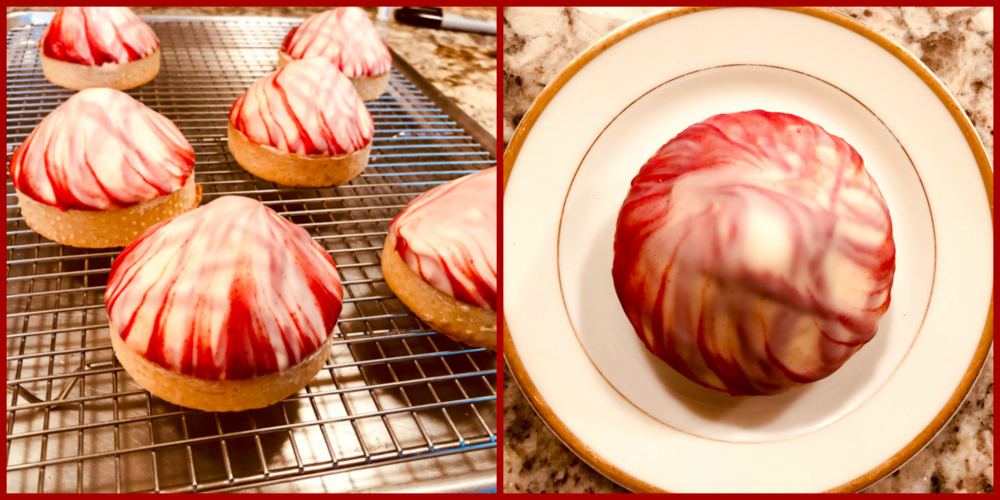
Temper the white chocolate by melting it in the microwave for 30 seconds at a time until half melted. Add in the grapeseed oil and combine. Portion out one-third of the chocolate and sieve in the red colour. Stir to combine then fill a paper piping bag halfway with the chocolate. Place the white chocolate in a smaller bowl and pipe the red chocolate in a grid pattern on top. Holding the tart shell, dip the cream coating into the chocolate and twist the tart as you remove it. Let it drip for a few seconds before turning it upwards and leave at room temperature to set. Pipe red chocolate over the grid pattern each time you dip a new tart, until you coat the six of them.

Allow them to fully set, place in the fridge to defrost for at least one hour before serving.

ENJOY!

to print the recipe, click here

Comments: When I coated the tarts and placed them on the rack to set,  I said to myself “did I make these? did I really make these?”  Nothing beats the thrill of pulling a recipe that seems a bit too complex and that takes me out of my comfort zone. More often than not, I have small issues with it, but not this time. They turned out better than I expected. I spread the preparation over three days, because with Valentine’s falling on a Thursday I had no choice. The tartlets were made on Tuesday evening, the compote on Wednesday evening.

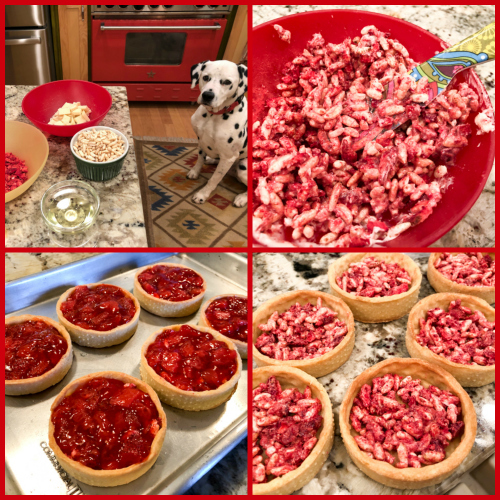
I urge you to watch Kirsten video on youtube. Her method to shape the dough in the tart rings is wonderful and if you follow it closely you’ll have tartlets with a perfect sharp angle at the bottom, instead of a rounded-up edge that makes spreading the filling a bit tricky. Small details matter. The addition of a tiny amount of water in the dough makes it easier to roll out. A pleasure to work with. I used regular saran wrap to cover the tarts before filling with beans (or rice, if you prefer that). Just make sure to crumble the plastic on top,  so that it dos not touch the ring during baking.  Once the tarts are cool, you are ready to move on to the two-component filling…

Mis-en-place is everything, and BogeyQT™ definitely approved the way I handled that step. A crusty base with puffed rice cereal, freeze-dried strawberries and white chocolate gives these babies intense flavor and a perfect contrast to the creamy topping that is added later. I changed the recipe for the strawberry compote, because I felt that just simmering the fruit in water and sugar resulted in a very loose mixture. I was afraid it would leak all over the place when I cut the tart. So I used a strawberry compote slightly thickened with cornstarch.  It maybe depends on the fruit available to you, Kirsten made them in Australia at the peak of the summer. Lucky lucky woman, I am in the desolate tundra of Kansas freezing my tropical bones. Once the compote is added, all you have to do is crown it with some seriously awesome white chocolate Chantilly cream.

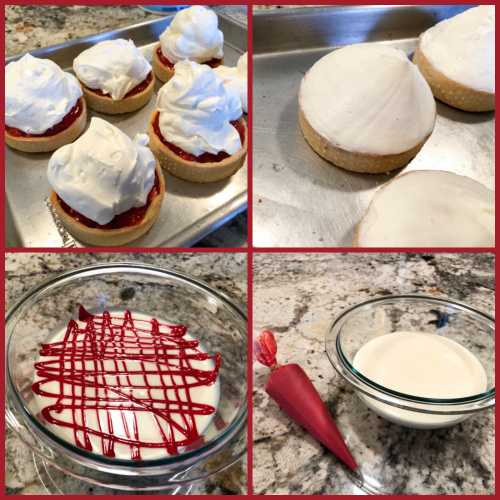
Not to repeat myself, but still doing it, you MUST watch her youtube video for this step (around minute 18). I was a bit worried about sculpting the top in a nice mountain-shape, Chantilly is not the most forgiving substance in patisserie world. But Kirsten, knowing that this step has the potential to induce hyperventilation, holds her spatula and with a very sweet smile says, eyes straight to the camera: I know you can do it!  I got faith on you….  Well, let’s say I would not allow cameras to show my performance, but somehow I managed to do it, a few blobs of cream finding the counter top, but not really that bad. And that final step? Swirling the top of the frozen tartlets in the white chocolate pool? That is THE coolest thing ever! Dip it right to the level of the tart shell, and then control your nerves and lift it as you turn. Don’t over-think it. Go for it. I tell you, it was almost as much of a thrill as crossing the finish line of a marathon back in 1986. Yeah, that’s about right.

The tart is simply amazing. The white chocolate-Chantilly cream is quite likely one of the most luscious toppings I’ve ever made, and all the components work together well: the extra crunchy layer with the freeze-dried strawberries is full of flavor, the compote sweet-and-tart, and then the creamy top. OMG-type of dessert. Trust me. You could change the color of the swirl component, maybe even add two different colors for a cool effect, adapting it to Easter, Christmas, Mardi Gras… One of the tastiest things I’ve made in a long time.

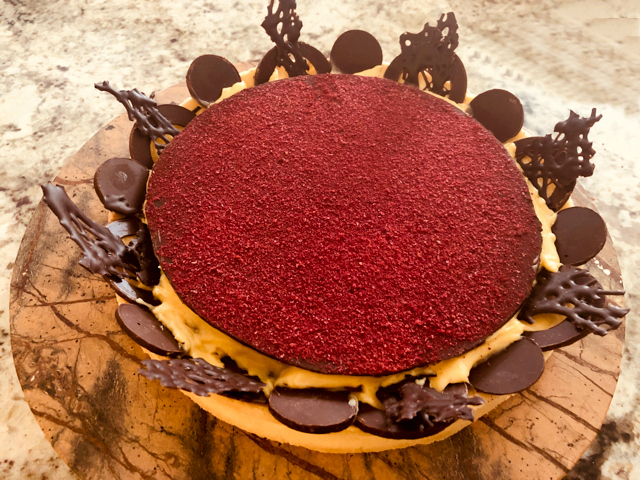
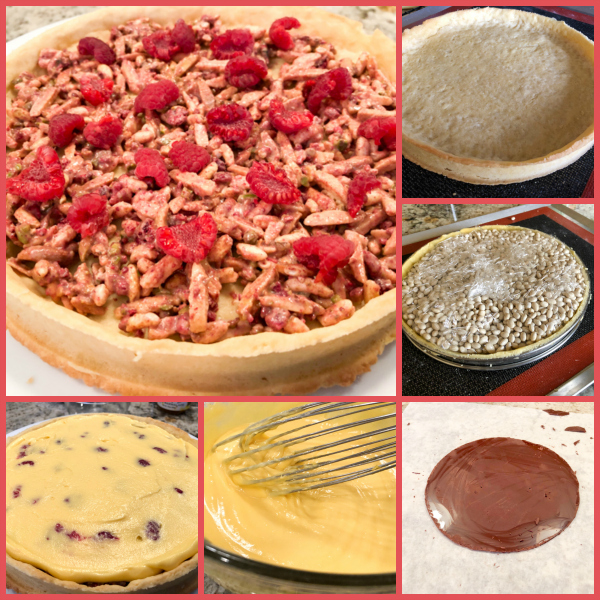
Now, time for a teaser recipe, which you can find at Savour.com.  Kirsten’s Crown of Savour is a single tart with some similarities to the Berry Rebellion. A tart base (slightly different recipe), a crusty layer made with pistachios, slivered almonds, puffed rice and white chocolate. Fresh raspberries spread on top, all covered with a superb vanilla cream perfumed with rose-water. To crown it, a disc of tempered chocolate showered with a dust of freeze-dried raspberries. It was a labor of love, but worth the effort.


I think the trickiest component of this tart was the tempered chocolate disc. Kirsten is undoubtedly the Queen of Chocolate. She is able to spread the tempered suspension super thin, so the result is a much more delicate topping. The decoration she chose for the tart is also totally different, she baked little sticks with meringue and stuck them in a nice pattern all around. You can marvel at it here.  I could not bring myself to go for those, as all my energy had been depleted in a certain chocolate tempering adventure. I decorated the edges with pieces of tempered chocolate I had played with. Kirsten’s Crown of Savour is a real masterpiece of patisserie.

The flavors of this tart were also quite amazing, Kirsten is big on contrasting textures. In the video, she points out that you can potentially simplify things by omitting the crunchy layer on top of the crust, but I do think it adds a lot to the dessert. If you spread preparation over a couple of days, it’s all pretty doable. Of course, the chocolate component a bit of a challenge. Savour has a few tutorials on tempering chocolate using different methods like tabling and microwave, so it’s actually all there for you to learn.  I need a lot more practice, my chocolate decorations are always a bit “heavy”, not enough finesse, because evidently I don’t have the “chocolate skill.” Not yet, that is…

As I mentioned, Savour right now has 260 videos. Most are 20 to 40 minutes long, some are shorter, some slightly longer. They show every single step to make the desserts, no matter how complex. You have access to the full recipe, as well as links to special items used (baking pans, silicone molds, piping gadgets). Finally, you also have access to a forum to ask questions to moderators and other bakers. If you’ve been following my blog, you know that I only recommend things I love, and never accept any requests to review books or products. I am absolutely in love with Savour and feel that anyone with a passion for patisserie will profit from their online classes.


Chef Kirsten, thank you so much for making classes available to home bakers like me, who live so far away from Australia and can only dream of taking a hands-on class from you.


ONE YEAR AGO: Emilie Raffa’s High Hydration Sourdough

TWO YEARS AGO: Short-Ribs with Chickpeas and Chard

THREE YEARS AGO: Asian-Style Short Ribs 

FOUR YEARS AGO: Herbed Goat Cheese Souffles

FIVE YEARS AGO: Barley Risotto with Peas

SIX YEARS AGO: Jammin’ Blueberry Sour Milk Pancakes

SEVEN YEARS AGO: Scallops with Black Pasta in Orange Cream Sauce

EIGHT YEARS AGO: Stir-fried Chicken with Creamed Corn

NNE YEARS AGO: Potato, Cheddar, and Chive Torpedo

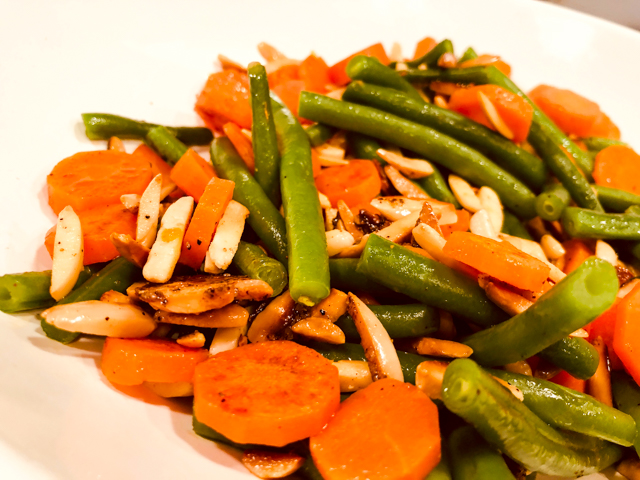
GREEN BEANS AND CARROTS WITH SPICY ALMONDS

Green beans with almonds is such a simple recipe. A bit like avocado toast: grab bread, toast it, smash avocado on it, top with whatever you like, give it a fancy name and be done with it. Yet, here I am to share an almost non-recipe with you. It turns out that this was unexpectedly delicious. And I will be making it again and again. That makes it blog-worthy in my book. So there!

GREEN BEANS AND CARROTS WITH SPICY ALMONDS
(from the Bewitching Kitchen)

1 teaspoon sugar
1 teaspoon chili powder
½ teaspoon ground za’tar
½ teaspoon salt
Pinch of cayenne pepper
a touch of olive oil butter
⅔ cup slivered almonds (or amount to taste)
green beans, cut into 1½-inch lengths
carrots, sliced thin
1 tablespoon olive oil
salt

To make the almonds: In a small bowl, combine the sugar, chili powder, za’tar, salt, and cayenne. Heat the olive oil in a small nonstick skillet. Add the almonds and cook, stirring occasionally, until they are beginning to brown, about 2 minutes. Sprinkle them with the sugar-spice mixture and stir almost constantly until the spices are fragrant, do not let it burn. Move them to a plate and reserve at room temperature.

Bring a medium saucepan of salted water to a boil over high heat. You have two options: add the green beans and carrots and cook both together until crisp-tender, about 4 minutes. Or if you prefer the carrots a bit more tender, add them first, cook them for about 3 minutes, then add the green beans for additional 4 minutes of cooking. Drain both veggies well, lay over paper towels or a kitchen towel to remove all excess water.

Finish the preparation: Add the olive oil to the a non-stick skillet and heat over medium-heat. Add the green beans and carrots and toss well. Sautee until you get some color on some of the green beans and carrots, the less you move them around the more they will brown. Season with salt, add the almond mixture, toss just a couple of times to spread them around the veggies. Transfer to a serving dish.

ENJOY!

to print the recipe, click here

Comments: Two game changers here, the inclusion of carrots and the sweet-and-spicy mix. We have green beans with almonds very often, but this preparation feels like a totally different recipe, with the carrots bringing a nice contrast of color, and the spice mixture giving just the right amount of naughtiness to the almonds. Simple, no doubt, but so delicious. Cumin could be a nice addition, although I do feel that it tends to overpower things a bit. You should come up with your own version of spices just keep the sugar and use your imagination. Keep in mind that nothing brightens up this type of dish more than a little squirt of lemon juice in the end, right before serving. I totally forgot about it.

Leftovers were great next day, but probably a lot better if someone had not picked all the almonds as a post-dinner snack. Confession: I did it. They were that tasty. I am sorry. Kind of.

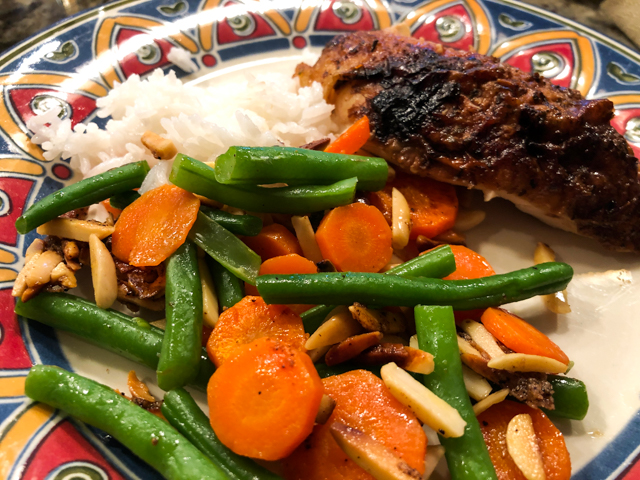
Dinner is served!  Store-bought rotisserie chicken, a bit of rice and this tasty side dish.
Easy to bring to the table even after traveling the whole day.

ONE YEAR AGO: Quiche 101

TWO YEARS AGO: Persian Butternut Squash Soup

THREE YEARS AGO: Walnut Cranberry Sourdough Bread

FOUR YEARS AGO: Ottolenghi in Brazil?

FIVE YEARS AGO: Roasted Winter Vegetables with Miso-Lime Dressing

SIX YEARS AGO: 2012 Fitness Report: P90X2

SEVEN YEARS AGO: Caramelized Bananas

EIGHT YEARS AGO: Roasted Lemon Vinaigrette

NINE YEARS AGO: Whole Wheat Bread


SOUS-VIDE OVERNIGHT OATMEAL

Let me get this out right away: I don’t care for oatmeal. At all.  Growing up in Brazil it was not part of my breakfast, in fact I only learned about it when I was 26 years old and arrived in the US for the first time for a post doc. I thought the texture was unpleasant, the taste very bland, unless you dump a ton of brown sugar and heavy cream and this and that on top. What would be the point then? However, oatmeal is very popular, considered a healthy option to start the day, keeping you full until lunch time with good amount of fiber, the right carbs, vitamins, and anti-oxidants. None of this would make me look forward to a bowl of oatmeal to start my day, especially considering I am not a breakfast person. But hubby loves it. And that was enough to make me try a sous-vide version. I had no idea it would be a game-changer for me. It’s really tasty. So, if you are an oatmeal hater who owns a sous-vide gadget, I urge you to give this recipe a try. If you don’t have a sous-vide, I heard that crock pot versions can be excellent too, but I have no personal experience with it.

OVERNIGHT OATMEAL SOUS-VIDE
(adapted from several sous-vide sources)

jars:
8 jars with 4-ounce capacity
or
4 jars with 8-ounce capacity

for each small (4oz) jar:
2 tablespoons steel-cut oats
70 g water
pinch of salt

for each bigger (8oz) jar:
4 tablespoons steel-cut oats
140 g water
pinch of salt

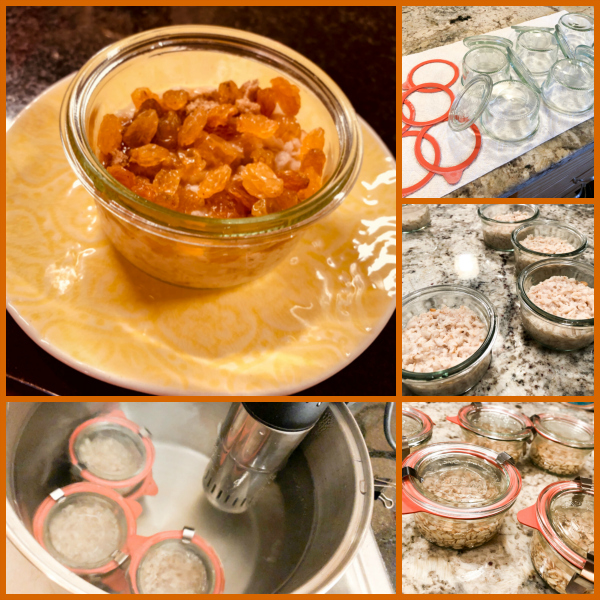
Using sous vide circulator, bring water to 155°F.  Fill the jars of your choice with the appropriate amount of oats, water, add the salt. Seal jars. If they have screw-caps, don’t tighten them too much. Lower jars slowly in the prepared water bath until fully submerged. Cover and cook for 10 to 12 hours.

Remove jars from water-bath. Stir oats and serve with the toppings of your choice. If using the small jars, you’ll need two of them to make a single portion.

ENJOY!

to print the recipe, click here

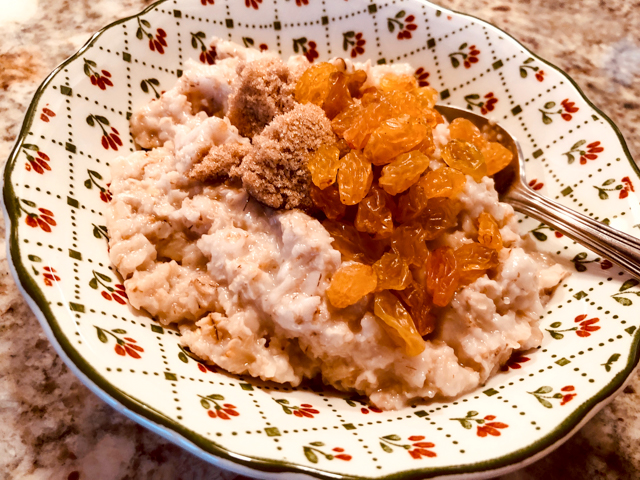
Comments: I now realize that texture was my main issue with oatmeal. For some reason, even after cooking for so many hours, the sous-vide results in oats with the exact amount of bite for my taste. I still prefer to have them later in the day with a fried egg on top. I call it light lunch. The jars, once ready, can sit in the fridge for a few days. When you are ready for breakfast (or any other time of the day you feel like it), pour the contents in a bowl and warm very very briefly in the microwave. Add the toppings you love and you are done.  Golden raisins and a touch of brown sugar is a nice combination, and yes, I’ve had that for lunch more than once.

As I mentioned, you can find plenty of recipes for overnight oatmeal using a slow-cooker.  I imagine they will please all oatmeal lovers, but if you are part of my team, sous-vide might be the real winner. Plus, I am always happy to find new uses for my beloved Anova gadget.

One last thing: many recipes using sous-vide call for longer cooking times. I prefer to keep a maximum of 12 hours, but 10 hours worked better for us. After 12 hours of cooking the texture got a tad too soft for our taste.

ONE YEAR AGO: A Valentine’s Day Opera

TWO YEARS AGO: Incredibly Simple Times Four

THREE YEARS AGO: Walnut-Cranberry Sourdough Bread

FOUR YEARS AGO: Ottolenghi in Brazil?

FIVE YEARS AGO: Roasted Winter Vegetables with Miso-Lime Dressing

SIX YEARS AGO: 2012 Fitness Report: P90X2

SEVEN YEARS AGO: Caramelized Bananas

EIGHT YEARS AGO: Roasted Lemon Vinaigrette

NINE YEARS AGO: Whole Wheat Bread