THE END OF GREEN BEAN CRUELTY

I’m talking about THIN green beans, of course…   😉

We learned about Michel Richard firsthand, at his wonderful, exciting restaurant Central in Washington DC.  What a delicious experience it was! The bread – that keeps coming to the table, always warm and impossible to say no to – and the gougeres alone are worth stopping by.  In his book Happy in the Kitchen, Michel Richard comments  that  most recipes for green beans cook them in boiling water, then quickly shock them in an ice-bath. However, he adamantly opposes this method when dealing with pencil-thin green beans. They are so delicate, so why would anyone furiously boil and shock the poor things, leaving them limp and lifeless?

I’ve been guilty of such green bean cruelty more than once, but I won’t ever do it again. When prepared  by Michel’s guidelines, they are simply irresistible, even served without any embellishments. However, pairing these beauties with small roasted tomatoes didn’t hurt them a bit.

GREEN BEANS WITH ROASTED TOMATOES
(from the Bewitching Kitchen)

for the green beans:
a bunch of pencil-thin green beans (amount enough for two)
1 Tbs olive oil
pinch of red pepper flakes
1/2 tsp orange zest
salt and pepper to taste

for the tomatoes
1 cup of grape tomatoes, cut in half
drizzle of olive oil
drizzle of balsamic vinegar
salt and pepper to taste

Start by roasting the tomatoes.  Spread them in a single layer on a small baking sheet lined with foil or parchment paper for easy clean up. Drizzle some olive oil and balsamic vinegar, shake them around, and season with salt and pepper.  Place in a 400 F oven until they get soft and start to brown around the edges, 20 to 25 minutes. Reserve, keeping warm.

Heat the olive oil in a non-stick skillet, add the red pepper flakes and the orange zest.  Keep in a gentle heat for a couple of minutes, until the mixture starts to get fragrant.  Increase the heat, add the green beans, and let them cook for a few minutes undisturbed, so that they get a little color where they make contact with the pan.  Stir them around to coat the beans with the flavored oil, and saute for a little while longer, until the beans are cooked through, but still al dente. Don’t overcook! Season with salt and pepper, add the roasted tomatoes on top, and mix gently.  Adjust seasoning, and serve right away.

ENJOY!

to print the recipe, click here

Comments: Michel Richard’s main message is to cook thin green beans straight by sauteing in a small amount of fat.  You can substitute butter or a mixture of butter and olive oil, or use a different type of oil, keep in mind that some – like walnut oil –  burn at a lower temperature, so it’s best to add them close to the end of cooking.

The combination of green beans and orange zest, worked quite well in this recipe,  with the touch of balsamic vinegar brought by the tomatoes.  It was a nice side dish for our grilled flank steak, but if you want a fully vegetarian meal, add some pasta or couscous, a big salad and a thick slice of grilled bread.  It’s  more than enough for a tasty dinner.  Just remember, be kind to the green beans!  😉

ONE YEAR AGO: Torta di Limone e Mandorle

Add to FacebookAdd to DiggAdd to Del.icio.usAdd to StumbleuponAdd to RedditAdd to BlinklistAdd to TwitterAdd to TechnoratiAdd to Yahoo BuzzAdd to Newsvine

MAHI-MAHI

I fall in love with words quite easily.  Mahi-mahi…. is just one of the many beautiful Hawaiian words.  When we visited Oahu I found it fascinating to  read the street names, which for the most part were quite hard for a foreigner to remember: Kamehameha, Mamalahoa, Kealakehe, Hualalai. They all seemed so…. musical!

It turns out that the Hawaiian alphabet lacks a few consonants:  C, J, Q, and X. It also makes no distinction between K and T.   When the complexity of a language decreases at one level, it often compensates on another.  The fewer consonants probably explains why so many Hawaiian words have duplicated syllables, giving the spoken language a playful component that’s quite pleasing.  But, I digress…  mahi-mahi (by the way, “mahi” means “strong”) is one of my favorite fish, at the top with striped sea bass.  It has a mild, but definitely not bland flavor, and a meaty texture that’s perfect for grilling, as this recipe (another gem I got from my friend Heather) will convince you.

GRILLED MAHI-MAHI WITH CITRUS MARINADE
(from  Heather’s kitchen)

2 filets of mahi-mahi (may substitute other firm-fleshed fish)
for the marinade:
2 T fresh lime juice
3 T rice vinegar
1 T finely chopped ginger
1 T finely chopped scallions
3 T mild vegetable oil (I used grapeseed)
1 T soy sayce
1/2 t Asian chili sauce (optional)
freshly ground black pepper to taste
Prepare a marinade by whisking all ingredients together. Marinate the fish for 30 minutes to 2 hours in the fridge.  Grill until cooked through. 

ENJOY!

to print the recipe, click here

Comments: This was one of the tastiest dinners in the past few weeks.  A fish like mahi-mahi is delicious on its own, so the less you mess with it, the better it is.  This preparation was perfect: a hint of lemon,  a little heat, and nothing else.  No elaborate toppings, crusts, or sauces.  A simple, delicious meal, as healthy as it gets.

We loved it with roasted asparagus, and with a mixture of white rice and wheat berries that, all modesty aside, was a spur of the moment inspiration that had me patting myself on the back.   I spotted some white rice in the fridge and some cooked wheat berries that I was saving for a salad.   I just mixed them and warmed them in the microwave. It was an absolutely delicious combination that will be a regular production in the Bewitching Kitchen.

ONE YEAR AGO: Memories of Pasteis

Add to FacebookAdd to DiggAdd to Del.icio.usAdd to StumbleuponAdd to RedditAdd to BlinklistAdd to TwitterAdd to TechnoratiAdd to Yahoo BuzzAdd to Newsvine

A DUTCH TIGER

Back in the 70’s, bakers in Netherlands realized that by coating bread dough with a thick paste made of rice flour, sugar, oil, and yeast, a crust would form during baking and develop cracks, giving each bread a unique pattern, akin to a tiger’s coat.  Tiger Bread, also known in the US as Dutch Crumb,  is a lot of fun to make and actually very easy, no wild yeast, no intense kneading.  A perfect recipe to make with kids, as they will have a blast with the changes in the bread as it bakes.  For my tiger rolls, I used the Vienna bread recipe made earlier during the  Bread Bakers’ Apprentice Challenge.   Peter Reinhart gives the option of the Dutch crumb at the end of that chapter, but not until folks at The Fresh Loaf forum raved about it I decided to re-visit it.

VIENNA BREAD WITH DUTCH CRUMB
(adapted from The Bread Bakers Apprentice)

Pate fermentee (made the day before)
140 g bread flour
2.5 g salt
1/2 teaspoon instant yeast and
100 g water at room temperature

Mix all ingredients, knead briefly and let it rise at room temperature for 1 to 2 hours. Place the mixture in the fridge overnight, remove from the fridge one hour before making the bread.

Dough:
185g  pate fermentee (you won’t use the full amount made)
170g unbleached bread flour
7g sugar
4.5g salt
2g instant yeast (3/4 tsp)
1/2 egg, slightly beaten
7g  unsalted butter, melted and slightly cooled
85-100 ml water, lukewarm (90 – 100 F)

Dutch Crumb Paste:
1 Tbs bread flour
3/4 cup rice flour
3/4 tsp. instant yeast
2 tsp. sugar
1/4 tsp. salt
2 tsp oil
8 tbsp water (or a little more) to make a thick paste.

Remove the pate fermentee from the refrigerator, cut it into 5-6 small pieces, cover and let it at room temperature for about 1 hour.

Stir together the flour, sugar, salt, and yeast in a large bowl. Add the pate fermentee pieces, the beaten half egg, butter, and 85 ml of the water.  Stir together with a large metal spoon, or with your hands, until the ingredients form a ball.  If too dry, add the rest of the water (I did). Let it rest for 20 minutes.

Knead by folding 3 times at 20 minutes intervals.  At the end of the third cycle of folding (at 1 hour fermentation), leave the dough covered, undisturbed, for another hour. Cut the dough into 6 equal pieces, pre-shape them as balls.  Let them rest for 15 minutes.

Make the topping layer by mixing all the ingredients for the Dutch crumb to form a thick paste. Shape each bread as rolls, being careful not to deflate the dough too much.  Place them on a floured surface without touching, apply a thick coating of crumb paste on the surface using a silicone brush or your fingers.  Let them rise for 60-90 minutes (they should not double in size).

Place the rolls (covered) in a 450F oven, turning the temperature down to 400F as soon as you start baking.  Remove the cover after 20 minutes, and continue baking them for a total of 30 to 35 minutes, until golden brown. Cool the rolls on a rack for one hour before eating.

ENJOY!

to print the recipe, click here

Comments: I made this bread twice on consecutive weekends, the first time I shaped it as a single loaf, but had some trouble to  fit it in my toaster oven.   This time I made small rolls and baked then in a tray of large muffins, covered with an improvised lid of heavy duty aluminum foil.  This was the only way I could bake them all at the same time in my small oven.  After 20 minutes baking, I removed the aluminum foil, quickly (and carefully) dumped the breads out of the muffin tin, and allowed them to continue baking sitting on the oven’s rack.

The crust is visually appealing, but what’s even better is its taste.   I actually had to control myself not to peel it off  leaving the naked roll behind.  😉  It is sweet and salty at the same time, crunchy, deliciously addictive.

The crumb is delicate, and the bread, thinly sliced, a perfect accompaniment to a bowl of soup, a simple salad, or a slice of Iberico cheese (one of our latest addictions).

I am submitting this post to Susan’s Yeastspotting

ONE YEAR AGO: Banana Bread (something I’ve been craving lately….)

Add to FacebookAdd to DiggAdd to Del.icio.usAdd to StumbleuponAdd to RedditAdd to BlinklistAdd to TwitterAdd to TechnoratiAdd to Yahoo BuzzAdd to Newsvine

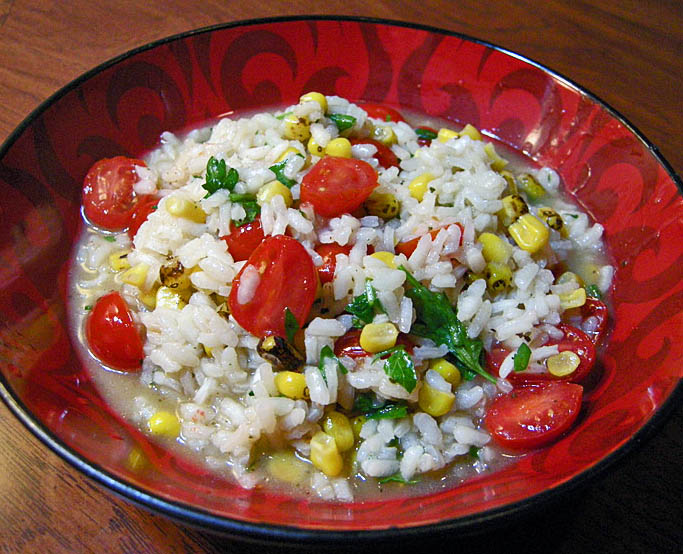
ROASTED CORN AND TOMATO RISOTTO

This excellent recipe from Fine Cooking, published in 2003, is best at the height of the Summer, with grilled fresh corn.  But,  one frozen product (that I am absolutely smitten with) makes it possible  year-round:  the roasted corn kernels from Trader Joe’s.   Their subtle smokey flavor stays sharp during cooking, and the charred kernels add color and pizazz to so many dishes.   I used them in this risotto, and  they made it even better.


RISOTTO WITH CORN, TOMATOES, AND BASIL

(adapted from Molly Stevens)

4 cups chicken broth (or vegetable stock)
1 cup roasted (or cooked) corn kernels
2 Tbs. olive oil
1 shallot, minced
1 cup arborio rice
1/3 cup dry white wine
1 cup halved cherry tomatoes
2 tsp. extra-virgin olive oil
3 Tbs. basil leaves, coarsely chopped
salt and freshly ground black pepper
1/3 cup freshly grated Parmigiano-Reggiano

Heat the broth in a pot to a simmer and keep it covered, hot.

Heat the olive oil in a wide pan over medium heat. Add the shallot and cook, stirring occasionally for about 2 minutes. Add the rice and stir until the grains are well coated with the oil. Pour in the wine, stir, and cook until the wine is absorbed, about 1 minute.

Ladle in about 1-1/2 cups of the hot broth, and cook, stirring occasionally, until absorbed, 3 to 5 minutes. Continue adding broth in 1/2-cup increments, stirring and simmering until the liquid is absorbed each time, at intervals of about 3 to 5 minutes.

While the rice is simmering, combine the tomatoes, extra-virgin olive oil, and 2 Tbs. of the basil in a small bowl. Season with salt and pepper and set aside.

When the rice is starting to get tender (16-18 minutes cooking time) stir in the corn. Continue adding more stock and stirring until the rice is creamy but not mushy – 20 to 25 minutes total. Remove from the heat, fold in the Parmigiano and then the tomato-basil mixture. Top each serving with the remaining basil and serve.

ENJOY!

to print the recipe, click here

Comments: If you don’t have a local Trader Joe’s, then just roast or grill your own corn.  The 10 or 15 minutes on a hot grill boosts its flavor so much that it justifies the extra step.  Adding the tomatoes at the very end preserves their   bright flavor, and ensures a nice presentation too.    Molly Stevens didn’t  finish her recipe with butter, as is traditional in the dish, but even without butter the risotto was substantial and satisfying.   I like to add a bit of lemon zest before plating, and serve it with some additional grated parmeggiano cheese!   😉

ONE YEAR AGO: Light Rye Bread

Add to FacebookAdd to DiggAdd to Del.icio.usAdd to StumbleuponAdd to RedditAdd to BlinklistAdd to TwitterAdd to TechnoratiAdd to Yahoo BuzzAdd to Newsvine