BBA #40: WHITE BREAD

The Bread Baker’s Apprentice Challenge brings us to White Bread, offered in three variations – I picked number 2, just because I like even numbers (they are never lonely…)

It is a very simple dough to prepare: buttermilk, flour, yeast, oil, one egg. I halved the recipe (our freezer is already overflowing with bread), and folded the dough instead of kneading it. You can shape the bread in many ways, take a look at the gorgeous dinner rolls made by Oggi (click here . )   I opted to make hamburger-style buns, brushing them with egg wash and sprinkling sesame seeds on top.

They turned out pretty nice, and tasted delicious!

Coming up next:  Whole Wheat…   I am looking forward to making it and comparing with my favorite sandwich bread, Light Whole Wheat, number 18.    Stay tuned…

CHICKEN SOUP on a CHILLY EVENING

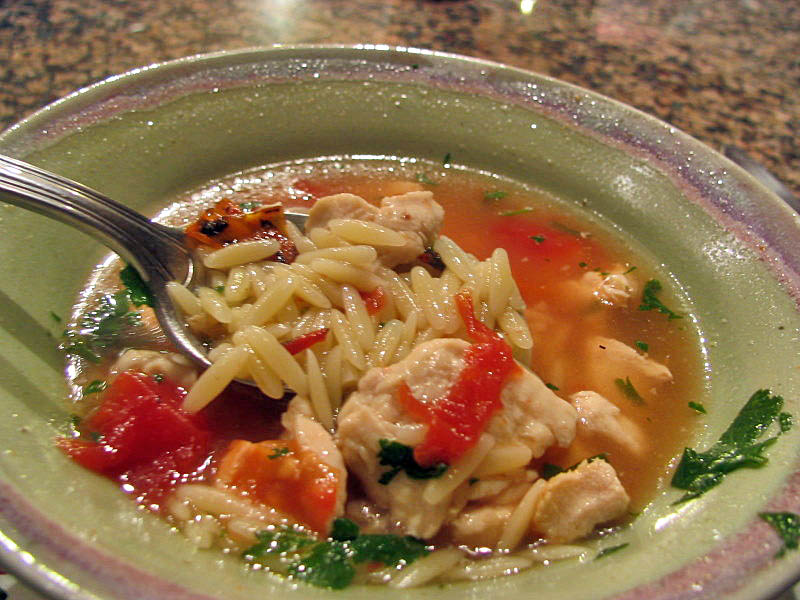
While rummaging through the 2,675 loose recipes around my house, I found one from 2006 that was whispering my name: a simple soup from the Mean Chef collection, which was perfect for one of last week’s chilly evenings.

YUCATAN-STYLE CHICKEN SOUP WITH ORZO AND LIME
(adapted from Mean Chef’s recipe)

3/4 cup orzo pasta
1 T olive oil
1/2 onion, diced
2 cloves of garlic, minced
1 serrano pepper, finely minced
2 chicken skinless chicken breasts, sliced into matchstick pieces
5 cups chicken broth (preferably home-made)
1/4 cup fresh lime juice
3/4 cup of diced tomatoes (I used organic, fire-roasted Muir)
1/4 cup chopped cilantro
salt and pepper to taste

Cook the orzo until al dente (do not overcook).  Drain well and reserve.

Heat the oil in a large saucepan and saute the onion and serrano pepper for a few minutes, until the onion is translucent.  Add the garlic and chicken pieces, and saute for a couple of minutes longer.

Add the chicken broth, lime juice, and tomato.   Bring to a boil and simmer gently until the chicken is cooked through.  Mix in the cooked orzo, season with salt and pepper, then add cilantro just before serving.

ENJOY!

to print the recipe, click here

Comments: I’d love to say that I always use homemade chicken stock, but it’s not true.  In a pinch I may use packaged stock, because it makes life easier.  But, in two instances I stay with my precious homemade version:  when making soups or risotto.   The flavor of the broth is powerful in these dishes, and your taste buds will appreciate the high road, as illustrated by this soup.

Orzo is my favorite pasta shape, but the same soup also shines with cooked rice. In Brazil we call that version “canja.”   It’s a soup with firm roots in Portugal, and my mom’s basic strategy to fight almost any kind of illness. I guess some things are the same all over the world… 😉

Please don’t skip the lime or the pepper, because without them this simple soup will be bland.  We like the flavor of cilantro, but members of the Cilantro Haters Association may skip it.   I never understood the advice to substitute parsley for cilantro, because apart from color, they have little in common.   But, I suppose a little parsley won’t hurt anything in this soup.

receita em portugues na proxima pagina

BLASTED BROCCOLI, STOVE-TOP VERSION

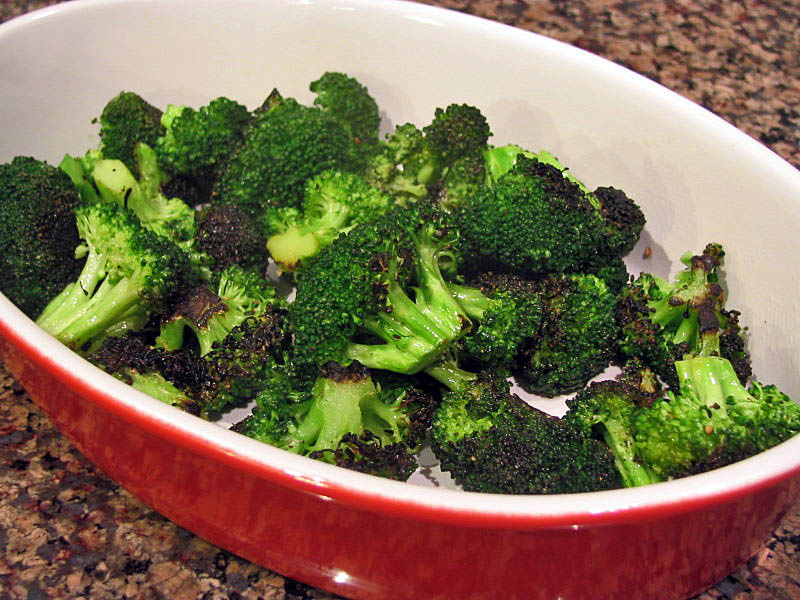
I love roasted vegetables, whether it’s cauliflower or butternut squash,  carrots or mushrooms, and especially  broccoli.  For reasons that I can’t explain, when broccoli is being roasted it’s become fashionable to call it  “blasted broccoli“.

I recently encountered a method for ‘blasted broccoli‘ that literally only took minutes to prepare.  We enjoyed it so much that I made it twice in the same week!  The strangest thing happened, though: now that I want to write about it, the link is gone.    I tried and tried to retrieve it, but without success.   All I can find are the usual recipes that call for roasting in a high oven. So, my apologies for failing to give proper credit, but here’s the method that we liked.

BLASTED BROCCOLI
(adapted from unknown source)

broccoli florets (enough for you and a lucky guest)
1 T olive oil
salt to taste
red pepper flakes
freshly squeezed lemon juice

Heat the olive oil until very hot, almost smoking, in a large skillet that will hold the broccoli in a single layer, with little or no overlapping.   Add the broccoli florets, sprinkle with salt, add red pepper flakes, shake the pan, and immediately cover it.

Leave it covered for exactly two minutes.

Open the pan and spritz lemon juice all over.  Check  the broccoli to see if it’s cooked to your taste (I like mine with a lot of bite).  If you want it softer,  then cover the pan  and cook again for another 30 seconds.

Serve immediately…

ENJOY!

to print the recipe, click here


Comments:  This recipe won me over because it’s lightening-quick, and leaves the broccoli exactly as I like it:  firm with a fresh and smoky flavor, from its intensely seared florets.  My stainless steel skillet was not in great shape afterward, but I suspect I over-heated the oil a bit.  The secret lies in closing the pan and allowing the broccoli to cook undisturbed, to create a little char at the bottom, and enough steam to begin cooking the florets.  I’m 99% sure that the original recipe asked to finish it with butter, but I opted for fresh lemon juice instead.  Feel free to improvise, as broccoli matches with balsamic vinegar, or grated parmiggiano cheese, or a little nutmeg…. just use your imagination.

When prepared this way the broccoli  has the quality of a classic roasted veggie, but with a “brighter”  flavor;  I couldn’t stop nibbling on it.    This one goes into my regular repertoire!

On a side note, this method reminded me of a recipe for Brussels sprouts that I made  long  ago from 101 Cookbooks.  It’s delicious,  producing the same kind of flavor in a veggie that’s a little challenging for lots of folks.  Give it a try even if you’re  Brussels-sprouts-challenged.

MEETING PETER REINHART


When I learned that Peter Reinhart was teaching some classes on Artisan Bread Baking in Texas, I had to enroll. I chose the Jan 31st event at the Central Market in Plano, TX, which is normally just a couple of hours from our home. Unfortunately, fate delivered an ice storm across my path just three days beforehand, making the driving pretty scary and quite a bit longer.

Still, I left early and managed to arrive an hour early at the Central Market, where I immediately saw Mr. Reinhart talking to his associates outside the beautiful classroom. I’d brought the book with me, hoping for his signature, but at first I couldn’t muster the courage to talk to him. It often happens when I’m confronted by people whom I admire: 90% of my composure disappears, leaving me to stumble on embarrassingly short sentences that may or may not make sense.

A past event comes to mind: the day that I met Francois Jacob, the 1965 Nobel Prize winner for his incredible work on the regulation of bacterial genes. In 1994 I was in Paris working at Institut Pasteur in the lab of Dr. Maurice Hofnung, one of Jacob’s students. Maurice had himself received an award from Legion d’Honneur, and Jacob was in attendance to celebrate the occasion. I was lucky enough to be a witness!

The large dining room was filled with small, elegantly set tables, at one of which I sat and waited. Suddenly, Dr. Jacob entered the room. We all felt expectation and tension in the air, until in slow, surreal motion he approached my table and sat down right across from me! We shook hands, exchanged the mandatory “Enchante / Enchantee,” and I spent the rest of the meal as a nervous wreck. But, it was worth it!

Those memories flashed through my mind in the Plano classroom, debating if I should talk to Mr. Reinhart. I finally convinced myself: “if you survived a meal with Francois Jacob, you can make it through a conversation with Peter Reinhart…” 😉 So, I got up and tracked down my bread guru. After accidentally breaking a glass full of water and ice with my handbag, and pulling a huge handle off the glass door as I left the room (I’m a walking disaster, in finest form), I met Peter in the hallway outside.

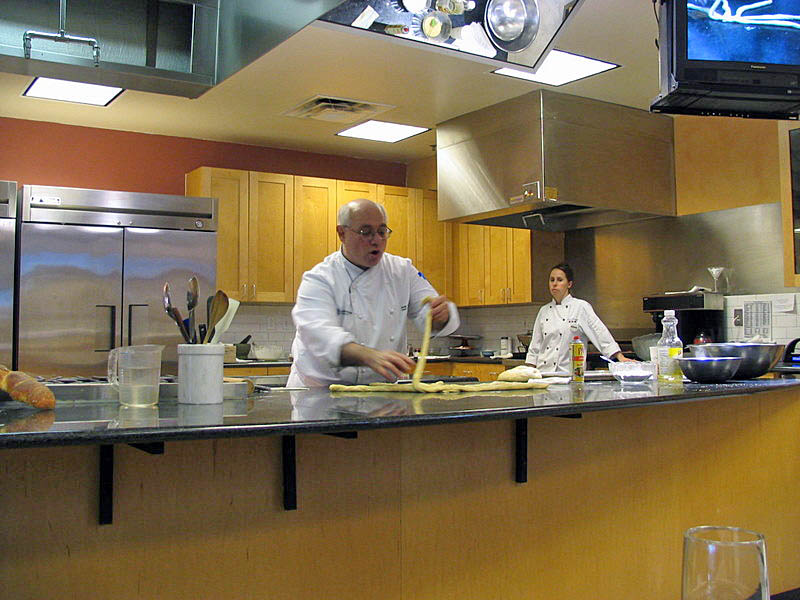
Mr. Reinhart is a wonderful, personable man, who immediately put me at ease. He’s impressed by the BBA Challenge, and was eager to discover any breads that were particularly tricky, or failed to meet expectations. I mentioned my trauma with the infamous 100% rye, and he wasn’t much surprised by my troubles. He then talked about the method of folding the dough a few times instead of extensive kneading. In fact, that point was the focus of his lecture.

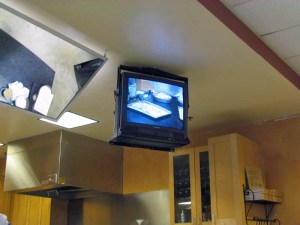
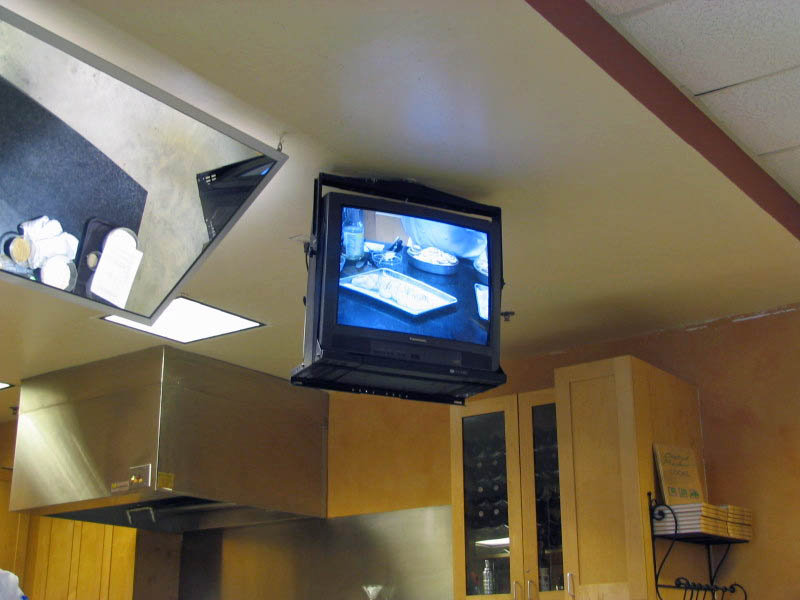
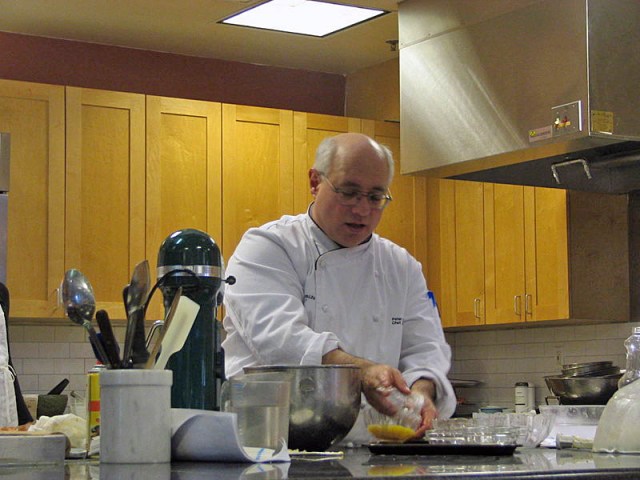
The venue was perfect: TV cameras positioned over the workspace, two flat screen TVs projecting the event on both sides of the room. Organizing and teaching the class wasn’t trivial. Mr. Reinhart worked non-stop shaping several breads, as well as baking breads that were shaped beforehand in three large ovens, each with idiosyncrasies: too hot, not hot enough, uneven heat. It was the kind of stuff that really happens, and nice to see how a professional deals with it: zero hyperventilation.

We tasted samples of each bread – starting with thumbprint jams, then French bread, crumb cake, sticky buns, challah and chocolate babka (everyone’s favorite!).

If you’re a novice bread baker, I recommend that you attend one of Peter’s classes. But, if that’s not feasible, then his new book (Artisan Breads Every Day) is a great alternative. It’s quite instructive: – clear, detailed descriptions of how to make a starter, to maintain it, and the most important thing: to get the most of your bread dough by folding it.

I was thrilled to see Mr. Reinhart explaining the method in his new book, because I’m also a huge fan of this approach, having used it in many of the BBA recipes.

The icing on the cake was meeting a bunch of wonderful people attending the event, friends I’ve met through cooking forums online (Sharon, Cindy, Amy, and Dona), and two bloggers who are also fellow BBA Challengers: TxFarmer, the outstanding baker who keeps a blog in Chinese, and Stacey, with her beautiful blog Magnifico, who traveled all the way from Arizona to be in Peter Reinhart’s class!

A fun day, worth the dreadful drive…. and yes, I got my book signed, with Peter’s legendary motto:

May your bread always rise!

BBA#39: VIENNA BREAD

Thirty-nine breads down, FOUR to go!   Seems like a dream, but we are getting to the end of the BBA Challenge

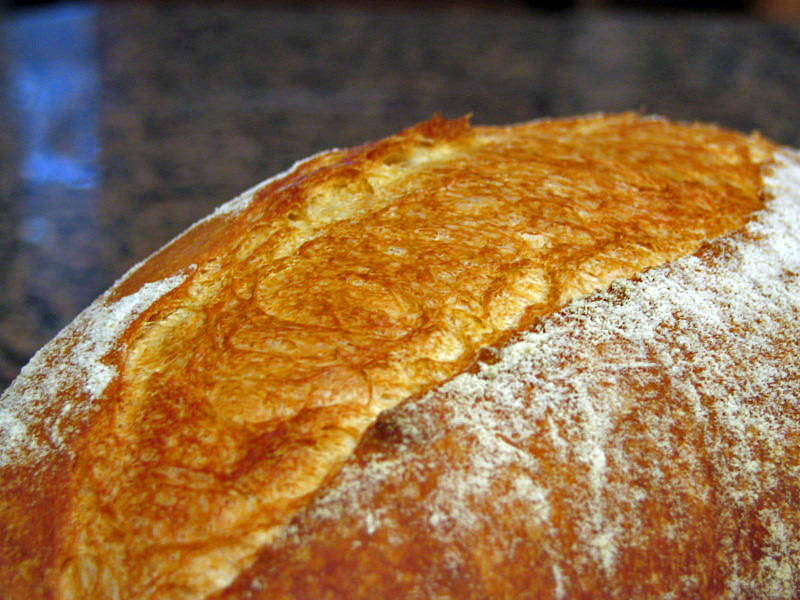
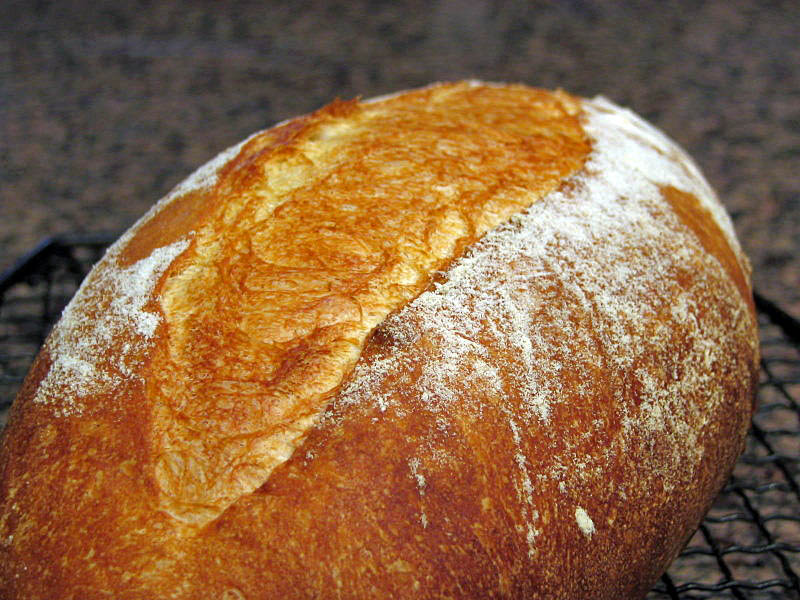
After last week’s bread, which fail to please the baker, I was eager to make this one, and the ice storm that hit us was the perfect excuse to indulge in bread baking.   Peter Reinhart’s  recipe requires a pate fermentee, made the day before.  The dough is reasonably rich with butter, egg, and sugar.   Wonderful to work with!   I mixed everything together, allowed it to sit undisturbed for 20 minutes, then folded the dough a few times.  One more cycle of folds after 60 minutes, another hour of rise, and the final shaping.  Nice and easy.   The shaped loaf was sprinkled with flour and slashed right before baking (click on the image to enlarge it).

The bread had amazing oven spring, as you can see by the
enlargement of the slashed region…

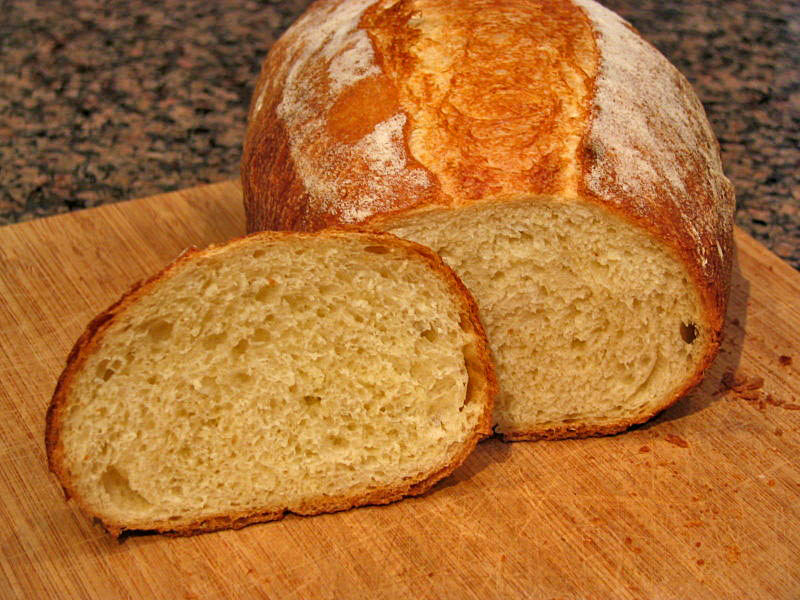
It feels very light for its size, the crumb is delicate, and so is the crust…

This was one of our favorites, and quite simple to make, no need for sourdough starters to enjoy a nice loaf of Vienna bread.

Only one small problem –  bread should be allowed to sit for at least one hour before cutting.  I could not obey this rule.  After cooling for 15 minutes, my husband asked how long until he could have a slice.  “About two hours” was my answer.   His?

“You’ve got to be kidding me.  Pass me the knife, will you”?      😉