SEMOLINA SOURDOUGH

OCTOBER 16th
WORLD BREAD DAY!

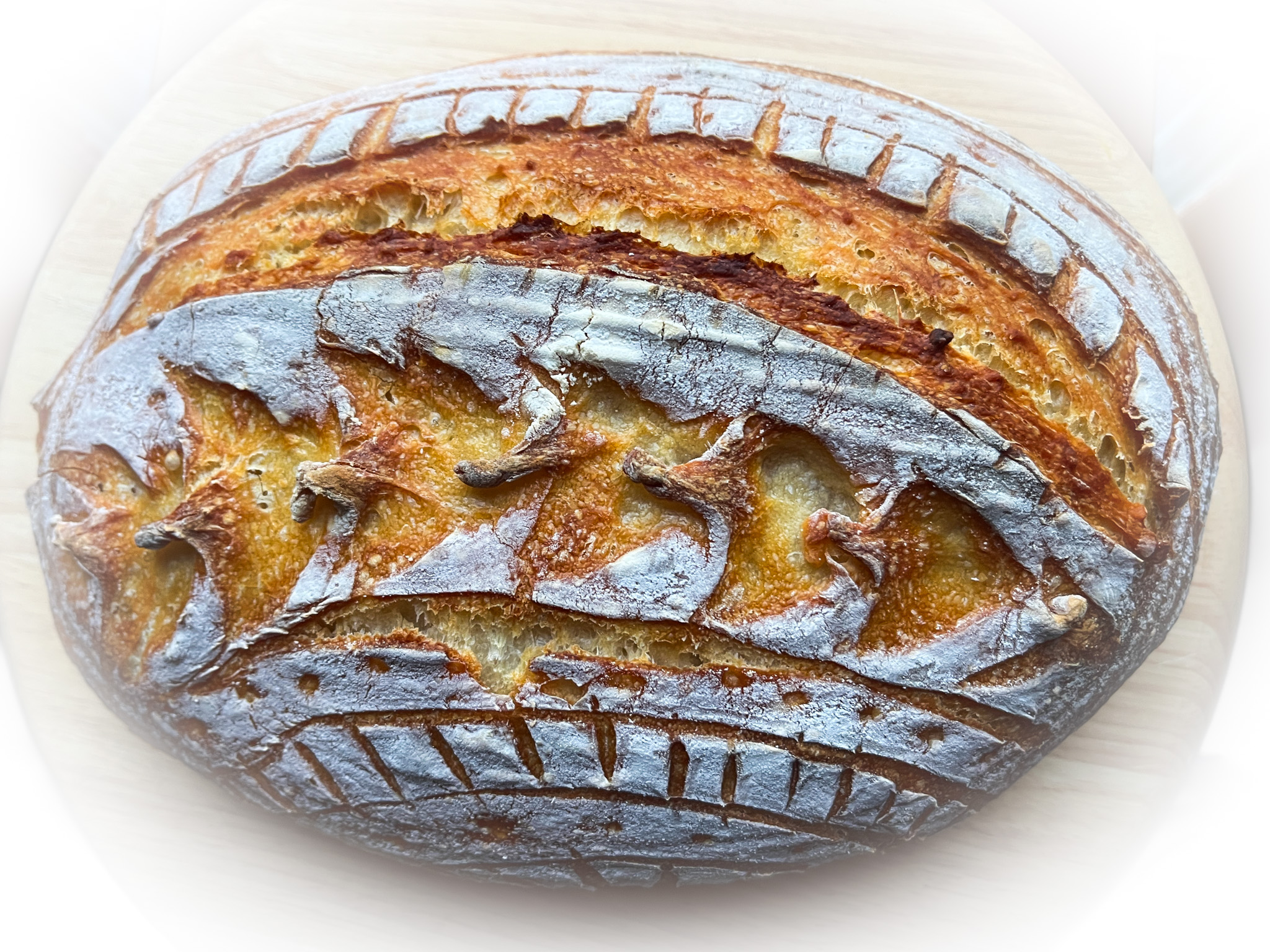
The key to this bread is to use fine semolina, I highly recommend this brand if you find it where you live, or if you don’t mind supporting the so-called Evil Empire aka amazon.com… The dough is soft, a pleasure to work with, the crumb develops a light yellow tone, and has great texture and taste. I am sold.

SEMOLINA SOURDOUGH
(from the Bewitching Kitchen)

300g white bread flour
225g fine semolina flour
355g water
50g sourdough starter at 100% hydration
9g salt

Mix all ingredients in the bowl or a KitchenAid type mixer fitted with the dough hook. Knead on low speed for about 4 minutes, adjust dough with flour is needed (I like to have it still glueing to the bottom of the bowl as it spins).

Transfer to an oiled bowl and ferment for 5.5 hours total. Perform a set of folds at 45 minutes intervals five times, which should take you about 3 hours and 45 minutes. Let the dough alone for the remainder of bulk fermentation. Shape as a batard, keep at room temperature for 1 hour and retard in the fridge.

Score and bake at 450F in a Dutch oven with the lid on for 30 minutes, remove the lid and bake for additional 15 to 20 minutes. Cool completely before slicing.

ENJOY!

to print the recipe, click here

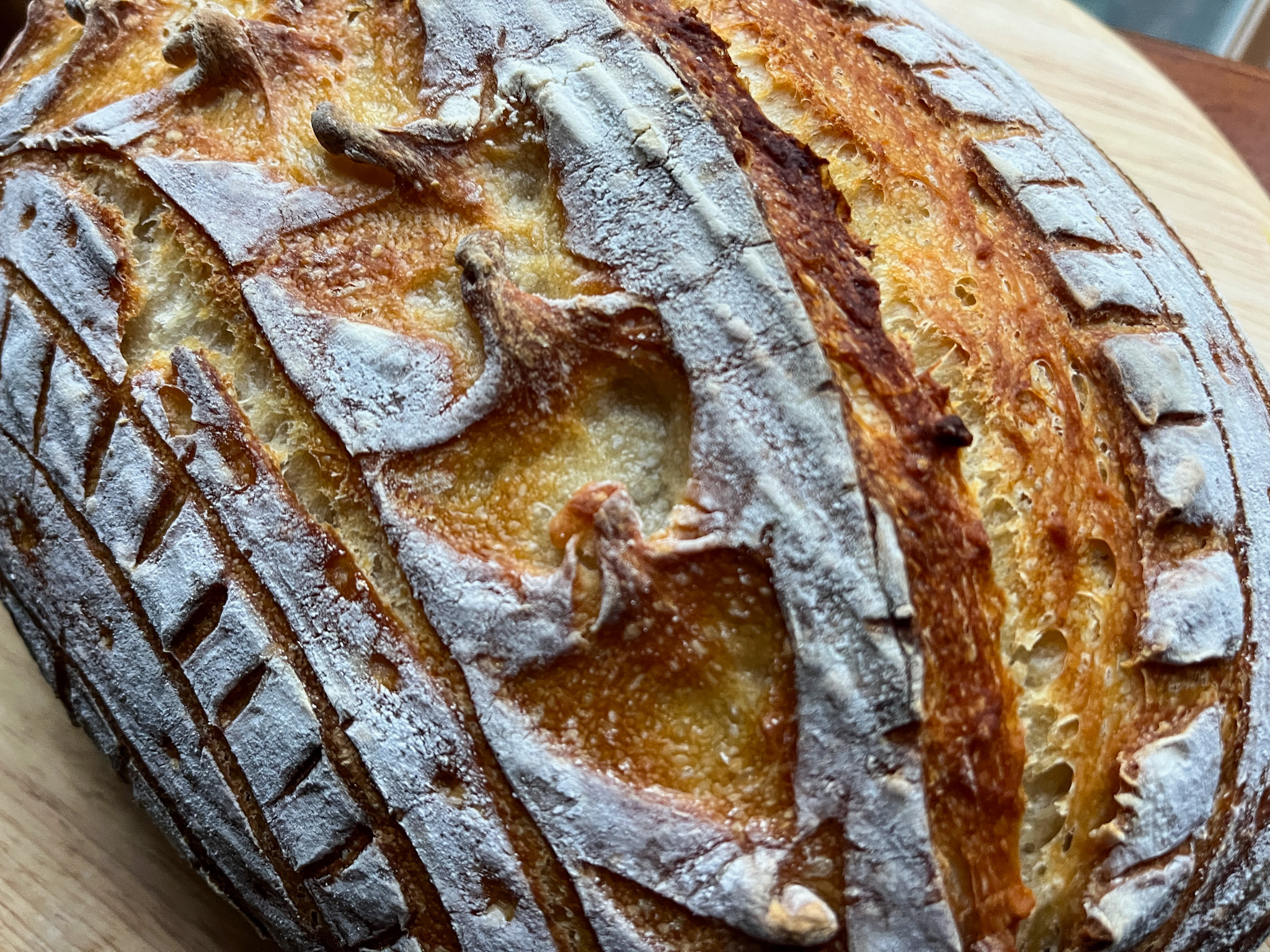
Comments: I used tapioca flour for the scoring because I like how it stays super white during baking, but you can use regular bread flour or rice flour if you don’t have tapioca. The central scoring was made with a razor blade in a series of V cuts and then I pulled the bottom part of the V shape and twisted backwards. The rest of the design was just razor blade and holes made with a chopstick.

I hope you give semolina sourdough a try, we absolutely loved this simple bread!

ONE YEAR AGO: Incredibly Simple, times three

TWO YEARS AGO: Chile Rellenos

THREE YEARS AGO: Vietnamese “Pizza”

FOUR YEARS AGO:  Chocolate Bonbons with Mango-Ganache Filling

FIVE YEARS AGO:  Giant Cookie Meets Mousse

SIX YEARS AGO: The Brazilian Battenberg

SEVEN YEARS AGO: Salzburg Sourdough

EIGHT YEARS AGO: If I had One Hour

NINE YEARS AGO: Apple Cinnamon Oatmeal Cake

TEN YEARS AGO: Sourdough Rye Bread with Flaxseeds and Oats

ELEVEN YEARS AGO: Apricot-Raspberry Sorbet: A farewell to Summer

TWELVE YEARS AGO: Marcela’s Salpicon

THIRTEEN YEARS AGO: Pork Kebabs

FOURTEEN YEARS AGO: Fondant au Chocolat

FIFTEEN YEARS AGOGot Spinach? Have a salad!

IL PANE DE VINCENZA

Funny how things work… I’ve been baking sourdough for 17 years, and all of a sudden I stumble on something new to me, something that mesmerizes me and makes me want to drop everything and give it a try. I stumbled by complete accident on the blog of Vincenza, which is written in Italian, but thanks to my Portuguese speaking, I can navigate without too many issues. Vincenza is a fantastic baker, from cakes to bread and macarons. Photography is also one of her hobbies, and her site definitely reveals that right away. This is my first attempt at making one of her recipes (Semolina Bread with Turmeric Lattice). I consider it a work in progress, as some improvement is needed with my handling of the lattice, but isn’t that what life is all about? Setting goals and having fun trying to reach them?

SEMOLINA SOURDOUGH WITH TURMERIC LATTICE
(from La Torte de Cenzy’s blog)

for the main dough:
320 g of double milled semolina flour
80 g bread flour
80 g sourdough starter at 100% hydration
280 g water
8 g salt
for the lattice:
300 g bread flour
150 g water
30 g sourdough starter
5 g salt
Turmeric to taste (I used 1/2 tsp)


In the bowl of a KitchenAid type mixer add the waters flours, and sourdough starter, mix with the dough hook until the flour is incorporated in the water. Let the dough rest for 1 hour, covered.

Sprinkle the salt over the surface and knead until very smooth, about 5 minutes. Transfer the dough to a slightly oiled bowl and make a set of folds. Allow the dough to bulk ferment for a total of 4 hours, folding the dough every 30 minutes for the first two hours. If the dough is too loose, give it another one or set of folds during that period.

Shape the dough as a batard and place it in a banneton with the seam up. Leave it at room temperature for 1 hour. At this point, make the turmeric dough by mixing all ingredients by hand in a bowl. Knead it very well to make it elastic and pliable, then cover the dough and keep it at room temperature overnight.

The following morning, roll out the turmeric dough and with a wheel make many strips that will have to be coupled two by two and with them form a basket weaving placed on a sheet of parchment paper. Cut flowers with a cookie cutter, making sure to flour the cutter well.

Turn on the oven to 450F.

Remove the main dough from the fridge, turn it over a sheet of parchment paper, so that the smooth side is up. ake the string from the fridge and turn it over on a sheet of parchment paper, spray it with a little water and cover the bread, turning the prepared lattice over on it and making it adhere well. Glue the flowers with a bit of water on one edge of the bread. Cut a deep incision along the entire side of the bread, off-center and immediately place it in a Dutch oven, cover, bake for 30 minutes, remove the cover and bake for additional 15 to 20 minutes. Cool completely before slicing.

ENJOY!

to print the recipe, click here

Comments: I was a little scared of making the lattice, but it was not bad at all. I used my roller cutter fully closed, so that the strips would be as narrow as it allows, but you can always use a ruler and cut it with a pizza cutter gadget. Make sure to flour the surface so that the rolling action will separate the strands efficiently. Make the lattice using sets of two strips, and the hard part is done. Well, maybe not quite. The toughest thing to me was adding it to the bread without abusing them (dough and lattice) too much. I did not do a good job on my first attempt, and the bread collapsed quite a bit due to my handling.

You can see it is lopsided and a bit deflated. Still, I am thrilled that somehow the lattice looked ok and the bread turned out delicious!

A few days later I used a similar method with a red dough (I used food gel color, because I was hoping for a real bright red, but feel free to go for natural agents like beet or sweet potato powder). I decided to proof the lattice with the main dough, and the result is totally different, it gets baked flat instead of raised.

I prefer the first look, but I will need to tweak the way I handle the lattice to avoid disturbing the dough too much. Still, the technique has so much potential, I am thinking braids could be fun to try too… So many breads, so little time!

.

Vincenza, thank you so much for your advice and help as I tried to mimic your gorgeous bake!

ONE YEAR AGO: Gruyere Cheese Biscuits

TWO YEARS AGO: Incredibly Simple Korean Chicken Thighs

THREE YEARS AGO:  Zucchini with Quick-Pickled Vegetables and Peanut Sauce

FOUR YEARS AGO: Nha Benta (Brazilian candy)

FIVE YEARS AGO: The Best, The Very Best Hummus

SIX YEARS AGO: Chicken Katsu

SEVEN YEARS AGO: Whole-Lemon Marinade: Long Overdue

EIGHT YEARS AGO: Tomato and Cucumber Salad with Almond Vinaigrette

NINE YEARS AGO: Eggplant Tomato Stacks

TEN YEARS AGO: The Couscous that Wasn’t

ELEVEN YEARS AGO: Apple-Cinnamon Bread

TWELVE YEARS AGO: Blueberry Galette

THIRTEEN YEARS AGO: In My Kitchen, August 2011

FOURTEEN YEARS AGO: Journey to a New Home

FIFTEEN YEARS AGO: Friday Night Dinner

SEMOLINA SOURDOUGH BOULE

Having recently exorcised a few of my sourdough demons, I am happy as a clam baking bread every weekend.  This version is an adaptation of a formula that called for 100% durum semolina flour.  I took a small step back by including some regular flour in the mix, just a tad.  The dough is mixed the day before baking and rises for 12 or more hours in the fridge.   The semolina flour – which must absolutely be the correct type – gives the crumb a yellow hint, and takes the taste of the sourdough into a new direction.   A simple bread, with delicate flavor, but a hearty crust just like expected from a rustic sourdough.

loaf1

SEMOLINA SOURDOUGH BOULE
(adapted from Michele, at  The Fresh Loaf Forum)


to make the levain:
35 g sourdough starter at 100% hydration
140 g water
140 g  Semola  di Grano Duro Rimacinata
(you will use all the starter, make sure to save some of your leftover)

for final dough:
350 + 50 g water
4 g of diastatic malt powder
400 g semolina flour (Semola di grano Duro Rimacinata)
160 g bread flour
13 g salt

 Make the levain 10 hours before preparing the dough.  Mix all ingredients and leave at room temperature for 10 hours.

When the starter is ready, mix 350 g water with the malt and the starter (all of it).   When well combined, add the semolina, and the bread flour, mix until a shaggy dough forms.  Let it rest for 20 to 40 minutes.

Add the salt and the remaining 50 g water.  Mix well (you can use a Kitchen Aid type mixer for 2 to 3 minutes in low-speed if you prefer).

Let the dough ferment at room temperature for 2 hours, folding the dough every 30 minutes.  After the last folding, leave the dough undisturbed for 20 minutes.

Shape the dough as a ball and place in a floured round container.  Leave at room temperature for 20 minutes, then refrigerate for 16 to 20 hours.

Remove the dough from the fridge 1 to 2 hours before baking in a 450F with steam for 20 minutes, then reduce the temperature to 430F and bake for 25 minutes longer, until dark brown.

Cool completely on a rack before slicing.

ENJOY!

to print the recipe, click here

crumb2

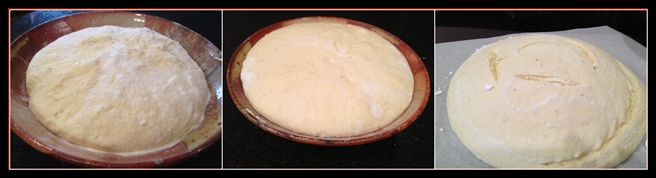
Comments:  If you are new to sourdough baking, this bread could be a bit challenging.   The semolina flour makes the dough pretty soft and very moist, it could scare a beginner into adding too much flour during handling.  The original recipe called for only three cycles of folding, but I added one more. The dough asked for it, it had not developed enough “muscle” at the third folding cycle.    I’ve been having trouble with my bread sticking to the banneton in long rises, so this time I took a different path and placed it inside a ceramic bowl heavily coated with rice flour.

composite

It worked really well, the bread expanded a bit during the overnight stay in the fridge, and had a nice shape after baking.  I left it at room temperature for a little over 2 hours before baking.

I wish I knew how to score the bread to get the amazing “flower effect” that Michele obtained, but until I see some type of tutorial for it online, I’ll have to accept a more old-fashioned, rustic type scoring.   Take a look at Michele’s full post about it and marvel at his technique…  I suspect the blade needs to be almost parallel to the surface of the dough instead of slashing deeply into it.

__________________________________________________________________________________________________________________________________

I am submitting this post to Susan’s Yeastspotting

__________________________________________________________________________________________________________________________________

ONE YEAR AGO: Forgive me, for I have sinned

TWO YEARS AGO: Cracked Wheat Sandwich Bread

THREE YEARS AGOAu Revoir, my Bewitching Kitchen

FOUR YEARS AGO:  French Bread