KALEIDOSCOPIC MACARONS

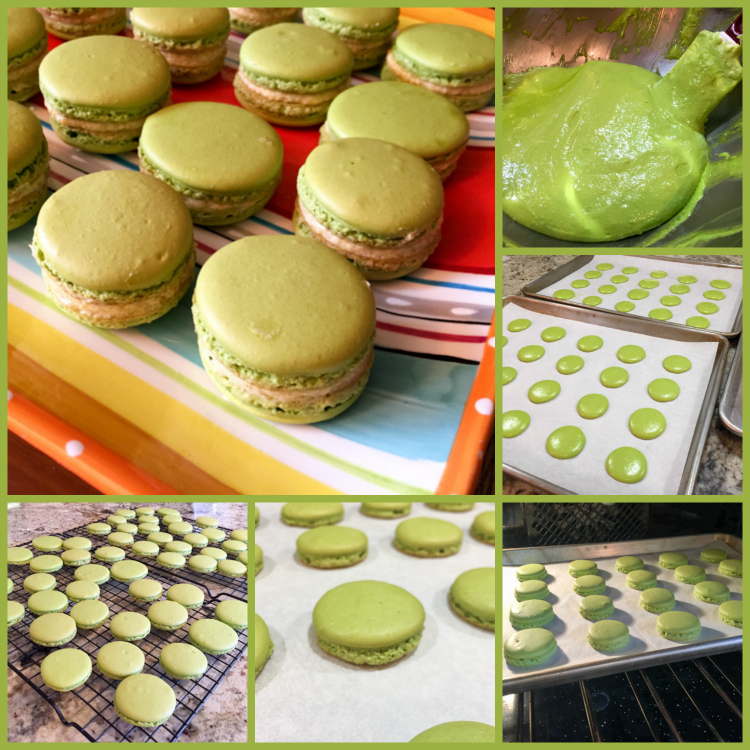
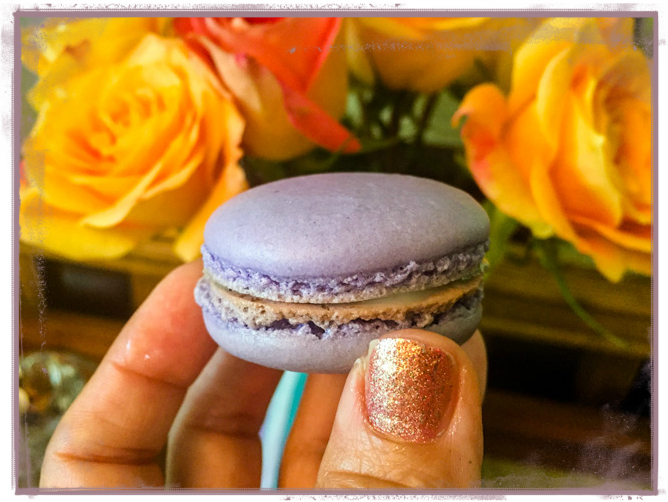
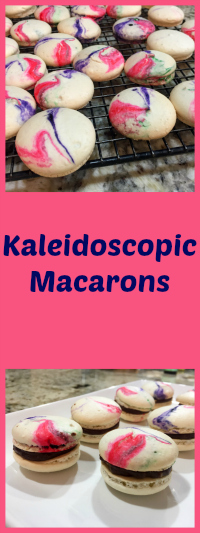
One more take on my ongoing obsession… But first, a relevant question: how far can we stretch the boundaries of these adorable cookies and still be comfortable calling them macarons? Apparently the boundaries are very blurry. From colors, types of fillings, decorations on top of the shells, we see endless variations. I cannot call myself a purist, as I am often taking liberties with classics, but I think my standards would be: macarons must be prepared with almond flour as the main component.  If other ground nuts are added, let them be a very minor player. Must contain a meringue incorporated with the flour by the macaronage method. Must have discernible feet. Other than those three requirements, I’ll accept anything. Savory fillings, neon-like colors, cute alternative shapes. For this batch, I experimented with a color effect. Some newbie errors took place, but I still performed better than I do at the golf course. Much, much better.

KALEIDOSCOPIC MACARONS
(from the Bewitching Kitchen, slightly adapted from Craftsy.com

Yield: About 72 shells; 36 assembled macarons

for the shells:
198 g powdered sugar
113 g almond meal
1/8 teaspoon dried lavender
113 g egg whites (I aged mine for three days)
1 g or a pinch of cream of tartar
100 g granulated sugar
Purple Gel color from AmeriColor
2 drops vanilla extract
for the filling:
chocolate ganache with finely chopped hazelnuts
recipe in this post

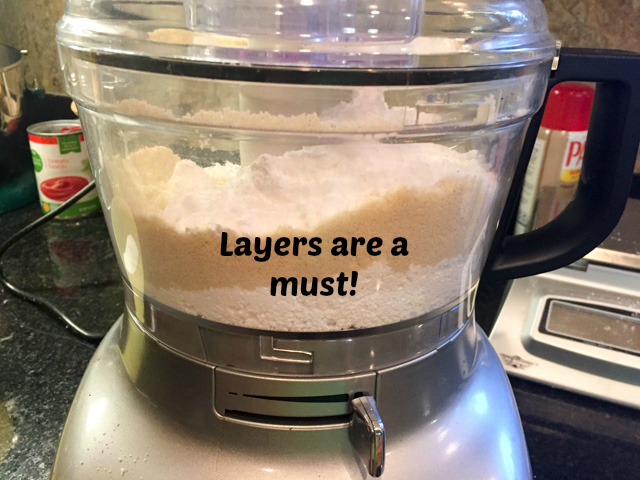
Line 2 or 3 heavy baking sheets with parchment paper or Silpat mats. Layer the powdered sugar, almond meal and lavender in a food processor or mini processor. Pulse until the mixture looks like fine meal, about 15 seconds. Pass through a sieve and transfer to a small bowl. Set aside.

Place the egg whites and pinch of cream of tartar in the bowl of a stand mixer fitted with the whisk attachment. Make sure that the bowl and the whisk are impeccably clean. Starting on medium speed, whip the whites with the cream of tartar until they look like light foam. The whites should not appear liquid. The foam will be light and should not have any structure.

Slowly rain in the granulated sugar, trying to aim the stream between the whisk and the side of the bowl. Turn the speed up to medium-high. Continue to whip the meringue until it is soft and shiny. It should look like marshmallow creme. Add the gel color and the vanilla. Staying at medium-high speed, whip the egg whites until the mixture begins to dull and the lines of the whisk are visible on the surface of the meringue. Bet until firm peaks form. Transfer the whites to a medium bowl.

Fold in the almond meal mixture in three increments. Paint the mixture halfway up the side of the bowl, using the flat side of a spatula. Scrape the mixture down to the center of the bowl. Repeat two or three times, then check to see if the mixture slides slowly down the side of the bowl. Open a plastic wrap on the counter, paint three lines of gel color of your choice separated by one inch. Pour the dough on top, wrap the plastic around, and insert the whole thing in a piping bag, making sure to have an opening in the wrap connected to the piping tip. Pipe shells on the prepared baking sheets.

Slam each sheet hard four to six times on the counter. Then fist bump each end of the sheet’s underside twice. Let the unbaked macarons dry until they look dull but not overly dry. Drying time depends on humidity. Ina dry climate, the macarons can dry in 15 to 20 minutes; in a humid climate, it can take 35 to 40 minutes.

While the macarons are drying, heat the oven to 330 F (170 C/gas mark 3). Bake one sheet at a time on the middle rack. Check in 11 minutes. If the tops slide, then bake for 2 to 3 more minutes. The macarons should release without sticking. Check one or two. If they stick, put them back in the oven for 1 to 2 more minutes. Let the macaroons cool for 10 minutes before removing from the pan.

Assemble the macarons: find two macarons similar in size and add a good amount of ganache to the bottom of one of them. Place the other on top and squeeze gently to take the filling all the way to the edge.  Ideally, store in the fridge for 24 hours for best texture.

ENJOY!

to print the recipe, click here
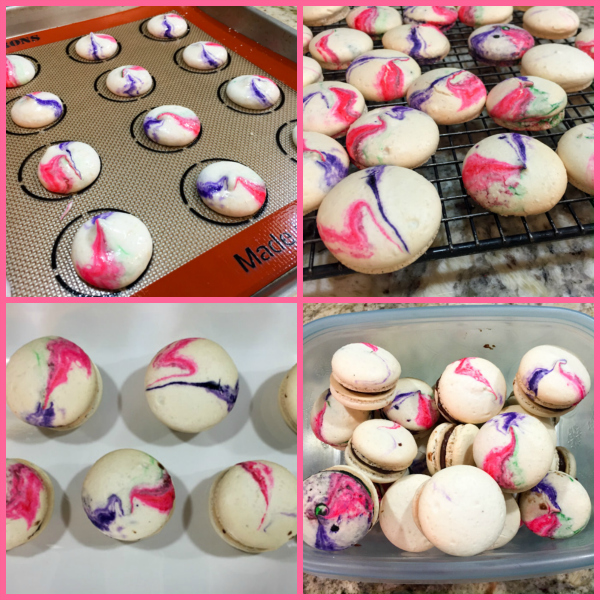
Comments: I know it’s hard to believe but I used three different colors for the shells, the green is barely noticeable, only in a few of them. Many of the shells got zero color. Puzzling? Read on, and the mystery will be solved. There are essentially two types of strategies to get more than one color in the macaron shell. You can make the dough, divide it in two (or three) portions, color each one separately, add them to the piping bag and allow them to mix during piping. I decided not to do it, because I was a bit insecure as to when to divide the dough, and maybe deflate it too much when mixing with the colors. I normally add the color very early in the process.  That brings me to method number two, which gives a very interesting marbled effect, when done correctly. You start by opening a plastic wrap over your counter. Then, you paint two or three solid lines of gel color over the plastic. Pour your dough with the optimal lava consistency over the plastic, wrap it around, and insert the whole thing inside a piping bag. See the photo below.

I realize it’s hard to see the lines of gel color on the first picture, but trust me, they are there. To my disappointment, the first 20 or so shells I piped were totally white! The reason is, when painting the lines they must go all the way to the icing tip, otherwise obviously you’ll get no color until the dough moves through and gets in touch with the gel.  Alternatively, you can use a long brush and paint the inside of the piping bag itself, making sure to reach down all the way to the tip. I must re-visit this technique and get the effect I was hoping for. It was quite frustrating to keep piping shell after shell, with no color, and then a little bit here and there. But hopefully practice makes perfect, and I will succeed next time.

As I mentioned before, the parallels between making macarons and golf are truly amazing! Once you take that golf club back, it’s over. For macarons, a little misjudgment and you don’t get what you want. The Macaron Gods are not very forgiving. And I’ve probably been extra naughty lately. You’d think?

Almond flour: $9.99

12 eggs: $3.50

Powdered sugar: $2.50

Matching outfit to macarons: Priceless!
Add to FacebookAdd to DiggAdd to Del.icio.usAdd to StumbleuponAdd to RedditAdd to BlinklistAdd to TwitterAdd to TechnoratiAdd to Yahoo BuzzAdd to Newsvine

ONE YEAR AGO: Zucchini Noodles with Sun-dried Tomato Pesto

TWO YEARS AGO: In My Kitchen, July 2015

THREE YEARS AGO: Sous-vide Pork Chops with Roasted Poblano Butter

FOUR YEARS AGO: Roasted Strawberry-Buttermilk Sherbet

FIVE YEARS AGO: Amazing Ribs for the 4th of July!

SIX YEARS AGO: Baby Back Ribs on the 4th of July

SEVEN YEARS AGO: Blueberry Muffins

EIGHT YEARS AGO: A Pie for your 4th of July


SaveSave

SaveSave

SaveSave

SaveSave

SaveSave

SaveSave

SaveSave

SaveSave

SaveSave

SaveSave

SaveSaveSaveSave

SaveSave

SaveSave

SaveSave

LEMON BUTTERCREAM MACARONS

I baked this batch back in February, evidently I took my sweet time (pun intended) to blog about them. The recipe is the same basic one I’ve been using from the Craftsy tutorial. I want to feel totally comfortable with it before moving to the Italian version. To get this color, I used a mixture of green and yellow gel coloring, but it’s hard to be precise about the amounts. I added a little bit of the green, mixed, added a little more, then some yellow, and gave a thorough mix. Crossed my fingers and hoped that the color would stay true during baking. You just never know. Not a single shell cracked, and all formed cute feet. What more can a baker ask to the Macaron Gods? Not much. Maybe uniformity in size? Yeah, that would be nice…


LEMON BUTTERCREAM MACARONS
(from the Bewitching Kitchen, adapted from Crafsy)

for the shells:
198 g powdered sugar
115 g almond meal
113 g egg whites (aged for three days)
a pinch of cream of tartar
100 g granulated sugar
Green and Yellow Gel colors from AmeriColor
2 drops vanilla extract

for the filling:
3 eggs
1 cup (200 grams) sugar
grated zest from 2 large lemons
juice of 2 large lemons
1 cup plus 2 tablespoons (230 g) chilled butter, cut in pieces

Line 3 heavy baking sheets with parchment paper or Silpat mats. Layer the powdered sugar, almond meal and lavender in a food processor or mini processor. Pulse until the mixture looks like fine meal, about 15 seconds. Pass through a sieve and transfer to a small bowl. Set aside.

Place the egg whites and pinch of cream of tartar in the bowl of a stand mixer fitted with the whisk attachment. Make sure that the bowl and the whisk are impeccably clean. Starting on medium speed, whip the whites with the cream of tartar until they look like light foam. The whites should not appear liquid. The foam will be light and should not have any structure.

Slowly rain in the granulated sugar, trying to aim the stream between the whisk and the side of the bowl. Turn the speed up to medium-high. Continue to whip the meringue until it is soft and shiny. It should look like marshmallow creme. Add the gel colors and the vanilla. Staying at medium-high speed, whip the egg whites until the mixture begins to dull and the lines of the whisk are visible on the surface of the meringue. Check the peak. It should be firm. Transfer the whites to a medium bowl.

Fold in the almond meal mixture in three increments. Paint the mixture halfway up the side of the bowl, using the flat side of a spatula. Scrape the mixture down to the center of the bowl. Repeat two or three times, then check to see if the mixture slides slowly down the side of the bowl. Put the mixture in a piping bag fitted with a Wilton #8 tip or another kind of your preference. Pipe rounds of the batter.

Slam each sheet hard four to six times on the counter. Then fist bump each end of the sheet’s underside twice. Let the unbaked macarons dry until they look dull but not overly dry. Drying time depends on humidity. Ina dry climate, the macarons can dry in 15 to 20 minutes; in a humid climate, it can take 35 to 40 minutes.

While the macarons are drying, heat the oven to 330 F (170 C/gas mark 3). Bake one sheet at a time on the middle rack. Check in 11 minutes. If the tops slide, then bake for 2 to 3 more minutes. The macarons should release without sticking. Check one or two. If they stick, put them back in the oven for 1 to 2 more minutes. Let the macaroons cool for 10 minutes before removing from the pan.

Make the filling: Beat together the eggs and the sugar with a Kitchen Aid type mixer on high-speed. Try to get the butter to double in volume by beating. Transfer to a saucepan and add the lemon zest and juice. Stir until it thickens slightly and all liquid is incorporated.  Pour the mixture into a bowl, cover with plastic wrap and cool in the fridge.

Once the lemon mixture is cold, put back into the bowl of the mixer, and beat with the wire whisk for a couple of minutes. Start adding the pieces of chilled butter, whipping until incorporated.  The mixture is now ready to be used to fill the shells.

Assemble the macarons: find two macarons similar in size and add a good amount of filling to the bottom of one of them. Place the other on top and squeeze gently to take the filling all the way to the edge.  Ideally, store in the fridge for 24 hours before savoring them.

ENJOY!

to print the recipe, click here

Comments: I made this batch before my dear niece Raquel sent me the macaron Silpat that I showcased in the Black Sesame Macarons post. The mat does make it a lot easier to get baking, as there’s no need to draw circles in parchment. Place the silpat over the baking sheet and off you are to a good start.  The lemon buttercream turned out very good to balance the sweetness of the shells. If you’d like to make it even easier, get some lemon curd from the store, but I imagine the texture is not as pleasing as homemade buttercream.

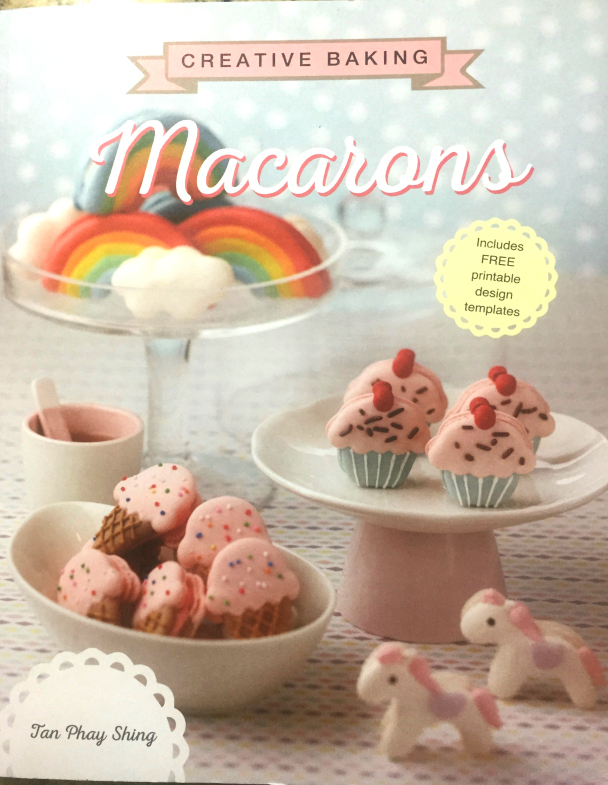
I must say that now I am not sure what I enjoy more, baking bread or macarons. They can easily turn into a bit of an obsession. And when you are obsessed, you tend to order special cookbooks. Such as….

order from amazon with a click here
(side note: I am not affiliated to amazon.com)

This is a more advanced macaron book. Can you imagine little macaron horses? I am not ready to face fancy shapes yet, but it’s fun to dream… It all starts with a dream, you know…

😉

Add to FacebookAdd to DiggAdd to Del.icio.usAdd to StumbleuponAdd to RedditAdd to BlinklistAdd to TwitterAdd to TechnoratiAdd to Yahoo BuzzAdd to Newsvine

ONE YEAR AGO: Raspberry Buckle

TWO YEARS AGO: Seafood Gratin

THREE YEARS AGO: Black Bean and Pepper Jack Burger

FOUR YEARS AGO: Carrot and Sesame Sandwich Loaf

FIVE YEARS AGO: Border Grill Margaritas

SIX YEARS AGO: Goodbye L.A.

SEVEN YEARS AGO: Vermont Sourdough


SaveSave

SaveSave

SaveSave

SaveSave

SaveSave

SaveSave

SaveSave

SaveSave

SaveSave

SaveSave

SaveSave

SaveSave

SaveSave

SaveSave

SaveSave

SaveSave

FIRST MONDAY FAVORITE: MAY 2017

Could someone tell 2017 that it is NOT a race to get to December?
Thanks.

Anyway, today is the First Monday of the month, so it’s time to showcase my favorite post of April. Easy job for me, very very easy, I do have a favorite, and it should not come as a surprise.

BLACK SESAME MACARONS!

Loved to design them, loved to make them, loved to share them with our departmental colleagues.  If you’d like to see the full recipe, click here

Thank you Sid, for organizing the First Monday Favorite!  
If you are a food blogger and would like to participate, drop Sid a line.

To see the contributions from my virtual friends, click on the link below

(comments are shutdown for this post)

https://static.inlinkz.com/cs2.js

BLACK SESAME MACARONS

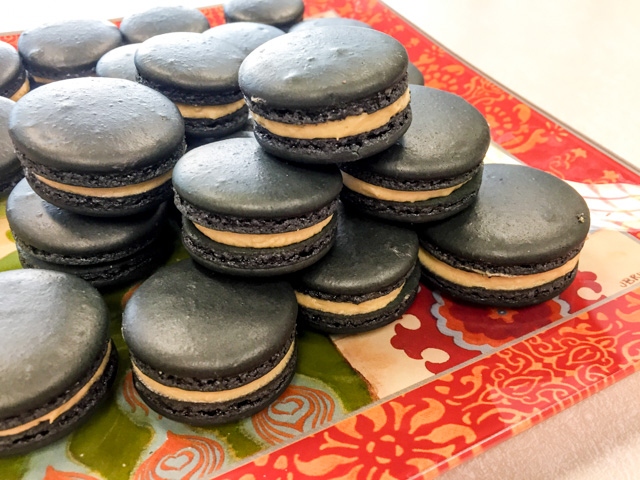
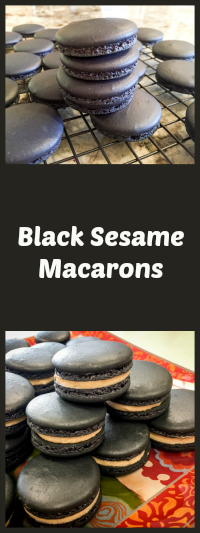
My macaron obsession goes on and on. I would love to bake a batch each weekend, but must keep in mind that even the most understanding departmental colleagues might say enough is enough. Plus, if I only make macarons…  brownies, cakes, and cookies will get jealous. So here I am to share with you a batch I am quite proud of: Black Sesame Macarons. Because, although I’m addicted to colors, we all know that black is beautiful…


BLACK SESAME MACARONS
(from the Bewitching Kitchen)

for the shells:
198 g powdered sugar
100 g almond meal
15 g black sesame powder (or you can grind black sesame seeds to a powder)
113 g egg whites (aged for three days)
1 g or a pinch of cream of tartar
100 g granulated sugar
Black Gel color  (about 1/2 teaspoon, add 1/4 to start and adjust as you mix)
for the filling:
8oz (227g) cream cheese
⅔ cup (134g) brown sugar
1 tsp (5g) vanilla extract
½ cup (122g) heavy whipping cream

Line 2 or 3 heavy baking sheets with parchment paper or Silpat mats. Layer the powdered sugar, almond meal and black sesame powder in a food processor or mini processor. Pulse until the mixture looks like fine meal, about 15 seconds. Pass through a sieve and transfer to a small bowl. Set aside.

Place the egg whites and pinch of cream of tartar in the bowl of a stand mixer fitted with the whisk attachment. Make sure that the bowl and the whisk are impeccably clean. Starting on medium speed, whip the whites with the cream of tartar until they look like light foam. The whites should not appear liquid. The foam will be light and should not have any structure.

Slowly rain in the granulated sugar, trying to aim the stream between the whisk and the side of the bowl. Turn the speed up to medium-high. Continue to whip the meringue until it is soft and shiny. It should look like marshmallow creme. Add the gel color and the vanilla. Staying at medium-high speed, whip the egg whites until the mixture begins to dull and the lines of the whisk are visible on the surface of the meringue. Transfer the whites to a medium bowl.

Fold in the almond meal mixture in three increments. Paint the mixture halfway up the side of the bowl, using the flat side of a spatula. Scrape the mixture down to the center of the bowl. Repeat two or three times, then check to see if the mixture slides slowly down the side of the bowl. Put the mixture in a piping bag fitted with one of the tips listed above. Pipe on the prepared baking sheets.

Slam each sheet hard four to six times on the counter. Then fist bump each end of the sheet’s underside twice. Let the unbaked macarons dry until they look dull but not overly dry. Drying time depends on humidity. In a dry climate, the macarons can dry in 15 to 20 minutes; in a humid climate, it can take 35 to 40 minutes.

While the macarons are drying, heat the oven to 330 F (170 C). Bake one sheet at a time on the middle rack. Check in 11 minutes. If the tops slide, then bake for 2 to 3 more minutes. The macarons should release without sticking. Check one or two. If they stick, put them back in the oven for 1 to 2 more minutes. Let the macaroons cool for 10 minutes before removing from the pan.

Make the filling:Whip the cream in a clean bowl till stiff peaks. In another bowl, whip the cream cheese, sugar, and vanilla extract.   Gently fold in the whipped cream into the bowl until well combined. Reserve.

Assemble the macarons: find two macarons similar in size and add a good amount of filling to the bottom of one of them. Place the other on top and squeeze gently to take the filling all the way to the edge.  Ideally, store in the fridge for 24 hours before digging in…

ENJOY!

to print the recipe, click here


Comments:  I am definitely not the first person to bake black macarons. A quick google expedition will show you a few other examples. Some recipes go to extent of using exclusively powdered sesame seeds as you would use almond meal for the shells. I did not want to do that, fearing that the change would be too much of a departure from the classic. So I used a small amount of black sesame powder (15 g in 115 g total seed/nut component). We could definitely taste it in the final product and I thought it was just right. More could have been overpowering.  My intention was to use a white chocolate filling, but I ran into problems and my filling never set enough to use. White chocolate is a temperamental creature. So I quickly whipped up (literally) a vanilla cream cheese filling and used it instead. It complemented well the sesame flavor of the shells, and the slight hint of caramel color given by the brown sugar looked good with the black surrounding it.

I was very happy with the way these turned out. Not a single shell cracked during baking, and the surface was for the most part pretty smooth. Beautiful, well-formed feet, and the black food coloring rose to the challenge. I am almost to the point of trying the Italian  meringue method, but want to tackle this simpler version a few more times. You know, build confidence first before facing the combination of hot syrup with egg whites.


I have yet another macaron post for you, shockingly green…  Stay tuned!

Add to FacebookAdd to DiggAdd to Del.icio.usAdd to StumbleuponAdd to RedditAdd to BlinklistAdd to TwitterAdd to TechnoratiAdd to Yahoo BuzzAdd to Newsvine

ONE YEAR AGO: Fine Tuning Thomas Keller

TWO YEARS AGO: Cauliflower Tortillas

THREE YEARS AGO: Majestic Sedona, Take Two

FOUR YEARS AGO: Secret Ingredient Turkey Meatballs

FIVE YEARS AGO: Swedish Meatballs and Egg Noodles

SIX YEARS AGO: Italian Easter Pie

SEVEN YEARS AGO: Black Olive Bialy

LAVENDER MACARONS WITH WHITE CHOCOLATE GANACHE

lavender-macaroncover
Confession number one:
 I have a macaron obsession. Odd, because when I lived in Paris by myself I never touched a macaron. Then a few years later, when Phil and I went back together for a sabbatical, I got hooked. It is the type of  concoction with just the amount of sweetness I like, the different fillings are a feast for the taste buds, but what really gets me, as you might imagine: the colors. I have a soft spot for colors. All of them. You should see my wardrobe. 😉

Back to macarons. A few months ago our friend Gary – Patissier Extraordinaire –  brought to my attention a book by Pierre Hermé, called quite simply Macarons. Once I got it, I quickly realized that  much like his classic masterpiece Desserts, Macarons is not for the faint of heart. My first adventure with it was almost a complete disaster, save for a few pistachio macarons that would barely qualify as such. In the book he says to use a convection oven at 350F, and I guess that was too high, or my oven misbehaved. Hard to tell. All I know is that my beautiful bright green macarons turned brown in 2.5 seconds right in front of my eyes, as I happened to be staring through the oven door when the metamorphosis took place. You know, the one that took perfect macarons to ruined ones.  Of course, they did not turn homogeneously brown, but all blotchy, really unappetizing. Yes, there was considerable amount of profanity that afternoon, in three languages, although French was first.

After that dreadful weekend, serendipity hit big time. I got an email from Craftsy.com with a special offer for their online classes. One of them was Miniature French Desserts, which included – you guessed it – macarons! I read the reviews and everyone raved about it. I signed up, downloaded the class and here I am to share with you my first real nice experience with these finicky creatures! Plus, Colette Christian, the wonderful instructor, gave me permission to share the recipe with my readers. How cool is that?

married112


LAVENDER MACARONS WITH WHITE CHOCOLATE GANACHE
(slightly adapted from Craftsy.com, published with permission from Colette Christian)

Yield: About 72 shells; 36 assembled macarons

for the shells:
198 g powdered sugar
113 g almond meal
1/8 teaspoon dried lavender
113 g egg whites (I aged mine for three days)
1 g or a pinch of cream of tartar
100 g granulated sugar
Purple Gel color from AmeriColor
2 drops vanilla extract
for the filling:
170 g white chocolate
85 g heavy cream
2 drops lavender extract

Line 2 or 3 heavy baking sheets with parchment paper or Silpat mats. Layer the powdered sugar, almond meal and lavender in a food processor or mini processor. Pulse until the mixture looks like fine meal, about 15 seconds. Pass through a sieve and transfer to a small bowl. Set aside.

Place the egg whites and pinch of cream of tartar in the bowl of a stand mixer fitted with the whisk attachment. Make sure that the bowl and the whisk are impeccably clean. Starting on medium speed, whip the whites with the cream of tartar until they look like light foam. The whites should not appear liquid. The foam will be light and should not have any structure.

Slowly rain in the granulated sugar, trying to aim the stream between the whisk and the side of the bowl. Turn the speed up to medium-high. Continue to whip the meringue until it is soft and shiny. It should look like marshmallow creme. Add the gel color and the vanilla. Staying at medium-high speed, whip the egg whites until the mixture begins to dull and the lines of the whisk are visible on the surface of the meringue. Check the peak. It should be firm. When you hold the beater up, the meringue should gently fall with and angle supporting the peak at the  with the angle supporting the peak at 11:30hs (easier to understand on the tutorial video). Transfer the whites to a medium bowl.

Fold in the almond meal mixture in three increments. Paint the mixture halfway up the side of the bowl, using the flat side of a spatula. Scrape the mixture down to the center of the bowl. Repeat two or three times, then check to see if the mixture slides slowly down the side of the bowl. Put the mixture in a piping bag fitted with one of the tips listed above. Pipe on the prepared baking sheets.

Slam each sheet hard four to six times on the counter. Then fist bump each end of the sheet’s underside twice. Let the unbaked macarons dry until they look dull but not overly dry. Drying time depends on humidity. Ina dry climate, the macarons can dry in 15 to 20 minutes; in a humid climate, it can take 35 to 40 minutes.

While the macarons are drying, heat the oven to 330 F (170 C/gas mark 3). Bake one sheet at a time on the middle rack. Check in 11 minutes. If the tops slide, then bake for 2 to 3 more minutes. The macarons should release without sticking. Check one or two. If they stick, put them back in the oven for 1 to 2 more minutes. Let the macaroons cool for 10 minutes before removing from the pan.

Make the filling: Place the white chocolate in a heatproof bowl. Bring the cream to a rolling boil in a small saucepan. Pour the hot cream over the chocolate, and let stand for 15 seconds. Stir with a spatula until smooth. If the chocolate has not fully melted, place the bowl in a saucepan of steaming water (the heat should be off), and let stand for 1 or 2 minutes. Stir again until the chocolate is fully melted. Add the lavender extract.

Assemble the macarons: find two macarons similar in size and add a good amount of ganache to the bottom of one of them. Place the other on top and squeeze gently to take the filling all the way to the edge.  Ideally, store in the fridge for 24 hours before devouring them… or sharing with great friends!

ENJOY!

to print the recipe, click here

compositemac

We’ve got feet!

Comments: I cannot tell you how much I loved this online class! Colette is personable, fun and a natural teacher.  The video perfectly timed so that you can actually make them in real-time together with her, pausing the video during baking, obviously. You can pause it, rewind it, save and watch it again and again. You’ll also get printed material with full recipes and variations.  Now, Colette is one super neat chef, because her kitchen ends up in the exact pristine condition as it was in the beginning. The same applies to her apron. I need to evolve into another type of human being to match her serenity and grace.

Her method is pretty straightforward.  For starters, she skips the sifting – and has a rationale for doing so. And she also prefers the simpler French meringue, again for reasons she states during class. I have to say that visualizing the macaron batter, and following her very careful explanation made all the difference. I concluded that in all my previous attempts I failed to mix the batter enough – that’s why many of my shells would crack and end up with a coarse texture, some hard chunks inside. If you have a deep desire to conquer macarons, her online video is a great option. I haven’t watched the other classes in the same video (Madeleines, Lemon Meringue Tartlets, and Opera Cake), but intend to do so in the near future. Madeleines have been on my list of goodies to make for… ever.  Or so it seems.

layersHer tip to add the dry ingredients in layers inside the food processor makes sure that things are incorporated smoothly. Macaron success is all in the small details and proper technique.  These had a very delicate lavender flavor. When you taste the white chocolate ganache – I know you will do it – try to stop after the second teaspoon, or you might run out of filling. Just saying…

macarons2
Colette also gives many tips to create your own flavors, it is amazing how versatile this cookie can be. As long as you respect simple rules to avoid messing up the basic formula, you’ll be fine. I would also like to invite you to take a tour of the blog Pizza Rossa. Rachael is very creative with her macarons, and came up with wonderful variations, including one that uses sesame seeds instead of almonds. She is inspiring me to spread my wings and try to fly a little higher.

I still want to try again the Italian meringue method because I am stubborn. There, I admitted it. And yes, that was confession number two. But Phil doesn’t need to know.

lavender-macarons-from-bewitching-kitchen


Add to FacebookAdd to DiggAdd to Del.icio.usAdd to StumbleuponAdd to RedditAdd to BlinklistAdd to TwitterAdd to TechnoratiAdd to Yahoo BuzzAdd to Newsvine

ONE YEAR AGO: Raspberry Chocolate Truffles

TWO YEARS AGO: Red Velvet Cupcakes

THREE YEARS AGO: Happy Valentine’s Day!

FOUR YEARS AGO:  A Few Blogging Issues

FIVE YEARS AGO: Dan Dan Noodles

SIX YEARS AGO:  Sophie Grigson’s Parmesan Cake

SEVEN YEARS AGO: Antibiotics and Food

Save

Save

Save