VOILA’ LES BAGUETTES!

Second chapter on Cooking Projects 2012!
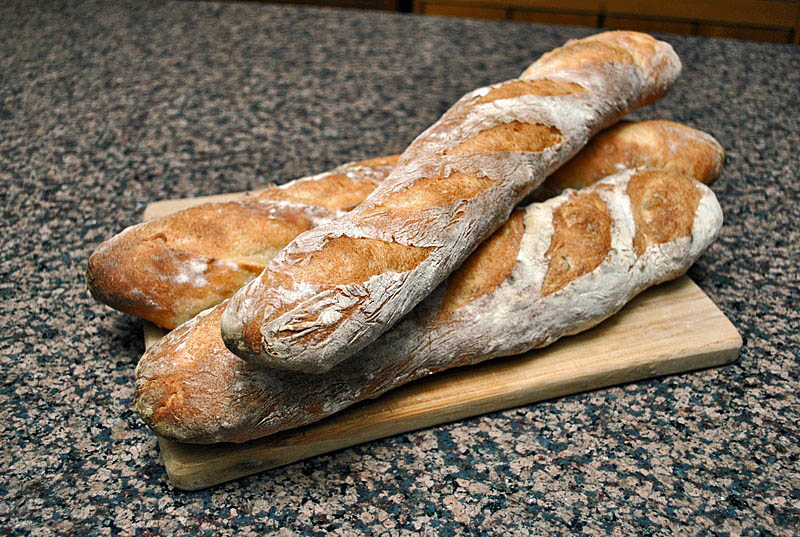
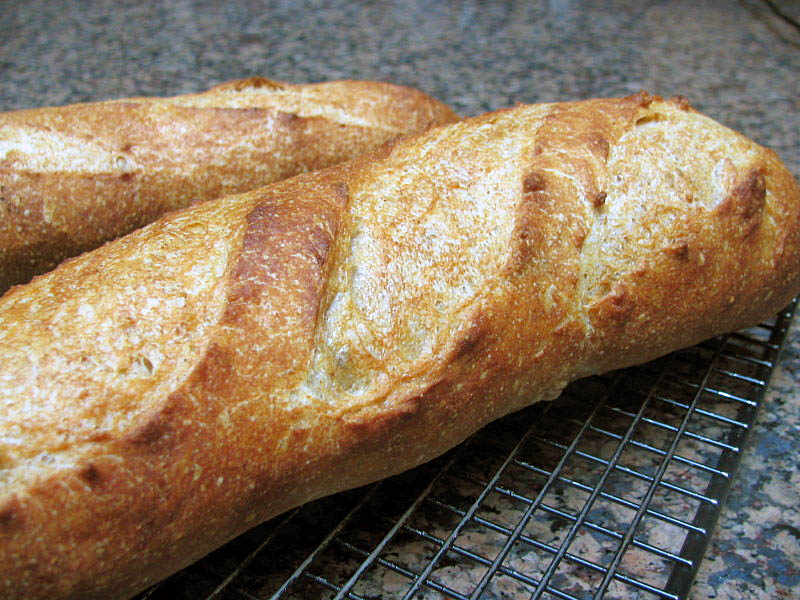
Five weekends. One hundred and twenty six ounces of flour. Blood. Sweat. A few tears. But, I am not afraid of shaping baguettes any longer. Is there room for improvement? No doubt, but the goal now shifts from shaping to baking: I must find a way to optimize the generation of steam.  Apart from that, I am pretty happy with my babies…
UN-KNEADED, SIX-FOLD FRENCH BREAD
(from Jeffrey Hamelman, Bread)

2 pounds + 4.5 oz  bread flour (8 + 1/4 cups)
1 pound + 10.6 oz water (3 + 3/8 cups)
3 + 1/2 tsp salt
1 + 1/4 tsp instant dry yeast

Place all the ingredients in a large bowl, and using your hands or a plastic scraper, bring them together forming a very shaggy mass.  The best way to do it is working the scraper down the sides of the bowl, and then rotating the bowl as you bring it up, and fold that part of the mixture on top. Do this movement about 20 times, which should mix everything together reasonably well at this stage.  Do not worry about how smooth the dough is, it will feel and look very “rough”.

Set a timer to go off every 30 minutes. You will fold the dough every thirty minutes, for a total of six times (at that point you will be 3 from the start).  At each cycle, fold the dough on itself using a scraper, for a total of 20 times,  either removing the dough to a surface, or folding it inside the bowl.  After the sixth folding cycle, leave the dough undisturbed for 30 minutes, then divide it in 12 ounce pieces (from the start,  you will be at the 3 hour and 30 minutes mark).  One full recipe makes 5 long baguettes.

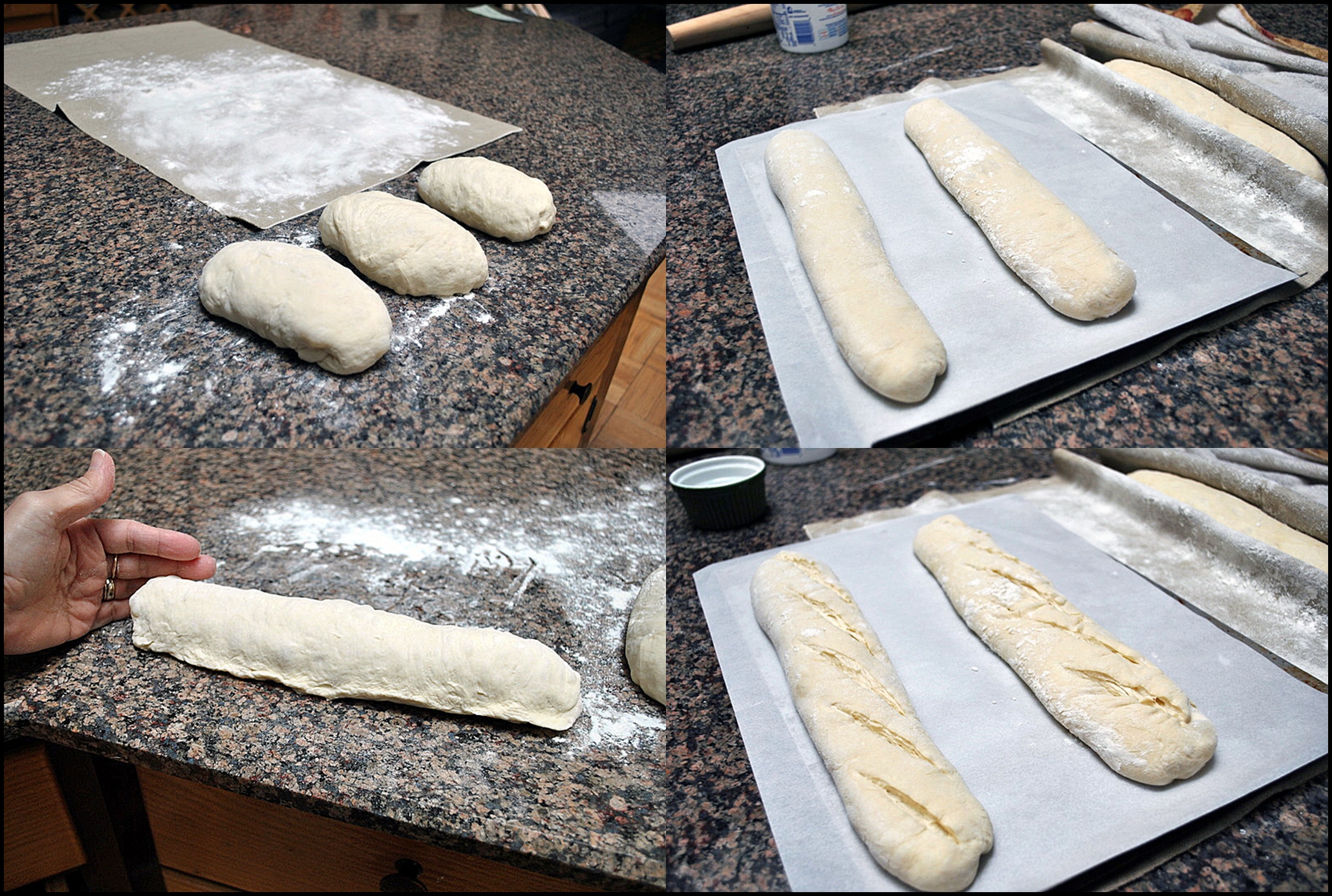
Gently form each piece into a cylinder shape, and let it rest for 15 minutes (very important to relax the gluten, don’t skip this step).  Shape as a baguette, then roll the baguettes to stretch them to their final size (make sure they will fit over your baking stone or the surface you intend to bake them on).

Let the baguettes rise (preferably using a couche well coated with flour) for 1 to 1 and a half hours at room temperature (ideally at 76 F).  Score the baguettes and bake in a 460 F oven, with initial steam, for a total of 22 to 25 minutes. Cool completely before slicing.

ENJOY!

to print the recipe, click here

Comments:   I like to do the first four of the six kneading cycles using a different technique:  I coat the granite counter top with a very light amount of olive oil,  and slam the dough on it 15 to 20 times.  You can see the technique demonstrated in this video.  The last two cycles I omit the “slamming”,  and simply fold it, so that the airy structure is not disturbed.   Phil insists that I should let him make a video of my “slamming technique”, but so far I resisted the idea.  Maybe one day… 😉

As to the shaping, I will be forever grateful to Gary, my friend and baker extraordinaire, who went through the trouble of mailing me a DVD of Chef Jeffrey Gabriel CMC, from Schoolcraft College. Gary made the video during his class on French baguettes, and I watched it over and over… and over!   The main difference between Chef Gabriel’s technique and this one, is that he is not too concerned with where the seam of the baguette ends up.   On my initial attempts, I was so worried about keeping the seam up for the final rise, that I ended up manipulating the baguettes too much and messed up their final shape.   Gary’s method is much more user-friendly, and once you score the baguettes and bake them, the seam position seems to have no influence on the final look of the bread.

A few important pointers for success:

1.  Coat the surface where the baguettes will rise (after the final shaping) with flour.   They WILL stick if you forget this step, leading to intense grievance.

2. Allow the dough to rest for 15 minutes before shaping.  You need that or the gluten will keep fighting back like an elastic band.

3. The better you get at shaping the baguettes, the longer they will be.  If you want to bake them covered to create steam, this could be a problem.  Consider making shorter baguettes – not authentic, but easier to bake in a home oven.

4. Baguettes are scored  with an odd number of slashes. Usually 5 or 7.   Some advise you to wet the blade to do it, I prefer to use a dry blade, as I like the “spiky” look of the slashes.

5.  The baker’s blade is sharp.  Make sure you cover it with the protective plastic cap when you are done, or, if using a blade with no cap, put it away. Leaving it sitting on the counter top is a recipe for disaster.   (sigh)

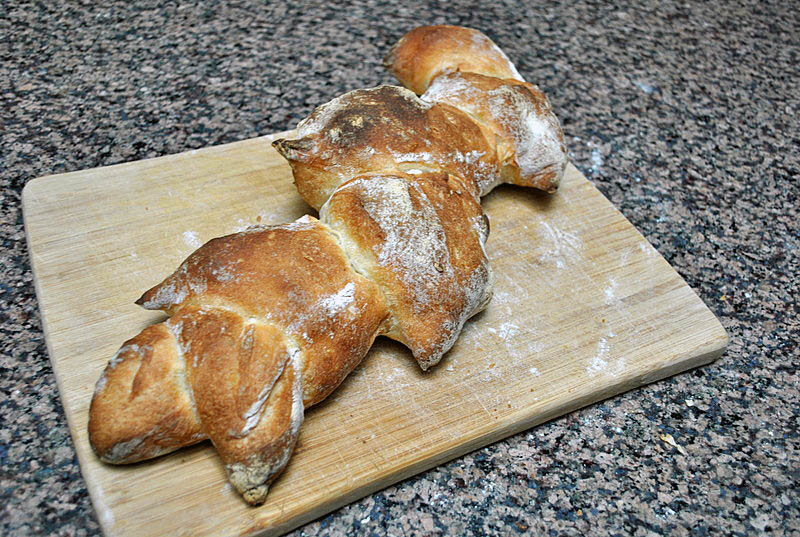
After practicing several weekends in a row, I now settled on making half this recipe, and shaping either 3 long baguettes or 4 medium-sized.   The tricky part is baking them: I can bake two at a time, so the last one must go through a longer rise.  Sometimes it seems to be slightly over-proofed, and the resulting baguette is a bit flat.  However, the taste is spectacular, this recipe produces a very creamy crumb, with a flavor that transported us to the 7eme arrondissement in Paris.  Not a bad virtual trip to take!   😉
I am submitting this post to Susan’s Yeastspotting

ONE YEAR AGO: Cornmeal English Muffins

TWO YEARS AGO: Cornish Hens for a Sunday Dinner

Add to FacebookAdd to DiggAdd to Del.icio.usAdd to StumbleuponAdd to RedditAdd to BlinklistAdd to TwitterAdd to TechnoratiAdd to Yahoo BuzzAdd to Newsvine

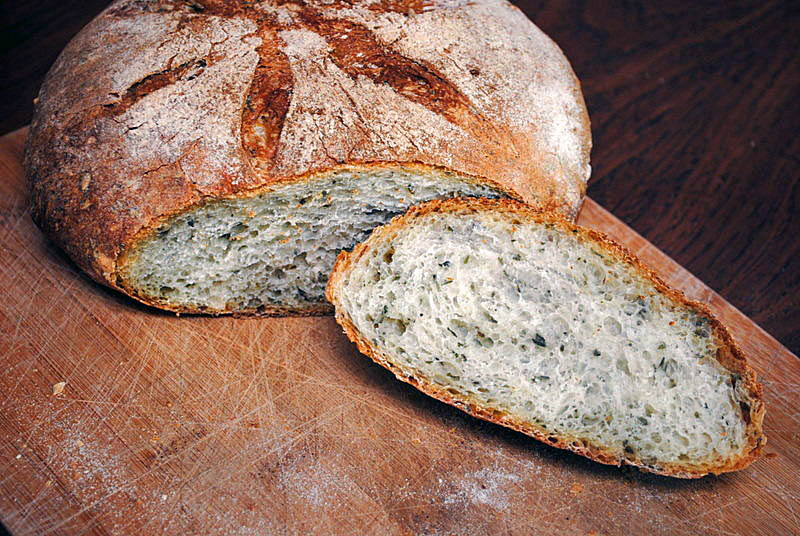
PAIN DE PROVENCE

As I mentioned before, I get a lot of inspiration for bread baking over at The Fresh Loaf Forum.  Browsing through their huge collection of recipes, one made me quite nostalgic, thinking about our good times living in France.  I absolutely had to make it: a “boule” loaded with herbes de Provence!  It cannot possibly get much better than that.   The recipe comes from Floyd, The Fresh Loaf’s host and a very accomplished bread baker. He got his inspiration from a recipe found in  Bernard Clayton’s Complete Book of Breads.  My copy, by the way, sits patiently at home, waiting for our return…   😉

I cut the recipe in half to make it easier to bake in my small Breville electric oven, but I’m posting the regular version, which will produce a larger loaf.  The dough requires an overnight poolish, but is very simple and straightforward to make.    Don’t be alarmed by the amount of herbs, they perfume the bread with just enough intensity to make you fall in love with it more and more at each bite.

PAIN DE PROVENCE
(adapted from Floyd’s recipe)

for the poolish (made 8 to 18 hours before the final dough):
1 cup bread  flour
1 cup water
1/2 teaspoon instant yeast

for the dough:
All the poolish made the day before
2 cups bread flour
1/2 cup Herbes de Provence
1 + 1/2 teaspoon instant yeast
1 teaspoon salt
1/4 cup orange liqueur such as Grand Marnier (I substituted orange juice)
1/4-1/2 cup water

The night before baking, make the poolish by mixing together 1 cup of flour, 1 cup of water, and 1/2 teaspoon of yeast to make a batter. Cover the container with plastic wrap and set aside for 8 to 18 hours until you are ready to make the final dough.

To make the dough, combine the remaining flour with the remaining yeast, salt, and herbs. Add the poolish, the liqueur, and 1/4 cup of the additional water. Mix the ingredients, and, if necessary, add more water or flour until the proper consistency is reached .

Mix by gentle kneading, and leave it undisturbed for 20  minutes in a lightly greased bowl.   Do three more cycles of gentle kneading (or folding)  every 30 minutes.  At the end of the last kneading (a little less than 2 hs of bulk fermentation),  let the dough rise undisturbed  for a full hour.

Remove the dough from the bowl and shape it into a ball or long loaf. Cover the loaf with a damp towel and allow it to rise again until doubled in size, which takes between 60 and 90 more minutes.

While the loaf is in its final rise, preheat the oven to 450F, with a baking stone inside, if you will be using it.   Just prior to placing the loaf in the oven, score the top of it with a sharp knife or razor blade.

Place the loaf in the oven and bake for 20 minutes at 450, then rotate it 180 degrees and reduce the oven temperature to 375 and baked it another 25 minutes. The internal temperature of the loaf should be around 200F.

Remove from the oven and allow to cool for at least a half an hour before serving.

ENJOY!

to print the recipe, click here

Comments: Of all the spices present in herbes de Provence, lavender is the one that I detect first and foremost.  I once visited that part of France at the time when the lavender fields were in full bloom, and the smell everywhere is simply unforgettable.   I thought the amount of herbs in the dough could be a bit excessive, but reading Floyd’s remarks about it gave me the reassurance to make it exactly as he did.  The aroma of the herbs is evident from the moment you mix the dough, but once the bread is midway through baking, you cannot wait to try the first slice.

The crumb is light and airy, and the bread is quite unique for its delicate herbal tones.  I have a special sandwich in mind for this bread,  but that is a story to be told another time…   😉

I am sending this to Yeastspotting….

ONE YEAR AGO:  Golspie Loaf

Add to FacebookAdd to DiggAdd to Del.icio.usAdd to StumbleuponAdd to RedditAdd to BlinklistAdd to TwitterAdd to TechnoratiAdd to Yahoo BuzzAdd to Newsvine

CIABATTA, A CLASSIC ITALIAN BREAD

I’ve made it before during the Bread Baker’s Apprentice Challenge, but was not very happy with the way it turned out.   Hard to believe that it took me 17 months to bake another batch, but time tends to fly by me.   November?  Are we in November already?  What happened to 2010, that started just the other day?   😉

Ciabatta, take two: the recipe from  “The Italian Baker” calls for a mixture of flour, water, and yeast made the day before (the “biga“), and used as part of the final dough.  A total fermentation time of 3 hours allowed us to have the bread in time for lunch, as it bakes very quickly, less than 25 minutes.   I am quite pleased with this recipe, I suppose that it would work even better in a real oven, but my Breville rose to the challenge!

CIABATTA
(from The Italian Baker)

for biga:
1/8 tsp active dry yeast
1 cup + 1 Tbs water at room temperature
1 + 1/4 cup all purpose flour (165 g)

Dissolve yeast in water, add the flour and form a sticky dough.  Leave it covered at room temperature for 16 to 24 hours.

for the final dough:
2.5 Tbs milk
1/2 tsp active dry yeast
5.5 ounces water (1/2 cup + 1.5 Tbs)
1/2 T olive oil
1 cup biga (250 g)
250 g all purpose flour
1/2 Tbs salt (7.5 g)

If kneading in a mixer, stir the yeast in the milk  and let it stand for  a  couple of minutes in the bowl.  Add the water, oil, the biga, and mix to incorporate, dissolving the biga in the liquid. Add the flour and salt, and mix at low speed for a couple of minutes.   Change to the dough hook and knead 2 minutes at low speed, and 2 minutes at medium speed.  Finish kneading by hand on a well-floured surface, but adding as little extra flour as possible.

Place the dough in an oiled bowl, cover, and leave at room temperature for 1 hour and 15 minutes.  Divide the dough, which will be very soft and bubbly, in two equal pieces.  Place each half on a well floured piece of parchment paper, and shape each as a cylinder, keeping the seam side down.  Stretch it gently to give the ciabatta overall shape (a rectangle of 10 x 4 inches), and use the tip of your fingers to make deep dimples all over the dough. Cover with a damp towel and let them rise for 1.5 to 2 hours.

Bake in a pre-heated 425 F oven, spraying the bread with water three times in the first 10 minutes.   Total baking time should be 20 to 25 minutes.   Cool the loaves on a rack, and…

ENJOY!

to print the recipe, click here

Comments:  Carol Field advises against kneading this dough by hand, because it is very hard not to add more flour to prevent it from sticking.  However, if you are familiar with the way a high hydration dough behaves,  go ahead and give it a try.  Keep in mind that the less extra flour you add, the better.   She also keeps the seam side up during rising, which forces her to invert the dough on the baking sheet (or stone).  I prefer to shape them seam-side down, then transfer them gently to the oven with the parchment paper still underneath. I think that this method minimizes deflating the dough.

We enjoyed our ciabatta with mozarella and ham for lunch, and at dinner it complemented spaghetti with meatballs that shall be the subject of a post in the very near future (they were AWESOME!)…

I am submitting this post to Susan’s Yeastspotting event…

ONE YEAR AGO: Lamb Stew with Parsnips, Prunes and Chickpeas

Add to FacebookAdd to DiggAdd to Del.icio.usAdd to StumbleuponAdd to RedditAdd to BlinklistAdd to TwitterAdd to TechnoratiAdd to Yahoo BuzzAdd to Newsvine

BBA#26: POOLISH BAGUETTES

These days the the wonderful aroma of bread is wafting through the Bewitching Kitchen  …   For those who don’t know about “The BBA Challenge“, a few months ago Nicole, of  “Pinch My Salt“, decided to bake every  bread from Peter Reinhart’s   book  “The Bread Baker’s Apprentice“, and sent out a virtual invitation to anyone interested in joining her.    It involves forty-three breads in all,  made in the order that they appear in the book.  Over two hundred people accepted the challenge, including me.  It’s been a ton of fun so far, with ups and downs, successes and failures.

Here we are, at recipe number 26: Poolish Baguettes

twobaguettes1cut

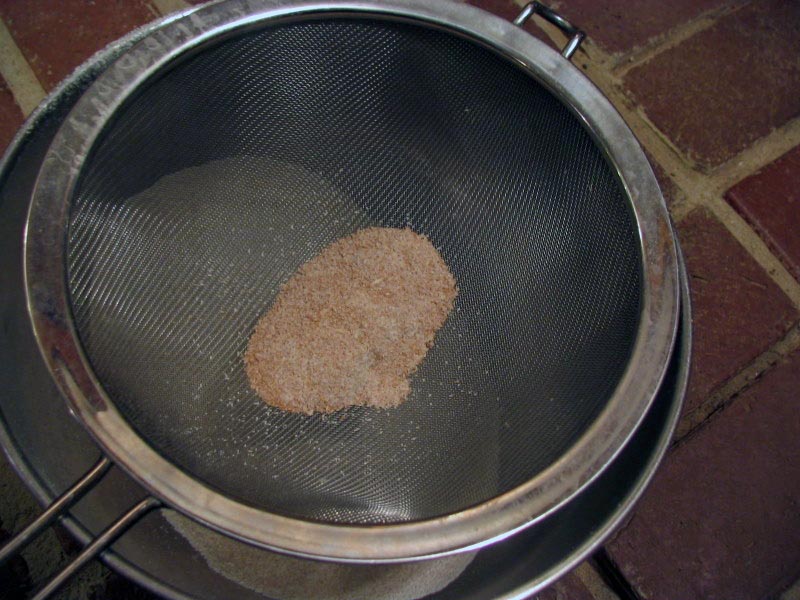
Poolish is a soft mixture of flour, water and yeast that ferments overnight (or longer) and then gets incorporated into a bread dough.  In this recipe, the dough contains both white and whole wheat flour, but the whole wheat is first sifted to remove some of the bran.  It’s an interesting method, and here’s all the bran left behind after sifting a few ounces of flour:

sifted

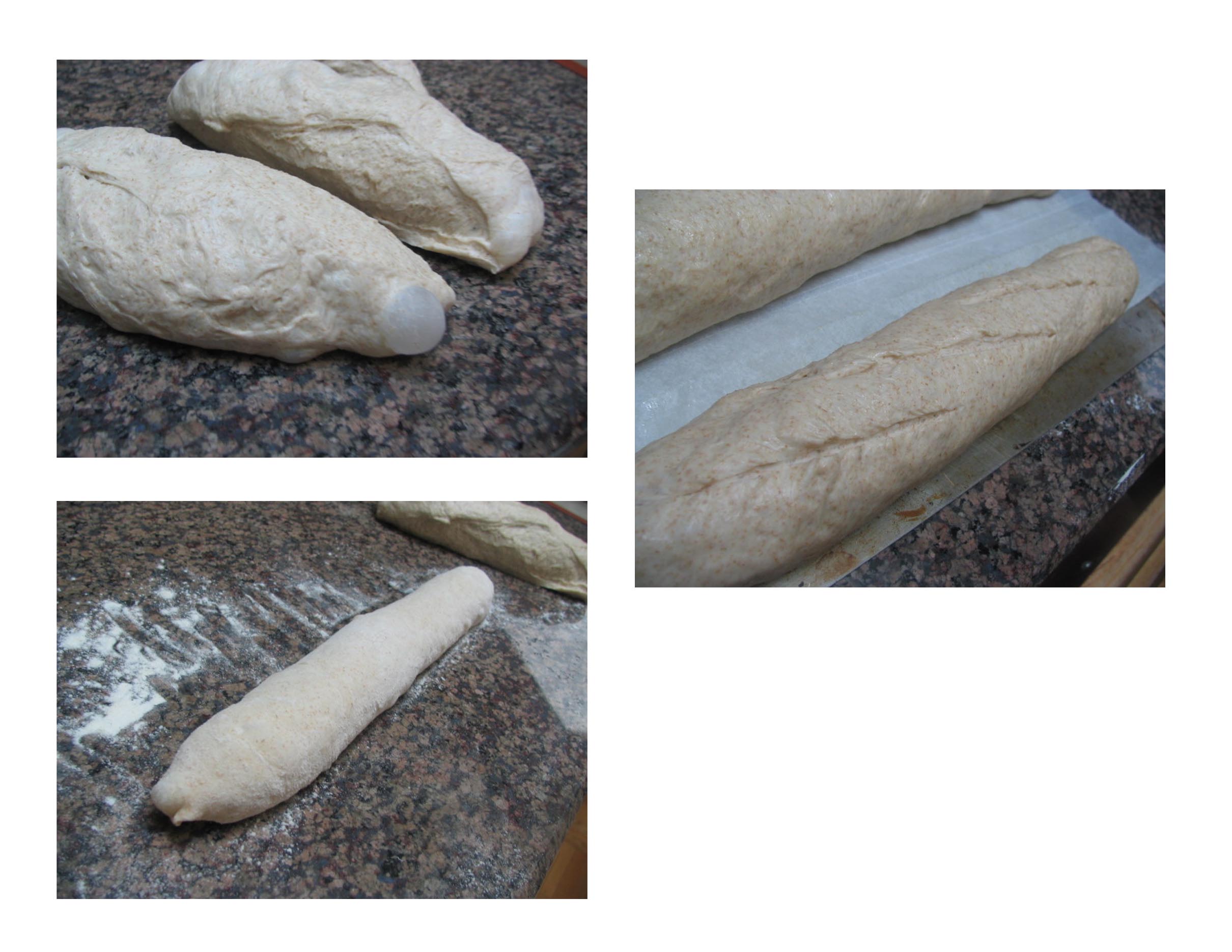
Reinhart’s recipe calls for kneading the dough.  I prefer folding instead of kneading, so that’s what I did: 3 folding cycles during the initial 2 hours of fermentation.  After cutting the dough into three pieces, I shaped each one as a baguette.  After two more hours rising, the baguettes were slashed with sharp razor blade, and placed in the oven.

Notice how bubbly the dough was…

compositeEven though  my slashing skills still need improvement, this time my shaping wasn’t too bad.   There are many online videos showing how to shape a baguette;  maybe one day if I get really good at it… I’ll post my own  😉

In the meantime, you can watch a particularly instructive video here….

These baguettes were delicious!   I’d probably reduce the proportion of whole wheat in the dough, but this recipe is already a winner for me and my husband.

twobaguettes