SOUR CREAM SANDWICH BREAD

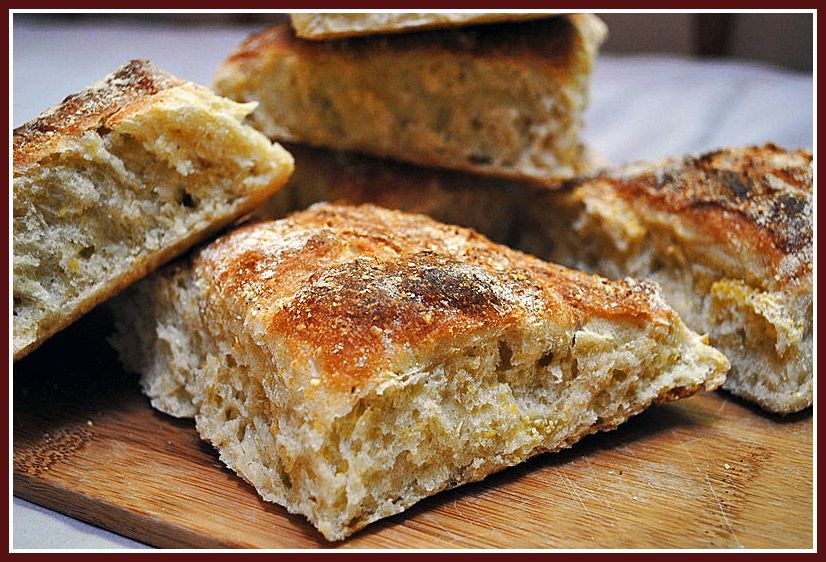
A simple but delightful sandwich bread, made with white flour, commercial yeast, and a bit of sour cream to provide a mildly tangy note, and a moist and tender crumb.   If you are baking under challenging conditions (that is, in a small oven), watch out for quite  an impressive oven spring: the bread might touch the heating element on top and… you don’t want that to happen.  Protect it with aluminum foil if needed.     The recipe comes from the one and only Dan Lepard, you can find it here.

SOURCREAM SANDWICH BREAD
(from Dan Lepard, published at The Guardian)

General method:
Sour cream is mixed with water, a little salt and sugar, and yeast.  Bread flour is added to form a sticky dough.

Dan uses minimal kneading, just 10 seconds every 10 minutes over half an hour, then the dough rises for 1 hour.

After shaping as a loaf, place in a pan and allow it to rise for 60 to 90 minutes.  The bread is baked in a 390F oven for about 45 minutes.

(for the detailed recipe, and printable version, click here)

Comments:  This is a great  recipe for those times in which you want a simple loaf for day-to-day sandwiches.  A slice, slightly toasted, with cottage cheese, salt and pepper, is a perfect way to start the day, next to a steaming cup of green tea.  Or, if you prefer to play on my husband’s team, make it a thin spread of blackberry preserves,.  Either way, Dan Lepard came up with yet another winner!

I am submitting this post to Susan’s Yeastspotting

ONE YEAR AGO: Pasta with Zucchini Strands and Shrimp

POLENTA-CRUST TOMATO LOAF

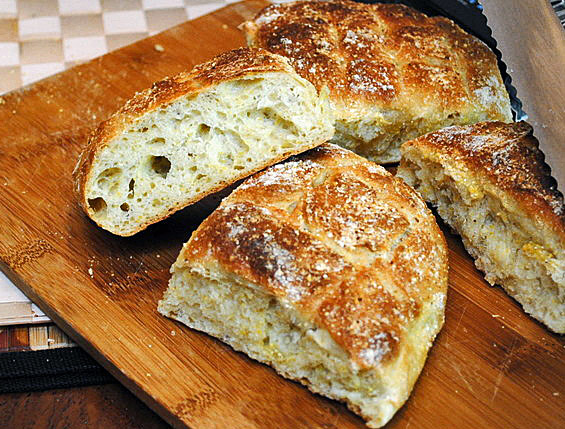
Another recipe designed by Dan Lepard, courtesy of the Guardian website. In terms of time and overall process, it is very similar to the semolina barbecue buns I blogged about last week, but it results in a bread with  a much more assertive flavor – thanks to the tomato and rosemary – and gorgeous crumb color. Even if you are new to bread baking, this recipe will not cause you any grievance – I promise… 😉


POLENTA-CRUST TOMATO LOAF

(Dan Lepard)
receita em portugues na pagina seguinte

100 g yogurt  (3.5 ounces)
25 g tomato paste (1 ounce)
25 ml olive oil (1 + 1/2 Tbs)
125 ml warm water (3.7 oz)
150 g sundried tomatoes in oil, roughly chopped (5 oz)
1 sprig rosemary, leaves picked
400 g bread flour (14 oz)
1½ tsp salt
1 tsp instant dry yeast
Polenta or coarse cornmeal, for shaping

Mix together the yogurt, tomato paste and oil, add the warm water and stir in the tomatoes and rosemary. Put the flour, salt and yeast in a mixing bowl, pour in the tomato mixture and work to a soft dough. Leave resting for 10 minutes, lightly knead on an oiled surface for 10 seconds, and return to the bowl. Repeat this minimal, quick kneading cycle twice more at 10-minute intervals, then leave the dough covered at room temperature for one hour.

Pat the dough into an oval, roll it tightly like a scroll, then roll it back and forth on the worktop, pressing down the ends so they taper slightly. Brush with water and roll in polenta or coarse cornmeal. Place seam-side down on a tray lined with nonstick paper, cover with a cloth and leave for an hour. Slash down the center and bake at 425 F (220 C) for 45 minutes. Allow it to completely cool before slicing.

ENJOY!

to print the recipe, click here

Comments: My favorite type of bread is a sourdough, made with a mixture of white and rye flours, sometimes a little whole wheat flour added in the formula.  Open crumb, hearty crust, a great match for any type of meal.  Having said that, I agree with Dan Lepard: this loaf has its place in the world, bread snobs should not be twisting their noses at it.  It smells terrific while it’s baking, almost as if you are making pizza.   Enjoy it with smoked ham or prosciutto, and for a more mellow alternative try a ricotta-based spread (ricotta, lemon zest, salt and pepper: simple, understated, but delicious).

I am submitting this red-tinted loaf to Susan’s Yeastspotting

ONE YEAR AGO: Light Whole Wheat Bread

Add to FacebookAdd to DiggAdd to Del.icio.usAdd to StumbleuponAdd to RedditAdd to BlinklistAdd to TwitterAdd to TechnoratiAdd to Yahoo BuzzAdd to Newsvine

receita em portugues na proxima pagina

SEMOLINA BARBECUE BUNS

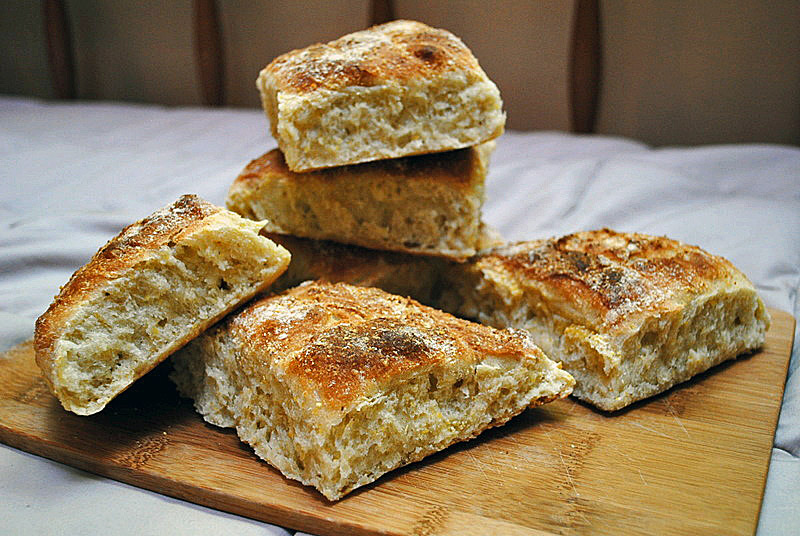
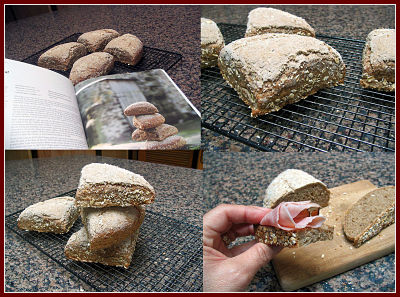
Before we left on our journey to L.A., I had this bread in my “to bake soon” list.  Life got impossibly busy, but I didn’t worry too much, because I knew it would be a perfect bread for the nano-kitchen: minimal kneading, and doable in our toaster oven.  Several of my virtual friends made this bread and raved about it, but that’s a no-brainer: Dan Lepard is the man behind the formula.  😉

SEMOLINA BARBECUE BANS
(from Dan Lepard – The Guardian website)

75g semolina or cornmeal, plus more to finish (I used fine cornmeal)
150 ml boiling water + 200 ml warm water
25g unsalted butter
1 tsp honey (I used agave nectar)
1 Tbs yogurt
1 + 1/2 tsp salt
1 tsp instant yeast
450 g bread flour
(olive oil for kneading)

Spoon the semolina into a mixing bowl, pour 150ml of boiling water over it, stir well and leave for 10 minutes. Use a fork to mash the butter, honey, yogurt and salt into the mixture, then slowly work in 200ml of warm water, breaking up any lumps with your fingers. Stir in the yeast and flour, work to a smooth, soft dough and leave for 10 minutes.

Give the dough three 10-second kneads on an oiled surface over 30 minutes, then leave, covered, for an hour. Roll the dough to about 25cm x 35cm on a floured surface, lay on a baking tray lined with parchment paper and leave covered for 20 minutes. Cut the dough into eight flat rectangular “rolls”  but do not separate them, just make a deep incision all the way down the baking sheet. Leave, covered, until risen by half (I cut into six rectangles, and allowed them to rise for 25 minutes).

Heat the oven to 465F.  Brush the tops of the buns with water, sprinkle with semolina and score a deep crisscross on top with a knife. Bake for about 20 minutes, until brown on top.  Let it cool for at least one hour on a rack before amazing yourself at how delicious the rolls taste.

ENJOY!

to print the recipe, click here

Comments: This bread is so simple to prepare that I am still a bit shocked by how good it turned out.  If you haven’t yet been sold to the idea that minimal kneading makes excellent bread, this recipe will convince you.  I didn’t roll the dough, just stretched it lightly to preserve as much as possible the airy texture acquired in the hour long rise.

Dan made this recipe with pulled pork sandwiches in mind, and the combination would deserve to go into the Sandwich Hall of Fame.  Unfortunately, we don’t have any pulled pork at the moment, but the rolls still tasted awesome with ham, cheese and a slice of juicy tomato.

I am submitting this post to Susan’s Yeastspotting… the second bread from our Bewitching-Nano-Kitchen.

ONE YEAR AGO: Lavash Crackers

Add to FacebookAdd to DiggAdd to Del.icio.usAdd to StumbleuponAdd to RedditAdd to BlinklistAdd to TwitterAdd to TechnoratiAdd to Yahoo BuzzAdd to Newsvine

GOLSPIE LOAF, from the Scottish Highlands

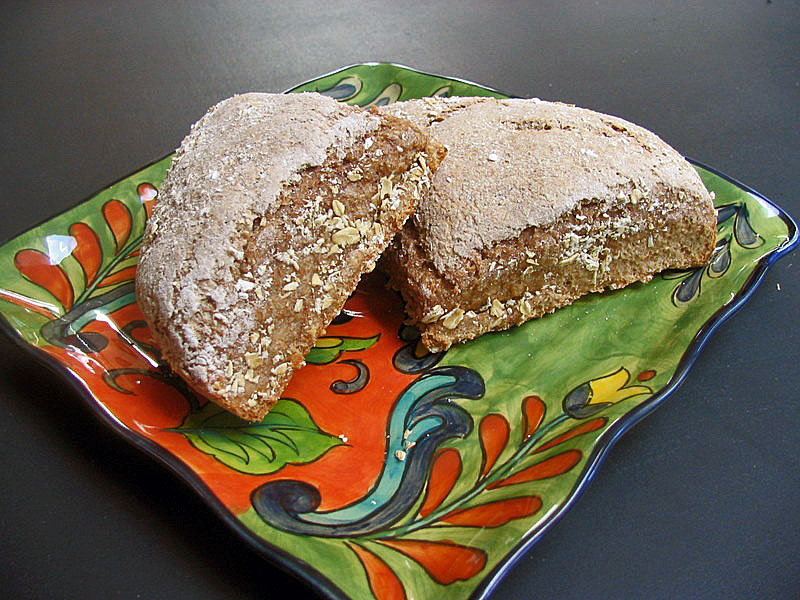
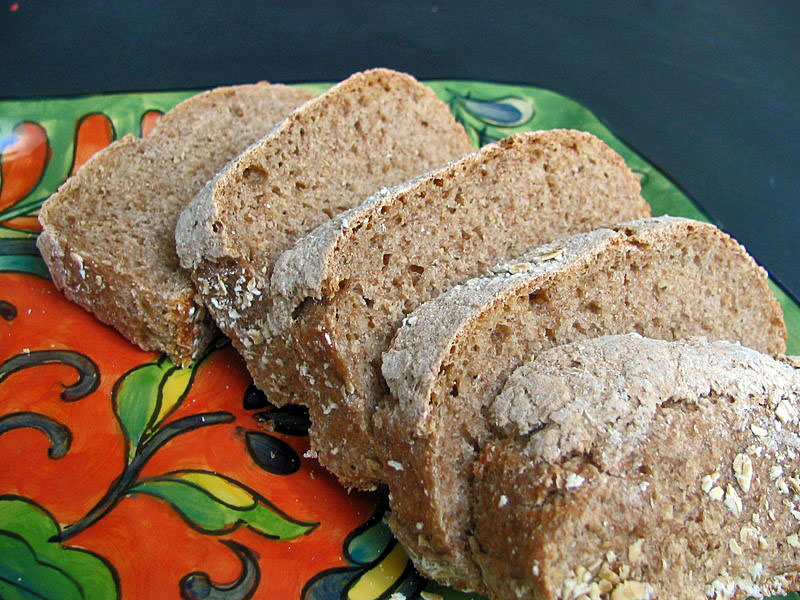
Different breads evolve around the world in harmony with the native cultures and environments:   flat breads like Indian naan and Ethiopian injera, French baguettes, English crumpets, and the salt-less Tuscan bread.   People everywhere bake bread with their local grains and flours, and according to their preferred diets.   If I had money and time I’d travel the world and experience each one in person.  Instead,  I take virtual trips by baking the world of bread in my own kitchen.  This past weekend I made a Golspie loaf from the Scottish highlands, based on an old grain called “bere“.    Of course, this grain isn’t easy to find, but in his masterpiece “The Handmade Loaf” Dan Lepard created a recipe that mimics the original, using rye sourdough starter and whole wheat flour. Don’t be put off by its looks:  Golspie is not the Jonny Depp of the Bread World, but it has the personality and charm of Sean Connery in his prime.

The Handmade Loaf is a must have book for bread bakers, and I highly recommend that that you get your own copy of Dan’s book.   Because I bake so many of its breads, it’s unfair to the author to post all the recipes, and for Golspie I’m just providing the the basic formula, which I slightly changed from the original to introduce a small amount of white flour.

GOLSPIE LOAF FORMULA
(adapted from Dan Lepard)

75% rye levain
62% water
100% flour (3/4 whole wheat + 1/4 white)
25% bread flour
2% salt
0.5% instant yeast
coarse oatmeal (enough for dusting the loaf)

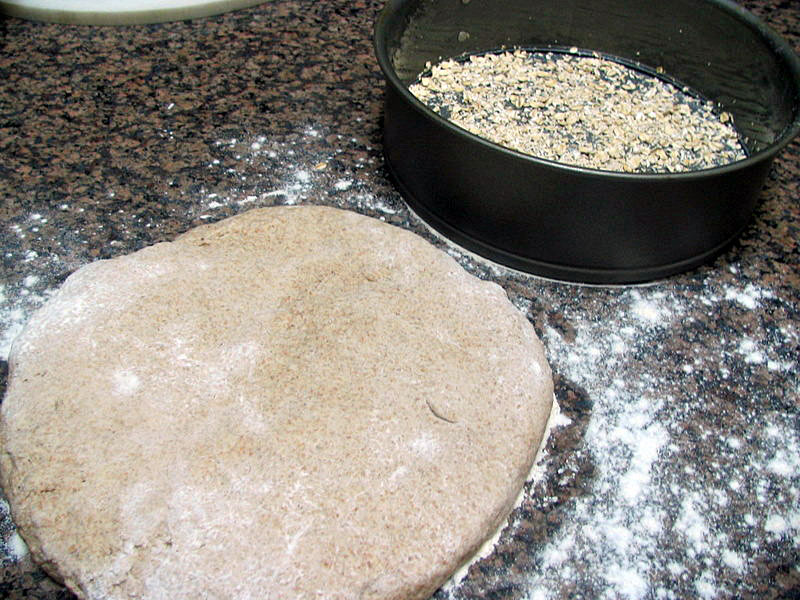
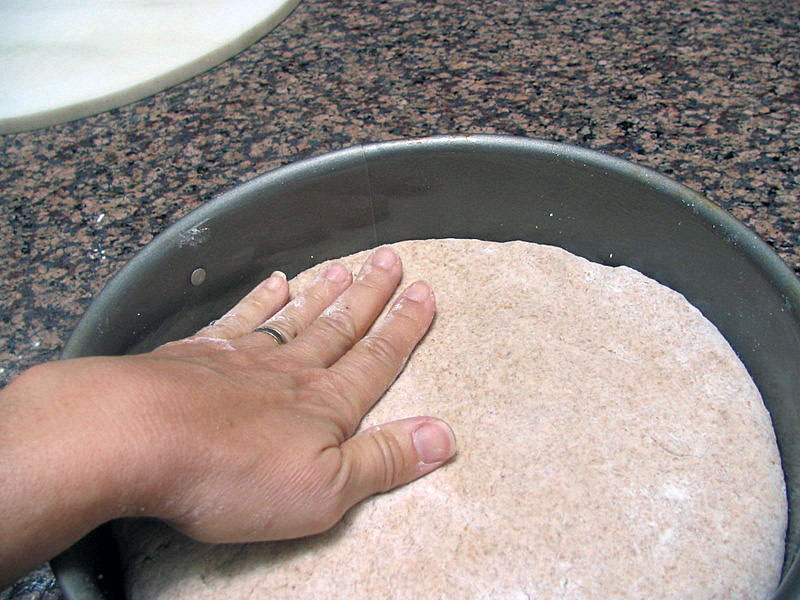
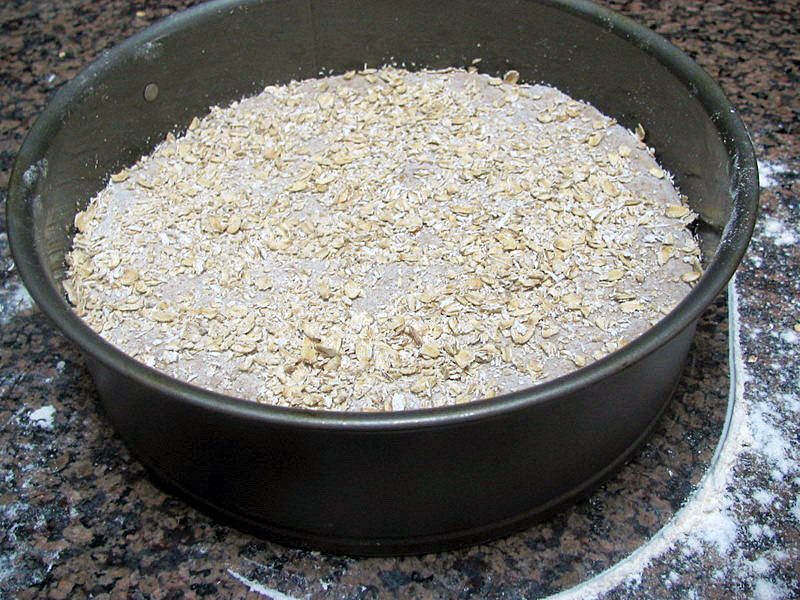
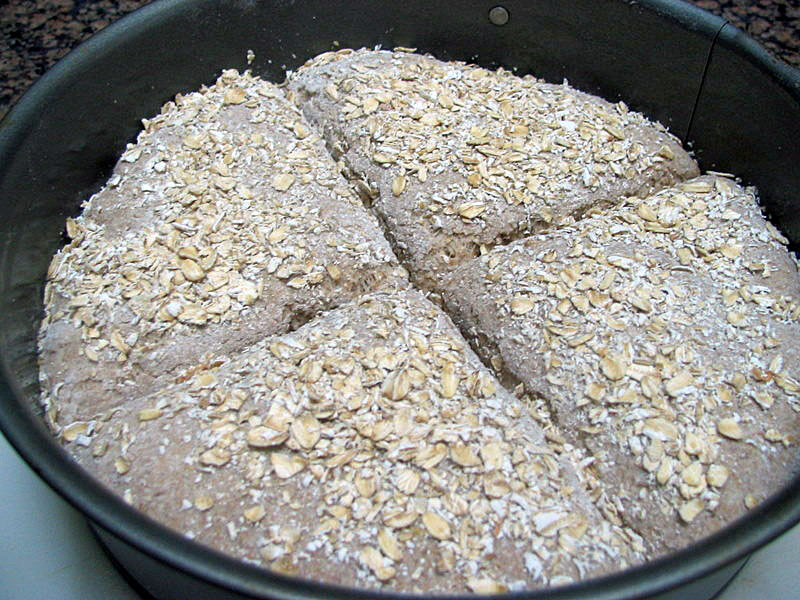
Comments:  The dough is made with minimal kneading (a couple of 10 second-kneading cycles), allowed to rise for an hour, shaped into a circle, and placed in a springform pan (around 8 inches in diameter), coated with coarse oatmeal.   Just before baking,  score the dough  all the way to the bottom in a cross-pattern that  later allows cutting it into its characteristic quartered shape.

Some photos of the process of making Golspie….

The dough is rolled out in a circle..

Placed in the springform pan, and gently patted to fill it….

Once in the pan,  coarse oatmeal is sprinkled on top….

Do not be afraid to do the crosscut…

ENJOY!

I am thrilled to submit this post to Yeastspotting….

Add to FacebookAdd to DiggAdd to Del.icio.usAdd to StumbleuponAdd to RedditAdd to BlinklistAdd to TwitterAdd to TechnoratiAdd to Yahoo BuzzAdd to Newsvine

FOR THE LOVE OF BREAD

A few years ago, a small revolution  took place among American bakers  after the publication of the no-knead bread recipe.  It was hard to surf the internet food world without daily encounters of posts about it.  Like many other people, I boarded that train, which I do not regret.  As a result of the “no-knead” recipe, I baked good bread at home, which was something I’d struggled with for years.  Also thanks to the “no-knead” recipe, I gained the self-confidence to attempt more elaborate breads, until my travels took me to an unforgettable turning point:  the “Handmade Loaf“, by Dan Lepard.

I now have too many bread-baking books,  but  The Handmade Loaf is the one that I cherish, in part because his respect and love for everything about bread shines through in every sentence.  Technically, his instructions are flawless and his photography is superb.  Sure, I can make and enjoy a loaf of bread that was mixed in five minutes, but that’s not the bread that I fell  in love with.  Rather, this is it….

WHITE THYME BREAD
(Dan Lepard’s  Handmade Loaf)

350 g bread flour
1 tsp sea salt
150 g water
150 g sourdough starter
1/2 tsp fresh yeast (I used instant)
25 g olive oil
100 g pitted green olives
1 tsp fresh thyme leaves, chopped
cornmeal

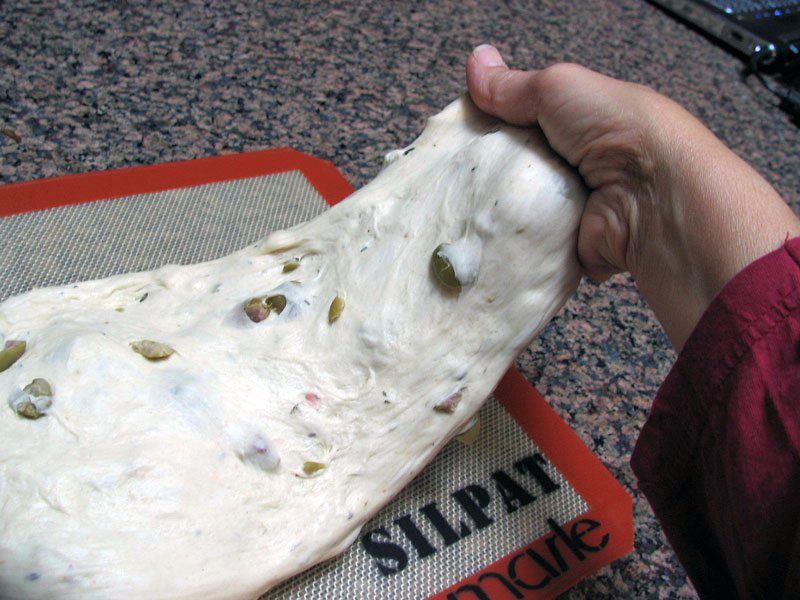
Combine the flours with the salt in a large bowl. In another bowl, whisk the water, starter, yeast, olive oil, olives, and thyme.  Add the liquid to the flour, then stir with your hands. Form a loose ball with the ingredients and allow it to rest for 10 minutes.

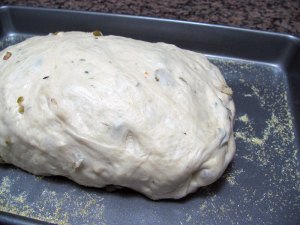
Proceed to kneading the dough three times at 1o minute intervals. Each kneading cycle will last only 10-15 seconds.  After the last kneading cycle,  let it rest for 10 minutes and form it into a rectangle.  Fold it by thirds like a letter, let it rest for 1 hour.  Stretch the dough again, fold it by thirds, allow it to rest for another hour.  Shape the dough very gently into a rectangle and pat the surface with your fingers  to flatten it slightly.   Sprinkle cornmeal on the surface, cover with a cloth and allow it to rise for 45 minutes.

Bake in a 425F oven for about 40 minutes.

ENJOY!

I am submitting this post to Susan’s Yeastspotting….

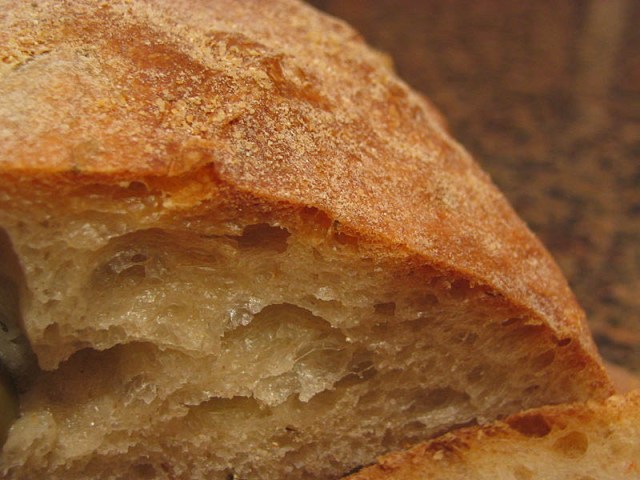
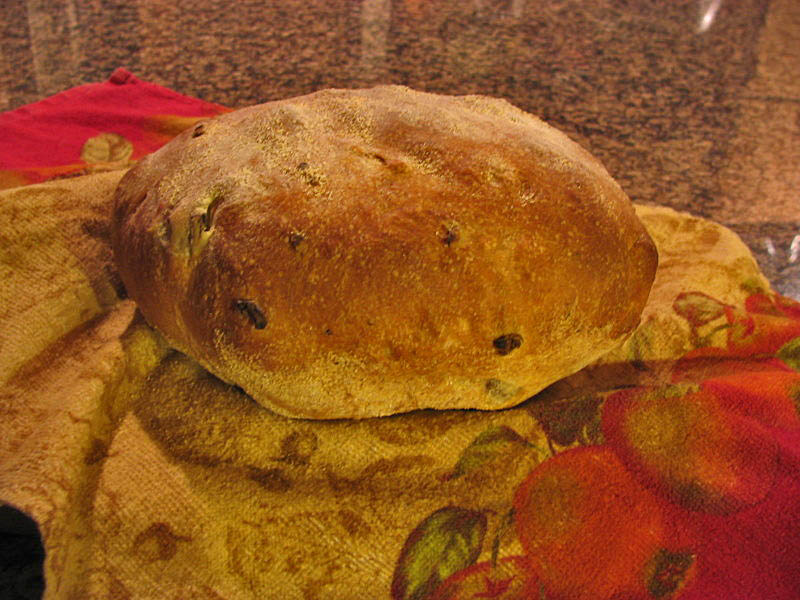
Comments: I’m not sure why this bread wasn’t called “White Thyme Bread with Green Olives,” as they are so obvious in the loaf.  Make sure to use best quality green olives;  Dan suggests piccolini olives from France, even if you have to pit them yourself.

The bread is supposed to be quite flat, but I decided to form a more rounded shape.   I could have slashed the surface,  but I didn’t expect as much oven bounce as it achieved during baking.

This bread is a departure from his white levain, because it calls for a small amount of commercial yeast in the dough.  That adjustment reduces the fermentation time, and creates a slightly less “creamy” crumb.  The addition of olive oil allows the flavor of thyme to permeate  the crumb, imparting an assertive, but not overpowering taste.

It’s bread as bread should be.  Thank you, Dan!

Here are some photos of the process…  Keep in mind that I gave only a short, summarized version of the recipe.  In the book, Lepard goes through all the steps in detail.  So, if you want to make  a loaf of bread in your own home that you can write a poem about later, then consider buying The Handmade Loaf.   It’s worth every penny.

Easy to fall in love…