BBA#33: PAIN POILANE

The BBA Challenge arrives at the “King of Breads”,  Pain Poilane, the most traditional bread in Paris!

Of course, pain Poilane brings us great memories! Every couple of weeks, we slightly changed our normal walking route from home to work, in order  to stop at the Poilane Boulangerie on Rue Grenelle in the 15th  arrondisement, and grab one of those huge “boules”, that we enjoyed to the last crumb on the succeeding days.

Lionel Poilane himself  trained each of the bakers that worked in his boulangerie, a process that started by making sure they could not only properly light their wood ovens, but also know when the oven temperature was correct for baking without a thermometer,  by using just their bare hands to “feel” the heat inside.    Each baker was responsible for the entire process of making each loaf, beginning to end.    This kind of passion and commitment fascinates me.

To mimic the great Poilane bread, Peter Reinhart uses 100% whole wheat flour, and a sourdough starter fed with whole wheat flour before being incorporated in the dough.  It makes a huge loaf, but I divided it in two and baked them on consecutive days, retarding one of the “boules” in the fridge overnight.  Kneading this dough is not for sissies.  It’s impossible to knead the full recipe in a KitchenAid mixer, no matter how powerful.  He recommends kneading by hand – which I’ve done in the past, but had to reconsider this time – my wrists simply could not take handling such  a large amount of dough.

So, I improvised – divided the dough in 4 small portions and… used the food processor to knead it.  Twenty to thirty seconds per portion did the trick, the dough ended up very smooth and elastic, with clear gluten development.

Here are some photos of the process, which, fortunately, went quite smoothly….

The whole wheat starter….

The dough, ready to rise for 4 hours….
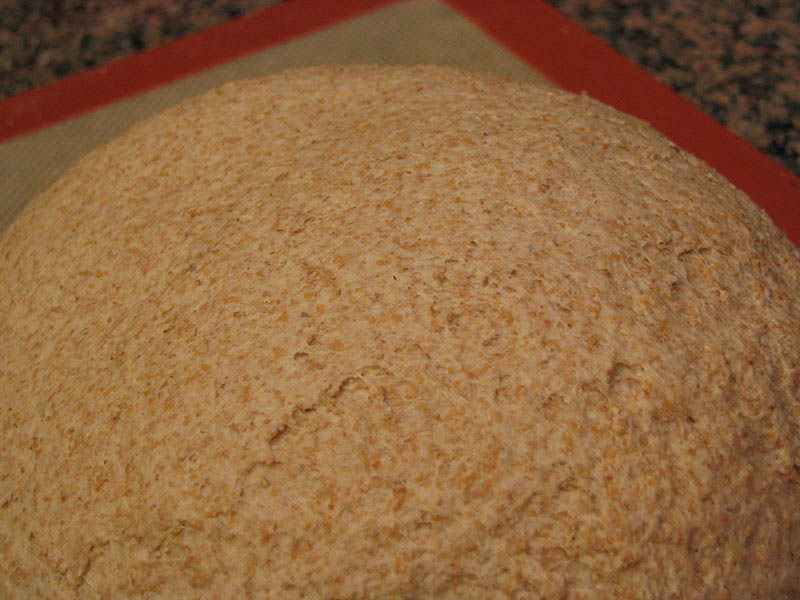
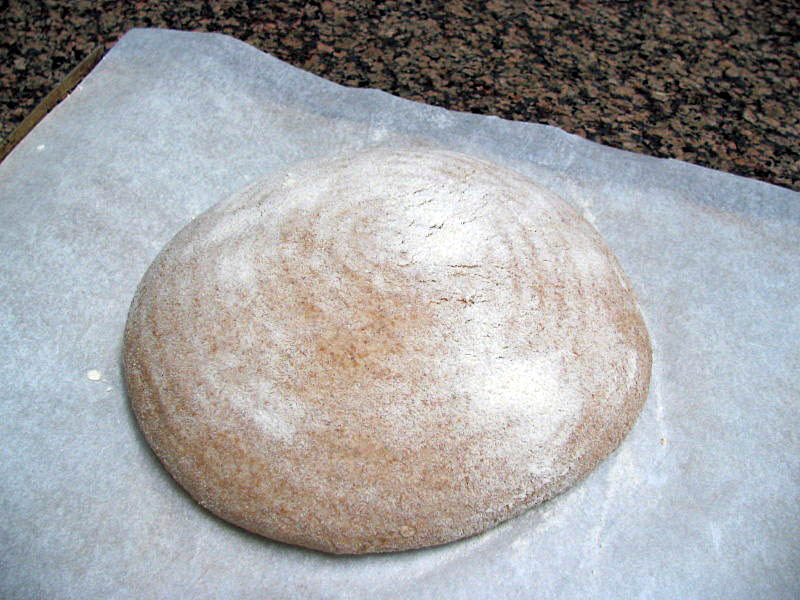
The final shaping and slashing…. right before going into the oven…
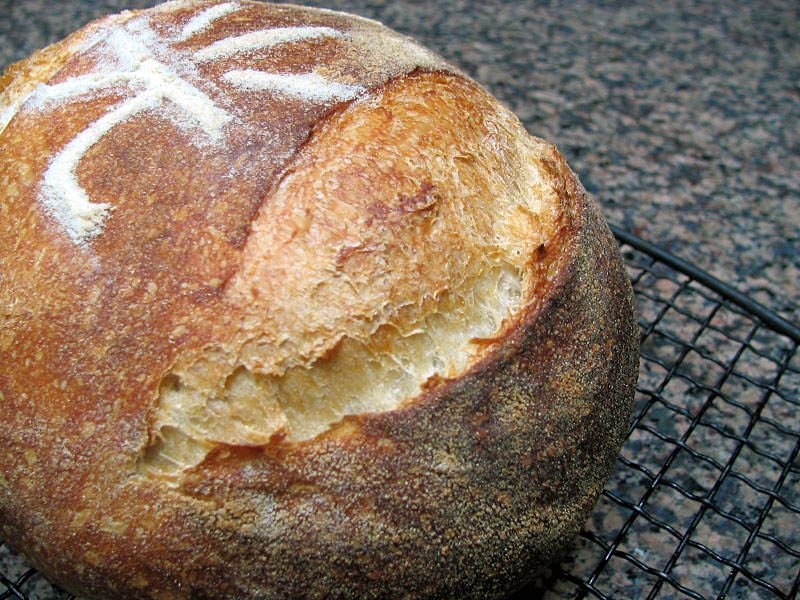
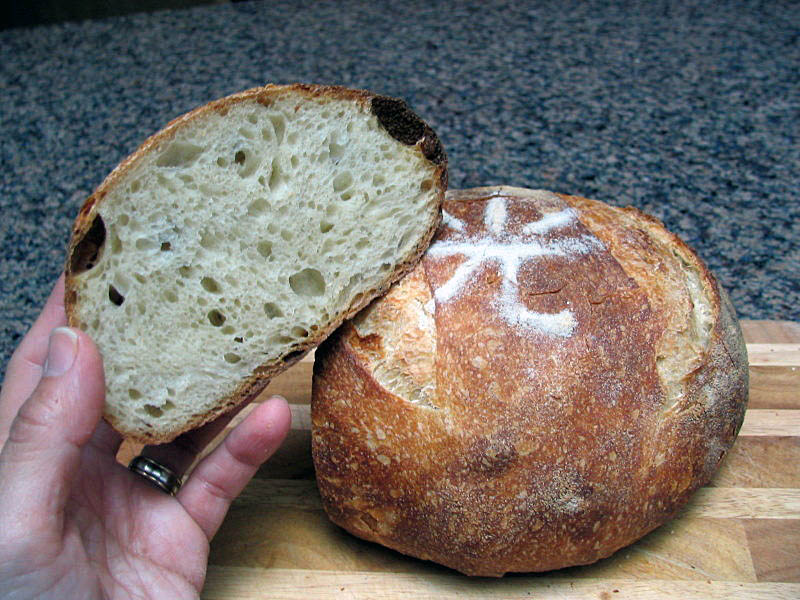
And the result: a dough with impressive oven spring (I wasn’t expecting that, because I was a little too enthusiastic with my blade and probably slashed it too deeply), tight crumb, complex flavor  (you’ll have to take my word on that one…)…

Don’t you love a happy ending? 😉
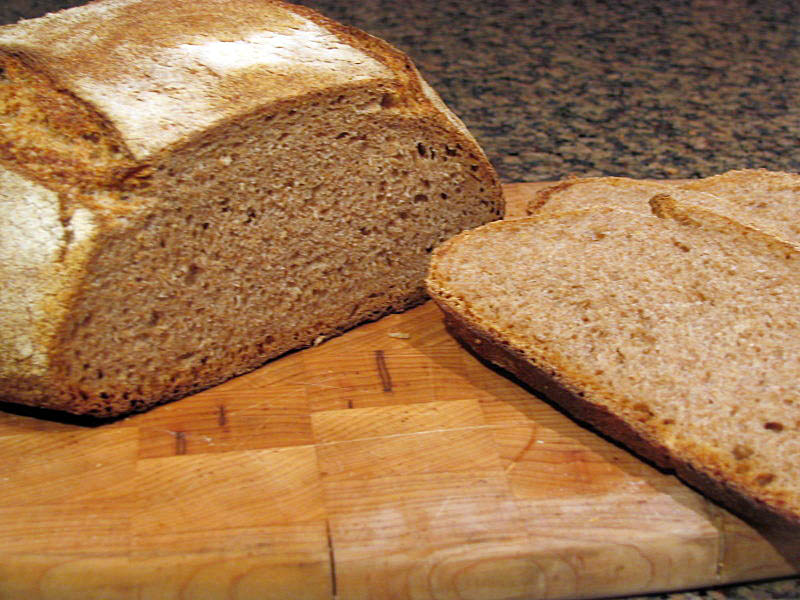
as to the second bread:   it did not have as much oven spring, even though I kept it at room temperature for a full 4 hours before baking.   But the flavor was better than the first loaf.

I am submitting this post to Susan’s Yeastspotting….

If you want to see the “real” Poilane…. jump to next page….

Continue reading

BBA#32: 100% SOURDOUGH RYE

The BBA Challenge has had its ups and downs.  Unfortunately with this bread I hit the lowest point in the whole challenge.  I had problems from the very beginning, my dough refused to get smooth, it felt like a mixture of sand and water, “breaking” as I tried to knead it.     I moved on, shaped the bread, allowed it to rise – which, it did not, I barely detect any changes – and baked it.

It was dense, and too chewy for my taste.   I definitely need more practice with this kind of a dough.  Rye won big time,  I got a lesson in humility….

Next day I cut the bread into thin slices and turned them into rye crisps, which were ok, but not great.

I look forward to the reports of my fellow bakers following the BBA Challenge, maybe they can give me some tips to deal with such a tricky dough.

BBA#31: NEW YORK DELI RYE

Following the BBA Challenge, we go forward with the sourdoughs, the next couple of which are made with rye flour.  Rye is low in gluten,  which increases the difficulty of handling it.  In this recipe Peter Reinhart uses a rye sponge, that’s made with a sourdough starter, rye flour, and lightly sauteed onions.  The sponge ferments for a few hours, gets refrigerated overnight, and the next day it’s mixed into a final dough with brown sugar, buttermilk, white and rye flours, and a small amount of commercial yeast.

I was a bit insecure preparing this dough – it’s easy to turn a rye dough into a gummy mess, so I paid extra attention to Peter’s advice to avoid over-kneading it.   And the onion smell was too strong, which only added to my worries and bothered my husband!

But, sometimes a bright light shines at the end of the tunnel!  This bread turned out awesome!  It delivered exactly what Peter promised: a flavorful New York deli rye bread…    My pictures don’t do it justice: it tasted much better than it looks.   😉

The crumb was tight but delicate, and the hint of onion in the background perfectly paired with the caraway spice.

My beloved, as usual, used it in a delicious sandwich creation:  grilled rib eye steak slices, sauteed mushrooms (both leftovers from last night’s dinner), and a few slices of Jarslberg cheese.   His remark afterwards:

Even Tom Colicchio would love this one!  😉

I’m pleasantly surprised by how much we both enjoyed this bread, especially because it’s my first time making this type of loaf.

Flash! Here’s something even more exciting… I enrolled in a class with Peter Reinhart himself in January!  I can hardly wait!   My Bread Baker’s Apprentice book is a little beaten up now, but  it’ll look like a million bucks once I get his autograph on it!   😉

Check the  New York deli rye made by Oggi, from “I Can do That”, by clicking here

Next on the challenge: 100% sourdough rye. That one’s REALLY intimidating.  Stay tuned…

BBA#30: BASIC SOURDOUGH BREAD

Here we are, at the beginning of my favorite, sourdough breads, which are all made from a “starter”, or, as Peter calls it, a  “seed culture”.    For  those unfamiliar with the BBA Challenge, it’s a net-event that was launched by Nicole, in which home bakers make every recipe from “The Bread Baker’s Apprentice“, in the order that they appear in the book;  forty-three breads in all.    People participating in this challenge agreed not to publish the recipes, so if you are interested, help the economy and buy the book.  😉

I’ve been regularly baking sourdough bread for the past two years, so I took some liberties and made a few changes in the overall method.  First, I didn’t put the “barm”  in the fridge overnight.  Instead,  I prepared it at 11pm the night before and used it next morning,  at 6am, without refrigeration.   I see no need to retard the barm in the fridge:  it adds an extra hour to the overall process (you do need to warm it to room temperature before using it), and from my experience it doesn’t  improve the bread’s flavor.  Retarding the dough after the final shaping is a better option, that is also discussed in the recipe.

My second change was the kneading method.  I am partial to folding the dough, as you can see by browsing my bread recipes in this site.   Why? Because it always works.   Kneading the dough in a machine or extensively by hand  may or may not produce the crumb texture I love: airy and full of uneven holes.  I don’t like to gamble with my breads, so I fold it.

The dough was easy to work with,  I am always  fascinated by the way it changes with minimal kneading over time.   These two photos show the dough 15 minutes after mixing all the ingredients, and after rising for 45 minutes.   I folded it at 45, 60, and 120 minutes, then allowed it to rise for 2 more hours (for a total of 4 hours) before shaping.

I’ve been flirting with the idea of stenciling my breads, and this time I decided to go for it.   It didn’t work perfectly.   I think I made my Chinese character too big, and I added too much flour in making it, but I’m hoping to improve my skills.

This is an ideogram that I like very much – guang – it means light, as in sunlight.  I guess my tropical nature attracts me to it.  😉

Excellent flavor, not too sour, the crust just the way we like it…

Click here is for a link to the sourdough post by Oggi, from “I Can Do That” – she did some nice different shapes  with her dough, very nice job!

BBA#29: PUGLIESE

Pugliese, as the name indicates, is a bread typical from Puglia, a region in the south of Italy. The bread is supposed to be quite crusty, perfect for olive oil tasting. Peter Reinhart’s recipe, like many others in the book, calls for a biga, prepared the previous day, and placed in the fridge overnight. For reasons absolutely out of my control, my biga stayed the whole night at room temperature instead of going to sleep in the fridge. I debated whether to go ahead with the recipe or start all over, but decided to go for it.

Other than forgetting to put the biga in the fridge… 😉  I had no issues with the recipe.  But, maybe my mistake contributed to a crumb texture a lot tighter than that shown on the book.  Still, it tasted very good, a little chewier than a regular Italian bread.   Once the BBA Challenge is over, I will revisit this recipe for sure!

Check out my fellow bakers’ take on Pugliese, by visiting:

Txfarmer’s blog here,

Oggi’s blog here