WHEN A KING MAKES A PROMISE…

HE DELIVERS!

Normally, I would shy away from baking a bread using exclusively whole wheat flour, because often they turn out dry, heavy, and not too flavorful. But those folks at King Arthur Flour know their bread extremely well, and recently highlighted in their blog their most popular recipe, a 100% Whole Wheat Bread. They promised that it would produce “a moist, close-grained, nutty, and rich bread, that slices as a dream.”    They did not lie: this is a deliciously hearty loaf, not heavy at all, with a hint of sweetness from the honey, perfect to start your day on a very “good carb-note.”


CLASSIC 100% WHOLE WHEAT BREAD

(from King Arthur website)

8 to 10 ounces lukewarm water
1 + 3/4 ounces vegetable oil
3 ounces honey
14 ounces whole wheat flour
2 + 1/2 teaspoons instant yeast
1 ounce dried milk
1 + 1/4 teaspoons salt

In a large bowl, combine all the ingredients and stir till the dough starts to leave the sides of the bowl. Transfer the dough to a lightly greased surface, oil your hands, and knead it for 6 to 8 minutes, or until it becomes smooth. Alternatively, knead it in a KitchenAid type machine (I did that for about 7 minutes at speed 2).

Transfer the dough to a lightly greased bowl or large measuring cup, cover it, and allow the dough to rise till puffy though not necessarily doubled in bulk, about 1 to 2 hours (mine doubled in a little over 1 hour).

Transfer the dough to a lightly oiled surface, and shape it into a loaf. Place it in a lightly greased 8 1/2″ x 4 1/2″ loaf pan, cover the pan loosely with lightly greased plastic wrap, and allow the bread to rise for about 1 to 2 hours, or till the center has crowned about 1″ above the rim of the pan (mine took only 1 hour to reach that point). Towards the end of rising time, heat your oven to 350F.

Bake the bread for 35 to 40 minutes, tenting it lightly with aluminum foil after 20 minutes to prevent over-browning. The finished loaf will register 190°F on an instant-read thermometer inserted into the center.

Remove the bread from the oven, and turn it out of the pan on  a rack to cool. If desired, rub the crust with a stick of butter; this will yield a soft, flavorful crust (I omitted this step). Cool completely before slicing.

ENJOY!

to print the recipe, click here

This slideshow requires JavaScript.

Comments: The variable amount of water given in the recipe accommodates for differences in humidity and temperature in each kitchen.  Start with 8 ounces and see how the dough behaves. It is very important not to add too much flour, or it will be too heavy.

Instead of using my regular oven, I baked this loaf on our Breville toaster/convection oven, and it performed very well. It is a fantastic appliance, one that will be used more and more in the near future.   😉

I am submitting this post to Susan’s Yeastspotting

ONE YEAR AGO: Basic French Bread

Add to FacebookAdd to DiggAdd to Del.icio.usAdd to StumbleuponAdd to RedditAdd to BlinklistAdd to TwitterAdd to TechnoratiAdd to Yahoo BuzzAdd to Newsvine

UNDER THE SPELL OF LEMONGRASS

I tasted lemongrass for the first time in 1986,  in a tiny Vietnamese restaurant in Redwood City, a few miles away from my home while I lived in California.  I’m afraid the restaurant, Than’s,  no longer exists. My former husband and I used to have lunch at Than’s on Saturdays.   In those days we knew next to nothing about Vietnamese food, but  on our first visit I ordered “Chicken in Lemongrass Sauce,” and thought I had died and gone to heaven.  Whenever we returned over the  following three years  we’d share two dishes, and lemongrass chicken was always one of them.   I just couldn’t get over it.    Some people say that you can substitute lemon zest, or Meyer lemon’s zest, …they lie.  Lemongrass has  NO comparable substitute:  it’s just that special and just that good.

So, when I had the luck of finding fresh lemongrass in our farmer’s market, I made sure to bring some home, and put it to good use….

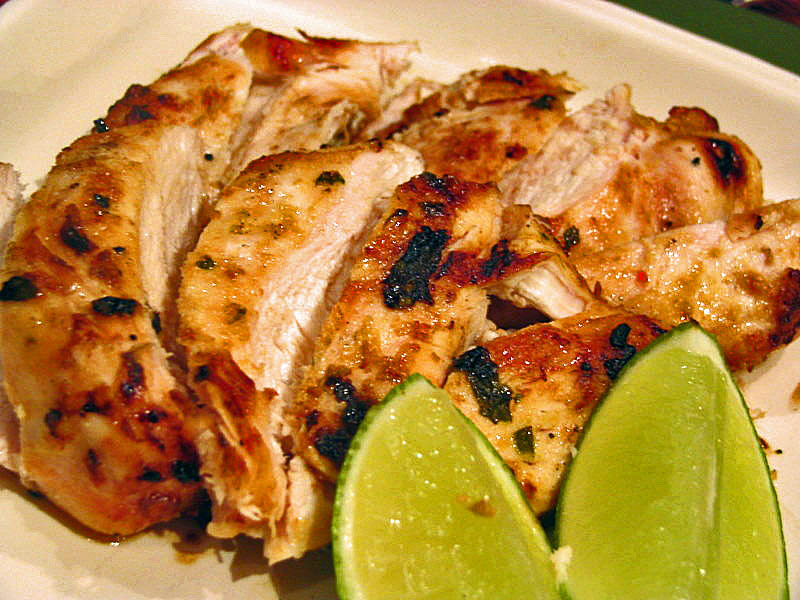
THAI CHICKEN BREASTS WITH HERB-LEMONGRASS CRUST
(adapted from Fine Cooking #86,  July 2007)

1 cup fresh cilantro leaves, chopped
1/2 cup coconut milk
1/4 cup chopped fresh lemongrass
12 fresh basil leaves
1 serrano pepper, finely chopped
1 garlic clove, finely chopped
salt to taste
2 tsp brown sugar
1/2 tsp black pepper
4 boneless, skinless chicken breasts, trimmed
1 lime, cut into wedges

Combine 3/4 of the cilantro with the coconut milk, lemongrass, basil, serrano, garlic, salt, brown sugar, pepper and coriander in a blender and puree until smooth. Place the chicken breasts in a dish in a single layer, and pour this marinade over them, turning to coat them completely. Refrigerate for 2 to 24 hours (mine stayed 7 hours in the fridge).

Heat a grill to medium high, grill the chicken until it has good grill marks on the first side, 4 to 5 minutes. Flip the chicken and continue to cook until completely cooked through (check by making a slice into one of the thicker breasts), 5 to 6 more minutes. Transfer to a serving dish and let rest for 5 minutes. Sprinkle with the remaining 1/4 cup cilantro and serve with the lime wedges.

ENJOY!

to print the recipe, click here


Comments: The secret for this recipe is blending the marinade to turn it into a thick paste.  The lemongrass flavor is more pronounced this way,  a blast of freshness in perfect balance with the coconut milk and herbs.

Food memories can be so strong!  While slicing  the lemongrass, I went straight back to Redwood City, and could almost visualize the table cloths in that simple, but amazing restaurant. It was run by a husband and wife, their two young kids very shy peeking at the customers from behind the counter. I often wonder where they are now, probably all grown up and graduated from college. 😉

ONE YEAR AGO: Greens, Grapefruit and Shrimp Salad

Add to FacebookAdd to DiggAdd to Del.icio.usAdd to StumbleuponAdd to RedditAdd to BlinklistAdd to TwitterAdd to TechnoratiAdd to Yahoo BuzzAdd to Newsvine

FARRO: GOOD FOR YOU AND TASTES GREAT TOO

Farro:  a fun word for a mysterious grain, about which a lot of controversy exists as to its origin.  Some say it’s a type of wheat, but that’s not the case,  farro is a grain from a related, but different plant.  It was a staple at the height of the Roman Empire,  and persevered since those days until now in central parts of Italy, where it’s still grown,  consumed and exported.   Farro is loaded with vitamins and low in gluten, so even people with gluten allergies may enjoy it. Plus, it performs well in  many kinds of recipes, from risottos to breads, from stews to salads.  What an amazing little grain, that’s perfect as the focus of my 200th post!   😉

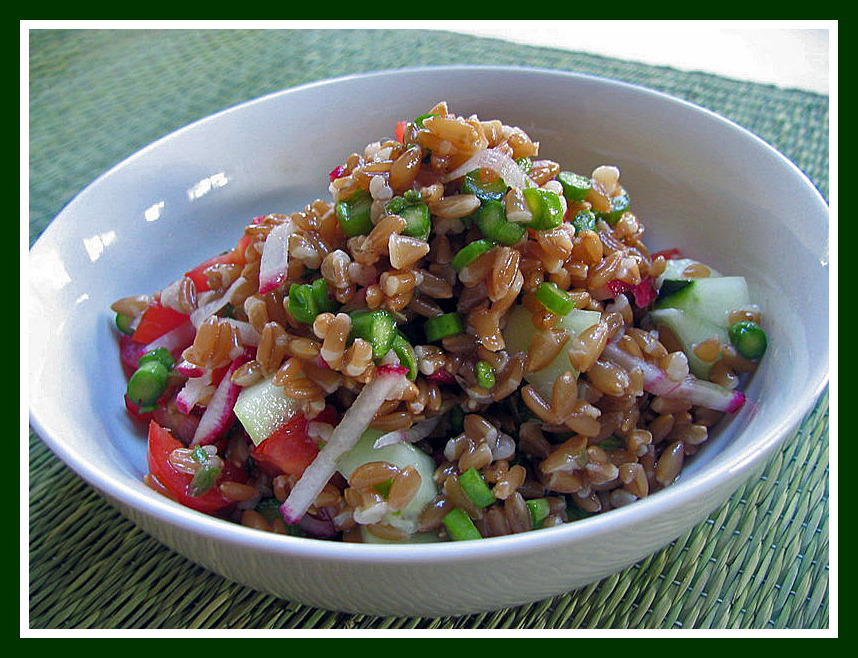
BEWITCHING FARRO SALAD
(from my kitchen)

to cook the grain:
1 cup farro  (not the pearled variety)
2.5 cups water
1/2 tsp salt

for the dressing (it will make more than you need):
1/2 cup olive oil
juice and zest of 1 lemon (or other citric fruits, alone or in combination)
pinch of salt
ground black pepper

for the salad:
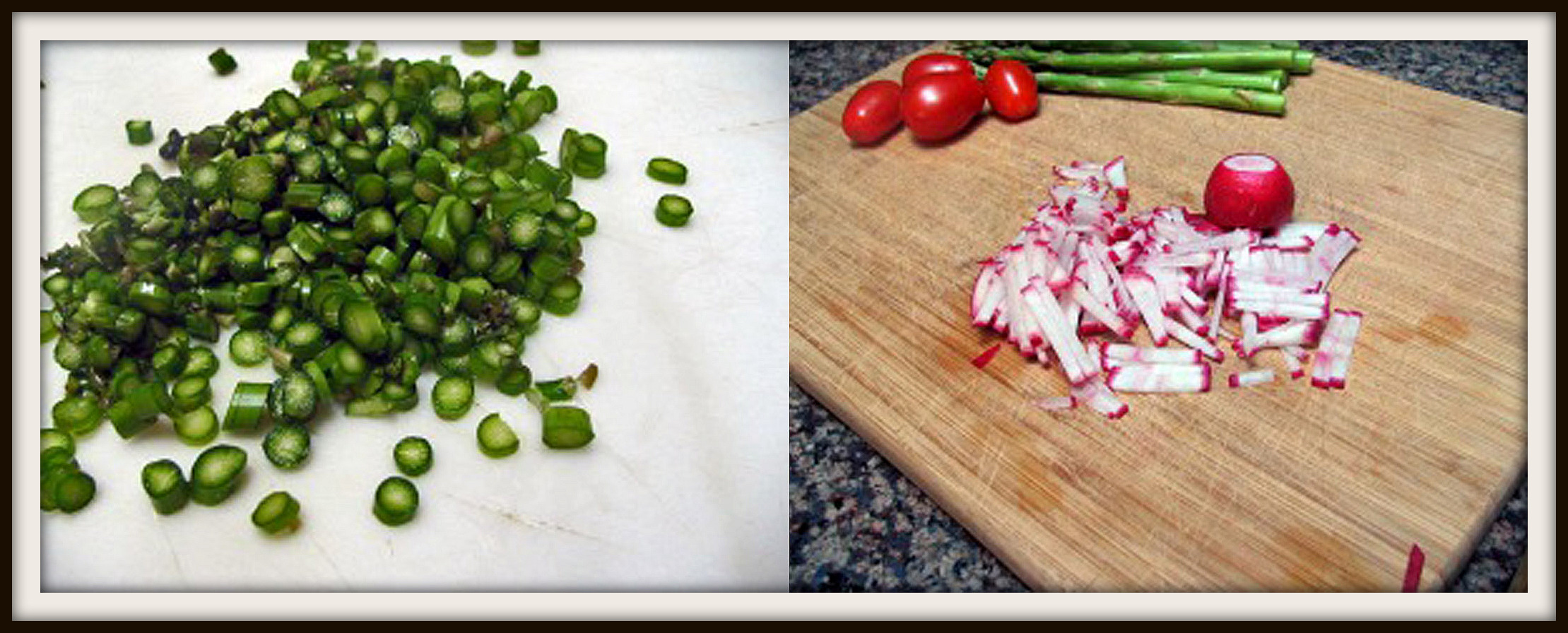
asparagus, finely sliced in tiny “coins”
radishes, cut in match sticks
diced tomatoes
diced cucumbers
minced cilantro (optional)

Cook the farro by mixing it with water and salt in a saucepan, bringing it to a boil and gently simmering it for 45 minutes (or a little longer, taste to decide when it’s fully cooked, but don’t let it get mushy).  If the grain cooks but there’s some water left, drain it. Otherwise just fluff it with a fork and allow it to cool to room temperature.

Make the salad dressing by mixing the olive oil with lemon juice, zest, salt and pepper.  Reserve.  Add the asparagus and radishes to a small bowl and sprinkle with some of the salad dressing, mixing to lightly coat them.

At serving time, mix the cooked farro with the diced tomatoes, cucumbers, cilantro (if using), asparagus and radishes, add more dressing to taste, adjust the seasoning.

ENJOY!

to print the recipe, click here


Comments: A couple of years ago I watched Anne Burrell  use raw asparagus as the main ingredient in an unusual salad.  She inspired me in this farro recipe.   Since the asparagus spears are raw,  thinly slice both them and the radishes.   If you add some dressing to these two ingredients and allow them to rest while you prepare the remainder of the salad, it will mellow their sharpness.

I haven’t given any exact amounts for the ingredients so that you can play with them, using more or less, depending on your own taste.  Skip some, add something else (onions, diced olives, capers, mint leaves), and adapt the dressing too: orange juice complements asparagus and farro quite nicely!

The grain doesn’t go mushy in the fridge overnight, and in fact the salad was still outstanding next day. I can see raw asparagus in our future quite often: couscous, orzo, and cracked wheat salads will never be the same…

My husband, after polishing off leftovers, said: “You are making this again, right”? – I guess food bloggers’ partners live in fear of never tasting the same dish twice… 😉

ONE YEAR AGO: From Sea to Table:  SUSHI

Add to FacebookAdd to DiggAdd to Del.icio.usAdd to StumbleuponAdd to RedditAdd to BlinklistAdd to TwitterAdd to TechnoratiAdd to Yahoo BuzzAdd to Newsvine

GROCERIES

This weekend I couldn’t get to the farmer’s market, so I resorted to the grocery store. Having found rhubarb at a Homeland on the other side of town made me go back again, hoping to score some celery root. No luck this time, but while checking out, the teenage cashier said to me:

“Ma’am, I’ve never seen anyone buying so much fresh food, the only thing you can’t eat here is the laundry detergent”!

I hadn’t noticed. But, back in the comfort of my kitchen I realized he was absolutely right (well, except that he missed the issue of Everyday Food ;-)).

This, my friends, is the way to start the weekend…

(click twice to enlarge it)

Add to FacebookAdd to DiggAdd to Del.icio.usAdd to StumbleuponAdd to RedditAdd to BlinklistAdd to TwitterAdd to TechnoratiAdd to Yahoo BuzzAdd to Newsvine

PAIN RUSTIQUE

Make this bread!  Even if you’re yeast-0-phobic,  even if you think you can’t  bake a bread to save your own life, …PLEASE  make this bread.  I’ll hold your hand throughout, and toast your success at the end!

PAIN RUSTIQUE
(from Hamelman’s Bread)

For the poolish
1 lb bread flour (3 + 5/8 cup)
1 lb water (2 cups)
1/4  tsp instant dry yeast

For the dough:
all the poolish made the previous day (about 2 lb)
6.1 oz water (3/4 cup)
1 lb bread flour (3 + 5/8 cup)
0.6 oz salt (1 Tbs)
0.17 oz yeast (1 + 1/2 tsp)

Make the poolish the day before: add water to a bowl, sprinkle the yeast on top, add the flour and mix until smooth with a large spoon.  Cover with plastic wrap and let it stand at room temperature for 12 to 16 hours (ideal temperature: 70 F).

This is what the poolish will look like the next day….

Prepare the dough:  add the flour, water and fermented poolish to the bowl of a Kitchen Aid-type mixer.   Don’t add the yeast or the salt yet.  Mix on first speed (or by hand) until it all comes together in a shaggy-looking mass.  Cover the bowl and let this mixture rest for 20 to 30 minutes.

Add the salt and the yeast over the dough, turn the mixer to the second speed and mix for 2 minutes.  Ideally, the temperature of the dough should reach about 76 F.  If kneading by hand, then work the dough until it’s smooth, about 6 minutes.

Cover the bowl and let it rest for 25 minutes.  Give a quick couple of folds to the dough (as shown here), let it rest 25 more minutes.   Fold the dough a couple of times again, and let it rest 20-25 minutes more, undisturbed.

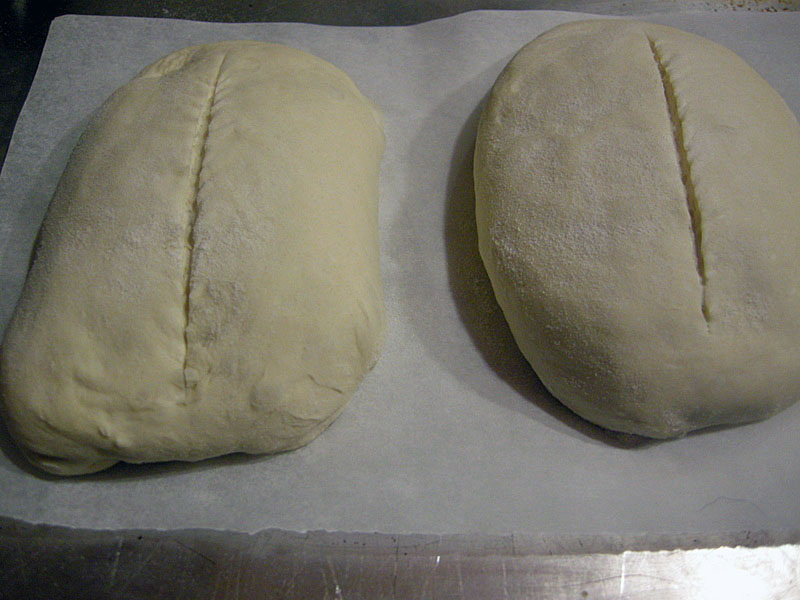
Gently divide the dough into two pieces, trying not to deflate it too much, and place them over lightly floured kitchen towels. Cover,  and let them stay for 20 to 25 minutes at room temperature, for a final quick proofing.  No need to shape the loaves in any particular way.

Invert the dough over parchment paper, so that the floured side is now up.  Slash the bread quickly with a single stroke of a razor blade or sharp knife.

Bake the loaves in a 460F oven, with steam (add ice cubes to a baking pan placed at the bottom of the oven, or use any method of your choice to add steam in the initial baking time).  The bread will be ready in about 35 minutes.   Let them cool completely on a rack before slicing.

ENJOY!

to print the recipe, click here

Comments:  My expectations were not too high for this bread when I first made it:  no wild yeast, no involved kneading and shaping.  When the loaves were ready to go into the oven, they seemed too flat, with a tendency to spread.   However,  they had  nice oven bounce, and the simple slash perfectly coached them into the final shape.   Each loaf was light as a feather, with a nice crumb and subtle sour flavor, thanks to the poolish.

Even though this recipe comes from Hamelmn’s book,  I did not make it as part of the Mellow Baker’s Challenge.  I had to take  a step back and turn into an avid observer of the group instead of a participant.  But make sure you jump over there to see what they are baking,  some great breads for the month of August, including baguettes…  😉

I am submitting this post to Susan’s Yestspotting

ONE YEAR AGO: A Souffle to Remember…  Julia Child

Add to FacebookAdd to DiggAdd to Del.icio.usAdd to StumbleuponAdd to RedditAdd to BlinklistAdd to TwitterAdd to TechnoratiAdd to Yahoo BuzzAdd to Newsvine