THAI CHICKEN CURRY

One of the features  I like the most in Fine Cooking magazine is their section called “Cooking without recipes.”   They pick a particular dish, say,  risotto or meatloaf or lasagna, and  dissect it into its basic techniques, helping you devise your own take on it.  A recent issue (number 110) offered an overview of Thai curries,  including poultry, seafood and vegetarian, from spicy to mild, with all sorts of aromatics to round out their flavors.  If you love curries – and who doesn’t? 😉 –  get this issue and start experimenting.   Here I share with you my first interpretation of a chicken version, that ranked high on the yummy-ness scale.
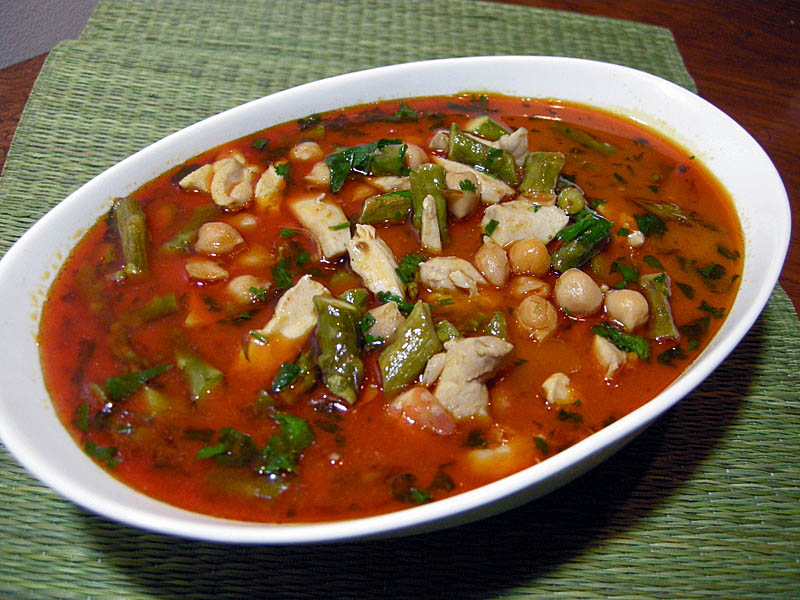
RED CURRY CHICKEN
(from the Bewitching Kitchen, inspired by Fine Cooking)

1 can of coconut milk  (13.5 oz)
1/8 to 1/4 cup red curry paste
1 cup chicken broth (or water)
1 Tbs lemon zest
2 Tbs. light brown sugar
2 tsp. fish sauce
1 Tbs grated fresh ginger
1 lb. boneless chicken thighs  cut into 1/4-thick bite-size strips
3/4 cup canned garbanzo beans, rinsed well
2 cups asparagus, cut in 1-inch pieces
salt to taste
1/2 cup minced cilantro leaves

Shake the can of coconut milk, open it and stir well if not completely smooth.  Transfer 1/2 cup of it to a saucepan and simmer for 5 minutes to thicken it up.  Don’t worry if it starts to separate.  Add the red curry paste, whisk for a minute, then add the broth, brown sugar, fish sauce, and the rest of the coconut milk left in the can. Bring to a simmer over high heat, and add the chicken pieces.  Lower the heat and simmer, stirring occasionally for about 10 minutes.

Add the lemon zest, ginger, asparagus, and garbanzo beans.  Simmer for 5 minutes, adjust seasoning with salt if necessary (fish sauce is salty, you may not need to add additional salt), sprinkle with the fresh cilantro and serve right away over white rice.

ENJOY!

to print the recipe, click here

Comments:  Cooking the chicken in the sauce (instead of sauteing it first) saves a messy step that’s particularly hard to deal with in a tiny kitchen, where I’m working with a two burner hot plate.  Plus, the meat turns out very tender and juicy this way.   Of course, if you prefer chicken breast instead of thighs  then substitute, but something about the velvety texture of chicken thighs makes them more appropriate for this type of recipe.   Once the meat is cooked   add the vegetables that you like (some of which might profit from a previous parboiling: potatoes, butternut squash, carrots);  as long as you pay attention to their cooking times, they’ll be fine.

Keep in mind that different brands of curry paste vary considerably in their spiciness.  If you’re new to this ingredient, then start with a small amount, taste, and add more according to your level of tolerance.

ONE YEAR AGO:  Zen and the Art of Risotto

Add to FacebookAdd to DiggAdd to Del.icio.usAdd to StumbleuponAdd to RedditAdd to BlinklistAdd to TwitterAdd to TechnoratiAdd to Yahoo BuzzAdd to Newsvine

ITALIAN EASTER PIE

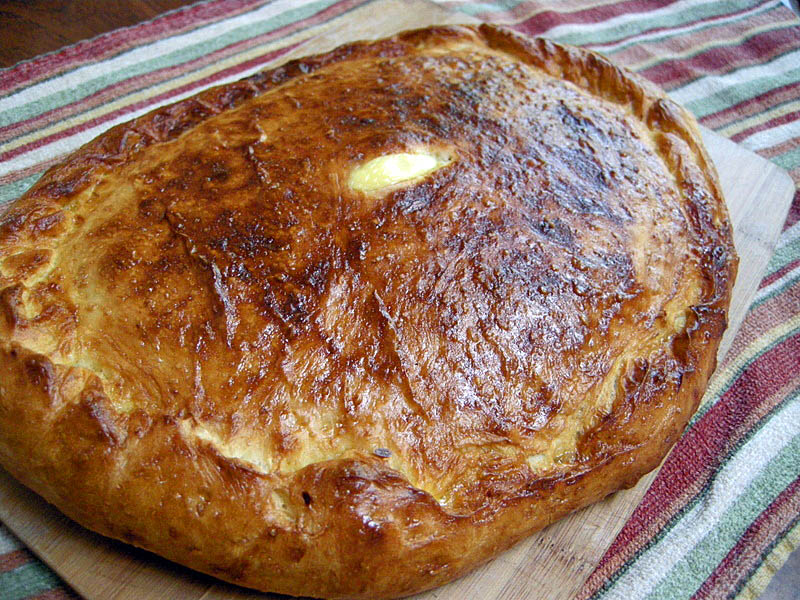
Each year I spot recipes for Easter Pie in websites and magazines, and I tell myself that I’ve got to see what it’s all about, but for one reason or another I never get around to making it.  Still, the chances that this was the year to end my Easter Pie virginity were slim, because the thought of rolling dough in our nano-kitchen was downright scary.  Yet, strange things happened. I read this post, and couldn’t stop thinking about it.  Then, having the house to myself for several hours on Sunday (my husband the golfer!) was the final push to jump in with both feet: when I’m facing a challenging project, solitude is my best friend.  😉

ITALIAN EASTER PIE
(adapted from King Arthur website)

for the crust:
2 + 1/2 cups all purpose flour
1 tsp salt
1 tsp instant yeast
1 Tbs sugar
1/8 cup olive oil
1/2 cup + 1 Tbs room temperature water

for the filling:
6 large eggs (3 of them hard boiled, and diced)
1/2 pound diced ham
1 cup ricotta cheese
1/2 cup grated parmiggiano-reggiano cheese
minced parsley to taste
salt and pepper to taste

for the glaze:
1 egg, beaten
1 Tbs sugar

Make the crust dough by adding all the ingredients in the bowl of a food processor and pmixing until a ball forms.  Adjust with more water if necessary.  When the dough forms a ball, process it for about 20 seconds. Remove it from the machine and knead gently by hand for a minute or so. Place in a lightly oiled bowl, and let it rise for 1 to 2 hours in a warm spot of your kitchen.  The dough should about double in size, and feel bubbly.

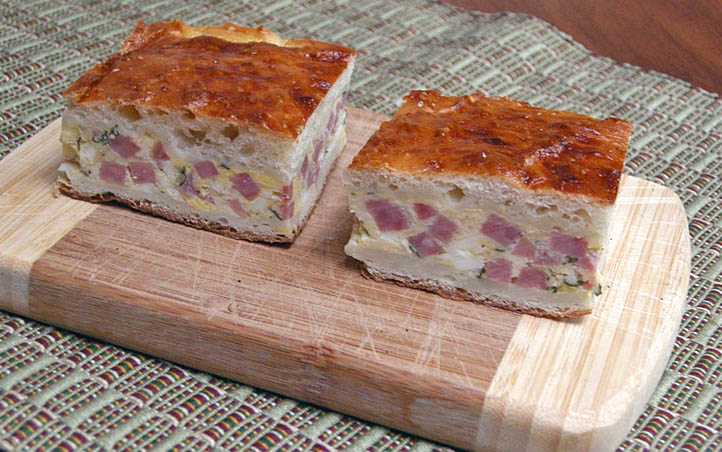
Meanwhile, prepare the filling by mixing the diced ham, boiled eggs, ricotta and Parmigiano cheese with the three raw eggs.  Add salt, pepper, and parsley.

When the dough has doubled in size, divide it into two equal portions and roll them into oval shapes, about 10”x 14”.  Place the filling over one of the dough disks, leaving a clean, 1/2 inch border.  Carefully lift the second disk of dough and layer on top of the filling, enclosing it by pressing the borders together.  Cut a slit on top of the pie with a knife or razor blade, and brush the surface with a glaze made from mixing the egg and sugar.

Bake it in a 350 F oven for 25 minutes or until the top is golden brown.  Remove to a rack and allow it to cool.

ENJOY!

to print the recipe, click here

Comments:  Things were going so smoothly during the preparations of dough and filling that I found myself multitasking:  a little vacuum-cleaning here, a little exercising there, and even a break to walk the dogs.  But, naturally, the dark clouds were gathering and the lightning struck big time when I went to roll out the dough, and found…… no rolling pin in the house!  Without naming names, someone dispatched my improvised rolling pin (an empty wine bottle without its labels) to the recyclable waste.  In desperation I tried a bottle of wine (with labels on!),  but it didn’t work.   Flour was flying and the dough was beyond its rise.  So, I took matters (literally) into my own hands, and  “rolled” it with the palm of my hand on parchment paper.  It’s not a relaxed activity for a Sunday morning; I don’t recommend it. Actually, it wouldn’t be too bad for a single crust concoction, like galette or another other rustic pie.   But, for this pie you’ll need two disks of dough with similar dimensions.  Perhaps Easter Pie was what prompted the invention of the rolling pin!  😉

All problems aside, this pie was wonderful!  As  Ms. Hamel mentioned in her post,  each Italian family has their own “authentic” version.  Some are loaded with meats, while some – like Pastiera Napoletana – have a sweet, cheesecake-like filling.  This version is lighter than most,  but still substantial.  If you celebrate Easter, then I suggest that you make it this weekend. If you don’t celebrate, it’s a delicious dish for a dinner party.  I’ve been enjoying it for lunch at work with a juicy tomato alongside.  Heaven!

ONE YEAR AGO: Black Olive Bialy

Add to FacebookAdd to DiggAdd to Del.icio.usAdd to StumbleuponAdd to RedditAdd to BlinklistAdd to TwitterAdd to TechnoratiAdd to Yahoo BuzzAdd to Newsvine

SaveSave

MAPLE-OATMEAL SOURDOUGH BREAD

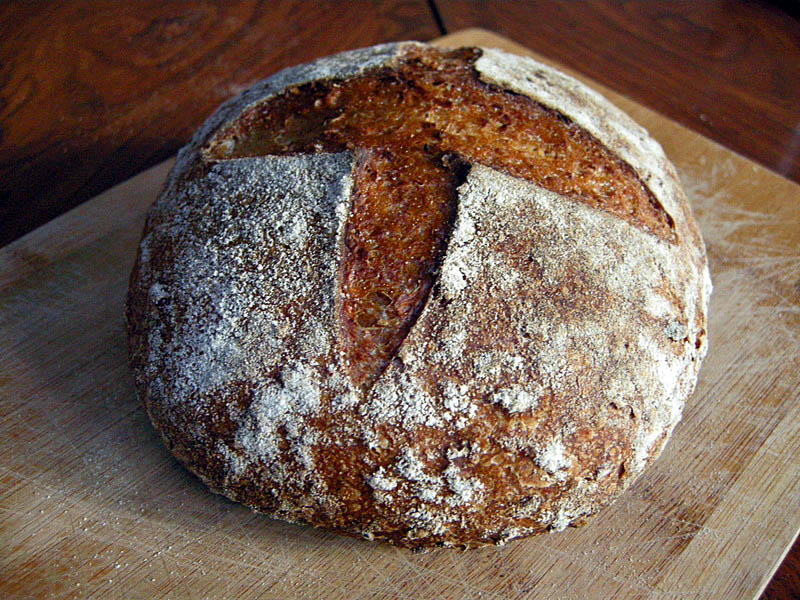
Two of my favorite bread baking sites are Wild Yeast and The Fresh Loaf.  Every Friday, I look forward to Susan’s Yeastspotting event,  that showcases  breads baked during the previous week by folks all over the world.  And The Fresh Loaf is a discussion forum with help and advice for beginners as well as experienced bakers.  Through my visits to both sites over several years,  I got to know – virtually, at least  –  some amazing bread bakers like MC, who runs the blog with the cute name “Farine.”   Not too long ago she raved about a bread from Orchard Hill Breadworks, a bakery in New Hampshire owned by Noah Elbers.  During her visit to the bakery, she learned how to make one of their signature breads, with two flavors I am quite fond of:  oatmeal and maple syrup.

I won’t lie to you, the preparation is a bit involved: the day before you’ll need to bake the oatmeal, refresh your sourdough starter, and make a poolish with commercial yeast. But your hard work will pay off, big time…   😉

NOAH ELBERS’ MAPLE-OATMEAL BREAD
(reprinted from Farine‘s blog, with permission from Noah Elbers)

447 g all-purpose unbleached flour
151 g whole-wheat flour
151 g steel-cut oatmeal, baked
328 g water
151 g liquid starter
151 g poolish
121 g pure maple syrup
16 g salt
 
The day before baking the bread:
1. Refresh your sourdough starter, to make sure it is bubbly and active when you make the dough next morning. I do that about 12 hours before mixing the dough, by mixing 2 tsp of mature starter with 150g water and 150g flour.  Next morning remove the amount you need and keep the rest in the fridge.

2. Make the poolish by mixing 100g flour + pinch of instant yeast + 100 g/ml water recipe: Leave to ferment overnight. You will not use it all, weigh what you need for the recipe.

3. Bake the oatmeal.  Boil water, then mix it with the oatmeal in a baking dish (200g oatmeal + 200g/ml boiling water).  Cover the dish with aluminum foil and bake in a 400F oven for 40 minutes.  The mixture will turn into a brick.  Once it cools, break the bits of oatmeal with your fingers, and weigh the amount needed for the dough.

On baking day:
Mix all the ingredients in a large bowl (except the salt),  kneading briefly to form a shaggy mass.  Let the mixture resting for 30 minutes.    Add the salt and incorporate by gentle kneading.

Let the dough rest for 40 minutes.  Knead by folding the dough in itself 4-6 times.  Let the dough rest for 40 minutes more.  Knead it again by folding.
Let the dough rise for 40 minutes, do one final cycle of kneading, then allow it to sit undisturbed for a full hour  (total bulk fermentation will be about 3 hours).

Shape the dough as a large batard, or divide in two and shape as a small round (that’s what I did).  Let the shaped bread rise for 1 hour at room temperature, then retard it in the fridge for 12-15 hours.

Bring the bread to room temperature for 2 hours before baking in a 450F oven for 45 minutes (25 minutes under steam, covered, 20 minutes uncovered).  Cool the bread for at least one hour before indulging in it.

ENJOY!

to print the recipe, click here

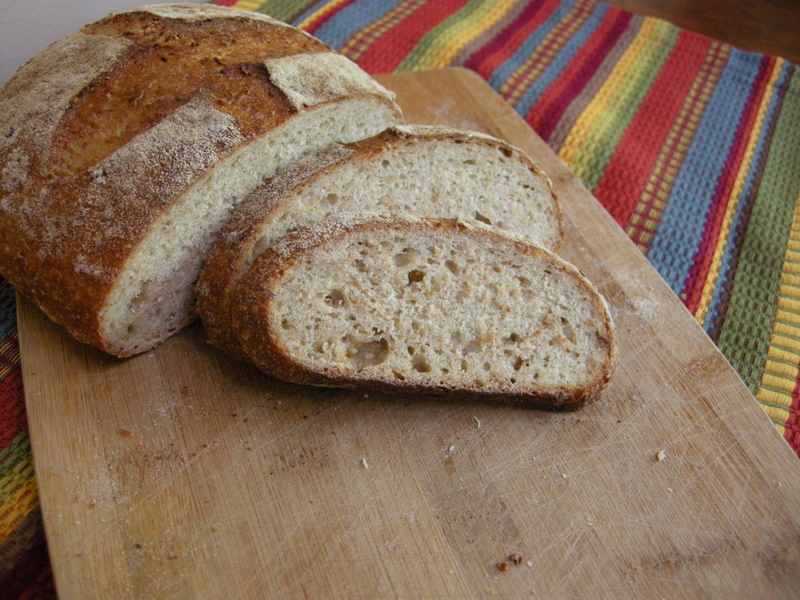
Comments: Even though this bread takes oatmeal and maple syrup, it is not sweet.  I think its sourdough nature creates a nice counterpart to the sweetness, so that the bread is quite versatile:  you can enjoy it with peanut butter and jelly (like my husband did), or go for a bit of Brie or Camembert (my favorite take).

I highly recommend that you visit Farine website, and click on the video made in the bakery during the preparation of this bread.  It is amazing to see how those talented bakers handle a huge amount of dough, from mixing to shaping.   And while you are net-surfing, make sure to stop by the bakery website and read about how it all started, a fascinating story told by Noah himself.

I am submitting this post to Susan’s Yeastspotting

ONE YEAR AGO: Black Trumpet-Coffee Crusted Pork Tenderloin (one of my personal favorites!)

Add to FacebookAdd to DiggAdd to Del.icio.usAdd to StumbleuponAdd to RedditAdd to BlinklistAdd to TwitterAdd to TechnoratiAdd to Yahoo BuzzAdd to Newsvine

THE END OF GREEN BEAN CRUELTY

I’m talking about THIN green beans, of course…   😉

We learned about Michel Richard firsthand, at his wonderful, exciting restaurant Central in Washington DC.  What a delicious experience it was! The bread – that keeps coming to the table, always warm and impossible to say no to – and the gougeres alone are worth stopping by.  In his book Happy in the Kitchen, Michel Richard comments  that  most recipes for green beans cook them in boiling water, then quickly shock them in an ice-bath. However, he adamantly opposes this method when dealing with pencil-thin green beans. They are so delicate, so why would anyone furiously boil and shock the poor things, leaving them limp and lifeless?

I’ve been guilty of such green bean cruelty more than once, but I won’t ever do it again. When prepared  by Michel’s guidelines, they are simply irresistible, even served without any embellishments. However, pairing these beauties with small roasted tomatoes didn’t hurt them a bit.

GREEN BEANS WITH ROASTED TOMATOES
(from the Bewitching Kitchen)

for the green beans:
a bunch of pencil-thin green beans (amount enough for two)
1 Tbs olive oil
pinch of red pepper flakes
1/2 tsp orange zest
salt and pepper to taste

for the tomatoes
1 cup of grape tomatoes, cut in half
drizzle of olive oil
drizzle of balsamic vinegar
salt and pepper to taste

Start by roasting the tomatoes.  Spread them in a single layer on a small baking sheet lined with foil or parchment paper for easy clean up. Drizzle some olive oil and balsamic vinegar, shake them around, and season with salt and pepper.  Place in a 400 F oven until they get soft and start to brown around the edges, 20 to 25 minutes. Reserve, keeping warm.

Heat the olive oil in a non-stick skillet, add the red pepper flakes and the orange zest.  Keep in a gentle heat for a couple of minutes, until the mixture starts to get fragrant.  Increase the heat, add the green beans, and let them cook for a few minutes undisturbed, so that they get a little color where they make contact with the pan.  Stir them around to coat the beans with the flavored oil, and saute for a little while longer, until the beans are cooked through, but still al dente. Don’t overcook! Season with salt and pepper, add the roasted tomatoes on top, and mix gently.  Adjust seasoning, and serve right away.

ENJOY!

to print the recipe, click here

Comments: Michel Richard’s main message is to cook thin green beans straight by sauteing in a small amount of fat.  You can substitute butter or a mixture of butter and olive oil, or use a different type of oil, keep in mind that some – like walnut oil –  burn at a lower temperature, so it’s best to add them close to the end of cooking.

The combination of green beans and orange zest, worked quite well in this recipe,  with the touch of balsamic vinegar brought by the tomatoes.  It was a nice side dish for our grilled flank steak, but if you want a fully vegetarian meal, add some pasta or couscous, a big salad and a thick slice of grilled bread.  It’s  more than enough for a tasty dinner.  Just remember, be kind to the green beans!  😉

ONE YEAR AGO: Torta di Limone e Mandorle

Add to FacebookAdd to DiggAdd to Del.icio.usAdd to StumbleuponAdd to RedditAdd to BlinklistAdd to TwitterAdd to TechnoratiAdd to Yahoo BuzzAdd to Newsvine

MAHI-MAHI

I fall in love with words quite easily.  Mahi-mahi…. is just one of the many beautiful Hawaiian words.  When we visited Oahu I found it fascinating to  read the street names, which for the most part were quite hard for a foreigner to remember: Kamehameha, Mamalahoa, Kealakehe, Hualalai. They all seemed so…. musical!

It turns out that the Hawaiian alphabet lacks a few consonants:  C, J, Q, and X. It also makes no distinction between K and T.   When the complexity of a language decreases at one level, it often compensates on another.  The fewer consonants probably explains why so many Hawaiian words have duplicated syllables, giving the spoken language a playful component that’s quite pleasing.  But, I digress…  mahi-mahi (by the way, “mahi” means “strong”) is one of my favorite fish, at the top with striped sea bass.  It has a mild, but definitely not bland flavor, and a meaty texture that’s perfect for grilling, as this recipe (another gem I got from my friend Heather) will convince you.

GRILLED MAHI-MAHI WITH CITRUS MARINADE
(from  Heather’s kitchen)

2 filets of mahi-mahi (may substitute other firm-fleshed fish)
for the marinade:
2 T fresh lime juice
3 T rice vinegar
1 T finely chopped ginger
1 T finely chopped scallions
3 T mild vegetable oil (I used grapeseed)
1 T soy sayce
1/2 t Asian chili sauce (optional)
freshly ground black pepper to taste
Prepare a marinade by whisking all ingredients together. Marinate the fish for 30 minutes to 2 hours in the fridge.  Grill until cooked through. 

ENJOY!

to print the recipe, click here

Comments: This was one of the tastiest dinners in the past few weeks.  A fish like mahi-mahi is delicious on its own, so the less you mess with it, the better it is.  This preparation was perfect: a hint of lemon,  a little heat, and nothing else.  No elaborate toppings, crusts, or sauces.  A simple, delicious meal, as healthy as it gets.

We loved it with roasted asparagus, and with a mixture of white rice and wheat berries that, all modesty aside, was a spur of the moment inspiration that had me patting myself on the back.   I spotted some white rice in the fridge and some cooked wheat berries that I was saving for a salad.   I just mixed them and warmed them in the microwave. It was an absolutely delicious combination that will be a regular production in the Bewitching Kitchen.

ONE YEAR AGO: Memories of Pasteis

Add to FacebookAdd to DiggAdd to Del.icio.usAdd to StumbleuponAdd to RedditAdd to BlinklistAdd to TwitterAdd to TechnoratiAdd to Yahoo BuzzAdd to Newsvine