GOODBYE L.A.

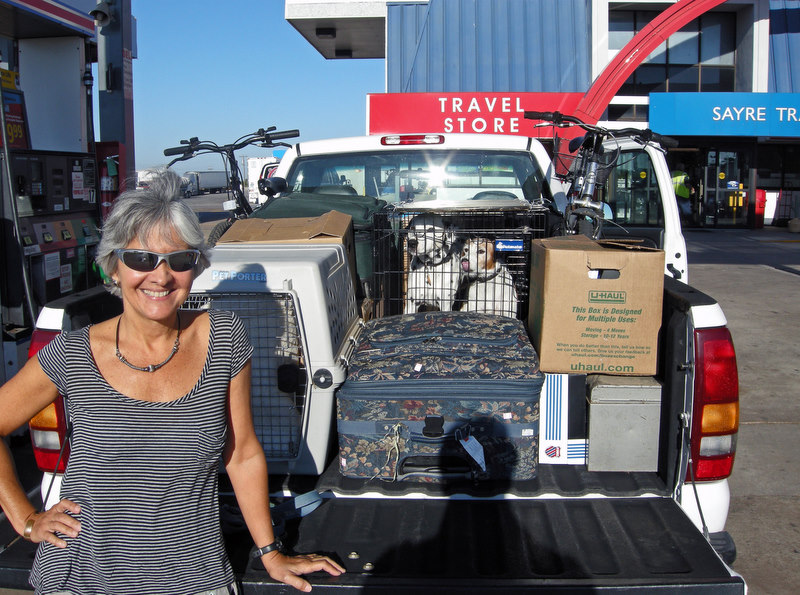
Ten months passed way too quickly, and our time in California is coming to an end.   We brought two dogs with us, and two dogs will travel back,  but only one will recognize the place as his old, beloved home.  Oscar has no idea how much his life will change, from a small patch of astroturf to a big backyard with fat squirrels waiting to tease him.  It’s close to dog-paradise.

We will miss many things from our stay in this amazing city.  All the friends we made, the time with C & C  (aka ” LA’s coolest couple”),  the conversations with our  our boss (both scientific and otherwise), and all our labmates at UCLA.  We’ll miss the EARLY morning runs up and down Beverly Glen (we completed 81 of those!), interrupted by  sunrise over Mulholland Drive, the walks with the dogs through our neighborhood canyons, and the howling coyotes in the middle of the night. I might even miss the nano-kitchen…  😉

The bar at Katsuya Sushi in Hollywood, unforgettable spot…

Franklin Canyon

View from Yamashiro restaurant, where great food is just the beginning…

Until we settle into a new (old) routine, I’ll take a little break from blogging.   I hope to see you soon in the (full-size) Bewitching Kitchen!

Everything changes, nothing remains without change.
(Buddha
563BC-483BC)

ONE YEAR AGO: 7-6-5 Pork Tenderloin


Add to FacebookAdd to DiggAdd to Del.icio.usAdd to StumbleuponAdd to RedditAdd to BlinklistAdd to TwitterAdd to TechnoratiAdd to Yahoo BuzzAdd to Newsvine

HONEY-GLAZED CHICKEN LEGS

A low-and-slow, followed by a high-and-fast blast in the oven is my favorite way to cook chicken pieces, similar to another recipe I blogged about in the past. In this version the proportion of honey is quite a bit higher, forming a glaze that acquires a fantastic mahogany hue in the final roasting time. The meat underneath will be the way we love it: juicy and tender.  The inspiration for this recipe came from the latest issue of Food and Wine magazine.

HONEY-GLAZED CHICKEN LEGS
(adapted from Food and Wine, May 2011)

1/4 cup + 1 tsp honey
2 Tbs + 1 tsp fresh lemon juice
2 Tbs soy sauce
salt and pepper to taste
4 chicken legs (or 8 chicken thighs)

Make the glaze by mixing all the honey, lemon juice, and soy sauce.  Sprinkle the chicken legs with salt and pepper, then use a brush to cover them with the glaze.  Place the chicken legs on a baking sheet, skin-side down, cover with aluminum foil, and slow roast at 325F for about 40 minutes.   Flip the pieces to have the skin side up, brush some more of the glaze over, cover with aluminum foil again, and continue cooking for  another 40-45 minutes.  (If you want to finish the recipe later, place it in the fridge).

Increase the oven temperature to 425F, remove the aluminum foil and roast until the skin is dark brown, 10 to 15  minutes (a little longer if roasting from the fridge).

ENJOY!

to print the recipe, click here

Comments:  Lots of recipes will have you roast poultry at a high temperature, but in my opinion, nothing compares to the “low and slow” approach.  Not only the meat retains moisture, but it makes no mess in the oven,  a huge bonus for neat-freaks such as myself.  😉

I like to prepare this type of recipe in two stages: the slow roasting on a lazy weekend afternoon, or a quiet evening.  After that, the meat can go to the fridge for a day or two.  When it’s time to enjoy it, just do the final, higher temperature roasting for 20 minutes.  White rice, pasta, couscous, or just a salad and a piece of bread, and you are set for a wonderful dinner!

ONE YEAR AGO:  French-Style Rolls

Add to FacebookAdd to DiggAdd to Del.icio.usAdd to StumbleuponAdd to RedditAdd to BlinklistAdd to TwitterAdd to TechnoratiAdd to Yahoo BuzzAdd to Newsvine

TWO-STAGE RISOTTO

Risotto is one of my favorite dishes,  but I refrain from making it for dinner parties because it does require some loving attention. No way to entertain your guests when risotto is on the menu, unless they don’t mind standing next to the stove with you, sipping wine and watching the rice gently bubbling away.

I’ve read a few articles describing how restaurants do it, though.  Obviously the customer cannot wait for 30 minutes as the kitchen staff prepares each plate to order, so they resort to a method said to work like a charm: the rice is cooked almost all the way through, then spread on a baking sheet to cool down.  Once the order comes in,  they spoon out a single serving, and finish it quickly on top of the stove.

I would be a bit insecure to try this approach for the first time on guests, but Phil and I were perfect guinea pigs for this experiment.  I  adapted a recipe for pea risotto from a recent issue of Food and Wine, and put the method to test.
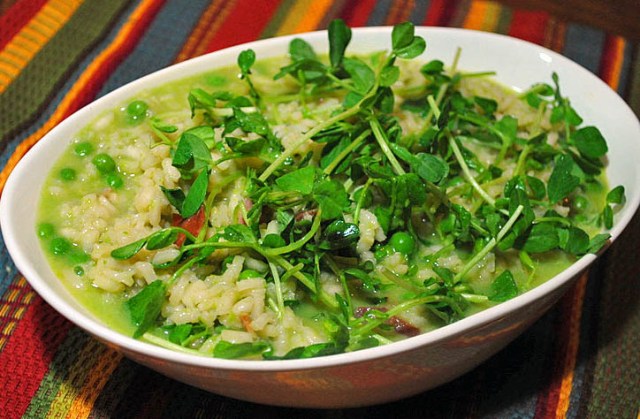
TWO-STAGE PEA AND PROSCIUTTO RISOTTO
(adapted from Food and Wine, May 2011)

3 slices of prosciutto, cut in small pieces (use scissors)
1 cup frozen peas, thawed
1 Tbs olive oil
1 small shallot, finely diced
1 cup arborio rice
1/4 cup dry white wine
4 – 5 cups chicken stock, warm (you won’t use it all)
1 Tbs butter
1/4 cup Parmiggiano cheese
salt and pepper to taste
a nice squeeze of lemon juice
1 cup pea shoots, very loosely packed

Heat the chicken stock in a saucepan, and keep on very low heat. Using a blender or the food processor, puree half the peas in 1/2 cup of chicken stock.  Reserve. Heat the olive oil in a large skillet, cook the prosciutto until it starts to get crisp. Remove the pieces and place over kitchen paper, reserve.

In the same skillet, cook the shallots seasoned lightly with salt and pepper, until soft and fragrant.  If necessary, add a little more oil, then the rice and cook stirring often until all grains are well coated.  Add the wine and simmer until absorbed, about 3 minutes.

Add enough hot chicken stock to cover the rice, and cook over medium heat, stirring often.  Keep adding stock, one ladle at a time,  until the rice is about 75% cooked through (taste it, it should feel still hard at the center; it took me about 25 minutes).  Remove from the stove and immediately transfer it to a baking sheet in a layer.   Place it in the fridge until time to serve the dish (several hours won’t harm it).

When it’s time to finish the risotto, heat 1 cup of the remaining chicken stock in  the skillet, add the rice, cook for a couple of minutes, then add the reserved pea puree (warm it briefly in the microwave).  When the rice is done, nicely al dente, add the peas, the prosciutto, the  grated cheese, the butter, and a squeeze of lemon juice.  Season with salt and pepper, add the pea shoots right before serving, and

ENJOY!

to print the recipe, click here

Comments: This is definitely the solution to the “risotto for guests”  puzzle.  It tastes exactly as if it was prepared all the way through, and it takes literally minutes to serve.  The other detail in this recipe that won me over: the pea puree.  I’ve made plenty of pea risottos before, they are always delicious, but turning part of the pea in a puree raises the dish to a new high.  I think many types of risotto will benefit from this approach, so that’s something to experiment with in the future.    My husband suggested  the addition of chevre cheese instead of Parmiggiano, and I bet it will be a  delicious variation.

Remember: if you love risotto and want to include it in your next dinner party menu, don’t be afraid of the two-stage method!

ONE YEAR AGO: Life is a matter of taste (a small tribute to David Rosengarten)

Add to FacebookAdd to DiggAdd to Del.icio.usAdd to StumbleuponAdd to RedditAdd to BlinklistAdd to TwitterAdd to TechnoratiAdd to Yahoo BuzzAdd to Newsvine

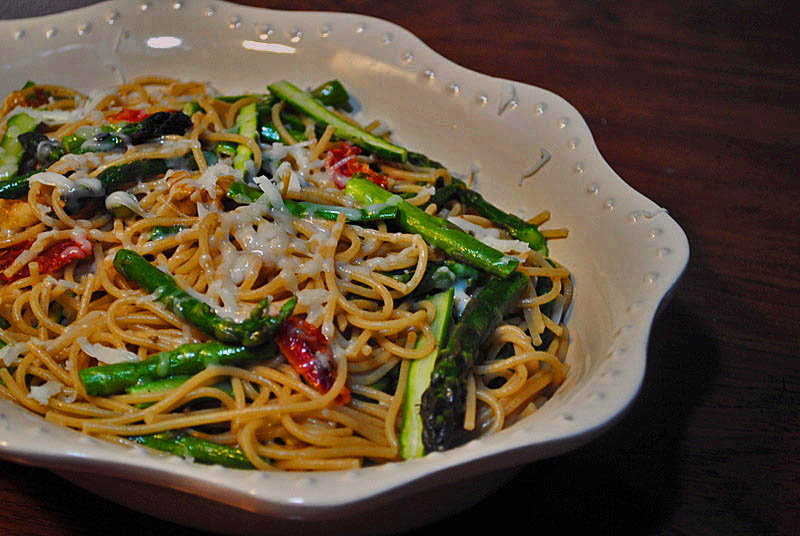
SPRING PASTA

Proving that there’s no such thing as too many recipes using asparagus, here is one more: a very tasty and healthy pasta dish to celebrate Spring, even if the season is already waving goodbye.  However, here in L.A. the warm weather is dragging its feet, temperatures barely hit the mid 70’s, and I still have to resort to long sleeves shirts.  It’s preposterous!

I got this recipe from a new food blog: Inspired Edibles, hosted by Kelly, where you’ll also find all sorts of articles related to nutrition and fitness, two topics I’m quite fond of.   Kelly got the recipe from  from Ellie Krieger, cookbook author and Food TV host. I made just a few changes to accommodate what I had around the kitchen.

SPRING PASTA
(adapted from this post in Inspired Edibles)

whole-wheat spaghetti (or pasta of your choice)
1 bunch of asparagus
1/2 cup walnuts, toasted and coarsely chopped
3 Tbs olive oil, divided
1 garlic clove
1/4 cup sun dried tomatoes, coarsely chopped
salt and pepper to taste
1/4 cup chicken stock (or water)
fresh parsley, chopped
Iberico cheese, grated (or Parmiggiano Reggiano)

Heat oven to 375 F.   Cut the tough stems off the asparagus and discard.  Cut the stems in half, and unless the stems are very thin, slice the lower half in half lengthwise.  Place them in a baking dish, coat lightly with 1 Tbsp olive oil, sprinkle salt, and bake for 12-15 minutes, until barely soft.

Start cooking the pasta according to the package instructions. Meanwhile, heat 2 Tbs olive oil on a large non-stick skillet and saute the garlic and the sun dried tomatoes for a couple of minutes, until the garlic is fragrant and the tomatoes start to soften up.  Season with a little salt and pepper. If the pasta is not cooked yet, reserve the sauteed mixture over very low heat.   Once the pasta is cooked, add it to the skillet together with the chicken stock, reserved asparagus, 3/4 of the walnuts, parsley and grated cheese.  Mix well, and warm it all together in medium-high heat for a couple of minutes.

Serve with the remaining walnuts and additional grated cheese on top.

ENJOY!

to print the recipe, click here

Comments:  The more I eat whole-wheat pasta the more I like it. Barilla is my top choice, but this time I used a Trader Joe’s alternative and found that its beautiful brownish color faded quite a bit upon cooking.  Not quite sure why that would happen, but it tasted fine, maybe a little less “toothsome” than Barilla.

Surprisingly,  there was no Parmiggiano in our home, so I used Iberico, a delicious Spanish cheese, similar to Manchego.  Since it’s not a hard, grating type cheese, it melted almost instantaneously in contact with the pasta.  Nothing wrong with that, actually, we loved it!  But it is a bit messy to grate, next time I’ll stick with the classic Parmiggiano.

Kelly, thanks so much for the inspiration,  you obviously picked a perfect name for your blog!   😉

ONE YEAR AGO:  Ice cream melts for mango


Add to FacebookAdd to DiggAdd to Del.icio.usAdd to StumbleuponAdd to RedditAdd to BlinklistAdd to TwitterAdd to TechnoratiAdd to Yahoo BuzzAdd to Newsvine

BUTTERMILK CLUSTER

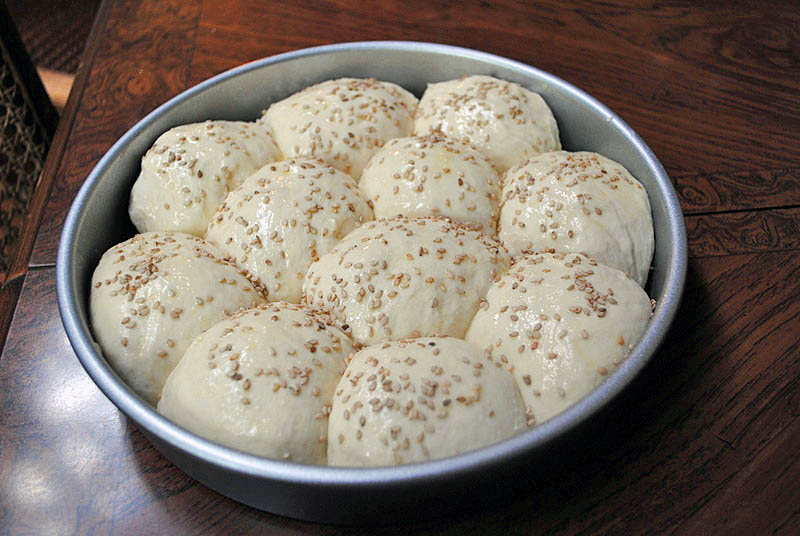
One of the English expressions that puzzles me the most is “easy as pie.”  That’s because I don’t see anything easy about making the dough,  rolling it out, and mastering the finishing touches that result in a gorgeous pie.  But, I promise  that this bread is  a cinch to make, and much, much easier than pie!  It quickly comes together,  so you can wake up on a sunny Sunday morning and make this bread in time for  brunch.

BUTTERMILK CLUSTER
(adapted from The Fresh Loaf Forum)

Makes 12 to 18 rolls, depending on size

6 to 6 1/2 cups (750 grams) bread  flour
1/2 tablespoon salt
1 envelope (2 1/2 teaspoons)  instant yeast
1 tablespoon warm water
2 cups buttermilk
1 tablespoon honey

Glaze:
1 egg beaten with 1 teaspoon water

Topping:
1-2 tablespoons seeds (poppy, sesame) or grains (cracked wheat, rolled oats)

Combine the flour and salt in a large bowl. Combine the warm water and yeast in a small cup and allow to proof for 5 minutes.

Pour the yeast, buttermilk, and honey into the flour mixture and mix to form a shaggy mass. Let the dough rest for 15 minutes, then do a 10-20 seconds kneading.  Cover the dough with plastic film, and let it rest for 15 minutes. Repeat the minimal kneading two more times, at 30 and 45 minutes, then let the dough rise for another 45 minutes undisturbed or until almost doubled in size (total bulk fermentation will be  about 90 minutes).

Divide the dough into 12 to 18 pieces. Shape each piece into a neat ball and place in a round dish or spring-form pan close together.

When all of the rolls are in the pan, cover again with plastic and set aside to rise again for 45 minutes to an hour. Meanwhile, preheat the oven to 425.

Uncover the rolls and brush gently with the egg wash. Sprinkle on the grain topping. I used sesame seeds.

Bake for approximately 30 minutes, until the rolls are firm and spring back when tapped.

ENJOY!

to print the recipe, click here

Comments:  I didn’t have a springform pan, and my smaller round cake pan could only fit 11 of the dough balls.   So, I shaped the leftover dough as a small loaf and baked it separately.


As I munched on these soft, springy rolls I kept thinking about Thanksgiving dinner :  they are perfect for that occasion, so keep them in mind. Thanksgiving is such a busy cooking day, and this recipe is so easy  that it will be something to give thanks for.  😉

Something strange and unexpected happened to the individual loaf I baked.  I sliced it, then placed on the kitchen counter to wrap in plastic and freeze.  But,  I forgot about it for a couple of hours and when I went to search for it, it was gone!   My beloved husband was not around, and one of the dogs is too short to reach the counter, which left two possibilities:

1. I have a double-personality disorder and the “other me” has no self-control.

2. The “other dog” knows how to get the most of those long skinny legs.

I guess we know which one it was (sigh).

I am sending this to Susan’s Yeastspotting

ONE YEAR AGO:  Grilled Lettuce Salad   (you’ve got to try it!)

Add to FacebookAdd to DiggAdd to Del.icio.usAdd to StumbleuponAdd to RedditAdd to BlinklistAdd to TwitterAdd to TechnoratiAdd to Yahoo BuzzAdd to Newsvine