WHEN A KING MAKES A PROMISE…

HE DELIVERS!

Normally, I would shy away from baking a bread using exclusively whole wheat flour, because often they turn out dry, heavy, and not too flavorful. But those folks at King Arthur Flour know their bread extremely well, and recently highlighted in their blog their most popular recipe, a 100% Whole Wheat Bread. They promised that it would produce “a moist, close-grained, nutty, and rich bread, that slices as a dream.”    They did not lie: this is a deliciously hearty loaf, not heavy at all, with a hint of sweetness from the honey, perfect to start your day on a very “good carb-note.”


CLASSIC 100% WHOLE WHEAT BREAD

(from King Arthur website)

8 to 10 ounces lukewarm water
1 + 3/4 ounces vegetable oil
3 ounces honey
14 ounces whole wheat flour
2 + 1/2 teaspoons instant yeast
1 ounce dried milk
1 + 1/4 teaspoons salt

In a large bowl, combine all the ingredients and stir till the dough starts to leave the sides of the bowl. Transfer the dough to a lightly greased surface, oil your hands, and knead it for 6 to 8 minutes, or until it becomes smooth. Alternatively, knead it in a KitchenAid type machine (I did that for about 7 minutes at speed 2).

Transfer the dough to a lightly greased bowl or large measuring cup, cover it, and allow the dough to rise till puffy though not necessarily doubled in bulk, about 1 to 2 hours (mine doubled in a little over 1 hour).

Transfer the dough to a lightly oiled surface, and shape it into a loaf. Place it in a lightly greased 8 1/2″ x 4 1/2″ loaf pan, cover the pan loosely with lightly greased plastic wrap, and allow the bread to rise for about 1 to 2 hours, or till the center has crowned about 1″ above the rim of the pan (mine took only 1 hour to reach that point). Towards the end of rising time, heat your oven to 350F.

Bake the bread for 35 to 40 minutes, tenting it lightly with aluminum foil after 20 minutes to prevent over-browning. The finished loaf will register 190°F on an instant-read thermometer inserted into the center.

Remove the bread from the oven, and turn it out of the pan on  a rack to cool. If desired, rub the crust with a stick of butter; this will yield a soft, flavorful crust (I omitted this step). Cool completely before slicing.

ENJOY!

to print the recipe, click here

This slideshow requires JavaScript.

Comments: The variable amount of water given in the recipe accommodates for differences in humidity and temperature in each kitchen.  Start with 8 ounces and see how the dough behaves. It is very important not to add too much flour, or it will be too heavy.

Instead of using my regular oven, I baked this loaf on our Breville toaster/convection oven, and it performed very well. It is a fantastic appliance, one that will be used more and more in the near future.   😉

I am submitting this post to Susan’s Yeastspotting

ONE YEAR AGO: Basic French Bread

Add to FacebookAdd to DiggAdd to Del.icio.usAdd to StumbleuponAdd to RedditAdd to BlinklistAdd to TwitterAdd to TechnoratiAdd to Yahoo BuzzAdd to Newsvine

FARRO: GOOD FOR YOU AND TASTES GREAT TOO

Farro:  a fun word for a mysterious grain, about which a lot of controversy exists as to its origin.  Some say it’s a type of wheat, but that’s not the case,  farro is a grain from a related, but different plant.  It was a staple at the height of the Roman Empire,  and persevered since those days until now in central parts of Italy, where it’s still grown,  consumed and exported.   Farro is loaded with vitamins and low in gluten, so even people with gluten allergies may enjoy it. Plus, it performs well in  many kinds of recipes, from risottos to breads, from stews to salads.  What an amazing little grain, that’s perfect as the focus of my 200th post!   😉

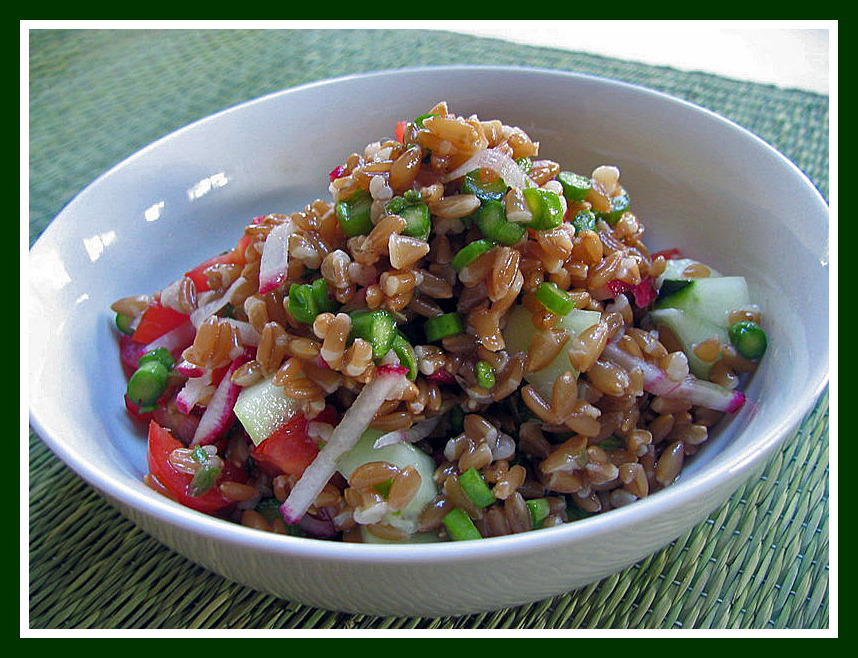
BEWITCHING FARRO SALAD
(from my kitchen)

to cook the grain:
1 cup farro  (not the pearled variety)
2.5 cups water
1/2 tsp salt

for the dressing (it will make more than you need):
1/2 cup olive oil
juice and zest of 1 lemon (or other citric fruits, alone or in combination)
pinch of salt
ground black pepper

for the salad:
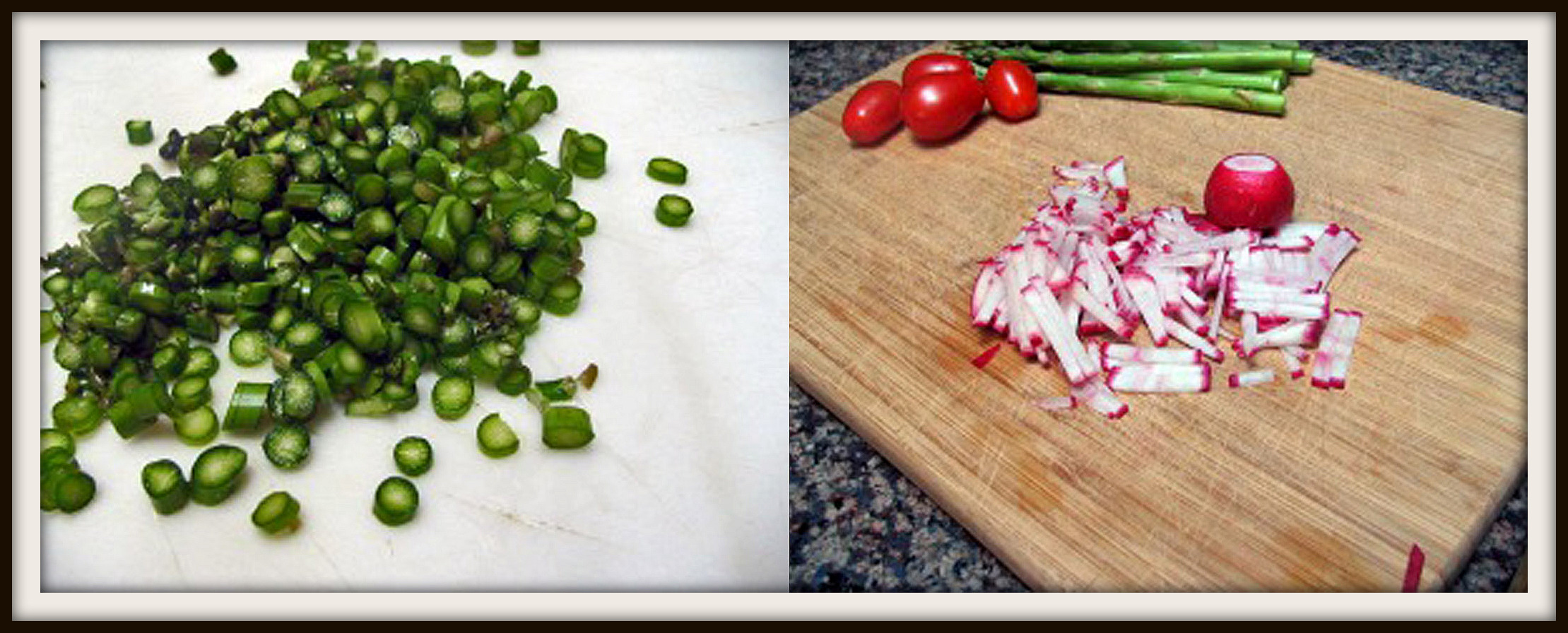
asparagus, finely sliced in tiny “coins”
radishes, cut in match sticks
diced tomatoes
diced cucumbers
minced cilantro (optional)

Cook the farro by mixing it with water and salt in a saucepan, bringing it to a boil and gently simmering it for 45 minutes (or a little longer, taste to decide when it’s fully cooked, but don’t let it get mushy).  If the grain cooks but there’s some water left, drain it. Otherwise just fluff it with a fork and allow it to cool to room temperature.

Make the salad dressing by mixing the olive oil with lemon juice, zest, salt and pepper.  Reserve.  Add the asparagus and radishes to a small bowl and sprinkle with some of the salad dressing, mixing to lightly coat them.

At serving time, mix the cooked farro with the diced tomatoes, cucumbers, cilantro (if using), asparagus and radishes, add more dressing to taste, adjust the seasoning.

ENJOY!

to print the recipe, click here


Comments: A couple of years ago I watched Anne Burrell  use raw asparagus as the main ingredient in an unusual salad.  She inspired me in this farro recipe.   Since the asparagus spears are raw,  thinly slice both them and the radishes.   If you add some dressing to these two ingredients and allow them to rest while you prepare the remainder of the salad, it will mellow their sharpness.

I haven’t given any exact amounts for the ingredients so that you can play with them, using more or less, depending on your own taste.  Skip some, add something else (onions, diced olives, capers, mint leaves), and adapt the dressing too: orange juice complements asparagus and farro quite nicely!

The grain doesn’t go mushy in the fridge overnight, and in fact the salad was still outstanding next day. I can see raw asparagus in our future quite often: couscous, orzo, and cracked wheat salads will never be the same…

My husband, after polishing off leftovers, said: “You are making this again, right”? – I guess food bloggers’ partners live in fear of never tasting the same dish twice… 😉

ONE YEAR AGO: From Sea to Table:  SUSHI

Add to FacebookAdd to DiggAdd to Del.icio.usAdd to StumbleuponAdd to RedditAdd to BlinklistAdd to TwitterAdd to TechnoratiAdd to Yahoo BuzzAdd to Newsvine

PAIN RUSTIQUE

Make this bread!  Even if you’re yeast-0-phobic,  even if you think you can’t  bake a bread to save your own life, …PLEASE  make this bread.  I’ll hold your hand throughout, and toast your success at the end!

PAIN RUSTIQUE
(from Hamelman’s Bread)

For the poolish
1 lb bread flour (3 + 5/8 cup)
1 lb water (2 cups)
1/4  tsp instant dry yeast

For the dough:
all the poolish made the previous day (about 2 lb)
6.1 oz water (3/4 cup)
1 lb bread flour (3 + 5/8 cup)
0.6 oz salt (1 Tbs)
0.17 oz yeast (1 + 1/2 tsp)

Make the poolish the day before: add water to a bowl, sprinkle the yeast on top, add the flour and mix until smooth with a large spoon.  Cover with plastic wrap and let it stand at room temperature for 12 to 16 hours (ideal temperature: 70 F).

This is what the poolish will look like the next day….

Prepare the dough:  add the flour, water and fermented poolish to the bowl of a Kitchen Aid-type mixer.   Don’t add the yeast or the salt yet.  Mix on first speed (or by hand) until it all comes together in a shaggy-looking mass.  Cover the bowl and let this mixture rest for 20 to 30 minutes.

Add the salt and the yeast over the dough, turn the mixer to the second speed and mix for 2 minutes.  Ideally, the temperature of the dough should reach about 76 F.  If kneading by hand, then work the dough until it’s smooth, about 6 minutes.

Cover the bowl and let it rest for 25 minutes.  Give a quick couple of folds to the dough (as shown here), let it rest 25 more minutes.   Fold the dough a couple of times again, and let it rest 20-25 minutes more, undisturbed.

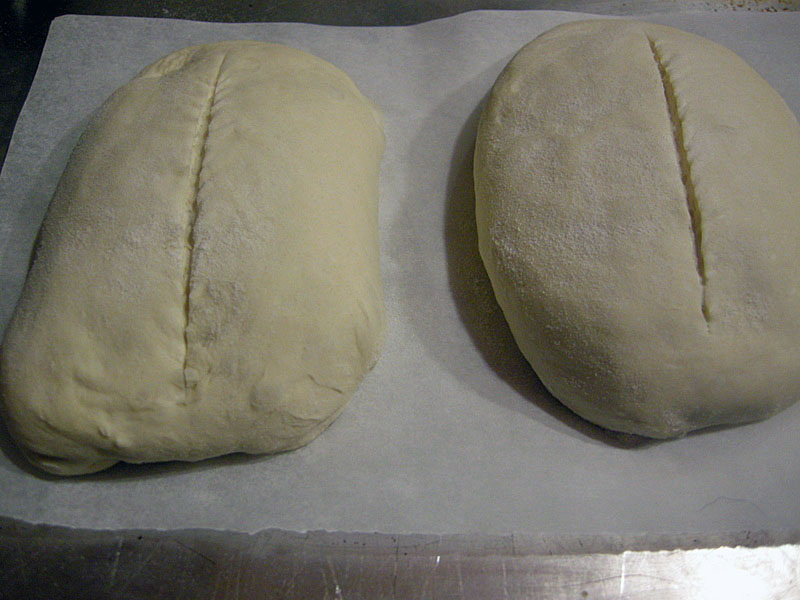
Gently divide the dough into two pieces, trying not to deflate it too much, and place them over lightly floured kitchen towels. Cover,  and let them stay for 20 to 25 minutes at room temperature, for a final quick proofing.  No need to shape the loaves in any particular way.

Invert the dough over parchment paper, so that the floured side is now up.  Slash the bread quickly with a single stroke of a razor blade or sharp knife.

Bake the loaves in a 460F oven, with steam (add ice cubes to a baking pan placed at the bottom of the oven, or use any method of your choice to add steam in the initial baking time).  The bread will be ready in about 35 minutes.   Let them cool completely on a rack before slicing.

ENJOY!

to print the recipe, click here

Comments:  My expectations were not too high for this bread when I first made it:  no wild yeast, no involved kneading and shaping.  When the loaves were ready to go into the oven, they seemed too flat, with a tendency to spread.   However,  they had  nice oven bounce, and the simple slash perfectly coached them into the final shape.   Each loaf was light as a feather, with a nice crumb and subtle sour flavor, thanks to the poolish.

Even though this recipe comes from Hamelmn’s book,  I did not make it as part of the Mellow Baker’s Challenge.  I had to take  a step back and turn into an avid observer of the group instead of a participant.  But make sure you jump over there to see what they are baking,  some great breads for the month of August, including baguettes…  😉

I am submitting this post to Susan’s Yestspotting

ONE YEAR AGO: A Souffle to Remember…  Julia Child

Add to FacebookAdd to DiggAdd to Del.icio.usAdd to StumbleuponAdd to RedditAdd to BlinklistAdd to TwitterAdd to TechnoratiAdd to Yahoo BuzzAdd to Newsvine

SUMMER’S TOMATOES…

…. always bring basil to mind. The classic threesome includes mozzarella, in a tasty caprese salad, but recently Fine Cooking offered a different twist: hearty beefsteak tomatoes topped with grilled corn and dressed with delicate basil oil, all of which was prepared in minutes. When it’s too hot to cook inside this meal is a breath of fresh air: everything’s grilled outside, the house stays cool, and so do you. 😉

GRILLED CORN AND TOMATO SALAD WITH BASIL OIL
(Fine Cooking Grilling issue, 2010)

for basil oil

1 cup basil leaves
1/2 cup olive oil
1/2 tsp salt

for the salad:
2 ears of corn, husks removed
2 Tbs olive oil
salt and pepper
2 large beefsteak tomatoes

Make the basil oil: bring a pot of water to boil, add the basil leaves and blanch them for 10 seconds. Immediately drain them and plunge them in a bowl with ice water to stop cooking. Drain the leaves again, squeeze them to remove excess water, and place over paper towels to dry. Chop the basil coarsely and add into a blender. Add the oil and salt, blend to form a puree. Let the puree settle for about 30 minutes, strain through cheesecloth or a chinois, pressing the leaves to release all the oil. Keep in the refrigerator until ready to use.

Prepare the corn: break the corn cobs in half, toss them with the olive oil, season with salt and pepper and cook them over a hot grill until browned in spots (about 2 minutes on each side, six minutes total). When cooked, return them to the bowl and allow them to cool. When you can handle them, cut off the kernels (lengthwise) with a large knife, and then set the cut corn aside until you’re ready to assemble the salad.

Make the salad: Slice the tomatoes 1/2 inch thick and season with salt and pepper. Arrange the slices on a plate, scatter the corn kernels over them and drizzle with basil oil.

ENJOY!

to print the recipe, click here

Comments: Until recently I’d never grilled an ear of corn. We’d always bring the corn to a boil in water with a little sugar and salt. That’s the way my husband’s family has always prepared corn, and trust me, it’s an excellent approach. I don’t even butter mine because it’s so flavorful; just a dash of salt and pepper is enough. But, for reasons that will soon become clear I’ve been grilling more often, sometimes even making a full meal in the grill.

I was satisfied by how well the beefsteak tomato worked in this recipe. We normally don’t buy them, but prefer smaller tomatoes (Campari, cherry, or grape). However, in this recipe the beefsteaks shine! If you find them in your farmer’s market, then don’t think twice and make this salad.

The basil oil is a bit of trouble to prepare, but worth the half an hour. Blanching the leaves produces a bright and beautiful green oil. Store any leftover basil oil in the fridge for about 1 week.

Note to self: Grill more corn! 😉

ONE YEAR AGO:  Focaccia

Add to FacebookAdd to DiggAdd to Del.icio.usAdd to StumbleuponAdd to RedditAdd to BlinklistAdd to TwitterAdd to TechnoratiAdd to Yahoo BuzzAdd to Newsvine

THE RHUBARB BROUHAHA: REVELATION COMPOTE

May 2009.   While browsing  at Tea and Cookies I became smitten with a recipe.  Her description of its texture and flavor, plus the fact that she called it a “revelation,” made me crave for it, even though I’d never had it before.  I even left a comment on the site with a commitment to make that dish the following weekend.   Why did it take over a year to finally do so?    I simply couldn’t find any fresh rhubarb!   I’ve been on a quest for it ever since.

A few weeks ago I stopped by a Homeland supermarket that I don’t normally shop, and while walking through the produce section I saw, in all its glory,  fresh rhubarb!    I heard myself saying aloud: “OOOOOH!  RHUBARB”! A lady standing nearby gave me a strange look and moved away, taking her child by the hand, in that protective mode that Moms often display in the face of a loony. Too excited to care, I grabbed a full bunch and left the store with THE biggest smile ever.  My husband finds it unpalatable, but I’m not so predisposed!

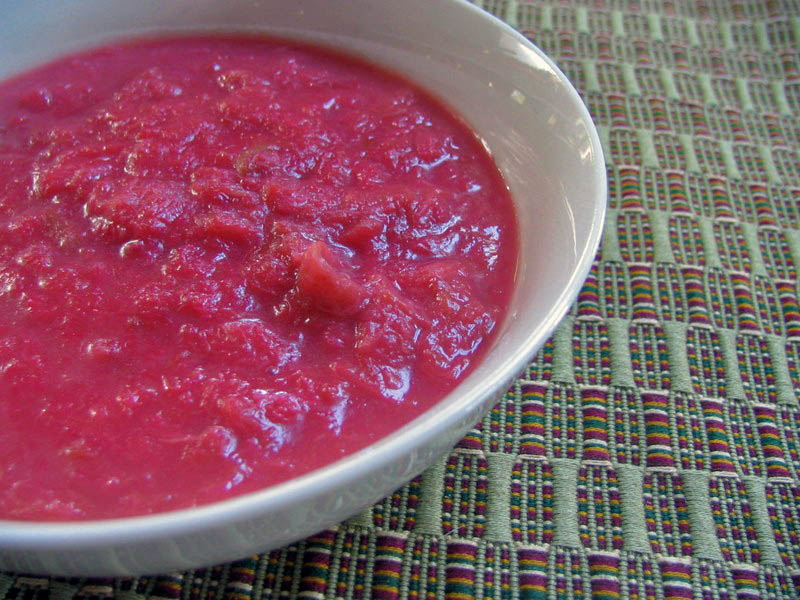
REVELATION RHUBARB COMPOTE
(from Tea and Cookies)
2 Tbs butter
1 lb rhubarb
3/4 cup sugar
2 TBS orange liquor (optional)

Trim the rhubarb of the ends, and split it lengthwise. Cut across in 1/4 inch pieces, forming  small cubes.

In a large bowl, toss the rhubarb with the sugar and set aside.

Melt the butter in a medium saucepan, add the sugar-coated rhubarb and the orange liquor, if using. Let this cook over a medium heat, undisturbed, for about 2 minutes. When the rhubarb has started to release juices, gently stir.

Continue cooking the compote over medium heat, stirring occasionally, until the juices are all released, then begin to thicken. Cooking time is about 10 to 15 minutes total, until the compote looks thick and the rhubarb is tender.

ENJOY!

to print the recipe, click here


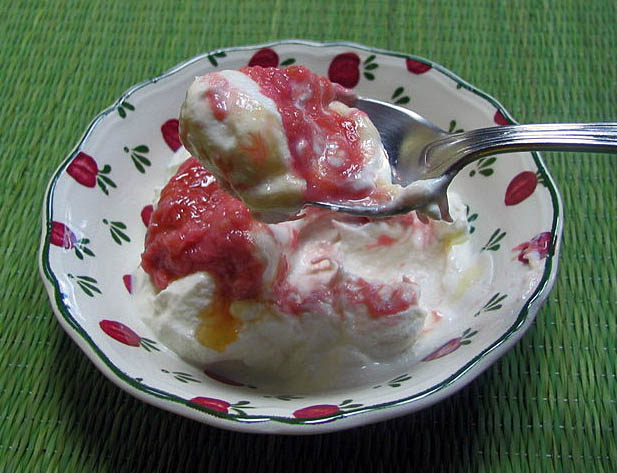
Comments: I could ‘t help but think of  “Happy in the Kitchen”  by Michel  Richard.  No, the book doesn’t have a recipe for rhubarb, but Happy in the Kitchen described me to a “T” while making this compote.  Maybe it was the long wait to finally get my hands on the plant, or maybe the anticipation of how it would taste.  It is indeed delicious!   My beloved stayed true to principles and didn’t care for it.    But I loved it:   by itself, with yogurt, with a swirl of honey, or… best of all,  over my homemade fromage blanc with a bit of agave nectar.  Each bite was unique in its own combination of flavors, and a perfect way to either start or end a day.

ONE YEAR AGO: Grilled Pork Tenderloin with Peanut Sauce

Add to FacebookAdd to DiggAdd to Del.icio.usAdd to StumbleuponAdd to RedditAdd to BlinklistAdd to TwitterAdd to TechnoratiAdd to Yahoo BuzzAdd to Newsvine