BBA#36: STOLLEN

The Bread Baker’s Apprentice Challenge, the adventure of baking every single recipe from Peter Reinhart’s book, brings us to Stollen, a festive European-style fruit-and-nut bread.   Once more, I cannot say I was thrilled about making it –  as far as fruit-breads go,  I like panettone, but have never tasted stollen – the sugar coating seemed excessive to me.   But, as happened in the not-too-distant past,  I was pleasantly surprised by a nice bread that, without the challenge, I would never attempt to make…

The previous three or four breads were all a bit involved, in the sense that they required a sourdough starter, sometimes a soaker in addition to it.  Stollen is much simpler – you can mix and bake the dough in the same day.   The recipe calls for a sponge made just one hour before the complete dough.

The dough doesn’t rise a lot, but it smells wonderful from the very beginning, thanks to the cinnamon, brandy, orange and lemon peel it contains.  Mr. Reinhart offers two different shaping methods, a regular loaf, and a crescent-shaped bread,  with a special fold all along it.
I chose the latter.

A few photos of the preparation…

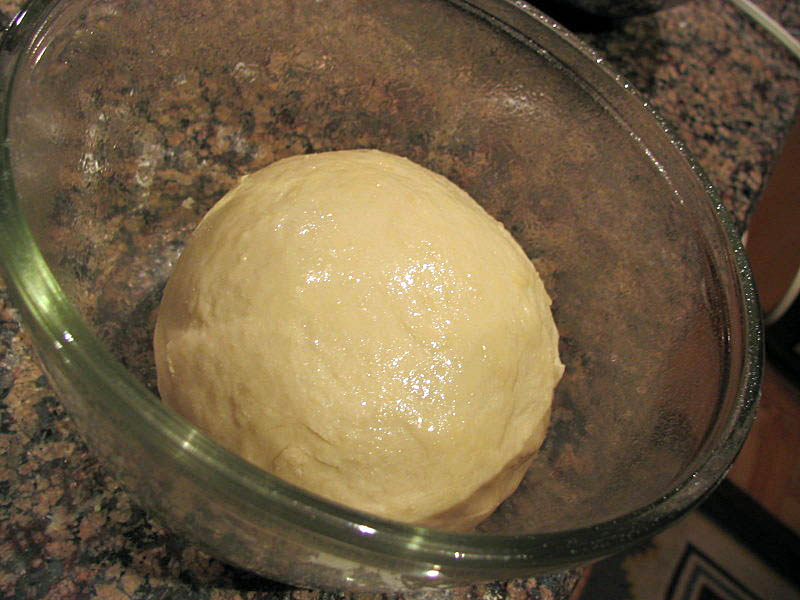
The sponge, almost ready to be mixed with the rest of the ingredients…

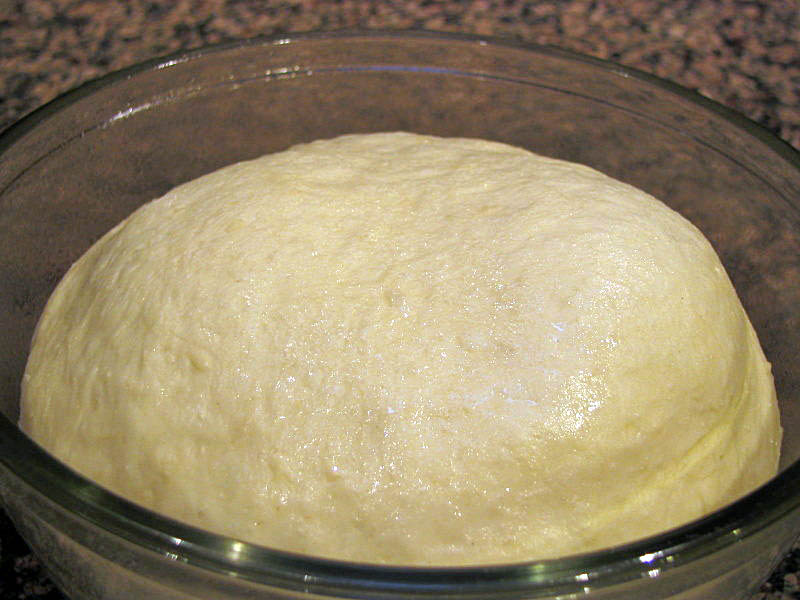
The dough, after 45 minutes rising…

The initial shaping…

The stollen, shaped and ready to go into the oven….

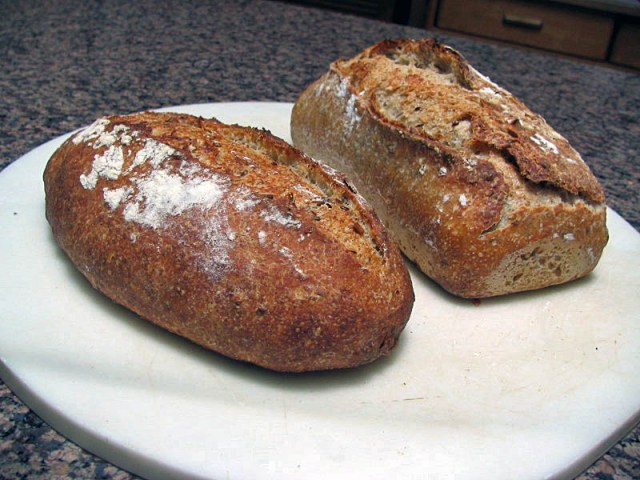
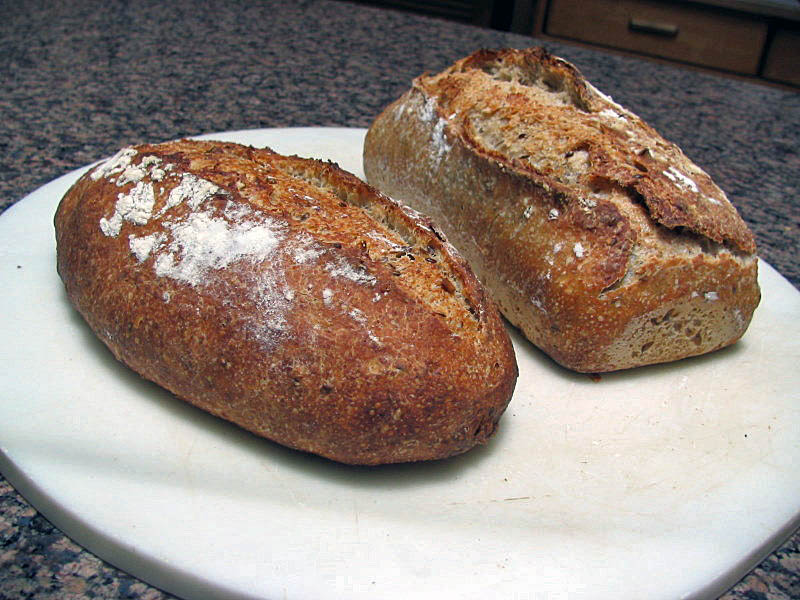
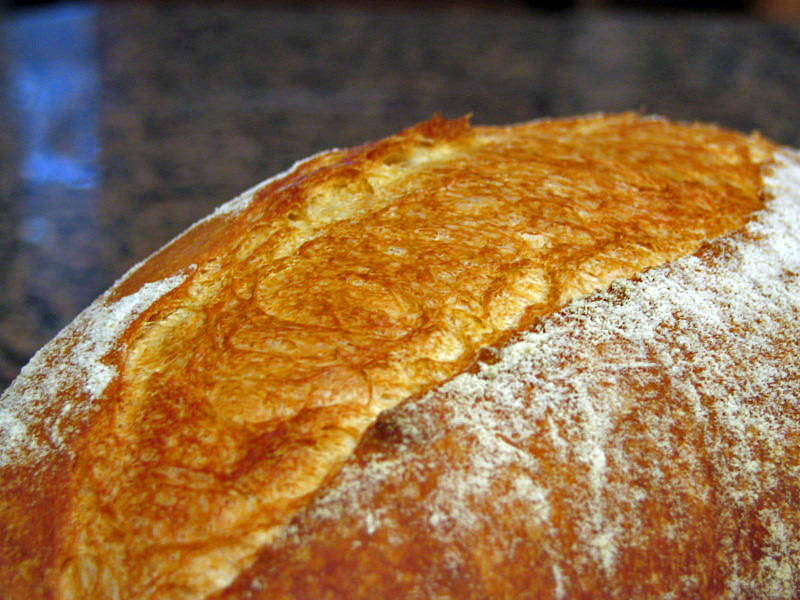
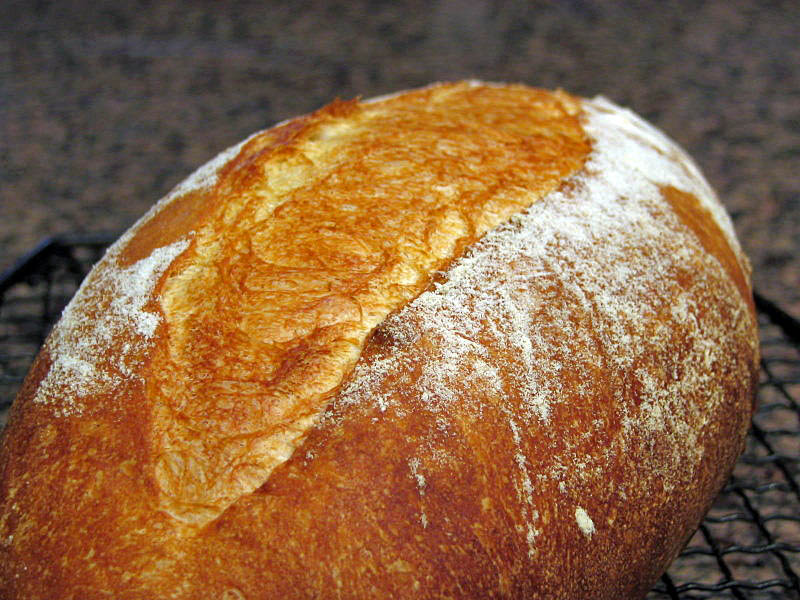
After baking, the loaf is brushed with a little vegetable oil, then dusted with a generous amount of powdered sugar.  After 1 minute, one more layer of powdered sugar is added on top….

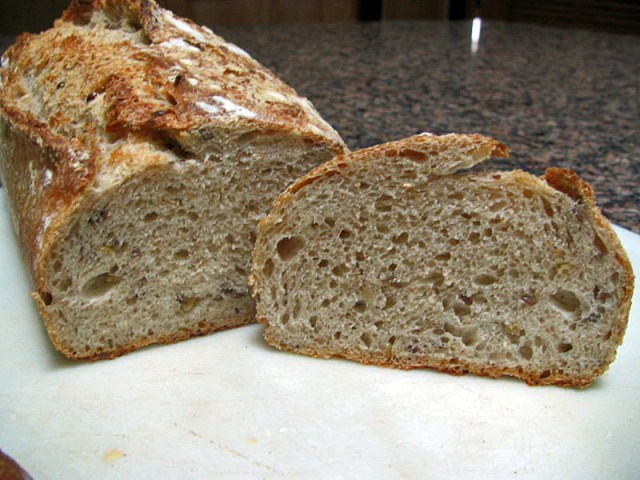
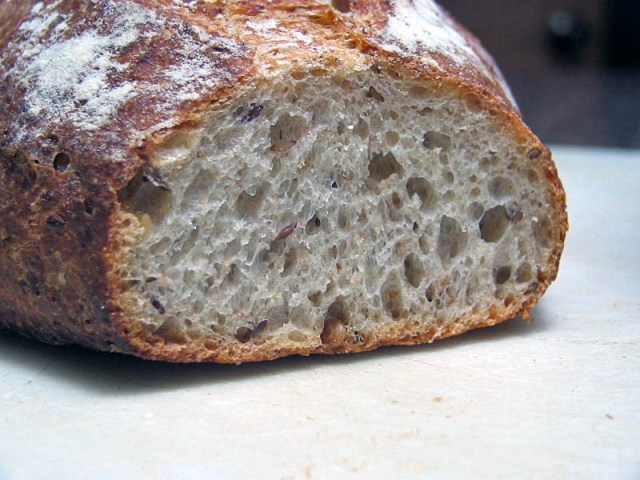
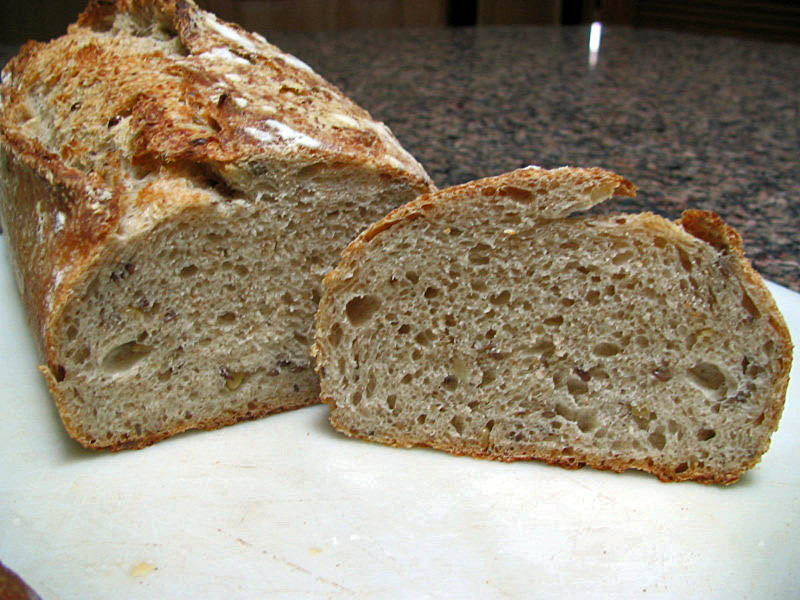
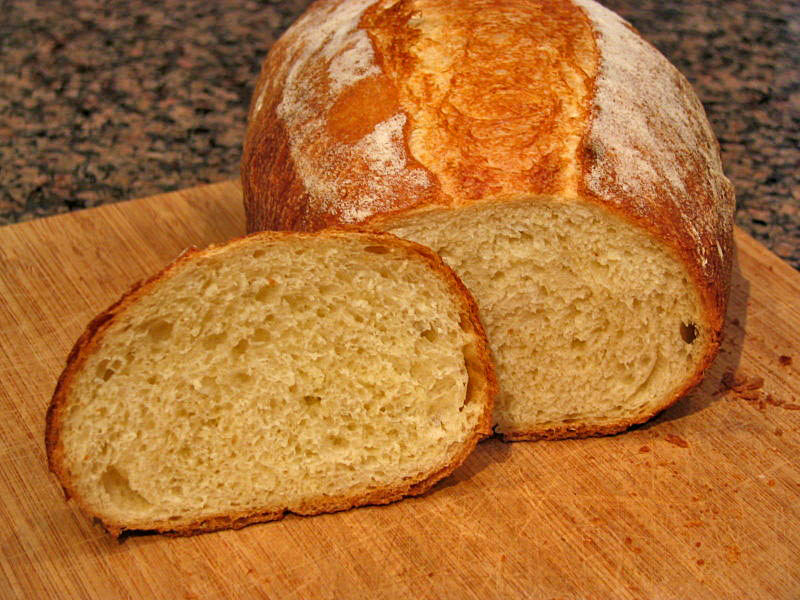
One long hour waiting….. until we finally sliced the bread….

For those familiar with panettone, I should say that stollen is quite different.  The texture is a little softer,  the cinnamon taste very obvious and pleasant.   The powdered sugar, that at first seemed a bit too much, is a perfect match to the bread.    Do not skip it…

Thrty six breads down…. seven more to go…

Next on the BBA Challenge:  Swedish Limpa.  Stay tuned!   😉

BBA#35: SUNFLOWER SEED RYE

HAPPY NEW YEAR!

On the first day of the year… I’d like to say that bread baking is a great way to welcome 2010!   I  debated whether to make a simple sourdough, or to mark another notch in my BBA Challenge-belt.   Once I realized that the BBA bread was a sunflower seed rye, I immediately went to work on it.   From its whole flours and sunflower seeds, the bread casts a healthy aura that’s perfect for this time of the year,  in which we all feel the impact of holiday excesses.

Welcome 2010 with Peter Reinhart’s couronne of
sunflower seed rye…

The recipe calls for a soaker and a firm sourdough starter.  Once again, I couldn’t find pumpernickel flour, and settled for a regular dark rye instead.  I still prepared the soaker exactly as described – mixing rye flour with water and allowing it to sit overnight.

The dough rose slowly and less than I expected, but it was fun to shape the ring.   First, form a ball, then poke a hole in the center, stretch it out, and finally make a deep indentation to define quadrants.  I added some flour to try to prevent the square from closing during the rising, but it didn’t end with dramatic look of the picture in the book.

The bread didn’t have the oven-bounce of a typical, white flour sourdough,  but it felt light as I grabbed it from the oven.  The taste was wonderful, hearty, and the toasted sunflower seeds made it just like Reinhart described:  a “loyal” bread, that stays with you long after you enjoy it.

Another winning recipe, and with it completed, only EIGHT breads remain to finish the Bread Baker’s Apprentice Challenge!

I am submitting this post to Susan’s Yeastspotting, my favorite weekly net-event…

Enjoy rye breads? Go to Foodista for more…
Rye Bread on Foodista

On a side note,  my New Year’s Resolution in 2008 was to regularly bake bread.   It’s been two years of ups and downs, many failures but so much fun!  If you’re a believer in New Year’s resolutions, have you considered baking bread?    😉

BBA#34: PUMPERNICKEL BREAD

Post #100 at Bewitching Kitchen!   Pop the Champagne and toast to food!

It’s hard to believe that only NINE breads remain in the BBA Challenge…   If you haven’t been following it, Nicole launched the event months ago with the idea of baking her way through the Bread Baker’s Apprentice, by Peter Reinhart, and invited other crazy bakers to join in.  We bake’em and blog’em, but if you want the recipes, then you’ll have to get the book.

I wasn’t too wild about making a pumpernickel bread, but I prepared my rye starter and mixed the dough. I couldn’t find pumpernickel flour, which is a particularly coarse grind of rye, so I had to use regular rye flour in its place. Sorry, Mr. Reinhart! 😉

I am glad to report that this bread was a winner, even without the correct flour!

I halved the recipe, mainly because I didn’t expect us to love it, but, in retrospect, that was a mistake: two of these loaves would be more than welcome in our home!

I had no problems whatsoever with this recipe.   I skipped pictures of the dough rising, because it didn’t seem to rise much, but this photo shows the slashed loaf, just before the oven.


The bread did have some oven bounce, which always makes the baker happy!   The crumb was tight and  lighter than that of the bread in the book .  I used instant coffee in the dough, maybe cocoa powder would make it darker.  It was tender, moist,  and had perfect balance of sweetness and sourness.  A piece of sharp, aged Cheddar cheese was declared the winning match for this bread …

Note to self:  next time, make the full recipe!  😉

BBA#33: PAIN POILANE

The BBA Challenge arrives at the “King of Breads”,  Pain Poilane, the most traditional bread in Paris!

Of course, pain Poilane brings us great memories! Every couple of weeks, we slightly changed our normal walking route from home to work, in order  to stop at the Poilane Boulangerie on Rue Grenelle in the 15th  arrondisement, and grab one of those huge “boules”, that we enjoyed to the last crumb on the succeeding days.

Lionel Poilane himself  trained each of the bakers that worked in his boulangerie, a process that started by making sure they could not only properly light their wood ovens, but also know when the oven temperature was correct for baking without a thermometer,  by using just their bare hands to “feel” the heat inside.    Each baker was responsible for the entire process of making each loaf, beginning to end.    This kind of passion and commitment fascinates me.

To mimic the great Poilane bread, Peter Reinhart uses 100% whole wheat flour, and a sourdough starter fed with whole wheat flour before being incorporated in the dough.  It makes a huge loaf, but I divided it in two and baked them on consecutive days, retarding one of the “boules” in the fridge overnight.  Kneading this dough is not for sissies.  It’s impossible to knead the full recipe in a KitchenAid mixer, no matter how powerful.  He recommends kneading by hand – which I’ve done in the past, but had to reconsider this time – my wrists simply could not take handling such  a large amount of dough.

So, I improvised – divided the dough in 4 small portions and… used the food processor to knead it.  Twenty to thirty seconds per portion did the trick, the dough ended up very smooth and elastic, with clear gluten development.

Here are some photos of the process, which, fortunately, went quite smoothly….

The whole wheat starter….

The dough, ready to rise for 4 hours….

The final shaping and slashing…. right before going into the oven…

And the result: a dough with impressive oven spring (I wasn’t expecting that, because I was a little too enthusiastic with my blade and probably slashed it too deeply), tight crumb, complex flavor  (you’ll have to take my word on that one…)…

Don’t you love a happy ending? 😉

as to the second bread:   it did not have as much oven spring, even though I kept it at room temperature for a full 4 hours before baking.   But the flavor was better than the first loaf.

I am submitting this post to Susan’s Yeastspotting….

If you want to see the “real” Poilane…. jump to next page….

Continue reading

BBA#32: 100% SOURDOUGH RYE

The BBA Challenge has had its ups and downs.  Unfortunately with this bread I hit the lowest point in the whole challenge.  I had problems from the very beginning, my dough refused to get smooth, it felt like a mixture of sand and water, “breaking” as I tried to knead it.     I moved on, shaped the bread, allowed it to rise – which, it did not, I barely detect any changes – and baked it.

It was dense, and too chewy for my taste.   I definitely need more practice with this kind of a dough.  Rye won big time,  I got a lesson in humility….

Next day I cut the bread into thin slices and turned them into rye crisps, which were ok, but not great.

I look forward to the reports of my fellow bakers following the BBA Challenge, maybe they can give me some tips to deal with such a tricky dough.