SAYING GOODBYE

Years ago I found a photo on the internet, and saved it to my computer.  It captured the photographer’s wife moments before taking their aging, sick dog to be put to sleep.    I remember staring at the image with tears in my eyes, because it was so touching. Today, a couple of years down the line, I can finally give credit to this unique photo. Amazing how the internet works, I did not find the author of the photo at the time I posted, but he found me. A cycle is completed.


(PHOTO CREDIT: COPYRIGHT JUAN DE SANTA ANNA – see all his work at http://www.bigguys.zenfolio.com)

Today our beloved dalmatian is running free  in some far away virtual place, chasing squirrels, wagging his tail, hopefully unaware of the deep sadness he left behind.

THE UNBEARABLE LIGHTNESS OF BAKING

My husband and I agree on most important subjects, from personal finances to laboratory experiments.  However, we  can’t decide who is the most stubborn.  Obviously, it is not me, but this week, I confess to a certain amount of stubborn determination…  

…I baked a cake.

FONDANT AU CHOCOLAT
(from a food blog)

175 g  bittersweet chocolate
240 g  butter
400 g sugar
8 eggs
130 g all purpose flour

Butter a 10-inch round cake pan.

Melt the chocolate with the butter and reserve.

Place a pan with a small amount of water inside over the stove burner, and bring the water almost to a boil.  Place a large bowl over the simmering water, and add to it the sugar and the eggs (still cold from the fridge).   Beat them together with a whisk or an electric beater, just until the mixture is at room temperature.

Pour the chocolate mixture into the egg/sugar, whisk to incorporate.   Sift the flour over it in three additions, and mix with a spatula until smooth, but do not over-mix.

Pour the batter into the baking pan and bake in a 350F oven until barely set in the center.

ENJOY!

to print the recipe, click here

Comments: This was the most straightforward recipe!  No creaming butter and sugar, no cooking syrup to the  “hair-of-an-angel” state, held at exactly 237.8 F while pouring over the spinning blades of a  mixer. Still, I created another Armageddon in my kitchen.

The recipe instructed to bake the cake for 30 minutes until barely set.  I baked for 35 minutes and it seemed set. Unfortunately, I didn’t stick a tester in the center because I didn’t want to ruin the surface.   Unfortunately, I trusted my  “instincts” and removed it from the oven. You’ll notice that I omitted the baking time in the recipe: please use a toothpick to make sure the fondant is cooked.

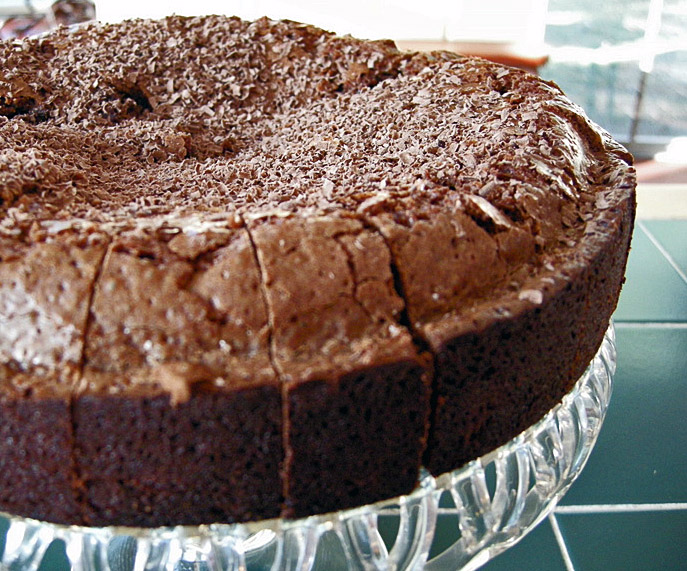
The recipe didn’t specify when or how to unmold it.  I am aware that some cakes should  cool in the pan,  others should come out right away.  I compromised  and waited 10 minutes.  It unmolded easily, but while flipping it over, the cake broke in two unequal pieces. One fell on the cake stand, the other on the countertop. Between them flowed a voluminous  lava of chocolate batter, too much to qualify my production as a “molten chocolate cake“.   Instead it became a “Cocoa Tsunami”, that took no prisoners.

I admit to shedding a few tears.  The saint I married assembled the pieces on a baking sheet,  placed them back in the oven at a mellow 325 F for 30 minutes, and I regained my composure.  Once both the cake and I had cooled off,  I shaved chocolate all over to cover the abuse.

Fate has repeatedly told me to stay away from cake baking.   I’m  just too stubborn, perhaps I must now admit, more than the man I married.   But, no need to tell him that…   😉

Notes to self:
1. Never use your bare hands to stop a flow of hot cake batter.
2. Chocolate fondant cake is so awesome that it’s worth the struggle.

ONE YEAR AGO: Pain de Campagne

Add to FacebookAdd to DiggAdd to Del.icio.usAdd to StumbleuponAdd to RedditAdd to BlinklistAdd to TwitterAdd to TechnoratiAdd to Yahoo BuzzAdd to Newsvine

receita em portugues na proxima pagina

TAKING A BREAK FROM THE NANO-KITCHEN

We flew back home this week to spend a few days in our own town.  I’m in a state of shock, all of a sudden realizing how much space we have. Here we could cook together while dancing, whereas in L.A. we are in a territorial-mode: I even growled at my beloved the other day because he insisted on opening the fridge while I did the dishes. The nerve!

I looked forward to cooking in our home, on a stove with four burners and real flames above an oven that can roast a couple of chubby turkeys side by side. Of course, deciding what to cook for our first dinner was excruciating. After an extensive consultation  with 9 cookbooks, I chose a recipe from Barbara Tropp: Chinese cooking at its best…
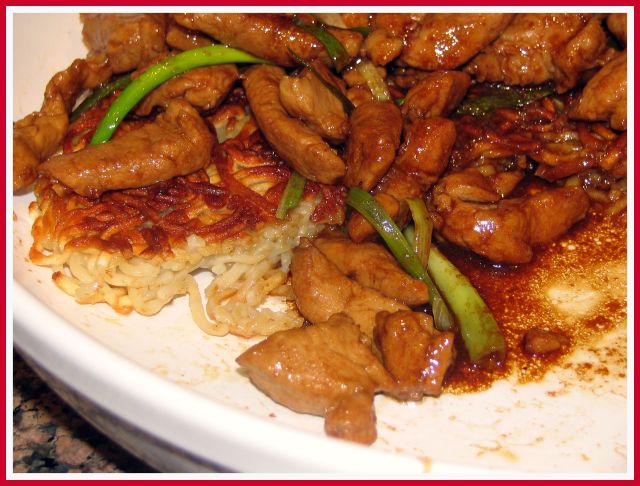
CAPITAL SAUCE PORK RIBBONS OVER POT-BROWNED NOODLES
(adapted from Barbara Tropp Modern Art of Chinese Cooking)

1 pound boneless pork loin

to marinate the meat:
2 T soy sauce
2 T Chinese rice wine
1 T water
4 t cornstarch
½ tsp sugar
1/4 tsp sesame oil
6 scallions

Sauce ingredients
3 T hoisin sauce
2 T Chinese rice wine
1.5 T soy sauce
5 t sugar
½ t sesame oil

2 T peanut oil

For the noodles:
½ pound long Chinese thin egg noodles
1 tsp sesame oil
1 tsp salt
6 T peanut oil

Cut the pork into thin slices 1/8 inch thick (against the grain). Cut each slice into ribbons, flattening them slightly with a meat mallet.

In a large bowl, mix the soy sauce, rice wine, water, cornstarch, sugar and sesame oil until thoroughly blended, then add the pork slices and allow to marinade for 1-3 hours at room temperature or overnight in the fridge. Drain well before stir-frying.

Cut the scallions into 2-inch pieces, trimming off the root ends. In a small bowl, mix the hoisin sauce, rice wine, soy, sugar, and sesame oil , stir well to dissolve everything.

Add 2 T of peanut oil to a very hot wok, swirl to coat the pan, add the pork slices and stir fry until opaque. Add the sauce ingredients and continue cooking until the pork is cooked through, then add the scallions and reserve until the noodles are ready.

Preparing the noodles:
Boil the noodles until cooked, but not mushy. Drain, then run through cold water until fully cooled. Shake off excess water and lay the cooked noodles over a dish cloth, blotting it out of excessive moisture. Transfer to a bowl, adding the sesame oil to coat the strands (the noodles can be kept cold at this stage for up to 2 days).

Heat a 12 inch skillet over high heat, add 5 T oil, and heat until a strand of noodle sizzles if gently dropped on the pan. Coil the noodles evenly on the hot pan, starting at the edges, and working your way through the center. Press them with a spatula, cover the pan, then cook until the bottom is browned (5-7 minutes).

Loosen the browned noodles, slip them out of the pan, transfer to a serving platter. Mound the pork on top of the noodles, and serve immediately.

ENJOY!

to print the recipe, click here

Comments: Barbara’s original recipe calls for deep frying the pork before the final stir-fry. I have done this “oil velveting” in the past, but this time I simplified it and cooked the pork all the way through in the wok. The main reason: we are home for just a few days, I didn’t want to deal with the leftover oil.   Is there a loss of quality in the final dish? In all honesty, yes. Velveting does wonders to improve the texture of stir-fries (as I mentioned before here), so if you can do it, follow her advice and deep fry the pork for a minute, remove it from the oil, drain it well, and add it to the wok AFTER you add the sauce and heat it up.

This is not a light recipe – obviously, any time you brown noodles on a frying pan, their calories will be multiplied by a factor of 2. However, sometimes it is good to indulge, so enjoy it without guilt, and cut back on excesses for a couple of days. 😉

Note to self:  try the “water-velveting method” in this recipe.

ONE YEAR AGO: Chocolate Chip Cookies

Add to FacebookAdd to DiggAdd to Del.icio.usAdd to StumbleuponAdd to RedditAdd to BlinklistAdd to TwitterAdd to TechnoratiAdd to Yahoo BuzzAdd to Newsvine

FIRE-ROASTED TOMATO RISOTTO

I’ve never met a risotto I didn’t like!  It’s one of the most versatile dishes around. You can get fancy  (lobster and saffron come to mind), or keep it simple, but it’s always satisfying.   This tomato risotto falls into the latter category, in that I didn’t roast the tomatoes myself.  Instead I used a Muir’s product that I’m quite fond of.  Their roasted tomatoes have just the right amount of heat and smoke, and these days I shamelessly admit gastronomic shortcuts without guilt, as long as they involve quality ingredients.   This risotto will also succeed with  homemade oven-dried tomatoes, or a lovingly prepared tomato confit.  But, for the time being try this version, which will warm up your senses, every single one of them! 😉

FIRE-ROASTED TOMATO RISOTTO
(inspired by Donna Hay)

1 shallot, finely minced
1 Tbs olive oil
1 cup Arborio rice (or other short grain rice appropriate for risotto)
3-4 cups of vegetable stock
1 can (14.5 oz) of Muir fire-roasted tomatoes, some of the liquid included
(I used  diced tomatoes with green chilies)
thyme
salt and pepper
1-2 Tbs butter to finish the dish

Heat the vegetable stock in a sauce pan, add all the tomatoes and some of the water, season lightly with salt and pepper, and reserve, keeping it warm.

Saute the minced shallots in olive oil until soft. Add the rice and saute for at least 2 minutes, stirring often, making sure each grain is well coated with oil.

Start adding the hot vegetable stock/tomato mixture, slowly, 1/2 cup at a time, allowing it to be almost fully incorporated before adding more liquid. Keep stirring gently. Add some fresh thyme towards the end of the cooking time. Keep the heat low, and pay attention to the changes in the rice grains:  they’ll become more plump and translucent as they cook. When the rice is ready (not mushy), add a little more stock.  Finish it by swirling some butter and stirring to form a nice emulsion with the sauce. Serve immediately.

ENJOY!

to print the recipe, click here

Comments: Donna Hay used tomato puree, white wine, and served her risotto with mussels.  We didn’t have any white wine on hand, so I just used stock and tomatoes. Whenever you make risotto, be sure to warm enough liquid for the cooking – better to have some leftover than to run out of it midway through the preparation. The amount in the recipe is more than enough, even considering variations in the type (and age) of the rice.

We enjoyed it with seared sea scallops, seasoned with salt, pepper, and a dust of ground coriander, then seared quickly on a hot non-stick skillet with a smear of olive oil. It was a good match for the fiery rice, leading my husband  to close the dinner with one of my favorite phrases: “you are going to make this again, right”? No worries there.  In fact, I think I’ll have an “encore”  next week! 😉

ONE YEAR AGO: A special dinner for two

Add to FacebookAdd to DiggAdd to Del.icio.usAdd to StumbleuponAdd to RedditAdd to BlinklistAdd to TwitterAdd to TechnoratiAdd to Yahoo BuzzAdd to Newsvine

receita em portugues na proxima pagina

ROASTED POTATO and OLIVE FOCACCIA

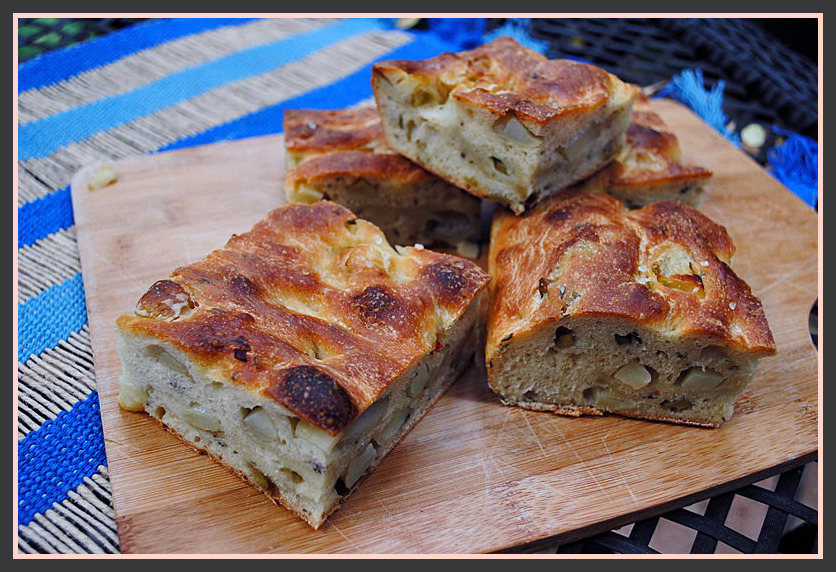
I am all for avoiding excesses, but every once in a while I will throw caution to the wind and indulge. A bread studded with chunks of roasted potatoes will not make you feel light as a feather, no matter how carefully you go through the “portion control” route. We are talking a fair amount of calories here, but those are very tasty calories, therefore, worth consuming. Just don’t bake it every week! 😉

This is another recipe designed by Dan Lepard, published on The Guardian website – you can shape it as a loaf, but I opted for a thick and rustic focaccia.  My electric oven handles flat breads a lot better than loaves, and it’s been a while since I made a focaccia anyway. The clock was ticking….

ROASTED POTATO AND OLIVE BREAD
(Dan Lepard)

450 g yellow, thin-skinned potatoes
a little olive oil to coat potatoes
375 g (ml) water
1 tsp instant dry yeast
100 g yogurt
50 g honey
175 g pitted green olives, coarsely chopped
1 small bunch dill, chopped (I substituted thyme)
2 tsp sea salt
625 g Italian 00 flour (I substituted bread flour)
Olive oil and salt flakes

The potatoes are briefly roasted and incorporated with all other ingredients to make a very sticky dough. Using Dan’s minimal kneading method, the dough rises for several hours, until patted in a baking dish as a focaccia or shaped as a loaf.

For a full, detailed recipe, please follow this link to Dan’s site.

ENJOY!

This slideshow requires JavaScript.

Comments: Part of the charm of this bread is the inclusion of potatoes and olives in large chunks, don’t cut them in small pieces. Next time I intend to roast the potatoes just a little bit longer, to make the flavor more prominent in the bread. Some pieces of potato will tend to fall off as you knead, don’t worry, just stick them back into the dough,  which, with each kneading cycle will be smoother and smoother.

I am sending this hearty focaccia to Susan’s  Yeastspotting event….

ONE YEAR AGO: SALMON CURRY (one of my favorite recipes ever!)

Add to FacebookAdd to DiggAdd to Del.icio.usAdd to StumbleuponAdd to RedditAdd to BlinklistAdd to TwitterAdd to TechnoratiAdd to Yahoo BuzzAdd to Newsvine