A DIFFERENT KIND OF COOKIE SWAP

I like to keep the blog varied. Never two bread posts in a row. Never two savory recipes in a row. But never say never, as I am about to break my own rules. My latest post involved cookies, and here you have another one. But, but, but…. I got so excited about this, I cannot wait to share. A cookie swap that is not quite what you think: you swap portions of a stamped cookie dough, forming a totally new pattern. I keep thinking about all the possibilities of mixing and matching. Shapes, designs, colors, cookie formulas (think chocolate and vanilla for a shocking color contrast).
MIX-AND-MATCH LEMON SUGAR COOKIES
(inspired by several sources)

113g unsalted butter (1/2 cup)
30g egg (whisk one egg and measure the amount)
1/4 cup honey (about 60 mL)
zest of 1/2 lemon
1 teaspoon lemon extract
50g granulated sugar
1/8 teaspoon salt
320g all-purpose flour

to decorate (optional):
vodka or everclear or lemon extract
dust luster powder in gold, pearl white, or any desired color

Melt the butter and set aside to cool slightly, but do not let it get solid.

Beat the 30g egg in the bowl of a Kitchen Aid mixer bowl until the yolk and white are fully mixed.  Add the honey, and lemon flavoring. You can do this step by hand using a whisk.

In another bowl, mix the sugar with the lemon zest and rub the zest with your fingers to release all the oils. Add the salt, then incorporate the mixture into the egg using the flat beater of the Kitchen Aid in medium-speed. Beat well, then slowly add the melted butter, constantly mixing.

Add flour (reserve about 1/2 cup) in very low-speed and mix in until you have a dough that is solid enough to knead. Remove the dough from the Kitchen Aid and add the rest of the flour by hand, you may not need the full amount. Pat the dough into a disc, wrap in plastic and place in the fridge for 30 minutes.

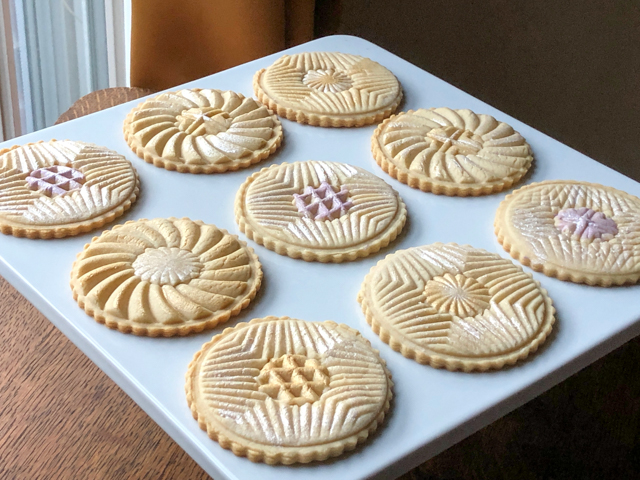
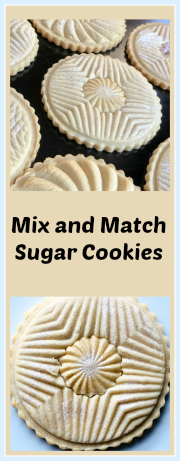
Roll it out to a thickness compatible with your cookie press, then press two or three patterns using any type of design you like. Using a small round cookie cutter remove the centers and swap them, as shown in this picture:
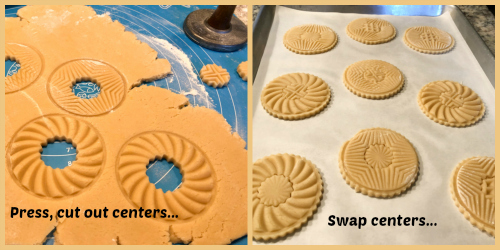
Freeze the cookies on a baking sheet lined with parchment paper for 15 minutes while you heat the oven to 350F. To avoid distortion of the cookies during baking, transfer the frozen cookies to a room temperature sheet, using the parchment paper to move them.

Bake for about 12 minutes, until edges start to get golden, but do not over bake. Let them cool for a few minutes on the baking sheet, than remove to a rack to cool completely.

If desired, use luster dust powder mixed with vodka or lemon extract to paint the surface.

ENJOY!

to print the recipe, click here
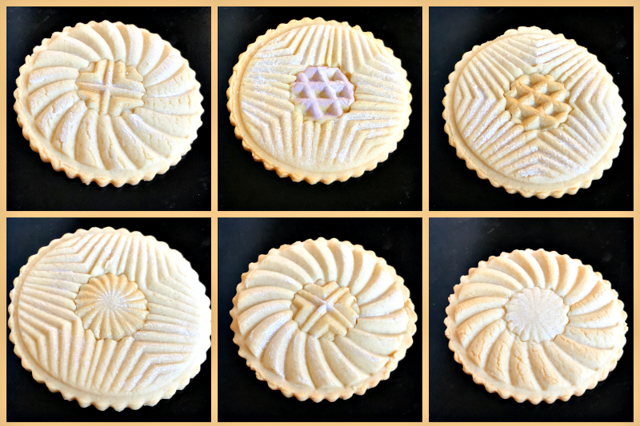
Comments: I am over the moon with these! You don’t have to go through the additional step of painting them, the pattern looks nice even if the cookies are kept plain, but I love working with luster dust. There is no need for precision, each cookie turns out a little different.
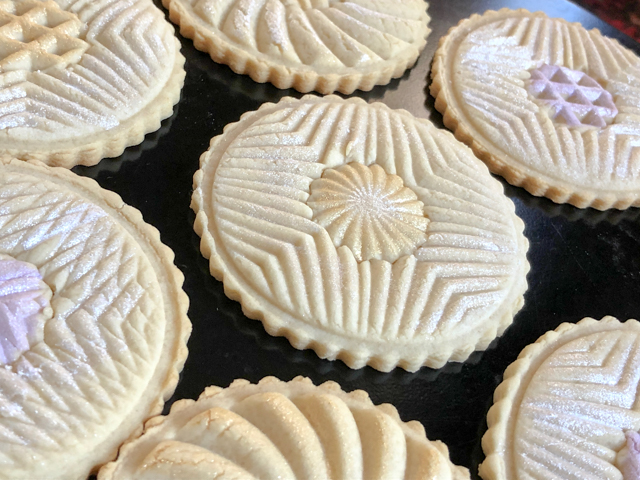
You can use any recipe that keeps the shape during baking, and always freeze the cut cookies before sticking in the oven. Another thing to keep in mind is to transfer the frozen cookies to a room temperature baking sheet, because sometimes baking them over a frozen cookie sheet might cause warping. By transferring to a room temperature surface, you avoid that problem.
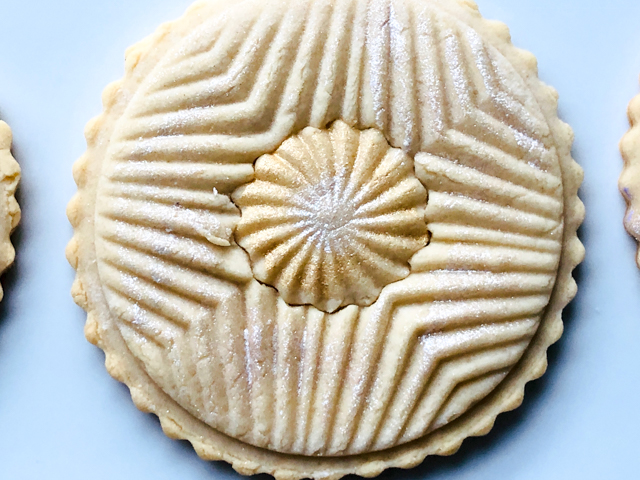
I cannot take full credit for this idea. I am a member of a great cookie group on Facebook (Molded Cookies of the World) and the moderator (Dawn Williams) has been playing with different cookie molds, joining them together. I decided to try it with the cookie stamps from Nordicware. They are sturdy, wonderful to use, and every single swap I did worked perfectly.

I am already planning my next batch… and the one after that…
ONE YEAR AGO: Scary Good Recipes for your next Halloween

TWO YEARS AGO: Pumpkin Sourdough

THREE YEARS AGO: First Monday Favorite

FOUR YEARS AGO: Secret Recipe Club: Paalak Paneer, a Farewell Post

FIVE YEARS AGO: In My Kitchen, November 2015

SIX YEARS AGO: Helen Fletcher’s Oatmeal Cookies

SEVEN YEARS AGO: Thai-Style Pesto with Brown Rice Pasta

EIGHT YEARS AGO: Shrimp with Spicy Orange Sauce

NINE YEARS AGO:  A Simple Appetizer (Baked Ricotta)

TEN YEARS AGO: Sour Cream Sandwich Bread

ELEVEN YEARS AGO: Pasta with Zucchini Strands and Shrimp

VEGAN RASPBERRY MACARONS

Vegan baking fascinates me. It is challenging – to put it mildly – to bake things when you cannot use any dairy or eggs. Macarons are considered tricky to bake, but I tell you, vegan macarons are what nightmares are made of. I’ve had so many failures, it’s not even funny. But then… then this happened, and I am still thrilled!

VEGAN RASPBERRY MACARONS
(adapted from Pies and Tacos)

for shells:
110 grams almond flour
110 grams powdered sugar
75 grams aquafaba
1/4 teaspoon cream of tartar
66 grams granulated sugar
for vegan buttercream:

125g powdered sugar, sifted
3 tbsp freeze dried raspberry powder (about 18g)
56g vegan butter (I used Earth Balance)
1/2 tsp lemon juice
tiny pinch of salt

To decorate:
Royal icing (optional)

Process the almond flour and powdered sugar in a food processor for about 20 seconds total using short pulses. Sift the mixture and reserve.

Place the aquafaba in the bowl of a mixer. Start whipping on low speed and add the cream of tartar. Whip for about 30 seconds, until the aquafaba starts getting white and thick like soup. Raise the speed to medium and continue to whip for another couple of minutes, until you are able to see streaks left by the whisk on the aquafaba.

Raise the speed to high, and start to add the granulated sugar, slowly, a bit at a time. Continue to whip until the aquafaba achieves stiff peaks, which can take 10 minutes or more, depending on your mixer.

Add the sifted dry ingredients to the whipped aquafaba. Start folding with a spatula slowly. Fold the batter forming a letter J with the spatula.

You will fold until the batter is flowing slowly but effortlessly off the spatula. To test it out, you can grab a teaspoon of batter and place it on a baking sheet, watch how it behaves for 1 minute. If the batter smooths out the top, it means you are ready to go. If batter forms a pointy tip, you have more folding to do. But be very careful. You also don’t want to overfold. Just fold a couple more times, and test again.

Transfer the batter to the piping bag. Pipe circles on a baking sheet lined with silicon mat. Slam the trays against the counter to release air bubbles. Let the trays rest for 30-45 minutes until the shells are dry.

Heat the oven to 285ºF. Bake one tray at a time for a total of 20 minutes, or until the macarons tops do not twist independently of the bottom if you try to rotate them. Let the macarons cool down before filling.

Make the filling: Sift the powdered sugar and freeze dried raspberry powder together. Whip the butter on medium for about 1 minute, until creamy. Add the powdered sugar and freeze dried raspberry powder and mix on low until combined. Raise the speed and cream for another minute, add the lemon juice and salt and continue whipping to incorporate it all. Adjust consistency with non-dairy milk or more powdered sugar, if needed.

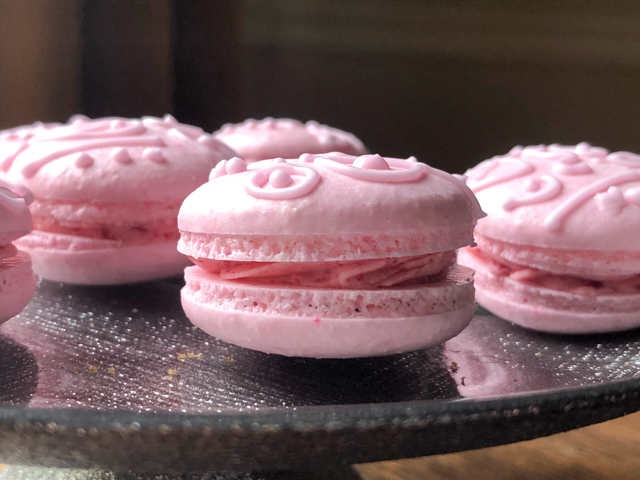
Assemble shells, fill with some buttercream, and decorate with Royal Icing using a very fine icing tip, if so desired. Let the macarons sit in the fridge overnight before enjoying them.

ENJOY!

to print the recipe, click here

Comments: Most vegan macaron recipes rely on aquafaba (the liquid from canned chickpeas), others use potato protein powder instead. I have tried the potato protein but had two epic failures and decided to concentrate on aquafaba. Most recipes will instruct you to reduce the aquafaba by boiling it down, which adds an extra step that this recipe omits. Having made 11 batches of vegan macs with many horrific outcomes, I can tell you that three things really matter:

1. the extent of whipping the aquafaba (contrary to egg whites, you cannot over-whip it, so when you think you’ve done enough, whip some more).

2. stopping the macaronage a little short, never taking it to the smooth level you could with a regular egg-white meringue recipe.

3. Baking at a lower temperature, 285F worked well for me. It is highly advisable that you check the temperature of your oven with a thermometer.

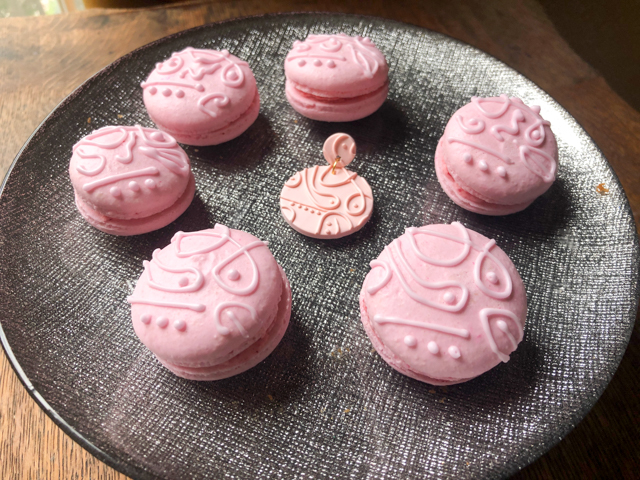
The inspiration for decorating the shells came from another obsession of mine, earrings. I am a shameless collector of clay earrings. They are very light (never hurt your earlobes), very colorful, and the moment I got this pair, I knew I had to turn it into macarons… Nothing like joining two obsessions!

The color is a bit off, it is not easy to judge as it also changes a bit with baking, but I am glad with the overall look. These beautiful earrings were made by an artist in Canada, check her etsy store here. She is a sweetheart!

Now the most important question. How do they taste? I will be totally honest with you, I cannot tell any difference in the shells using egg white meringue or aquafaba. The off-putting smell of aquafaba totally disappears upon baking. The texture is perfect, the taste undistinguishable (to me). I do find the vegan buttercream less flavorful than one made with real butter, but it’s not a deal-breaker. These macs were a big hit with our colleagues and also at the homeless meal, I shared the batch 50:50.

If you are interested in vegan macs, I advise you to stop by Pies and Tacos (hosted by Camila, a Brazilian-American baker with a passion for these cookies) and watch her very detailed videos on the subject.

ONE YEAR AGO: Scary Good Recipes for your next Halloween

TWO YEARS AGO: Devil Wears Chocolate

THREE YEARS AGO: Slow-Cooker Pot Roast with Potatoes, Carrots, and Fennel

FOUR YEARS AGO: The Best, the Very Best Hummus

FIVE YEARS AGO: Cheddar Cheese Crackers

SIX YEARS AGO: A New Take on Cauliflower Puree

SEVEN YEARS AGO:
 In My (NEW!) Kitchen

EIGHT YEARS AGO:
 
The Lab Move and New Beginnings

NINE YEARS AGO:
 Honey-Oat Pain de Mie

TEN YEARS AGO:
 Carrot and Leek Soup

ELEVEN YEARS AGO:
 Chicken Parmigiana 101