THE MANY FACES OF KALE

The other day I bought a huge, and I mean HUGE bunch of kale with the firm idea of making a frittata with it. As the afternoon moved along, I changed my mind on our menu, and the kale transmogrified into a light gratin.   But I also  toyed with the idea of simple kale chips (which I love), only to drop that and settle on a salad.  Maybe settle is not quite right.  By the time I jumped on dinner preparation, the kale ended up as pesto. Flip-flopper? Who, me?  😉
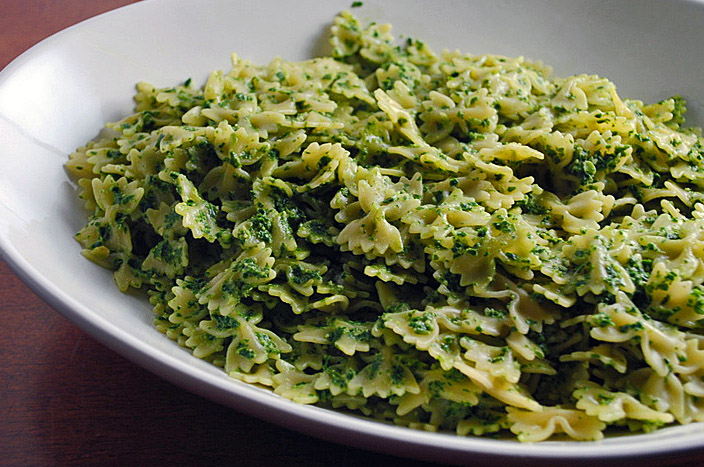
FARFALLE WITH KALE PESTO
(from the Bewitching Kitchen)

1 big bunch of kale, stems removed, leaves coarsely chopped
1/4 cup of walnuts, toasted
pinch of red pepper flakes
olive oil
squeeze of lemon juice
salt and pepper
1/4 to 1/3 cup yogurt

Bring a large pot of lightly salted water to boil.  Drop the kale leaves and blanch them for a couple of minutes.  Immediately drain, and rinse briefly in cold water. Drain well, then place in a salad spinner to dry the leaves as much as possible.

Add the toasted walnuts and red pepper flakes to the bowl of a food processor, and process for a few seconds.  Add the blanched kale and process together with the nuts until a paste forms.  Season with salt and pepper.  Squeeze lemon juice all over. Close the processor, and add the olive oil as a stream.  Once the oil is incorporated, stop to scrape the sides of the bowl, add yogurt and process until everything is smooth.   Taste, adjust seasoning, and reserve.

Meanwhile, cook farfalle pasta until al dente, reserving some of the pasta cooking water.  When the pasta is cooked, mix with the pesto, and add the reserved cooking water to thin the sauce, if necessary.   Serve with plenty of parmigiano-reggiano cheese grated on top.

ENJOY!

to print the recipe, click here

Comments:  I’ve seen recipes for kale pesto in which the raw leaves are processed with the usual suspects (garlic and olive oil).  I decided it would be too harsh for our taste, so  I took the extra step of blanching the leaves.  If you are a garlic lover, add a couple of cloves together with the walnuts.   I loved this version of pesto,  and even used some as a spread for a ham sandwich at lunch next day.   All amounts are a bit eye-balled,  if you like the flavor of olive oil to be more pronounced, use more and omit or reduce the yogurt.   Don’t leave the lemon juice out, though – it adds that citric brightness that is a must in this recipe.

For additional kale inspirations, a small sample of recipes from the internet:  

Kale Gratin … A nice recipe from Taste Food,  she used spinach, but I think kale would be great too

Kale Salad with Butternut Squash… from Eats Well with Others

Kale Frittata... from My Kitchen in the Rockies

Golden Chard Pie… from the early days of my blog

Kale Chips… from not so early days of my blog

and for an interesting twist on this great veggie, take a look at these cute Quinoa and Kale Patties

ONE YEAR AGO:  Short and Sweet

TWO YEARS AGO: Ciabatta, a Classic Italian Bread

THREE YEARS AGO: Magical Lamb Stew

YOU ARE ALL INVITED!

Cookies and coffee will be available at 3:45pm…

THE PUZZLES OF FERRIC ENTEROBACTIN TRANSPORT THROUGH FepA

When Gram-negative bacteria acquire iron, the metal crosses both the outer membrane (OM) and the inner membrane (IM). But, existing radioisotopic uptake assays only measure iron passage into the cell as the accumulation of the radionuclide in the cytoplasm. We devised a novel methodology that exclusively observes the OM transport reaction of ferric enterobactin (FeEnt) by Escherichia coli FepA. This technique, called postuptake binding, revealed previously unknown aspects of TonB-dependent ferric siderophore transport reactions. The experiments showed, for the first time, that despite the discrepancy in cell envelope concentrations of FepA and TonB (approximately 35:1), all FepA proteins were active and equivalent in FeEnt uptake, with a maximum turnover number of approximately 5/min.   The accumulation of FeEnt in the periplasm required the binding protein and inner membrane permease components of its overall transport system; postuptake binding assays on strains devoid of FepB, FepD, or FepG did not show uptake of FeEnt through the OM. However, fluorescence labeling data implied that FepA was active in the fepB-minus strain, suggesting that FeEnt entered the periplasm but then leaked out. Further experiments confirmed this futile cycle; cells without FepB transported FeEnt across the OM, but it immediately escaped through TolC.  These ferric siderophore acquisition systems are crucial to the pathogenesis of Gram-negative bacteria, and our results show that cathecolate siderophores, which are transported by OM receptors such as FepA, CirA, FecA and Fiu, play a defining role in colonization of the gut by E.coli.

Anyone who falls asleep will hurt my feelings!   😉

CINNAMON WREATH

What if I told you that this bread is one of the easiest breads I’ve ever made, and that it is ready in less than 2 hours from the time you grab your bag of flour?  Hard to believe, but true.   I first marveled at the recipe over at Baker Street, a blog I got to know earlier this year and now follow very closely, since it’s full of tempting recipes…

CINNAMON WREATH
(from Baker Street)

for the dough:
2 cups flour
½ tsp salt
½ cup lukewarm milk
1 envelope active dry yeast (2 + 1/4 tsp)
⅛ cup melted butter
1 egg yolk
1 tbsp sugar
for the filing:
¼ cup melted butter
4-5 tbsp sugar
3 tsp cinnamon
Mix the yeast and sugar with the lukewarm milk and let it sit a few minutes while the yeast bubbles and foams up.
.
Add the egg yolk, the melted butter, the flour and the salt, then knead the dough and shape into a ball. Place the dough in a large, greased bowl, then cover and place in a warm space and let rise until doubled in size (about 1 hour).
.
Heat the oven to about 400 degrees Fahrenheit. Roll the dough out to a thickness of 1cm (1/4 inch).  Spread the melted butter across all of the dough, then sprinkle the cinnamon and sugar mixture.  Reserve a small amount of melted butter for the top of the bread.
.
Roll up the dough, and using a knife, cut the log in half length-wise. Twist the two halves together, keeping the open layers exposed (see photos on Baker Street site). Give a round shape, then transfer to a lightly buttered baking tray.
.
Brush a little butter on top and sprinkle some sugar and cinnamon mixture. Bake for 30 to 35 minutes, until the bread is golden brown. Reduce the oven temperature to 350 degrees Fahrenheit after 5-10 minutes to stop it burning.
.
ENJOY!
.
to print the recipe, click here
.
Comments: This bread would be outstanding for a brunch. It’s almost like a cinnamon roll, but with a different texture.  Your whole house will smell like cinnamon while it bakes and later sits on the counter, cooling.   I don’t have photos of the bread after slicing, because I made it for a departmental potluck and in this type of event it’s better not to turn into a typical food blogger: the person who would snatch a slice of bread from the lips of a guest just because it shows the perfect crumb structure, and run away with it, camera in hand.  😉
.
Phil loved this bread, and already requested that I make it again on a Sunday morning, as it will be even better still warm from the oven.  I had to bake it in the evening and we only tried the bread at lunchtime next day.   Not the ideal situation, but when you must be  in the lab by 8am, some accommodations are in order.
.
Next time I will make sure to roll out the dough a bit thinner, and form the cylinder a little tighter, to have more layers.  I confess that I forgot the final step of adding butter, sugar and cinnamon on top.  In other words: I must make it again to perfect it!
.
Please stop by Baker Street to see her masterpiece, as well as a tutorial on rolling and slicing the dough.  By the way, this bread is also known as Estonian Kringel.  Whatever its name, it is worth having it in your bread repertoire.
.
I am submitting this post to Susan’s Yeastspotting.
.
ONE YEAR AGO:  Yeastspotting 11.11.11
.
TWO YEARS AGO: Oven-baked Risotto
.

INSPIRATIONS AND A BLOG AWARD!

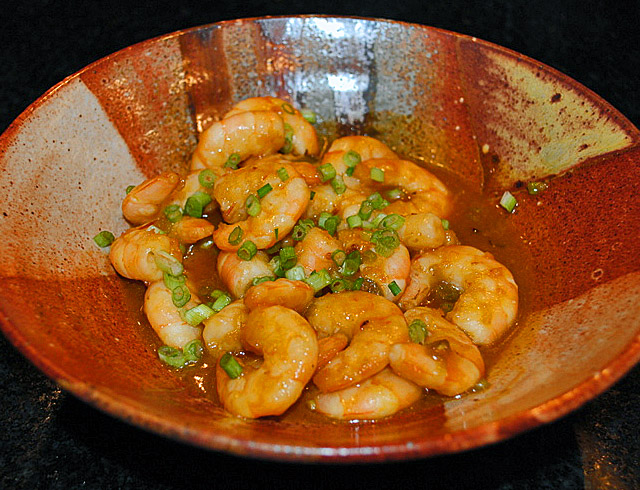
Every once in a while events happen in beautiful harmony. Last week I got notification of a new blog post by Kelly over at Inspired Edibles.  She shared a recipe for cauliflower puree, and her post immediately made me crave some.  I even exchanged a couple of emails with her comparing notes, as I had a version in my blog, from a couple of years ago.   I made the puree on a Sunday to have it ready for our dinner next day.  To serve with it, I picked a simple recipe (Mondays are busy days for us):  Shrimp in Spicy Orange Sauce…    Right as my shrimp defrosted in the fridge next day, Kelly published a new post with a recipe for Spicy Orange Ginger Shrimp!   subliminal, virtual inspiration?   I like to think so…  😉

SHRIMP WITH SPICY ORANGE SAUCE
(from Cooking Light magazine, August 2007)

1 + 1/2 pounds peeled and deveined large shrimp
1 Tbsp cornstarch
1/4 cup fresh orange juice
2 Tbsp  soy sauce
2 Tbsp honey
1 Tbsp rice wine vinegar
1 Tbsp chile paste
2 Tbsp canola oil
1 Tbsp minced, peeled fresh ginger
1/3 cup chopped green onions

Place shrimp in a medium bowl. Sprinkle with cornstarch, toss well to
coat, and set aside.  Combine orange juice, soy, honey, vinegar, and chile paste in a small bowl.  Reserve.

Heat canola oil in a large skillet  over medium-high heat. Add minced ginger to the pan.  Stir fry for 15 seconds or until fragrant. Add shrimp mixture, stir fry for 3 minutes. Add the juice mixture and onions, cook for a couple of minutes or until the sauce thickens and the shrimp are done, stirring frequently.

ENJOY!

to print the recipe, click here

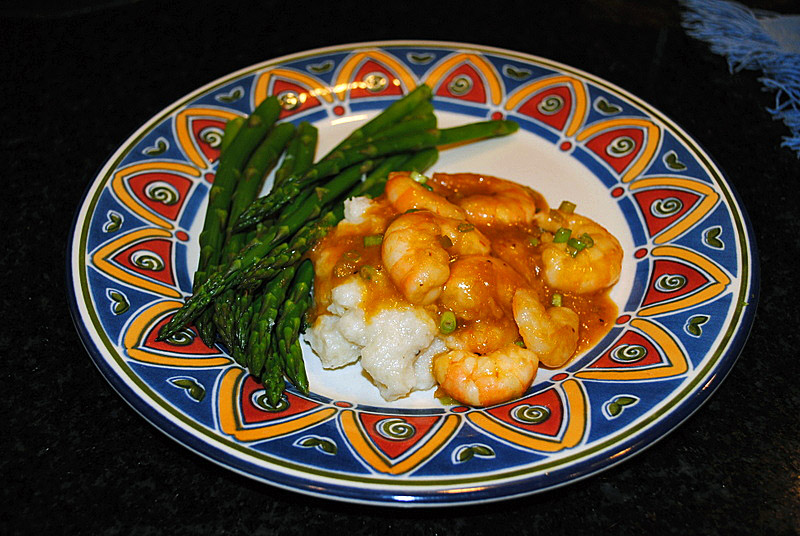
So here is my delicious dinner, served!   Shrimp in a tasty and quick to prepare orange sauce,  over  cauliflower puree with a hint of apple.  A match I had never attempted, but is now classified as “made in heaven!”  Usually I would serve this type of dish with steamed rice, but I must say the cauli puree worked its magic here.  The meal was slightly more substantial, leaning into the comfort food zone,  great way to wrap up a Fall weeknight.

And, to go along in the inspired route,   Alaina from Flat Leaf Parsley   awarded me the  “Very Inspiring Blogger Award“.  Inspiring!  How wonderful is that?    The award requires that you say 7 things about yourself.  I’ve played this game before, and was tempted to just copy the same 7 facts here, but I thought that would be almost cheating.   So here you have seven “new” ones:

1. I’ve worn the same perfume for the past 30 years: a Brazilian cologne called Free.  Every year when I go to Brazil I stock up, and usually also get a couple of bottles from friends and family as gifts.  They know I would have a hard time without it!

2.  I have no sense of orientation whatsoever, and get in frequent trouble because of it.  I turn to the wrong side on the street and inside buildings. I get lost going from the bathroom to  my table in restaurants. It is pathetic and at times very embarrassing.

3. I am very good both at parallel and back -parking,  love the challenge of fitting our pick up truck in the tiniest spots.  And, I am obviously very modest!  😉

4. I used to drive a Porsche 944 Turbo.  Red. Gorgeous. Not a wise economical decision from a maintenance perspective  (it had over 100 thousand miles when I bought it), but I had a blast driving it!

5.  I studied Mandarin Chinese for a few years, wish one day I can find the energy and time to go back to it. Writing ideograms is an introspective and rewarding experience.

6.  Every day for the past 4 years, I send a picture of something beautiful (landscape, animals, flowers, sunsets) by email to a group of family members and friends. I call it “Beleza do Dia” (Beauty of the Day), and really enjoy doing it.

7. My motto: everything in moderation, except exercise…  😉    I have more than 30 fitness-related DVDs to provide enough “muscle confusion”, although P90X is my favorite.

Thank you so much, Alaina, for passing me this award!

ONE YEAR AGO:  A Simple Appetizer (Baked Ricotta)

TWO YEARS AGO: Sour Cream Sandwich Bread

THREE YEARS AGO: Pasta with Zucchini Strands and Shrimp

THE LAB MOVE AND NEW BEGINNINGS

Almost three months have gone by since we moved our lab from OU to KSU.  I  wish I had been able to compose a post about it sooner, but let’s just say that life has been tremendously busy ever since.   Those who follow my blog might remember that our home move was a saga of epic proportions.  As a consequence, I lost many nights of sleep worrying about the lab move because it’s a lot more complex, and too many things can go wrong.  One of the major differences between a home move and a lab move, is a higher sense of urgency in the latter. When you move your home, you can always leave boxes hanging around, and set up just the basics:  a place to sleep, a place to cook, a place to sit down and collapse at the end of the day.   But, a lab is a full entity of sorts. The whole thing needs to be put in place as quickly as possible because: no lab, no work.  No work, no progress.  We anticipated a lag of a couple of weeks, and that’s more or less what happened.   A big thanks goes to a company called  TLM (Transportation Logistic Management), that moved all our stuff without breaking or losing anything!  Plus, their whole crew was a pleasure to interact with, very nice group of men and women working hard and in great spirits.  If you can believe it, they went through the trouble of wrapping up our large test tubes individually.  And we have more than 500 of these!
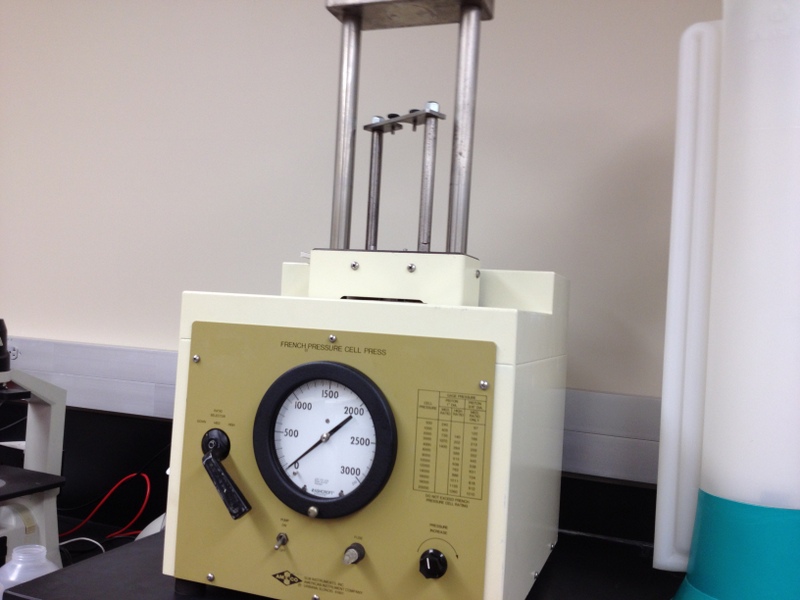
One of the most stressful things about a lab move is that quick decisions need to be made on the spot.  For instance, this “little” piece of equipment, called a French press, weighs a ton (well, almost a ton) and obviously once it sits on a spot, it better be its permanent home!   😉

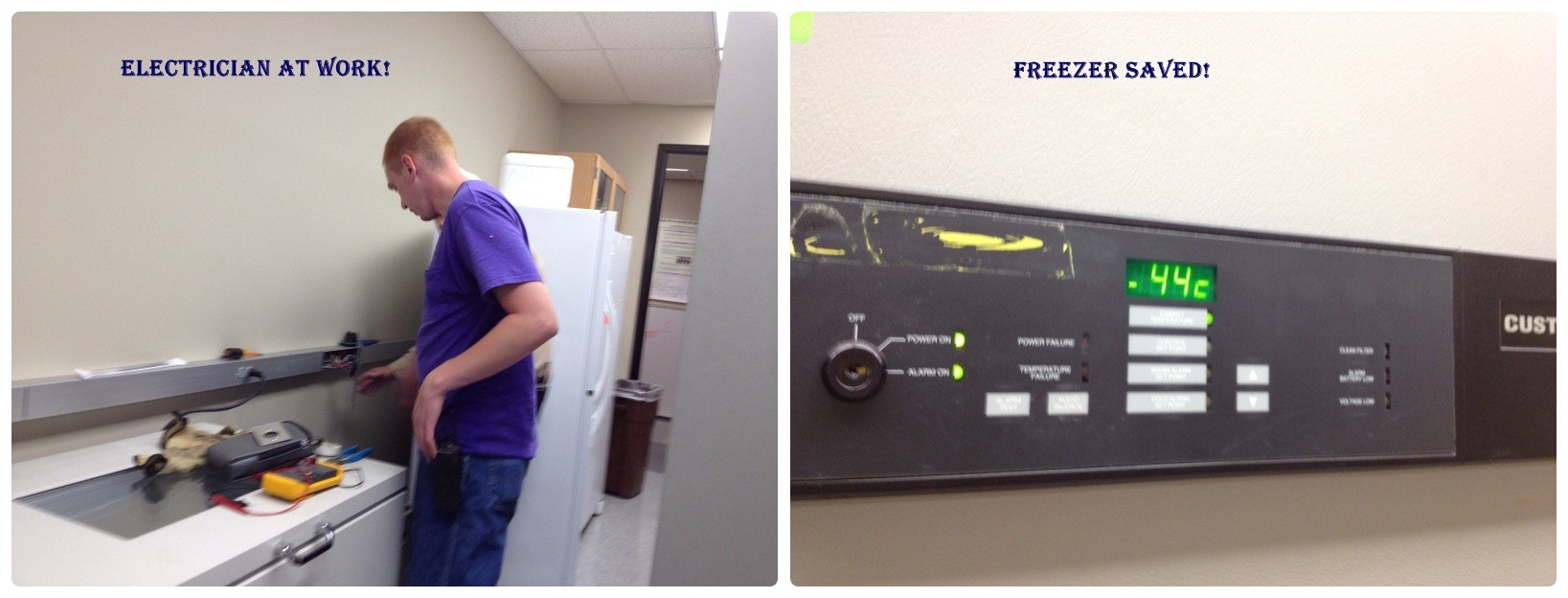
Of all things that were moved, perhaps the most important was our – 70 C freezer.  It holds all our bacterial strains, as well as  very sensitive reagents.  TLM had a nice strategy to deal with it: they packed the whole lab over a couple of days, and closed the truck. Next morning, at 5am they came to get the freezer, loading it just before starting the 312-mile drive. Six hours later, the freezer would be unloaded first and quickly plugged.  If you don’t open the door, the temperature will stay cold enough to preserve its precious contents.  Well, to add a little excitement to the adventure, once the freezer was unloaded, we realized that the plug and the outlet did not match!  Frantic calls were made to electricians on campus, and they came to the rescue. Thanks to their efficiency, our freezer was plugged back when the temperature had risen only to – 44 C.   Big sigh of relief!
Another very tricky piece of equipment to move was our double water-distiller.  All parts are made of glass, connections are delicate and convoluted.  I bet our grad student was wondering if it would ever be back in working condition…;-)

But it had a happy ending!

The huge baby shown below is a cell culture hood.  We use it to work with mammalian cells, much more fragile and prone to contamination than bacteria. This machine has a special laminar flow of air that isolates the environment inside the hood.  Plus, it also holds a germicidal UV lamp to sterilize that environment.  It weighs a lot more than a ton, and it required a special lift to have its legs installed in place.

But once it is all said and done,  setting up a new lab is a great experience!

Drawers are labeled… and stuff is stored inside….

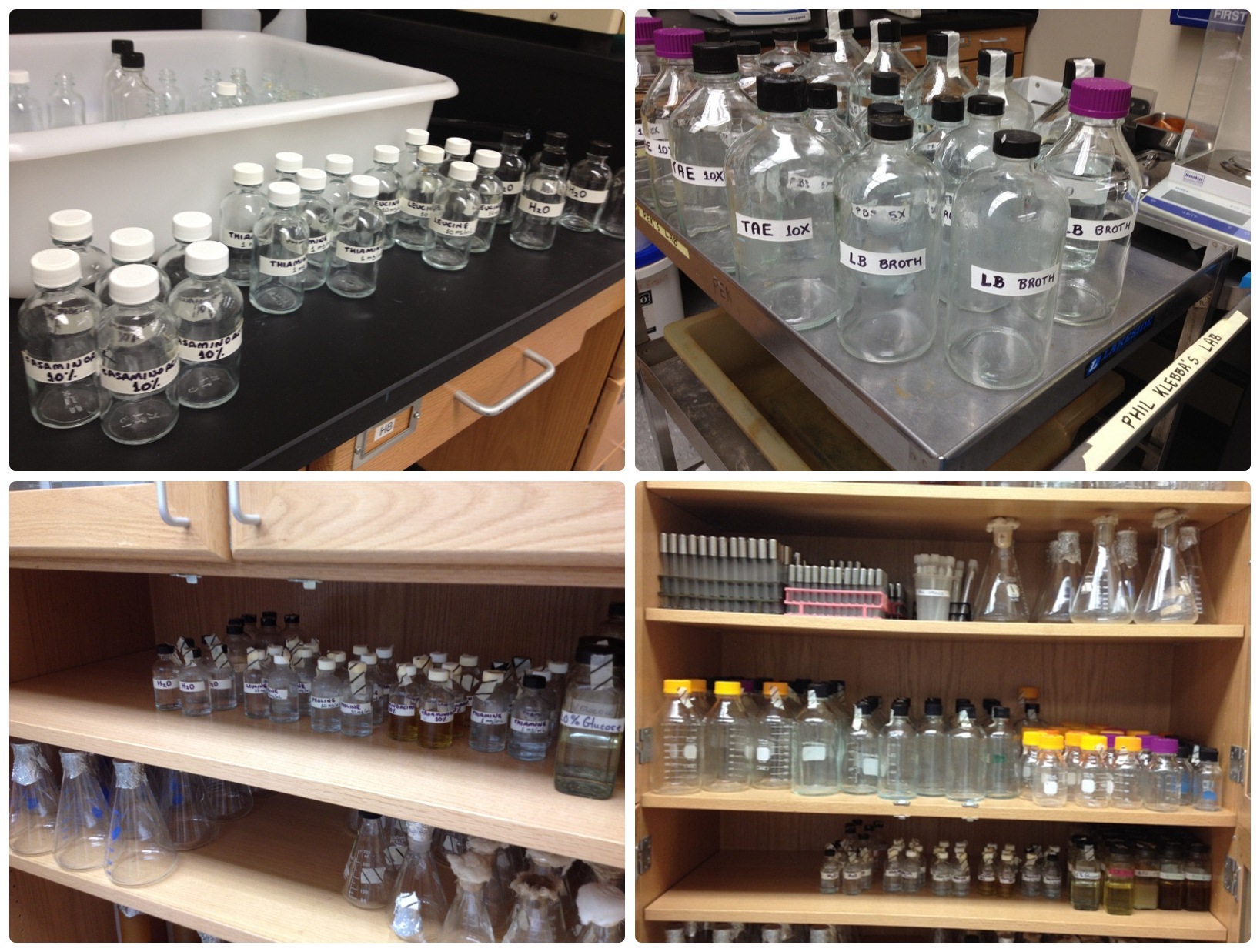
New, clean bottles are labeled, solutions prepared, sterilized and stored, ready for use…

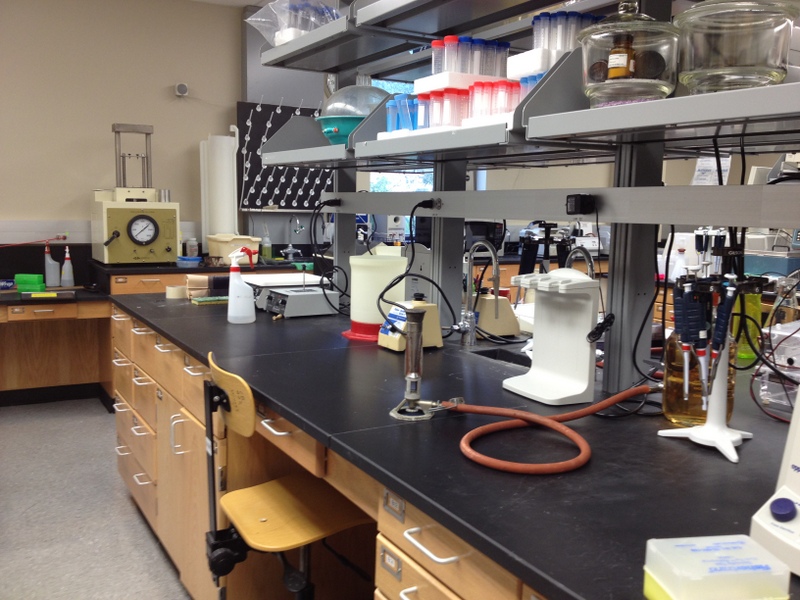
Chemicals are organized, benches get ready for experiments….

And we are finally back, cranking up some data!  Here is a shot of our SLM Fluorometer 8100, a Rolls Royce of a machine,  that needs to be operated in a dark room. It got a nice upgrade before our move, and it will be a major player in our projects in the near and not so near future.

I hope you enjoyed the glimpse on what a lab move involves.  I can tell that we intend to retire here (not anytime soon, mind you!), because another move would just about kill us!  😉  Seriously, though, we are thrilled to join KSU and feeling energized and ready for this next phase in our professional life.

If you want to know a little more about our research, visit our webpage at KSU by clicking here….

ONE YEAR AGO: Honey-Oat Pain de Mie

TWO YEARS AGO: Carrot and Leek Soup

THREE YEARS AGO: Chicken Parmiggiana 101