A REAL OSCAR WINNER

Last weekend, on a visit to one of Los Angeles Animal Shelters, my husband spotted a very thin and shy terrier, with golden fur and beautiful dark eyes, that had been found wandering the streets of Hollywood. It was love at first sight. We named him Oscar, and our home is now his home.

Maybe I am a little insecure still….

But I am already working hard on getting my brother to love me….

Do you think he will resist my charm for very long?

No one else seems to….

Add to FacebookAdd to DiggAdd to Del.icio.usAdd to StumbleuponAdd to RedditAdd to BlinklistAdd to TwitterAdd to TechnoratiAdd to Yahoo BuzzAdd to Newsvine

36 HOUR SOURDOUGH BAGUETTES

Over the past two and a half years I became comfortable baking rustic breads  using wild yeast.  The baguette, however, gave me lesson after lesson in humility. Baguettes are deceptively simple to prepare, but if you seek a bread with Parisian quality, then each step of preparation must be flawless: bulk fermentation, shaping, final proofing, and baking.  I’ve tried many recipes, but they never quite matched the superb baguettes of the 7th Arrondisement, where we used to live.

That all changed during our recent trip home.  I was looking forward to baking a  sourdough bread in our own kitchen, and decided on sourdough baguettes.  I followed the detailed instructions of TxFarmer, one of the most accomplished bakers of The Fresh Loaf Forum, and voila‘,  the baguettes from my own oven were just the way I’d hoped for…


TxFARMER’s 36 HOUR SOURDOUGH BAGUETTES

(recipe found at The Fresh Loaf forum)

150 g very active sourdough starter (at 100% hydration)
425g all purpose flour
300g cold water
10g salt

Mix water and flour into a lumpy mass, cover and place in the fridge for 12 hours.

Remove from the fridge, add the starter and salt to the dough, and mix until distributed. The dough will be very sticky, but you should resist the temptation to add more flour. Allow it to rise at room temperature for 2 to 3 hours, kneading by the “stretch and fold method” every 30 minutes. The dough may rise about 30% of its total volume. Place the dough covered in the fridge for 24 hours.

Remove the dough from the fridge and let it warm up for 1 to 2 hours – you want it to rise but not get overly bubbly, because that will make shaping very tricky later. Divide the dough in four pieces, taking care not to deflate it too much. Place each piece over floured parchment paper, and let it relax for 40 minutes.

Shape each one as a baguette (for a nice tutorial, click here), proof for 30 to 50 minutes, and bake with initial steam at 460 F for 25 minutes.

Let it completely cool before slicing.

ENJOY!

to print the recipe, click here

Comments: When Txfarmer described this recipe as “everything I know in one bread,”  she meant it. She baked multiple batches to perfect it, and made it clear that you need a good “feel” for the dough to get good results. That’s why the initial stretch and fold cycle varies from 2 to 3 hours, depending on the ‘strength” (gluten development) of your dough. The final rise at room temperature will also change depending on the temperature of your kitchen, and how much “lift” the starter provided during the 24 hour fermentation in the fridge. If you are new to bread baking, particularly using wild yeast, all these variables are intimidating. But if you’ve baked your share of sourdough breads, then consider making a batch of these baguettes, which taste incredibly good! The crumb is open, the taste surprisingly mellow, with an almost “sweet” component, hard to imagine in a sourdough.

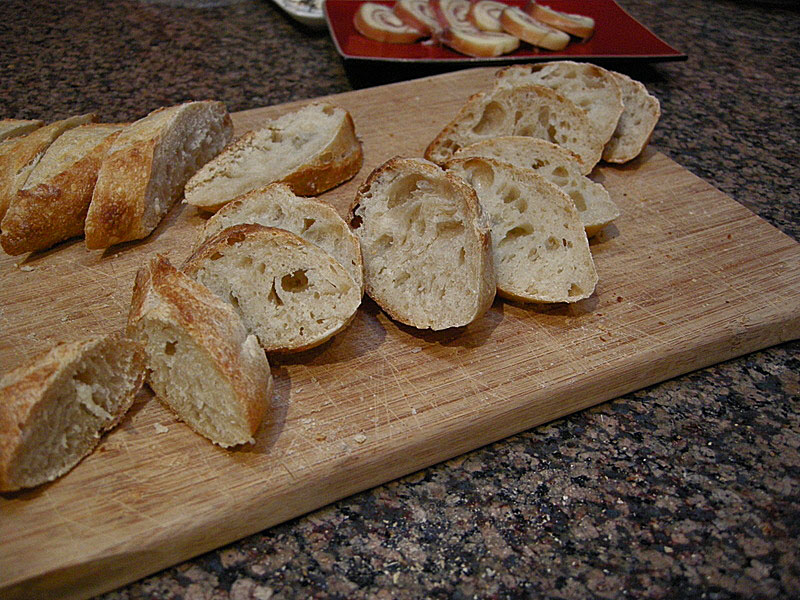
You may have noticed that my individual baguettes ended with different types of crusts. The difference lies in how I generated steam during baking. Two baguettes were baked with an inverted roasting pan (sightly wet) on top: they developed a nice, shiny crust, with a “caramel” color. The other two baguettes were baked in a perforated pan, with steam coming from water poured in a cast iron pan placed at the bottom of the oven. Their crust is less shiny, but they had more oven spring. My favorite method is the inverted roasting pan, but it has a major drawback: I can only bake one baguette at a time.

If you dream of perfecting baguettes at home, you MUST try TxFarmer’s recipe. Many bakers already did, and raved about it (check the discussion at The Fresh Loaf Forum by clicking here).

I am submitting this post to Susan’s Yeastspotting event…

This slideshow requires JavaScript.

ONE YEAR AGO: Potato and Leek Braise

Add to FacebookAdd to DiggAdd to Del.icio.usAdd to StumbleuponAdd to RedditAdd to BlinklistAdd to TwitterAdd to TechnoratiAdd to Yahoo BuzzAdd to Newsvine

receita em portugues na proxima pagina

SAYING GOODBYE

Years ago I found a photo on the internet, and saved it to my computer.  It captured the photographer’s wife moments before taking their aging, sick dog to be put to sleep.    I remember staring at the image with tears in my eyes, because it was so touching. Today, a couple of years down the line, I can finally give credit to this unique photo. Amazing how the internet works, I did not find the author of the photo at the time I posted, but he found me. A cycle is completed.


(PHOTO CREDIT: COPYRIGHT JUAN DE SANTA ANNA – see all his work at http://www.bigguys.zenfolio.com)

Today our beloved dalmatian is running free  in some far away virtual place, chasing squirrels, wagging his tail, hopefully unaware of the deep sadness he left behind.

THE UNBEARABLE LIGHTNESS OF BAKING

My husband and I agree on most important subjects, from personal finances to laboratory experiments.  However, we  can’t decide who is the most stubborn.  Obviously, it is not me, but this week, I confess to a certain amount of stubborn determination…  

…I baked a cake.

FONDANT AU CHOCOLAT
(from a food blog)

175 g  bittersweet chocolate
240 g  butter
400 g sugar
8 eggs
130 g all purpose flour

Butter a 10-inch round cake pan.

Melt the chocolate with the butter and reserve.

Place a pan with a small amount of water inside over the stove burner, and bring the water almost to a boil.  Place a large bowl over the simmering water, and add to it the sugar and the eggs (still cold from the fridge).   Beat them together with a whisk or an electric beater, just until the mixture is at room temperature.

Pour the chocolate mixture into the egg/sugar, whisk to incorporate.   Sift the flour over it in three additions, and mix with a spatula until smooth, but do not over-mix.

Pour the batter into the baking pan and bake in a 350F oven until barely set in the center.

ENJOY!

to print the recipe, click here

Comments: This was the most straightforward recipe!  No creaming butter and sugar, no cooking syrup to the  “hair-of-an-angel” state, held at exactly 237.8 F while pouring over the spinning blades of a  mixer. Still, I created another Armageddon in my kitchen.

The recipe instructed to bake the cake for 30 minutes until barely set.  I baked for 35 minutes and it seemed set. Unfortunately, I didn’t stick a tester in the center because I didn’t want to ruin the surface.   Unfortunately, I trusted my  “instincts” and removed it from the oven. You’ll notice that I omitted the baking time in the recipe: please use a toothpick to make sure the fondant is cooked.

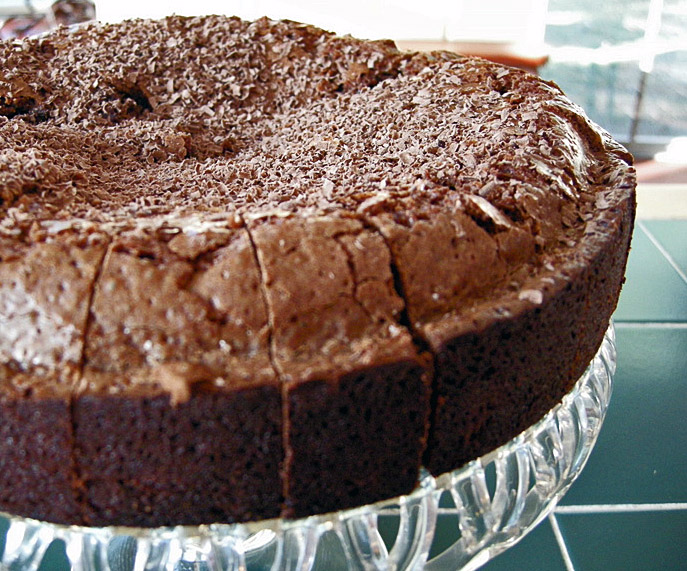
The recipe didn’t specify when or how to unmold it.  I am aware that some cakes should  cool in the pan,  others should come out right away.  I compromised  and waited 10 minutes.  It unmolded easily, but while flipping it over, the cake broke in two unequal pieces. One fell on the cake stand, the other on the countertop. Between them flowed a voluminous  lava of chocolate batter, too much to qualify my production as a “molten chocolate cake“.   Instead it became a “Cocoa Tsunami”, that took no prisoners.

I admit to shedding a few tears.  The saint I married assembled the pieces on a baking sheet,  placed them back in the oven at a mellow 325 F for 30 minutes, and I regained my composure.  Once both the cake and I had cooled off,  I shaved chocolate all over to cover the abuse.

Fate has repeatedly told me to stay away from cake baking.   I’m  just too stubborn, perhaps I must now admit, more than the man I married.   But, no need to tell him that…   😉

Notes to self:
1. Never use your bare hands to stop a flow of hot cake batter.
2. Chocolate fondant cake is so awesome that it’s worth the struggle.

ONE YEAR AGO: Pain de Campagne

Add to FacebookAdd to DiggAdd to Del.icio.usAdd to StumbleuponAdd to RedditAdd to BlinklistAdd to TwitterAdd to TechnoratiAdd to Yahoo BuzzAdd to Newsvine

receita em portugues na proxima pagina

TAKING A BREAK FROM THE NANO-KITCHEN

We flew back home this week to spend a few days in our own town.  I’m in a state of shock, all of a sudden realizing how much space we have. Here we could cook together while dancing, whereas in L.A. we are in a territorial-mode: I even growled at my beloved the other day because he insisted on opening the fridge while I did the dishes. The nerve!

I looked forward to cooking in our home, on a stove with four burners and real flames above an oven that can roast a couple of chubby turkeys side by side. Of course, deciding what to cook for our first dinner was excruciating. After an extensive consultation  with 9 cookbooks, I chose a recipe from Barbara Tropp: Chinese cooking at its best…

CAPITAL SAUCE PORK RIBBONS OVER POT-BROWNED NOODLES
(adapted from Barbara Tropp Modern Art of Chinese Cooking)

1 pound boneless pork loin

to marinate the meat:
2 T soy sauce
2 T Chinese rice wine
1 T water
4 t cornstarch
½ tsp sugar
1/4 tsp sesame oil
6 scallions

Sauce ingredients
3 T hoisin sauce
2 T Chinese rice wine
1.5 T soy sauce
5 t sugar
½ t sesame oil

2 T peanut oil

For the noodles:
½ pound long Chinese thin egg noodles
1 tsp sesame oil
1 tsp salt
6 T peanut oil

Cut the pork into thin slices 1/8 inch thick (against the grain). Cut each slice into ribbons, flattening them slightly with a meat mallet.

In a large bowl, mix the soy sauce, rice wine, water, cornstarch, sugar and sesame oil until thoroughly blended, then add the pork slices and allow to marinade for 1-3 hours at room temperature or overnight in the fridge. Drain well before stir-frying.

Cut the scallions into 2-inch pieces, trimming off the root ends. In a small bowl, mix the hoisin sauce, rice wine, soy, sugar, and sesame oil , stir well to dissolve everything.

Add 2 T of peanut oil to a very hot wok, swirl to coat the pan, add the pork slices and stir fry until opaque. Add the sauce ingredients and continue cooking until the pork is cooked through, then add the scallions and reserve until the noodles are ready.

Preparing the noodles:
Boil the noodles until cooked, but not mushy. Drain, then run through cold water until fully cooled. Shake off excess water and lay the cooked noodles over a dish cloth, blotting it out of excessive moisture. Transfer to a bowl, adding the sesame oil to coat the strands (the noodles can be kept cold at this stage for up to 2 days).

Heat a 12 inch skillet over high heat, add 5 T oil, and heat until a strand of noodle sizzles if gently dropped on the pan. Coil the noodles evenly on the hot pan, starting at the edges, and working your way through the center. Press them with a spatula, cover the pan, then cook until the bottom is browned (5-7 minutes).

Loosen the browned noodles, slip them out of the pan, transfer to a serving platter. Mound the pork on top of the noodles, and serve immediately.

ENJOY!

to print the recipe, click here

Comments: Barbara’s original recipe calls for deep frying the pork before the final stir-fry. I have done this “oil velveting” in the past, but this time I simplified it and cooked the pork all the way through in the wok. The main reason: we are home for just a few days, I didn’t want to deal with the leftover oil.   Is there a loss of quality in the final dish? In all honesty, yes. Velveting does wonders to improve the texture of stir-fries (as I mentioned before here), so if you can do it, follow her advice and deep fry the pork for a minute, remove it from the oil, drain it well, and add it to the wok AFTER you add the sauce and heat it up.

This is not a light recipe – obviously, any time you brown noodles on a frying pan, their calories will be multiplied by a factor of 2. However, sometimes it is good to indulge, so enjoy it without guilt, and cut back on excesses for a couple of days. 😉

Note to self:  try the “water-velveting method” in this recipe.

ONE YEAR AGO: Chocolate Chip Cookies

Add to FacebookAdd to DiggAdd to Del.icio.usAdd to StumbleuponAdd to RedditAdd to BlinklistAdd to TwitterAdd to TechnoratiAdd to Yahoo BuzzAdd to Newsvine