MOROCCAN COOKED CARROT SALAD

Simple. Quick. Delicious.  From a cookbook that I highly recommend, Mediterranean Fresh, by Joyce Goldstein.   The secret is in the dressing, that pairs citrus and cumin, giving the carrots a very subtle background of heat.   Do not skip toasting the cumin seeds.  In recipes with so few ingredients, you need to bring out the best in each of them, and toasting spices does just that, makes them talk to you loud and clear.


MOROCCAN COOKED CARROT SALAD

(adapted from Mediterranean Fresh)

1/2 cup mixed citrus dressing (recipe follows)
1/8 tsp cayenne pepper
1/2 tsp toasted cumin seed, ground
2 Tbs sugar
1 pound carrots
salt to taste
fresh parsley, minced

Mixed citrus dressing
Whisk together all these ingredients:
1/2 cup olive oil
zest of 1 orange
1/4 cup freshly squeezed orange juice
2 Tbs fresh lemon juice
1/2 tsp sugar, if needed (I omitted)
salt and pepper

Toast whole cumin seeds using a small non-stick skillet over medium heat, moving them constantly to avoid burning. Let them cool slightly, and grind them. Mix the citrus dressing with the spices and sugar.

Peel the carrots and cut in thin slices. Cook in boiling salted water for 5 minutes, or until they start to get tender, but do not overcook. Drain and toss with the dressing. Adjust the seasoning, and add minced parsley just before serving.   Serve warm or at room temperature.

ENJOY!

to print the recipe, click here

Comments: If this salad does not appeal to you because you are not fond of carrots, consider making the dressing, because it will go quite well on many veggies as well as composed salads. I can envision my default method to cook asparagus getting a boost from this mixed citrus dressing at the end. The original recipe called for three tablespoons of sugar, I used only two, as carrots are naturally sweet already.

The recipe serves 4 to 6 people, I scaled it down for the two of us, but next time I’ll make a full batch to have leftovers. We had just a tiny bit left, which was still wonderful next day, but left me craving for more.

BBA#41: WHOLE WHEAT BREAD

With only two breads remaining at the end of the BBA Challenge, I was hoping for something wonderful to say about Reinhart’s version of whole wheat bread.   But unfortunately, this bread fought hard for last place with the now infamous 100% sourdough rye.

I wasn’t the only participant to have problems with this recipe; you can jump to Oggi’s blog for her comments about it.  At some point I’d like to improve at breads with low to no white flour, because they consistently provided lessons on humility.   So, without further ado, here are the proofs of my crime, with apologies to Mr. Reinhart.

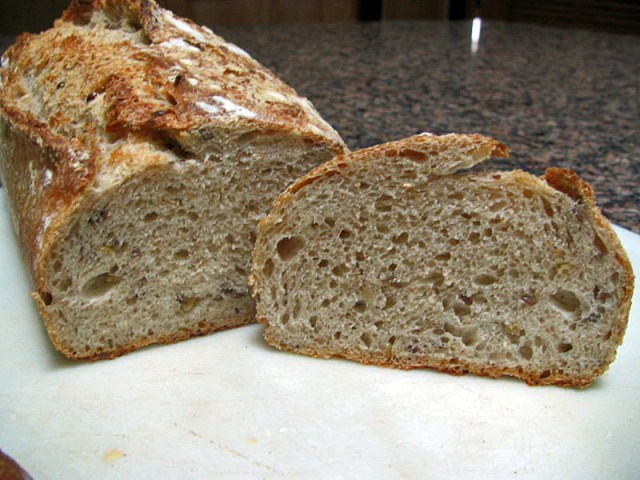
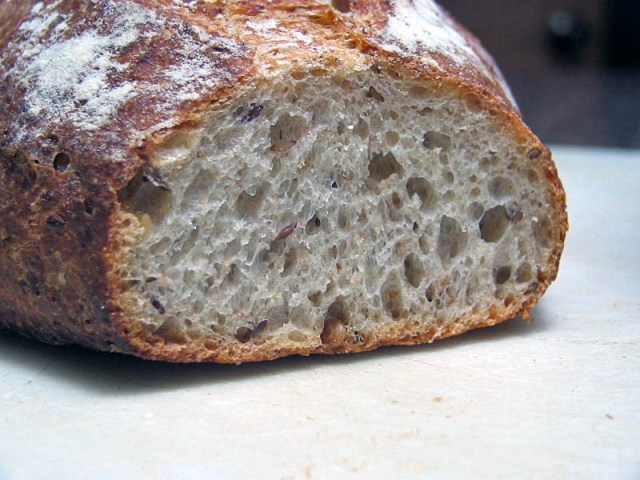
The dough was sticky, grainy and generally unpleasant to work with. The crumb was tight, as expected for this variety, but the taste was just plain bland.   Even my husband, who eats all my failures with a smile (while saying that I’m too hard on myself…violins playing, please) told me “if a bread isn’t even good with butter and this awesome fig jam, then something’s seriously wrong with it”.

I will be making croutons… (sigh)

Life goes on, so does the challenge. I’m anticipating the final two breads, which look like masterpieces… Stay tuned!

TORTA DI ZUCCHINI

I sincerely hope that I’m below the radar of the food-blog-police, or I may be in trouble for posting too many zucchini recipes.  Without a doubt, to my mom’s shock and disbelief, zucchini is one of my favorite vegetables. While growing up I wouldn’t even try it, little did I know my how much my tastes would change!

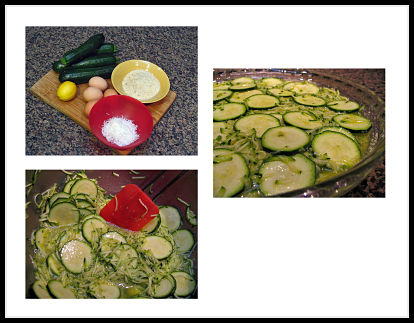
The first time I tried this recipe was more than 20 years ago; it comes from an old, out of print cookbook by Giuliano Bugialli.   It’s unusual because this “torta”  takes no flour.  It also contains zucchini cut in two different ways: grated and sliced.  The grated component becomes creamy during baking, surrounding the more defined slices to form a light, refreshing, sort of crust-less quiche. By skipping the breadcrumbs, this recipe is also low in carbohydrates, for those who are counting.

TORTA DI ZUCCHINI
(from Giuliano Buggiali)

1 pound zucchini (2 medium-size), grated
1 pound zucchini, sliced thin
4 eggs, beaten
zest of 1 lemon
1/4 cup grated parmiggiano cheese
salt and pepper
fresh parsley, minced
fresh bread crumbs (about 1/2 cup)

Grease a pyrex pie dish with butter. Sprinkle some bread crumbs to coat.

Mix the beaten eggs with the lemon zest, parmiggiano cheese, 1/4 cup of bread crumbs, parsley, salt and pepper.  In another bowl, place the grated and sliced zucchini. Shake the dish carefully to distribute the slices more or less evenly. Add the egg mixture to it, mix gently, and pour into the prepared pie dish.  Sprinkle the remaining 1/4 cup of bread crumbs on top, forming a very light coating.

Bake in a 375F until set and golden on top.   Allow it to cool for at least 15 minutes before serving.   Serve warm or at room temperature.

ENJOY!

to print the recipe, click here


Comments: This “torta”  makes a nice light meal, possibly served with soup or a salad.  In the summer I like to match it with tomatoes from the garden or from the farmer’s market.   Leftovers are best re-heated in the oven, because microwaving tends to make it watery.

On a side note… in Brazilian Portuguese, if someone says things that make no sense, either because they are wrong or have no relevance whatsoever,  the favorite expression is “to talk zucchini”  (falar abobrinhas).   I have absolutely no idea where the expression comes from, but maybe it helped shape my negative childhood view of zucchini.   Glad I got over it.   😉

ANTIBIOTICS AND FOOD

If I were to define myself professionally, I’d say I am equal parts microbiologist, molecular biologist, and biochemist.  I obtained my doctorate in biochemistry in 1986, working on the genetic instability and antibiotic resistance of bacteria. Since then, I’ve studied bacterial pathogenesis, vaccine biotechnology, and more recently, the biochemistry of iron uptake by Escherichia coli and Listeria monocytogenes, two potentially lethal bacterial contaminants of food. As a result of these experiences, I have strong opinions about the use of antibiotics in food production.

Watching the news this week, I saw a pig farmer from my home state (Oklahoma) defending the practice of feeding pigs antibiotics to improve their health and weight.   I’d love nothing better than to invite that man over for a cup of coffee and a conversation, so I could ask him what exactly he knows about the use of antibiotics.  For example, has he ever heard of the term “plasmid?”  What about you?  If you care to read about it, then follow me to the next page….

Continue reading

PAIN DE MIE AU LEVAIN

Just for a change, here’s a bread that’s not part of the BBA Challenge…  😉

Who doesn’t love a good bread? But, while some people prefer a hearty crust, uneven holes and an assertive taste, others like a tight, smooth crumb enveloped in a soft crust.  This  “pain de mie” joins the best of both worlds: it’s leavened with sourdough starter, but it’s moderate hydration produces a surprisingly closed crumb, especially if you bake it contained in a loaf pan. It’s a perfect sandwich bread, with more “pizzazz” than anything you’ll find at the grocery store.

I discovered this recipe in a wonderful French blog called Makanai: Bio, Bon, Simple. When a French woman (who has superb boulangeries on every corner) bakes bread at home, then I pay attention: she must be an outstanding baker! You can read Flo’s detailed description here.

PAIN DE MIE AU LEVAIN
(adapted from Makanai’s blog)

210 g  sourdough starter (mine was at 80% hydration)
420 g water
500 g bread flour
130 g rye flour
11.5 g fine sea salt (13 g if using unsalted seeds)
30-35 g seeds of your choice
(I used flax seeds and roasted, salted sunflower seeds)

Mix the flours, water, and sourdough starter until they form a shaggy mass.  Let it stand at room temperature, covered, for 30-45 minutes (autolyse).  Add the salt and mix it with either using a Kitchen Aid-type mixer for a few minutes, or by hand.  Add the seeds and knead with the machine for about 7 minutes at low speed.  Alternatively, mix gently by hand to incorporate the seeds and knead the dough by folding 4 times during the first hour, at 15 minute intervals.  Let the dough rise undisturbed for another full hour, in a warm place, covered.

Refrigerate the dough for 12 to 24 hours (very important step!), misting the surface lightly with olive oil, and covering with a plastic wrap.

The next morning remove the dough from the fridge, remove the plastic and cover it with a towel, to rest at room temperature for 2 hours before shaping.  Meanwhile, prepare a loaf pan by lightly coating it with olive oil and sprinkling flour, especially in the corners. You can make a single large loaf or divide it half depending on the size of your pan.  Mine was a 9×5 loaf pan, so I divided the dough in uneven pieces, placed the larger one in the loaf pan, and shaped the smaller one as a “batard“.   Ideally, the dough should fill 2/3 of the height of your pan.

Allow the shaped bread to rise 2 hours at room temperature, slash it with a blade, sprinkle some flour on top and bake it in a 435F oven for about 45 minutes, with an initial burst of steam.  Check the internal temperature: the bread will be done when it reaches at least 200F.

If you are patient enough, let the bread cool for a couple of hours before slicing it. Good luck with that… 😉

ENJOY!

to print the recipe, click here

Comments: This was a fun bread recipe. If you’re a novice baker, then incorporating the seeds and folding by hand might be a little intimidating, so use a mixer instead. If you are experienced with minimal kneading and folding, then by all means use the technique here.

For the sandwich bread, I slashed the dough slightly off-center, as Flo did in her blog.

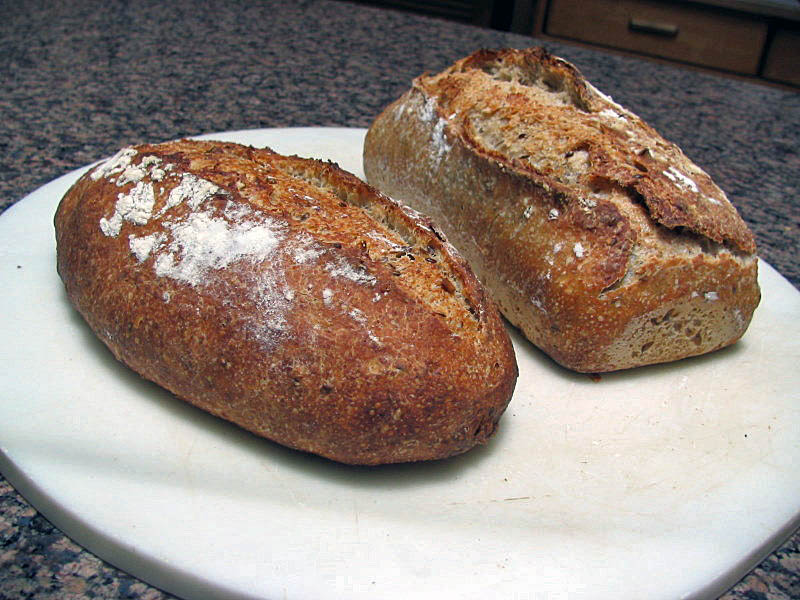
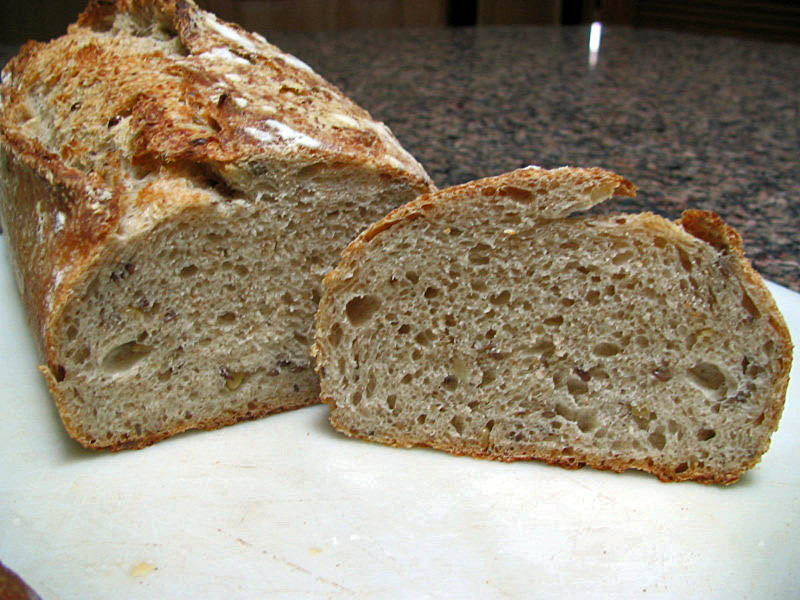
The same dough, baked in the loaf or free form, produced breads with different characteristics. The “batard” browned more, and the crumb was more open, reminiscent of a levain bread with a heartier crust.

My favorite method to create steam is to fill a large roasting pan (like this one) with hot water, and empty it before inverting it on top of the bread.  These affordable roasting pans, sold for cooking outdoors, effectively mimic a “steam oven.” Bake the bread covered in this way for the first 30 minutes, then remove the cover to promote full browning of the crust.  I used this method for both the breads in this post.
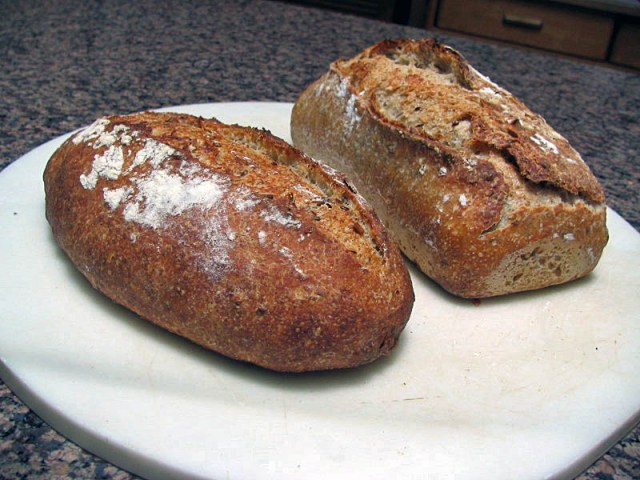
The textures and flavors of this bread were outstanding! Its slices stood out in ham and cheese sandwiches, and were hearty with a thin spread of fig jam. I normally don’t even care for bread with jam, but my husband twisted my arm and I’m glad that he did!

I am submitting this post to this week’s Yeastspotting, to join Susan’s fun on Friday….