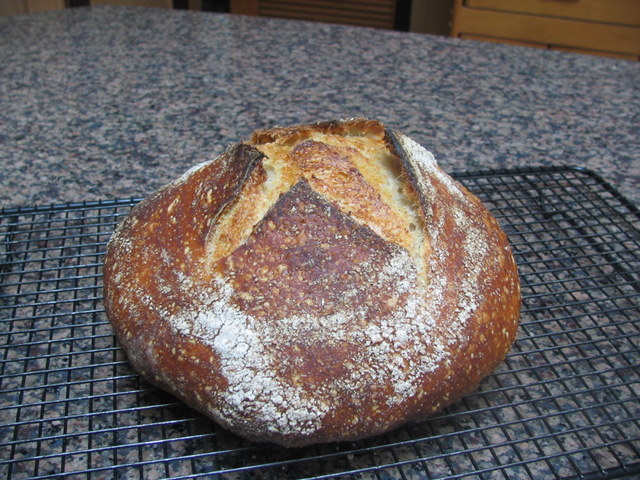
BBA#30: BASIC SOURDOUGH BREAD

Here we are, at the beginning of my favorite, sourdough breads, which are all made from a “starter”, or, as Peter calls it, a  “seed culture”.    For  those unfamiliar with the BBA Challenge, it’s a net-event that was launched by Nicole, in which home bakers make every recipe from “The Bread Baker’s Apprentice“, in the order that they appear in the book;  forty-three breads in all.    People participating in this challenge agreed not to publish the recipes, so if you are interested, help the economy and buy the book.  😉

I’ve been regularly baking sourdough bread for the past two years, so I took some liberties and made a few changes in the overall method.  First, I didn’t put the “barm”  in the fridge overnight.  Instead,  I prepared it at 11pm the night before and used it next morning,  at 6am, without refrigeration.   I see no need to retard the barm in the fridge:  it adds an extra hour to the overall process (you do need to warm it to room temperature before using it), and from my experience it doesn’t  improve the bread’s flavor.  Retarding the dough after the final shaping is a better option, that is also discussed in the recipe.

My second change was the kneading method.  I am partial to folding the dough, as you can see by browsing my bread recipes in this site.   Why? Because it always works.   Kneading the dough in a machine or extensively by hand  may or may not produce the crumb texture I love: airy and full of uneven holes.  I don’t like to gamble with my breads, so I fold it.

The dough was easy to work with,  I am always  fascinated by the way it changes with minimal kneading over time.   These two photos show the dough 15 minutes after mixing all the ingredients, and after rising for 45 minutes.   I folded it at 45, 60, and 120 minutes, then allowed it to rise for 2 more hours (for a total of 4 hours) before shaping.

I’ve been flirting with the idea of stenciling my breads, and this time I decided to go for it.   It didn’t work perfectly.   I think I made my Chinese character too big, and I added too much flour in making it, but I’m hoping to improve my skills.

This is an ideogram that I like very much – guang – it means light, as in sunlight.  I guess my tropical nature attracts me to it.  😉
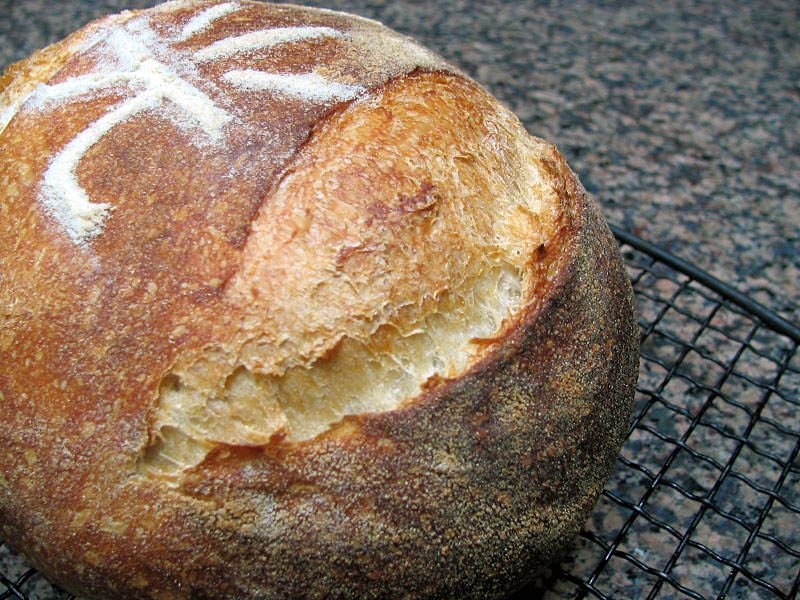
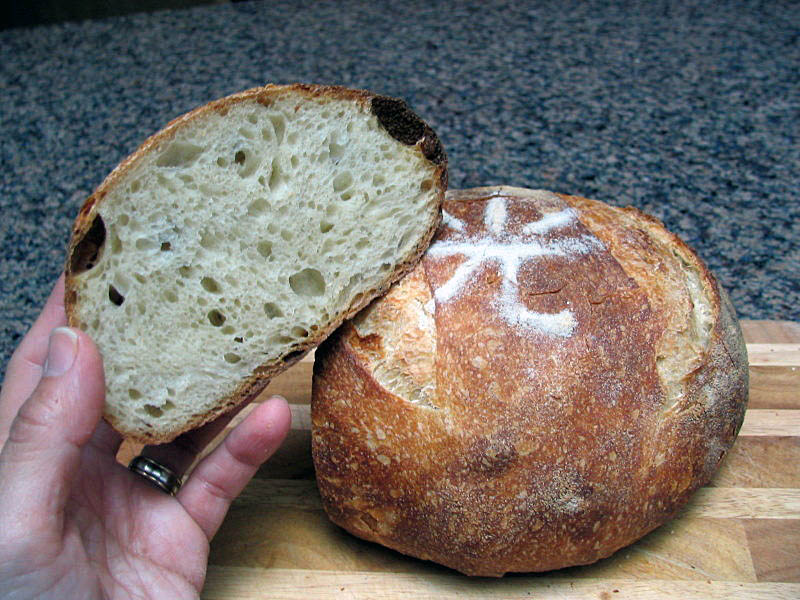
Excellent flavor, not too sour, the crust just the way we like it…
Click here is for a link to the sourdough post by Oggi, from “I Can Do That” – she did some nice different shapes  with her dough, very nice job!

THE BREAD WE LOVE

Two food items that I can’t survive without are bread and cheese.  When I lived in Paris I had a permanent smile on my face because it seemed like every street corner had a fantastic boulangerie, with wonderful fresh bread.  Often, not far away was a strategically placed  fromagerie wafting the intoxicating smells of cheese through the neighborhood, the best possible form of advertisement.
IMG_1633

My favorite bread is a sourdough loaf with delicate flavor, a hardy crust, and a creamy crumb with open, uneven holes. Simple to say, but a little harder to accomplish.   After more than a year of experimenting with different recipes I’m ready to share one of my favorites, not only because it delivers on all these counts, but because it’s excellent when prepared in the evening and baked the next morning.  To me, it’s the perfect way to make bread during the hot Summer months.

The recipe comes from a book that should be part of any bread baker’s library, called quite simply: “BREAD: A baker’s book of techniques and recipes,”  by Jeffrey Hamelman. You can find it here. This post will be my first submission to Yeastspotting.

VERMONT SOURDOUGH WITH WHOLE WHEAT
(adapted from Hamelman’s “Bread”)

Liquid Levain
2.4 oz bread flour
3 oz water
1 oz mature liquid levain (see comments at the end of the post)

Final dough
12 oz bread flour
1.6 oz whole-wheat flour
7.4 oz water
5.4 oz Liquid levain
0.6 oz salt (1/2 T)

Make the liquid starter (levain) 12 to 16 hours before preparing the dough, and let stand uncovered at room temperature. If you don’t have a sourdough starter, follow this link for a great lesson on how to make it.

Add all the ingredients for the dough (except the salt) in the bowl of an electric mixer. Mix on first speed (or by hand) just until they are combined into a shaggy mass. Cover the bowl and let it sit at room temperature for 20 minutes to 1 hour (this is called autolyse). At the end of autolyse, sprinkle salt all over and mix with the dough hook on second speed for 1 to 2 minutes (or knead by hand about 4 minutes).

Let it rise (ferment) at room temperature for 2.5 hours, folding the dough at 50 and 100 minutes (see my photos after the jump).

Shape the dough into a ball ( “boule”; great youtube video for shaping all kinds of bread can be found here), place it with the seam up  in a round container (banettons are your best option) lined with a fine cloth and transfer to the refrigerator for 8 to 12 hours. Remove from the fridge a couple of hours before baking (Hamelman says it is not necessary, that you can bake it straight from the fridge).

If using a clay baker (my favorite way), place the baker in the cold oven and turn it on to 440F. Allow the oven to warm to that temperature for at least 10 minutes. Using mittens, open the lid and quickly transfer the dough to the baker, so that the seam is now down, then slash the surface according to your liking, and close the lid.

Bake covered for 30 minutes, open the lid (don’t forget the mittens), and allow it to bake for at least 15 more minutes. You want a dark crust and internal temperature of at least 200F. Allow it to completely cool on a rack before cutting the bread (2 hours should be enough).

IMG_1627

Continue reading

THE HANDMADE LOAF

IMG_1462-1

Like a Mother who adamantly refuses to name her favorite child, I have a hard time picking a favorite cookbook. But, if someone asked me which cookbook had the greatest impact on my cooking,  I’d pick “The Handmade Loaf” by Dan Lepard, hands down.

If you dream of making great bread, if you feel that calling those preserved abnormalities at the grocery store “bread” is disrespectful to bakers everywhere, then you need this book.   Not only are the photos  gorgeous, but Dan’s writing will excite you to try every single bread from the book.  Isn’t that the mark of a great cookbook? Each page you turn makes you want to stop reading and start cooking! 😉

His main message is simple: if you want to become great at baking bread, forget about using a bread machine, or even a mixer. You won’t be pushing buttons, you will be using your hands to knead the dough. But his kneading technique is miles and miles ahead of the traditional, back-breaking, sweat-inducing method. You’ll fold the dough instead,  allowing time to accomplish what brute force used to do. You will also, for the most part, use yeast captured from your own kitchen, starting from flour, water, and a few raisins.  This book will completely change your approach to bread baking.

Yes, you will make the sourdough starter. Yes, at first you will feel intimidated. Yes, you will make mistakes, but you’ll soon realize that the starter is a very forgiving creature. Some of you who read my profile might be mumbling: “yeah, right, she is a biochemist who works with bacteria, easy for her to make starter”.  Believe me, I felt intimidated too.  I was afraid of the sourdough turning rotten, of my breads not rising, tasting flat, ending up hard as a hockey puck. In part because those things happened to me in the past, I was convinced that bread baking was simply not my cup of tea.

That all changed with “The Handmade Loaf”.  My first starter was born on March 2008 (I now have more than one). Since then, I’ve baked sourdough bread on a regular schedule, by far the MOST rewarding activity in my Bewitching Kitchen. I will share many of my bread baking adventures here, so stay tuned. 😉

Meanwhile, would anyone care for a piece of levain bread with black olives?
DSCN2236

Add to FacebookAdd to DiggAdd to Del.icio.usAdd to StumbleuponAdd to RedditAdd to BlinklistAdd to TwitterAdd to TechnoratiAdd to Yahoo BuzzAdd to Newsvine