PUFF PASTRY TWISTS WITH CINNAMON AND CARDAMON

You can conceivably use store-bought puff pastry (try to find a brand that uses real butter, not shortening), but a lot of the fun is making your own. For this type of pastry, no need to do too many folds. Great project for a weekend, but avoid days of excessive heat.


PUFF PASTRY TWISTS WITH CINNAMON AND CARDAMON
(from The Bewitching Kitchen, adapted from several sources)

3 cups (390g) all-purpose flour
1½ tablespoons sugar
1½ teaspoons salt
2 teaspoons white vinegar
1 cup ice water (you may not need the full cup)
for butter square:
3 sticks unsalted butter, chilled

Process flour, sugar, and salt in food processor until combined. With processor running, add vinegar, followed by ¾ cup super cold water. Add remaining ¼ cup water as needed, a little at a time with the machine always running. Stop adding water when the dough comes together, and immediately remove from the processor, gathering the dough gently with your hands. Form into a square, wrap in plastic and refrigerate for 1 full hour.

Start working on the butter block: Lay the three butter sticks side by side over a sheet of parchment paper and cover with a plastic wrap. Gently pound butter with rolling pin until butter is softened, then roll out as an 8-inch square, trying to keep the thickness equal all over the extension of the butter. Wrap the square in plastic and refrigerate until chilled, about 1 hour.

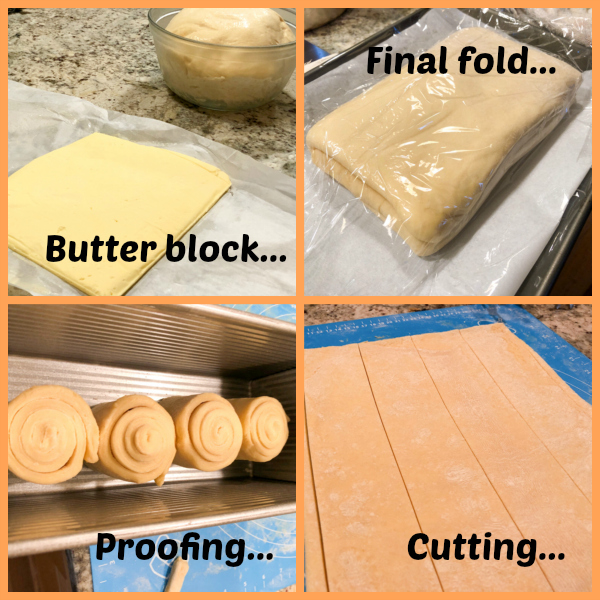
Roll chilled dough into 14 inch square on lightly floured counter. Place chilled butter square diagonally in center of dough. Fold corners of dough up over butter square so that corners meet in middle and pinch dough seams to seal (see first photo of the composite below). Gently roll dough into 14-inch square, dusting with extra flour as needed to prevent sticking. Fold dough into thirds like a business letter, then fold rectangle in thirds to form a square, try to make it as neat as possible. Wrap dough in plastic, freeze for 30 minutes and remove to the refrigerator, keeping it there for 60 minutes more.

Repeat the folding and rolling twice, if you can do it fast no need to refrigerate, but if at any time you feel the butter warming, place it in the fridge for 45 minutes before the next rolling out. Once you complete the foldings, let the dough rest for 2 full hours before finally using it.

MAKING THE TWISTS
1/2 of the puff pastry made as above
½ cup sugar
3 tablespoon unsalted butter melted
pinch of salt
2 teaspoons ground cinnamon
¼ teaspoon ground cardamom

Mix sugar, salt and spices in a small bowl. Reserve. Heat the oven to 400F and line a baking sheet with parchment paper (it works better than silicone for this type of bake, disregard what you see in the composite picture below, I switch to parchment on the second batch).

Roll the puff pastry into a large square (about 12 x 12 in), the thinner the better without allowing it to crack. Brush melted butter all over the pastry, then sprinkle the sugar-spice mixture, pressing gently with the fingers. Fold the pastry sheet in half, enclosing the sugar mixture. Cut narrow strips with a pizza roller. Twist each piece and place on the parchment-lined sheet.

Bake for 14-15 minutes until golden brown.

ENJOY!

to print the recipe, click here

Comments: These turned out absolutely delicious, although they un-twisted quite a bit during baking. I should have pressed the ends harder on the parchment paper, but still it didn’t compromise the experience. I cut the long strips in half because I did not want to have very long twists, so do what you think is best for you.

Yes, making puff pastry from scratch takes a bit of work, but quite a bit of it is waiting for the dough to chill. I will make turnovers pretty soon, so stay tuned!

ONE YEAR AGO: Three Delicious Bakes

TWO YEARS AGO: Banana Bread from the Experts

THREE YEARS AGO: Shrimp Stir-Fry with Snow Peas and Cashews

FOUR YEARS AGO: Pickled-Roasted Chickpeas with Cashew Cream

FIVE YEARS AGO: Twice-Baked Goat Cheese Souffle

SIX YEARS AGO: A Star from England in the Bewitching Kitchen

SEVEN YEARS AGO: Hommage to the Sun

EIGHT YEARS AGO:The Fabulous Three
.
NINE YEARS AGO: Turkey-Chorizo Burger with Green Chile Dressing
.
TEN YEARS AGO:Taco Salad
.
ELEVEN YEARS AGO: Semolina Sourdough Boule
.
TWELVE YEARS AGO:Forgive me, for I have sinned
.

THIRTEEN YEARS AGOCracked Wheat Sandwich Bread
.
FOURTEEN YEARS AGO:  Au Revoir, my Bewitching Kitchen
.
FIFTEEN YEARS AGO:French Bread
HOME BAKERS COLLECTIVE: JUNE PROJECT

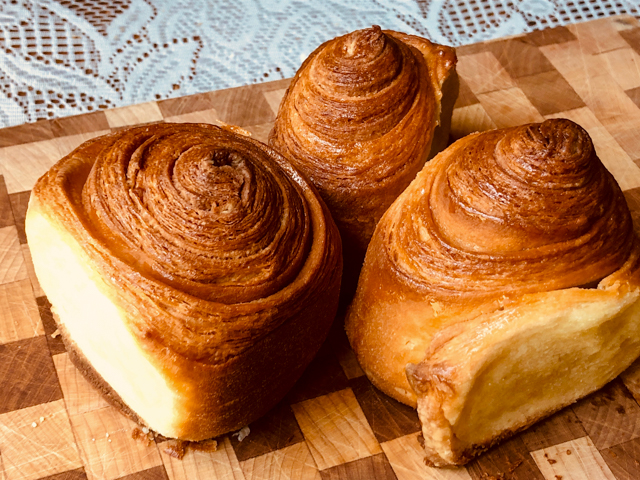
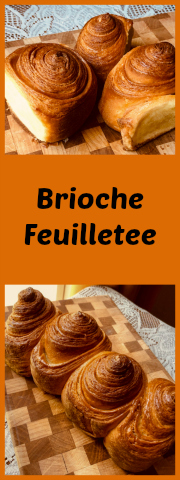
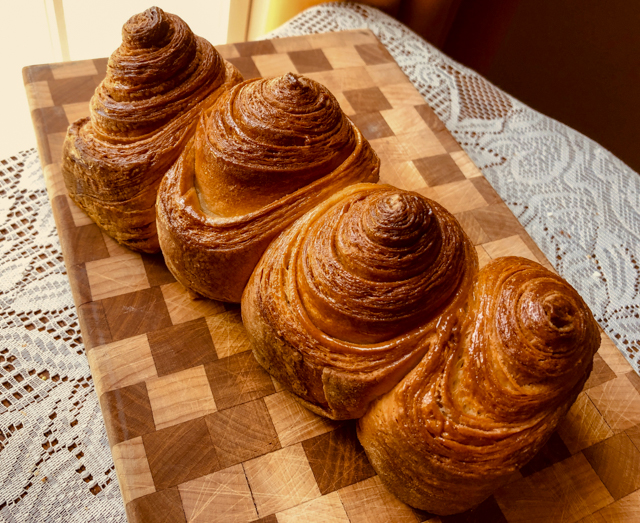
We just passed Summer solstice. It always makes me sad, knowing that days will be getting shorter and my beloved sun will stay around less and less time each day. Covid-19 is showing its ugly face again, adding more uncertainty to a year that has been full of it from the beginning. But for every yin there is always a yang, and the month of June also brought another group challenge by the tent bakers. This time Alex Tent Baker Extraordinaire came up with the theme, and he was quite straightforward with it. Laminate something. That was his  brief. A brief brief. I loved it! I had quite a few options dancing in my mind, but quickly settled on a Brioche Feuilletée, because it is all about the lamination, no distractions from it. So, without further ado, my assignment is here for you.

BRIOCHE FEUILLETÉE
(recipe from Matt Adlard’s Bake it Better)

for the dough:
415g all-purpose flour
8g salt
50g sugar
85g eggs
153g whole milk
42g soft, unsalted butter
9g instant yeast

for the butter block:
250g unsalted butter

OVERVIEW OF THE RECIPE 
(simplified version, original recipe is copyrighted)

The dough is prepared using all the ingredients and allowed to proof for one hour. It is next transferred to the fridge overnight. At that time, the butter block is made with dimensions of approximately 7 x 8 inches and also placed in the fridge.

Next day the butter block is enclosed in the dough and three folds are performed. First a double fold, the other two single folds. The dough is rolled out and cut into four strips, about 2.5 inches in width. Each strip is rolled and placed inside a loaf pan for a final proofing of 2 to 2 and a half hours.

Bake in a 325F oven for 45 minutes to 1 hour, until deep golden. Remove from the pan and allow it to cool completely.

ENJOY!

to print the recipe overview, click here

Comments: If you want to know all the details and tips that make this recipe easier to follow, you will have to join Matt Adlard’s site. It would not be fair to publish his detailed instructions here, plus his video is a great help. I’ve been a member of his online group for a few months and highly recommend it for those interested in all areas of patisserie. I will write a full blog post about it in the near future. Not only you learn a lot, but you get to interact with a lot of cool, baking-fanatic folks. See what they bake, follow their progress, share failures and victories.


Matt bakes it in a slightly different way. He adds a baking sheet and a heavy weight to the top of the pan, so that as the dough rises during baking, it gets squished on top, ending in a cool rectangular shape, laminated on all sides, but flat. I did not have a pan with the appropriate dimensions to achieve that effect, so I went with the regular baking in which it all freely explodes upwards.


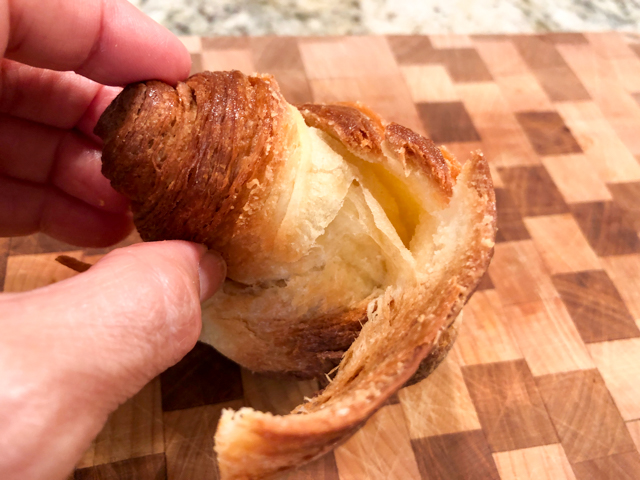
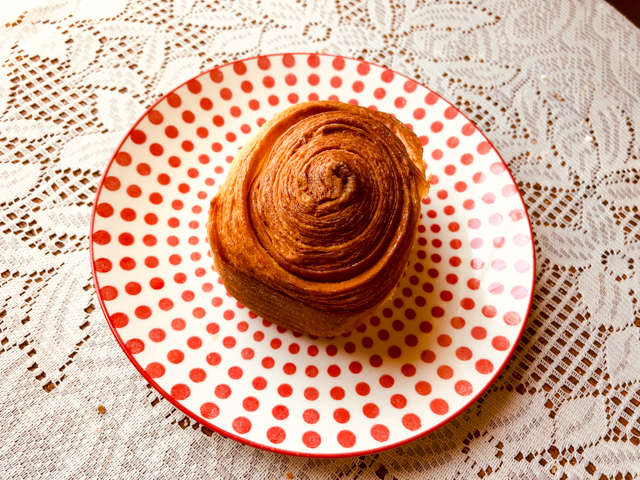
No matter how you bake it, the result will be the same: layers of buttery goodness that you roll out and enjoy. Nothing else is needed, as the bread is quite rich and indulgent as it is, but if you want to spread it with jam, more butter, clotted cream, you will not hurt my feelings. And I bet Matt will not mind a bit either.

Alex, thanks for a great challenge this month… It is hard to believe that one year ago   we were all frantically practicing for the show in our own homes, wondering  who were the other bakers, how would we get along…  Good times.

For my readers, make sure to stop by the Home Bakers Collective, to see what my friends laminated this month… If the link is not yet published, try again a little later in the day.

ONE YEAR AGO: In My Kitchen, June 2019

TWO YEARS AGO: In My Kitchen – July 2018

THREE YEARS AGO: In My Kitchen, July 2017

FOUR YEARS AGO: Secret Recipe Club: Falafel and a Bonus Recipe

FIVE YEARS AGO: Chocolate Toffee Banana Bread

SIX YEARS AGO: In My Kitchen, June 2014

SEVEN YEARS AGO:  Strawberry Frozen Yogurt

EIGHT YEARS AGO: Baked Coconut and “The Brazilian Kitchen”

NINE YEARS AGO: Honey-Glazed Chicken Legs

TEN YEARS AGO: French-Style Rolls

ELEVEN YEARS AGO: Chicken Breasts, Coffee, and Serendipity

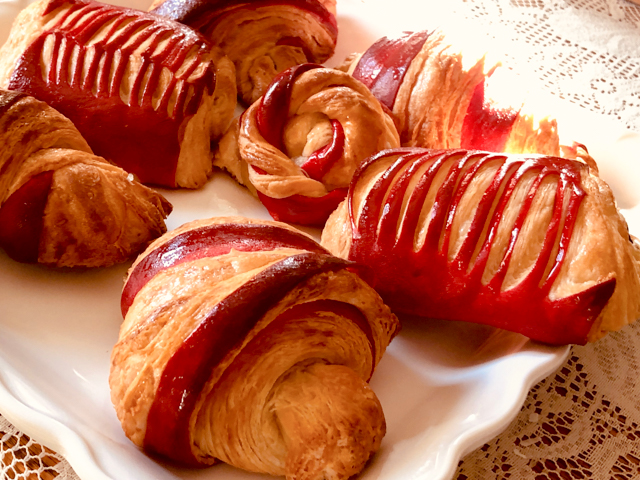
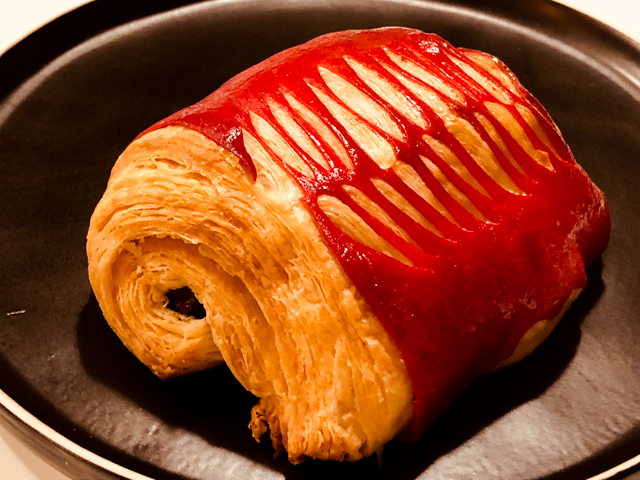
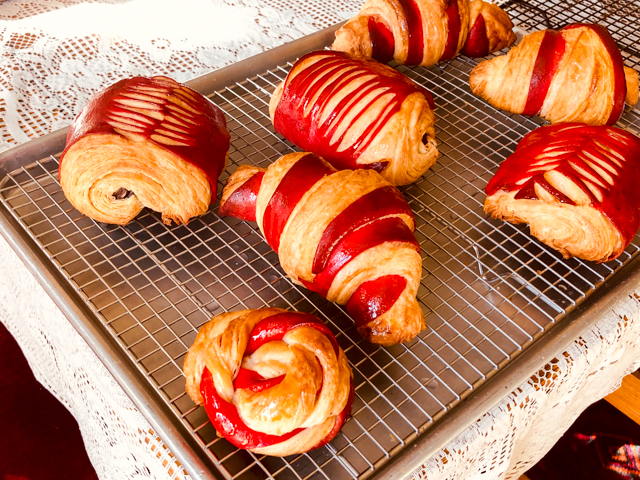
BICOLOR CROISSANT AND PAIN AU CHOCOLAT


For the past few months, I could not get bicolor croissants and their close cousins – pain au chocolat – out of my mind. As you may already know, I tend to get obsessed about things. That means that two bad batches in a row did not prevent me from trying again. They were heavy and doughy, with almost no lamination.  You probably won’t find a detailed recipe in cookbooks, but youtube videos (some not in English) promise to show you how to succeed in a home setting. Keep in mind that for the most part, these are made in patisseries by bakers who have those incredibly efficient rolling machines (sheeters) at their disposal.  Fear not, I am ready to share a recipe and a method that worked well for me. My main advice: do not rush it. This is not the type of recipe to try and adapt for a tent-baking situation. Take your time. Keep the dough and yourself cool at all times.

BICOLOR CROISSANTS & PAIN AU CHOCOLAT
(adapted from many sources)

for main dough:
490g all-purpose flour
36g sugar
10g osmo-tolerant yeast (or regular instant  yeast, same amount)
16g salt
300g full-fat milk
70g butter, melted and cooled
for butter block:
340g butter cut in pieces, cold
(unsalted Land O’Lakes *see comments)
35g flour

Batons of chocolate
1 egg for egg wash
simple syrup (water and sugar, equal amounts by weight, dissolved by boiling and cooled)

Make the dough the day before.  Add all ingredients except butter to the bowl of a KitchenAid type mixer with a dough hook. Process for about 3 minutes, then add the butter, and mix for about 4 minutes longer, at low-speed. The dough should feel smooth and elastic.

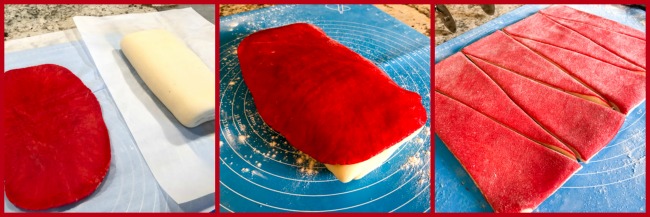
Remove from the machine, knead by hand a few times, place in a bowl coated with a little butter, cover and leave at room temperature for 1 hour. Remove 110g of dough and add a few drops of red gel dye. Wearing gloves, knead the color into the dough, adding more if necessary. It will take a little while, the color will resist mixing at first. Make sure it is totally incorporated throughout the little ball of dough.  Reserve both doughs in separate bowls, covered, and place in the fridge overnight.

Make the butter block. Add cold butter and flour to the bowl of a KitchenAid type mixer fitted with the mixing blade. Process for about 2 minutes. Make an envelope for the butter using parchment paper. Fold 24-inch length of parchment in half to create a 12-inch rectangle. Fold over 3 open sides of rectangle to form 8-inch square, creasing the folds very firmly.  Unfold parchment envelope, add the butter/flour and refold the envelope. Roll gently until the butter is uniform in thickness and forms a perfect 8-inch square.  Refrigerate 30 minutes.

Roll the main dough (with no color) over a lightly floured surface to a rectangle about 9 x 16 inches, so that you can set the butter square in the center and fold the top and bottom parts over it, with a seam in the exact middle of the butter square. Gently glue the open sides of the dough so that the butter is all cozy inside. Turn the dough so that the seam is vertical now, perpendicular to you.  Roll again to the same general dimension (9 x 16 inches).  Make the first fold: divide the dough in three pieces (eye-balling is fine). Bring the top third down, and the bottom third up, in what is known as the envelope fold. Place the folded dough in the fridge covered with plastic for 45 minutes, transfer to the freezer for 20 minutes.

Roll the dough again to the same dimension (9 x 16 inches). Make the second fold, exactly like you did the first. Place the folded dough in the fridge, covered with plastic for 45 minutes, transfer to the freezer for 20 minutes.

Roll the dough again to the same dimension (9 x 16 inches). Make the third and final fold. Bring the top part down and the bottom part up to almost meet at the center, leaving a small space between the edges, so that you can fold the dough right there in the center.  That is known as the “book-fold.”  Refrigerate for 1 hour and freeze for 20 minutes.

While the dough cools, it’s time to roll out the red dough. You need to make it thin and a little bigger than the dimension of the folded white dough, so that it sits on top of it. When the dough is out of the freezer, moisten it very lightly with water, place the rolled out red dough on top, and gently roll them both together (you can flip the dough to place the red one at the bottom after rolling a few times).

Roll both doughs together to a final dimension of 9 by 20 inches. Ideally, roll slightly bigger than that, then cut neatly to that final dimension. If for some reason some parts near the edges do not have the red dough on it, do not worry. Just proceed with cutting the pieces, it will not hurt the final look.

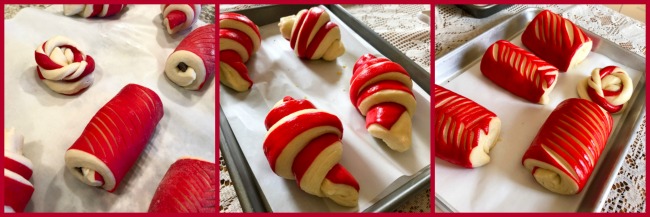
I used half the dough to make croissants and half to make pain au chocolat.  To make the croissants, I cut a 9-inch square from the dough and eye-balled triangles from it. With the rest of the dough I cut rectangles that were about 3 1/2 by 4 1/2 inches.  Shape croissants and enclose two chocolate batons per pain au chocolat, placing the red dough at the bottom in both cases.

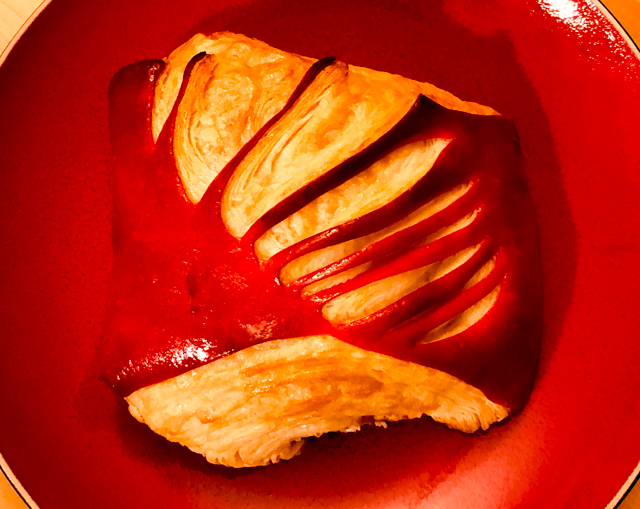
Right after shaping the pain au chocolat, make parallel cuts with a razor blade on the red dough to expose the plain dough underneath. Some scraps from the dough I used to shape as a little flower. Allow the shaped pastries to proof for 2 and a half to 3 hours.

Heat the oven to 350F (higher temperatures will affect the red color).  Brush the pastries very lightly with egg wash, and place them in the freezer for 15 minutes to allow the butter to solidify a bit. Bake for 30 to 35 minutes. Cool on a rack. If desired, brush the surface with a simple syrup while they are still hot for a little shine.

ENJOY!

to print the recipe, click here

Comments: I used all-purpose flour and American butter, not the fancy 82% or higher fat butter than many recipes recommend. American butter has slightly more water, it resists better the rolling and pounding without incorporating into the dough, and it laminates well too. Particularly with the two-color dough, I felt it gave a lighter and better laminated final product. European butter made the croissants doughy and a lot of butter leaked during baking. It is possible that I need to improve my technique before using a higher fat butter with the two-color dough. If it works well for you, go for it. Freezing the dough before baking is a nice additional step that I learned in Artful Baker and decided to incorporate in the recipe. 

In theory, there are two ways to incorporate the red dough on the plain one. You can do what I did, or you can roll both doughs to the final dimension (9 by 20 inches) and place the red on top at that time. I tried both ways, and prefer the method I shared here. It is quite tricky to roll the red dough by itself as a large sheet and it is not as efficiently “glued” to the main dough since you simply place it on top and proceed to cutting the pieces. I should also mention that Philip, Baker Extraordinaire, makes a colored dough that does not contain yeast and it works very well. Check his method here. I am going to try that next time.

On shaping. As you roll the croissants or the little pain au chocolat, it is important to make it tight, by stretching a bit, generating tension as you roll. I was a bit worried about the layer of red dough and got too gentle with the shaping, so the pain au chocolat was not as tight as it should have been. Most were already unrolling during proofing. So that is definitely a detail to keep in mind.

Overall I am pretty happy with these babies. My previous attempts were  heavy and dense, with no open structure at all inside.  These had a nice crumbly crust, good butter flavor (even using American butter), and felt pretty light when handled. All I need to do next is optimize the shaping. And perhaps explore a different color scheme… Orange? Black?

ONE YEAR AGO: Lemon-Blueberry Entremet Cake

TWO YEARS AGO: Walk Strong3: A review of Jessica Smith’s latest workout program

THREE YEARS AGO: Pork Medallions with Black Berry Compote

FOUR YEARS AGO: Indian-Spiced Chicken with Chickpeas and Spinach

FIVE YEARS AGO: Curry Cardamon Cookies

SIX YEARS AGO: In My Kitchen, March 2014

SEVEN YEARS AGOBoeuf Bourguignon for a Snowy Evening

EIGHT YEARS AGO: Chickpea Salad

NINE YEARS AGO: Soft Spot for Chevre

TEN YEARS AGO: Roasted Onion and Asiago Cheese Miche