POLENTA-CRUST TOMATO LOAF

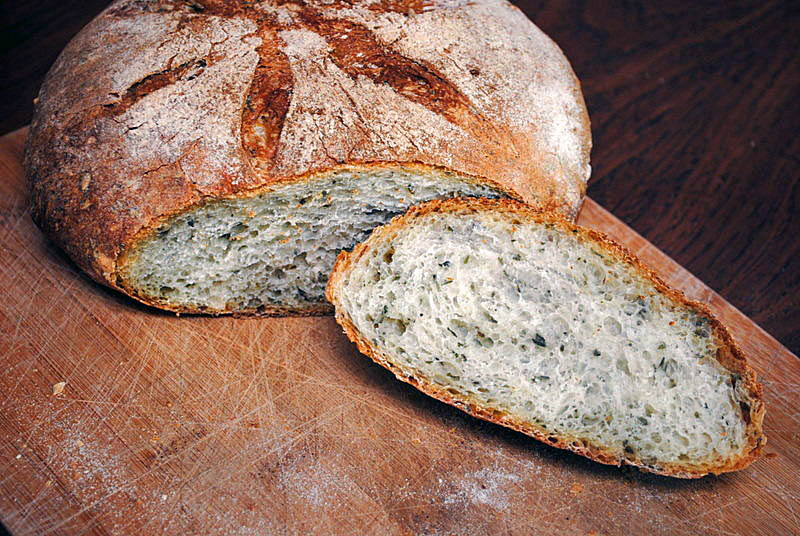
Another recipe designed by Dan Lepard, courtesy of the Guardian website. In terms of time and overall process, it is very similar to the semolina barbecue buns I blogged about last week, but it results in a bread with  a much more assertive flavor – thanks to the tomato and rosemary – and gorgeous crumb color. Even if you are new to bread baking, this recipe will not cause you any grievance – I promise… 😉


POLENTA-CRUST TOMATO LOAF

(Dan Lepard)
receita em portugues na pagina seguinte

100 g yogurt  (3.5 ounces)
25 g tomato paste (1 ounce)
25 ml olive oil (1 + 1/2 Tbs)
125 ml warm water (3.7 oz)
150 g sundried tomatoes in oil, roughly chopped (5 oz)
1 sprig rosemary, leaves picked
400 g bread flour (14 oz)
1½ tsp salt
1 tsp instant dry yeast
Polenta or coarse cornmeal, for shaping

Mix together the yogurt, tomato paste and oil, add the warm water and stir in the tomatoes and rosemary. Put the flour, salt and yeast in a mixing bowl, pour in the tomato mixture and work to a soft dough. Leave resting for 10 minutes, lightly knead on an oiled surface for 10 seconds, and return to the bowl. Repeat this minimal, quick kneading cycle twice more at 10-minute intervals, then leave the dough covered at room temperature for one hour.

Pat the dough into an oval, roll it tightly like a scroll, then roll it back and forth on the worktop, pressing down the ends so they taper slightly. Brush with water and roll in polenta or coarse cornmeal. Place seam-side down on a tray lined with nonstick paper, cover with a cloth and leave for an hour. Slash down the center and bake at 425 F (220 C) for 45 minutes. Allow it to completely cool before slicing.

ENJOY!

to print the recipe, click here

Comments: My favorite type of bread is a sourdough, made with a mixture of white and rye flours, sometimes a little whole wheat flour added in the formula.  Open crumb, hearty crust, a great match for any type of meal.  Having said that, I agree with Dan Lepard: this loaf has its place in the world, bread snobs should not be twisting their noses at it.  It smells terrific while it’s baking, almost as if you are making pizza.   Enjoy it with smoked ham or prosciutto, and for a more mellow alternative try a ricotta-based spread (ricotta, lemon zest, salt and pepper: simple, understated, but delicious).

I am submitting this red-tinted loaf to Susan’s Yeastspotting

ONE YEAR AGO: Light Whole Wheat Bread

Add to FacebookAdd to DiggAdd to Del.icio.usAdd to StumbleuponAdd to RedditAdd to BlinklistAdd to TwitterAdd to TechnoratiAdd to Yahoo BuzzAdd to Newsvine

receita em portugues na proxima pagina

SEMOLINA BARBECUE BUNS

Before we left on our journey to L.A., I had this bread in my “to bake soon” list.  Life got impossibly busy, but I didn’t worry too much, because I knew it would be a perfect bread for the nano-kitchen: minimal kneading, and doable in our toaster oven.  Several of my virtual friends made this bread and raved about it, but that’s a no-brainer: Dan Lepard is the man behind the formula.  😉

SEMOLINA BARBECUE BANS
(from Dan Lepard – The Guardian website)

75g semolina or cornmeal, plus more to finish (I used fine cornmeal)
150 ml boiling water + 200 ml warm water
25g unsalted butter
1 tsp honey (I used agave nectar)
1 Tbs yogurt
1 + 1/2 tsp salt
1 tsp instant yeast
450 g bread flour
(olive oil for kneading)

Spoon the semolina into a mixing bowl, pour 150ml of boiling water over it, stir well and leave for 10 minutes. Use a fork to mash the butter, honey, yogurt and salt into the mixture, then slowly work in 200ml of warm water, breaking up any lumps with your fingers. Stir in the yeast and flour, work to a smooth, soft dough and leave for 10 minutes.

Give the dough three 10-second kneads on an oiled surface over 30 minutes, then leave, covered, for an hour. Roll the dough to about 25cm x 35cm on a floured surface, lay on a baking tray lined with parchment paper and leave covered for 20 minutes. Cut the dough into eight flat rectangular “rolls”  but do not separate them, just make a deep incision all the way down the baking sheet. Leave, covered, until risen by half (I cut into six rectangles, and allowed them to rise for 25 minutes).

Heat the oven to 465F.  Brush the tops of the buns with water, sprinkle with semolina and score a deep crisscross on top with a knife. Bake for about 20 minutes, until brown on top.  Let it cool for at least one hour on a rack before amazing yourself at how delicious the rolls taste.

ENJOY!

to print the recipe, click here

Comments: This bread is so simple to prepare that I am still a bit shocked by how good it turned out.  If you haven’t yet been sold to the idea that minimal kneading makes excellent bread, this recipe will convince you.  I didn’t roll the dough, just stretched it lightly to preserve as much as possible the airy texture acquired in the hour long rise.

Dan made this recipe with pulled pork sandwiches in mind, and the combination would deserve to go into the Sandwich Hall of Fame.  Unfortunately, we don’t have any pulled pork at the moment, but the rolls still tasted awesome with ham, cheese and a slice of juicy tomato.

I am submitting this post to Susan’s Yeastspotting… the second bread from our Bewitching-Nano-Kitchen.

ONE YEAR AGO: Lavash Crackers

Add to FacebookAdd to DiggAdd to Del.icio.usAdd to StumbleuponAdd to RedditAdd to BlinklistAdd to TwitterAdd to TechnoratiAdd to Yahoo BuzzAdd to Newsvine

PAIN RUSTIQUE

Make this bread!  Even if you’re yeast-0-phobic,  even if you think you can’t  bake a bread to save your own life, …PLEASE  make this bread.  I’ll hold your hand throughout, and toast your success at the end!

PAIN RUSTIQUE
(from Hamelman’s Bread)

For the poolish
1 lb bread flour (3 + 5/8 cup)
1 lb water (2 cups)
1/4  tsp instant dry yeast

For the dough:
all the poolish made the previous day (about 2 lb)
6.1 oz water (3/4 cup)
1 lb bread flour (3 + 5/8 cup)
0.6 oz salt (1 Tbs)
0.17 oz yeast (1 + 1/2 tsp)

Make the poolish the day before: add water to a bowl, sprinkle the yeast on top, add the flour and mix until smooth with a large spoon.  Cover with plastic wrap and let it stand at room temperature for 12 to 16 hours (ideal temperature: 70 F).

This is what the poolish will look like the next day….

Prepare the dough:  add the flour, water and fermented poolish to the bowl of a Kitchen Aid-type mixer.   Don’t add the yeast or the salt yet.  Mix on first speed (or by hand) until it all comes together in a shaggy-looking mass.  Cover the bowl and let this mixture rest for 20 to 30 minutes.

Add the salt and the yeast over the dough, turn the mixer to the second speed and mix for 2 minutes.  Ideally, the temperature of the dough should reach about 76 F.  If kneading by hand, then work the dough until it’s smooth, about 6 minutes.

Cover the bowl and let it rest for 25 minutes.  Give a quick couple of folds to the dough (as shown here), let it rest 25 more minutes.   Fold the dough a couple of times again, and let it rest 20-25 minutes more, undisturbed.

Gently divide the dough into two pieces, trying not to deflate it too much, and place them over lightly floured kitchen towels. Cover,  and let them stay for 20 to 25 minutes at room temperature, for a final quick proofing.  No need to shape the loaves in any particular way.

Invert the dough over parchment paper, so that the floured side is now up.  Slash the bread quickly with a single stroke of a razor blade or sharp knife.

Bake the loaves in a 460F oven, with steam (add ice cubes to a baking pan placed at the bottom of the oven, or use any method of your choice to add steam in the initial baking time).  The bread will be ready in about 35 minutes.   Let them cool completely on a rack before slicing.

ENJOY!

to print the recipe, click here

Comments:  My expectations were not too high for this bread when I first made it:  no wild yeast, no involved kneading and shaping.  When the loaves were ready to go into the oven, they seemed too flat, with a tendency to spread.   However,  they had  nice oven bounce, and the simple slash perfectly coached them into the final shape.   Each loaf was light as a feather, with a nice crumb and subtle sour flavor, thanks to the poolish.

Even though this recipe comes from Hamelmn’s book,  I did not make it as part of the Mellow Baker’s Challenge.  I had to take  a step back and turn into an avid observer of the group instead of a participant.  But make sure you jump over there to see what they are baking,  some great breads for the month of August, including baguettes…  😉

I am submitting this post to Susan’s Yestspotting

ONE YEAR AGO: A Souffle to Remember…  Julia Child

Add to FacebookAdd to DiggAdd to Del.icio.usAdd to StumbleuponAdd to RedditAdd to BlinklistAdd to TwitterAdd to TechnoratiAdd to Yahoo BuzzAdd to Newsvine

BBA#15: ITALIAN BREAD

IMG_2097

Fifteen breads down, twenty-eight to go…

Once more I should say that all recipes from the challenge can be found here, a must-have book for any serious (or beginner) bread baker.

Reinhart’s Italian Bread is quite similar to the previous one (French Bread), except that it takes a “biga” instead of a “poolish”. No need to run away all scared, those are terms to describe the pre-mixture of flour, water, and yeast, that generally ferments for 24 hours before being used in the final dough. Usually a “biga” is firmer (contains less water).

For this bread, I changed the method of kneading. Instead of adding the dough to the Kitchen Aid and watching the machine do its job, I kneaded it myself, but used my favorite method: folding. I put the advice from bakers over at “The Fresh Loaf” to work, folding the dough twice, at 40 and 80 minutes, then forming a “boule” at 120 minutes. One more hour rising, and into the oven it went. These pictures show the second folding (made in two directions), and the “boule” right after shaping. Notice how bubbly it was, even before the final rise.
composite1

After 1 hour at room temperature, the dough rose about 1.5X of its original size, as expected. It had a spongy texture, airy and light. It lost some of it when I dumped it into my clay pot, but not much. It had good enough oven spring to recover.
finalboule

This bread is spectacular, the crumb has excellent texture, the crust is not too hard, not too soft, just right. As my husband put it, “it is not very easy to stop eating it”. Indeed. It was a wise decision to make half the recipe, because there is only so much running one can do. 😉
IMG_2095

A final shot of the crumb…

crumb

BBA#11: Cranberry-Walnut Celebration Loaf

Eleven breads down, thirty-two more to go!

A reminder to readers: recipes for all the breads from “the BBA challenge,” are found in Peter Reinhart’s book.
IMG_1656

My hopes were not high for this one.   It’s a bit too festive for my taste, and I had trouble with a previous braided loaf (Challah), which made me a little worried.  However, much to my own amazement, this loaf was not difficult and turned out very well. My only remark is that the water  called for in the recipe (1/4 to 1/2 cup) seems excessive. I did not add any water, and the dough was already almost in need of a little flour.  Be careful if you make it, and hold back on the liquid  (thanks, Susie! If it wasn’t for your heads up, I would’ve probably ended up with trouble in my hands… :-))

The dough contains eggs, milk, cranberries and walnuts;  it is leavened by commercial, instant yeast.   After rising for 2 hours it is cut in 6 pieces (3 large, 3 small), that are shaped into logs, and braided. The small braid is placed on top of the big one, forming a double-braided loaf, quite impressive!

doughballsIMG_1644IMG_1645formed

cranberry1

… a final shot of the crumb….

IMG_1660

We both loved the bread!  It’s rich, but not overly sweet due to the tartness of  the cranberries, and great toasted.   The orange extract complements the cranberries, but if I made it again I’d use orange zest instead.