
I’ve wanted to make crumpets from scratch for the longest time! I love the fact that they are full of tiny holes, smoother and creamier than regular bread, perfect to slather with butter or jam, or top with a poached egg and indulge… Recently I took a major step in the right direction, by getting crumpet rings (remember?). And tried not one, but two recipes, one leavened by sourdough starter, and the second a more authentic version, with commercial yeast and baking soda. Both methods produced completely different types of crumpets, and I favored the non-sourdough version. I know, who could imagine that? 😉
 (click to enlarge)
TRADITIONAL CRUMPETS
(From Andy’s blog at The Fresh Loaf forum)
250 g bread flour
5 g salt
15 g yeast
275 g water
0.75 g bicarbonate of soda
70 g water
Add the flour and the salt to the bowl of an electric mixer, and mix on first speed for a minute. Dissolve the yeast in lukewarm water. Combine the yeast with the flour/salt and beat on first speed for 2 minutes. Scrape the bottom and the sides of the bowl, and beat on second speed for 6 minutes. Cover the bowl and let it sit on a warm place for 1 hour.
Heat a griddle to 390F (200 C). Dissolve the bicarbonate in the cold water and mix this solution to the batter. Use right away, pouring a small amount of batter in well greased crumpet rings. Cook for about 8 minutes on the first side, until bubbles form and the batter seems almost dry on top. Remove the rings – carefully, they are hot! – and flip the crumpets, cooking for no more than 2 minutes on the second side. Cool on a rack, and enjoy!
to print the recipe, click here
SOURDOUGH CRUMPETS
(from The Sourdough Companion)
Preferment
125 g all purpose flour
175 g water
12.5 g sourdough starter
Batter
125 g all purpose flour
175 g milk
300 g preferment (all the amount made)
5 g salt
5 g bicarbonate of soda
Make the preferment and let it sit at room temperature for 12 to 24 hours.
Next day, mix all the ingredients for the batter, and let if sit for 4 hours undisturbed at room temperature. Heat a griddle to 390 F (200 C). Pour small amounts of the batter in greased crumpet rings, and cook for 8 minutes on the first side, remove the rings carefully, and flip them to cook on the second side for a couple of minutes. Cool on a rack, and enjoy…
to print the recipe, click here
Comments: Both recipes are pretty straightforward, with little hands-on time required. The traditional method allows you to have crumpets ready in about 1.5 hours, versus a little over 4 hours for the sourdough variation (not counting the pre-ferment prepared the day before). The next sets of photos give you an idea of how different the batters looked right before cooking, and how the authentic version gave a more hole-y texture in the crumpets already during cooking.
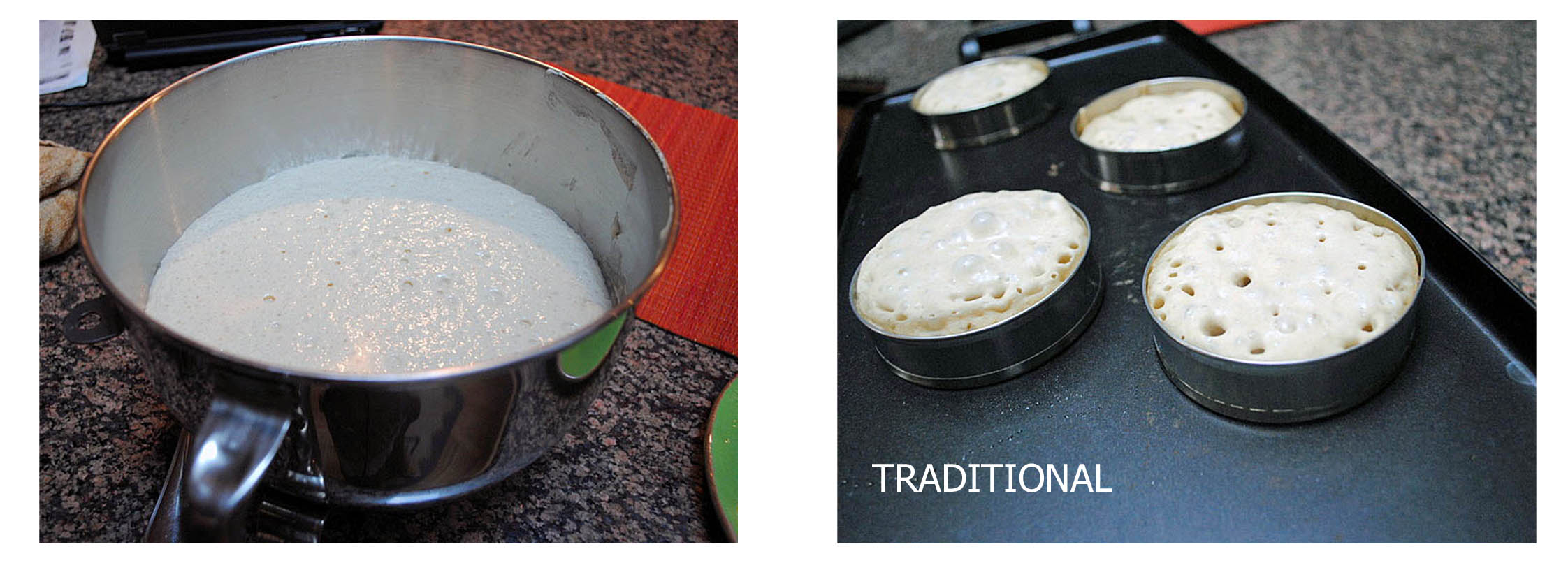
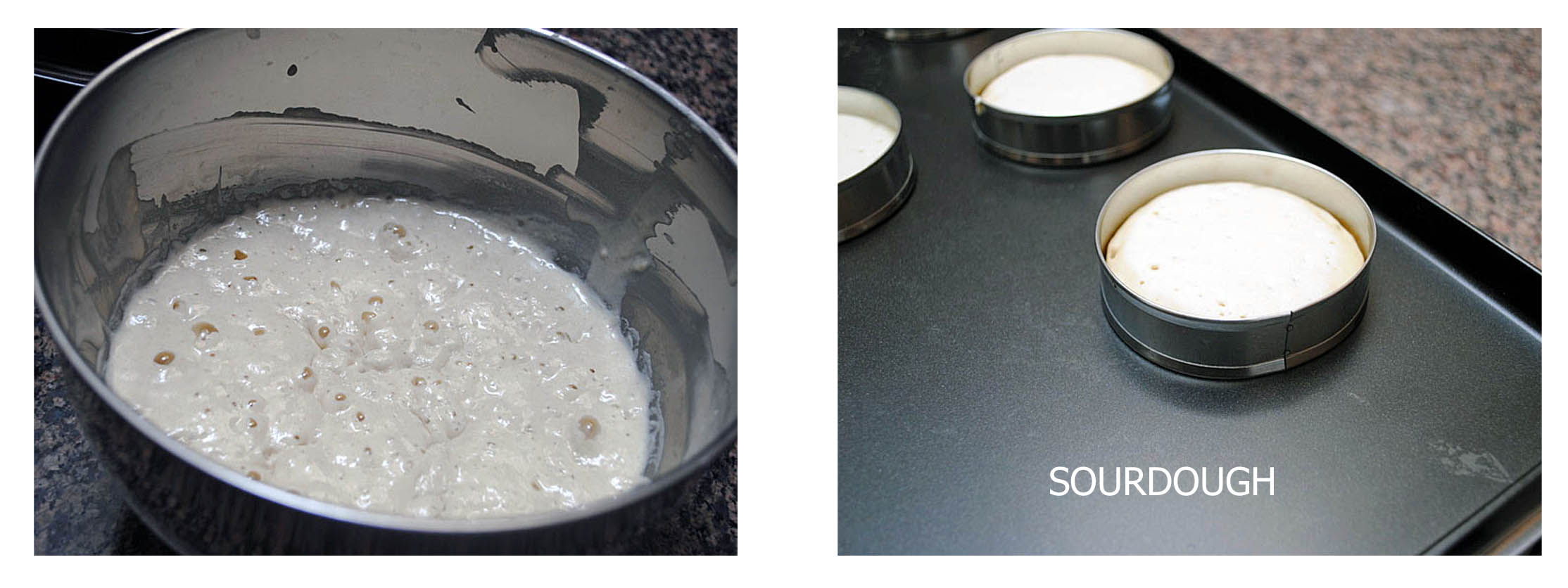
A few pointers for success:
1. Do not fill the rings more than halfway, because if you do, the holes will close when you flip the crumpets. It is tempting to add more batter, but resist the urge to do so. Also, it will be harder to cook them through if they are too thick.
2. Do not cook them on a griddle that is too hot, or you will have a hard crust at the bottom and the crumpets won’t cook uniformly. Better to keep a lower temperature and cook longer.
3. Do not cook the second side longer than 2 minutes, or you might end up with an English muffin! 😉
4. Grease the rings again for each batch of crumpets, so that they are easily removed. Crumpets are fragile, if they stick to the ring their shape can be compromised.
5. The rings are hot, and stay hot for a while once you remove them from the griddle. It is easy to forget about it as the second batch gets going (sigh).
In my second attempt – the traditional recipe – things worked a lot better, and even the crumpets that were a bit too thick and “lost the holes” on the surface after flipping, revealed a wonderful crumb structure…
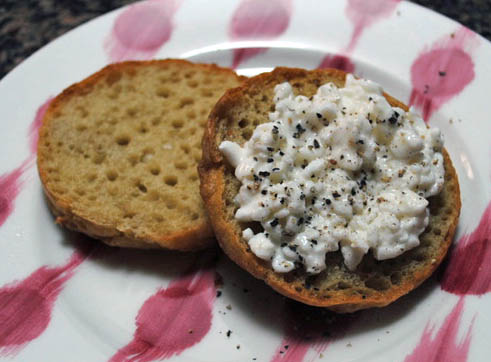
You don’t need rings to cook English muffins because they hold their shape well, but they are a must-have for crumpets. You can of course improvise using empty, clean cans of appropriate diameter. This would be a fun weekend project, kids would love to help you out…
I am submitting this post to Susan’s Yeastspotting…
ONE YEAR AGO: Sweet Emergency
TWO YEARS AGO: The Bread We Love


 Bewitching Kitchen