POTATO ROQUEFORT CAKES WITH RIPE PEARS

I don’t know Michael Bauer, so I have absolutely no ulterior motives for returning to the recipes of his book ‘Secrets of Success,” except for the fact that many of them result in absolutely delicious dishes 😉

This recipe comes from Fabrice Marcon, who was a sous chef for Paul Bocuse, and then opened his own restaurant in San Francisco, Hyde Street Bistro. His cuisine falls into the category of “French-Californian,” simple words that attract me the way that flowers attract bees. France and California: two places I called home in the past, that always bring a nostalgic smile to my face.

Try this dish, it’s very good.
potatocakes1

(receita em portugues na pagina seguinte)


POTATO ROQUEFORT CAKES WITH RIPE PEARS

(from Michael Bauer, Secrets of Success, original from Fabrice Marcon)

4 russet potatoes, scrubbed
8 ounces firm Roquefort cheese, crumbled
2 T olive oil
salt and pepper
2 Anjou pears, diced
1/2 pounds salad greens of your choice
1 tsp fresh tarragon, chopped
hazelnut oil

for vinaigrette

1 T red wine vinegar
1 t Dijon mustard
1 shallot, minced
1 T olive oil
salt and pepper

Heat the oven to 375F, and bake the potatoes until tender (about 1 hour). Let them cool until you can handle them, peel them, and transfer the flesh to a bowl. Mash slightly, add the roquefort and 1 T olive oil. Stir until smooth. Season to taste with salt and pepper, going light on the salt as roquefort is salty. Form the mixture into 4 equal patties, 1/2 inch thick. Refrigerate for 2 hours.

Make the vinaigrette by whisking the vinegar, mustard, and shallots in a small bowl to blend well. Slowly whisk in the olive oil to form an emulsion. Season with salt and pepper. Refrigerate until ready to use.

Heat the oven to 350F. Heat the remaining tablespoon of olive oil in a skillet over medium heat. Add the potato patties and brown on both sides until golden brown, 7 minutes total. Transfer them to the oven and bake for 5 minutes.

Meanwhile, make the salad. Toss the pears with the salad greens and tarragon. Add the vinaigrette and place in a serving bowl, or divide into individual plates. Top the salad with the potato cakes, and drizzle with a little hazelnut oil.

(serves 4 regular guests, or 2 very hungry people… )

ENJOY!

to print the recipe, click here

Comments – Great food is all about contrast. A little spice, a little sweetness, something smooth, something crunchy, teasing your palate at every bite. This dish is it. The roquefort cheese (which must not be too soft or the cakes will not stand up to the frying), counteract the sweetness of the pears extremely well, and the hazelnut oil ties it all. Who doesn’t like cheese, fruit and nuts? 😉 The cakes are wonderful by themselves, but please follow Marcon’s take on it, you won’t regret it.
Continue reading

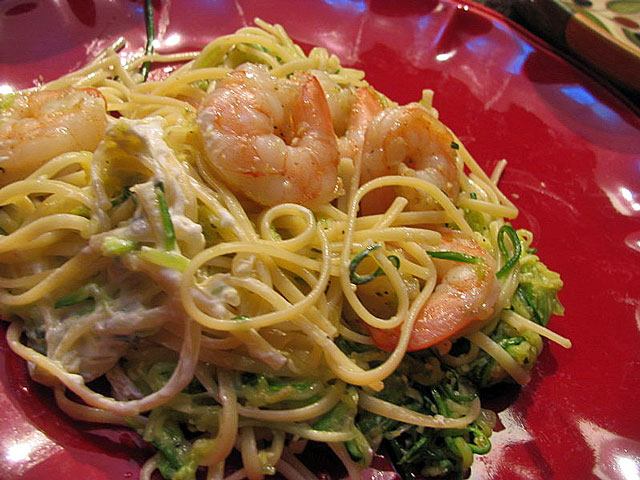
PASTA WITH ZUCCHINI STRANDS AND SHRIMP

The pasta of my childhood was all about the sauce, either a heavy red sauce,  or an equally heavy white sauce, often loaded with cheese.  I loved them both, and I still make slightly lighter versions every once in a while.   But, over the past few years my taste buds gravitated more and more towards pasta with veggies.  Now the sauce plays a secondary role, formed in part  by a simple ladle of the pasta cooking water, full of  the starch released during cooking.

The possibilities for this kind of dish are nearly endless.  I’m fond of cutting zucchini to match long stranded pasta, like spaghetti or fettuccine.    This recipe, which I threw together in minutes the other day, is perfect for weeknights: quick, simple to make, not too heavy, but substantial enough to leave you satisfied and happy at the end of a busy day.

PASTA WITH ZUCCHINI STRANDS AND SHRIMP

served

(serves two, amounts are pretty flexible)

dried spaghetti, fettuccine or any long strand pasta
12 large shrimp, peeled and deveined
2-3 medium size zucchini
1 shallot, finely diced
1 T olive oil
1/2 ounce goat cheese, crumbled
lemon zest
salt and pepper

Place a large pot with water to boil.

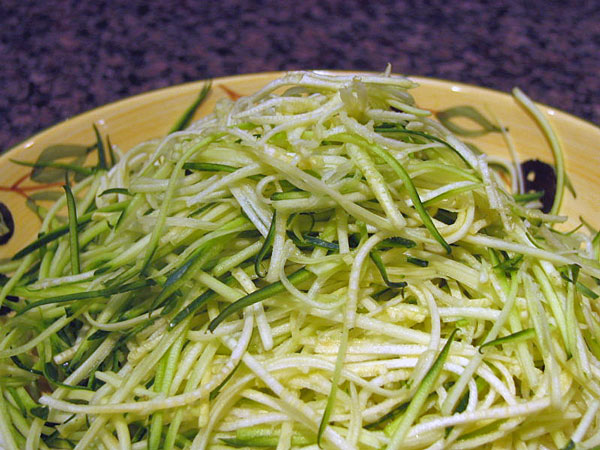
Prepare the zucchini by cutting off both ends and using a mandolin or food processor to cut it lengthwise  into fine strands. Ideally, you want the dimensions of the zucchini to match the pasta, but don’t worry too much about it, just make sure to have long, even-sized strands.

When the water boils, add the pasta:   while it cooks, heat a little olive oil in a large saute pan, add the diced shallot, season lightly with salt, and cook for a couple of minutes in medium heat.  Add the shrimp and cook on both sides until opaque, do not overcook.  Remove the shrimp to a plate and add the zucchini to the pan, increasing the heat to high.  Season with a little salt and pepper, and when the zucchini cooks down return the shrimp to the pan.  Cook it together with the zucchini for a minute.

When the pasta is cooked al dente, remove 1/2 cup of the cooking water and set aside;  drain the pasta and add it to the zucchini/shrimp mixture.  Add some of the pasta water to get the consistency you like, immediately sprinkle the goat cheese and mix everything gently to allow the cheese to slowly melt and incorporate into the dish.  Right before serving sprinkle lemon zest on top of the pasta, and adjust seasoning if necessary.

ENJOY!

to print the recipe, click here

Comments: Zucchini strands or ribbons are a busy cook’s best friends!  If you have a food processor, it takes just seconds to cut, but if you prefer not to deal with washing the processor, a mandolin or a box grater, which is what I used, works well too.

julienne1

The amounts are flexible:  the higher the proportion of zucchini, the lighter the dish will be.  It’s is a wonderful way of “stretching” the pasta, by shaving off some calories without compromising flavor.

I like the combination of goat cheese with zucchini and shrimp.   Some people find that seafood and cheese don’t go well together, but in this case I beg to differ.

You can make many variations on this basic dish – omit the shrimp, add black olives, sun dried tomatoes, fresh herbs such as oregano, mint, or basil.  Zucchini is very “social”, enjoys playing with all sorts of flavors, so let’s profit from it  😉

para receita em portugues, siga ate’ a proxima pagina….

Continue reading

CHICKEN PARMIGIANA 101

parmigg1

When a person has a cookbook addiction, planning meals can be stressful.  Like a dog with five balls to fetch, I go from one cookbook to another, saying to myself “this might be pretty good“, or  “wow, I’ve got to make this one instead“…   But, the thing is that the meals we love to eat, the ones we crave the most, are not from cookbooks.  When I ask my husband what he’d like to have for dinner, he often says “you haven’t made chicken parmiggiana in a while“….  The truth is, I sometimes ask the question hoping for exactly that  answer, as I also love it and crave it.   My Mom used to make some type of parmiggiana all the time, chicken, beef,  so I have lots of fond memories.  Once I started making it for my own family, they also loved it, closing a wonderful cycle.

This post is written with a special someone in mind, my youngest stepson who is in college and starting to cook  for himself and for friends.  He’s had my chicken parmiggiana many times, I know he’l love to make it, so I’ll be going through every step showing exactly how I do it, in a  Crash-Course: Chicken Parmiggiana 101.

Alex, this one’s for you!  😉

CHICKEN PARMIGGIANA
(family recipe; step by step photos after the jump)

ready2

3 boneless chicken breasts, preferably organic

salt and pepper

2 eggs, beaten with 2T water and a pinch of salt

1 cup flour

1 cup bread crumbs

1/4 cup vegetable oil

2 cups tomato sauce (bottled or homemade)

shredded cheese (mozzarella or another melting cheese of your choice)

Butterfly the chicken breasts (see comments for explanation), season both sides with a little salt and pepper. Pound the fillets gently with the flat side of a meat mallet or the handle of a table knife, protecting the meat with plastic (Saran Wrap or similar).

Place three bowls or trays side by side, add flour to the first, season the flour with 1/2 tsp salt and a little black pepper. Add the beaten eggs to the second, and bread crumbs to the third.  Coat the chicken fillets with flour, transfer to the egg mixture, coating both sides with it. Allow the excess to drip out, transfer the meat to the bread crumbs tray.  Pat the bread crumbs well all over the meat, to make it stick.

Heat vegetable oil in a large frying pan until  very hot but not smoking. Fry each piece of chicken on the first side until golden, 90 seconds to 2 minutes. Turn to fry the second side for a similar amount of time.  Remove from the oil and place over absorbent kitchen paper to blot excess oil.  When all pieces are fried, place them in an oven-proof baking dish or cookie sheet, add tomato sauce and shredded cheese on top.

Place in a 350F oven for 15 minutes. If you like, turn the broiler on high for a couple of minutes to get a nice browning.  Serve immediately with cooked pasta in tomato sauce, or any other side dish of your preference.

ENJOY!

to print the recipe, click here


Continue reading

BBA#26: POOLISH BAGUETTES

These days the the wonderful aroma of bread is wafting through the Bewitching Kitchen  …   For those who don’t know about “The BBA Challenge“, a few months ago Nicole, of  “Pinch My Salt“, decided to bake every  bread from Peter Reinhart’s   book  “The Bread Baker’s Apprentice“, and sent out a virtual invitation to anyone interested in joining her.    It involves forty-three breads in all,  made in the order that they appear in the book.  Over two hundred people accepted the challenge, including me.  It’s been a ton of fun so far, with ups and downs, successes and failures.

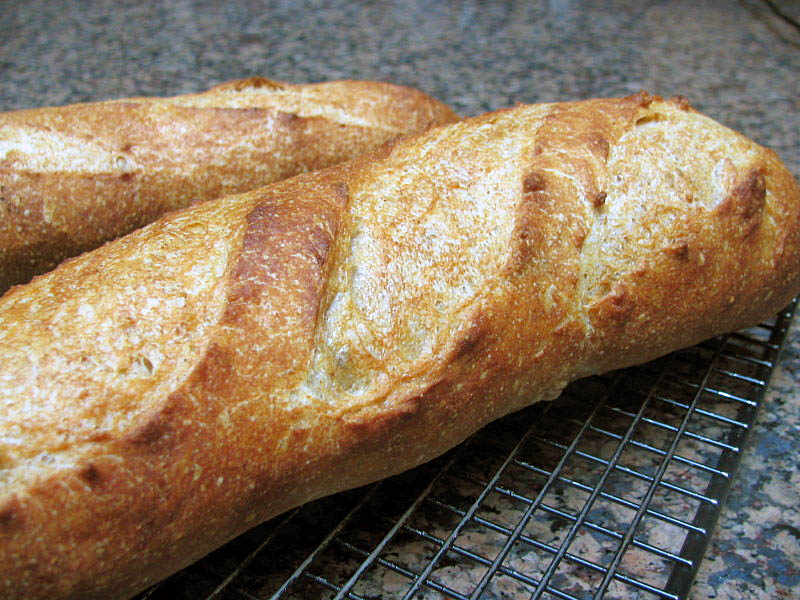
Here we are, at recipe number 26: Poolish Baguettes

twobaguettes1cut

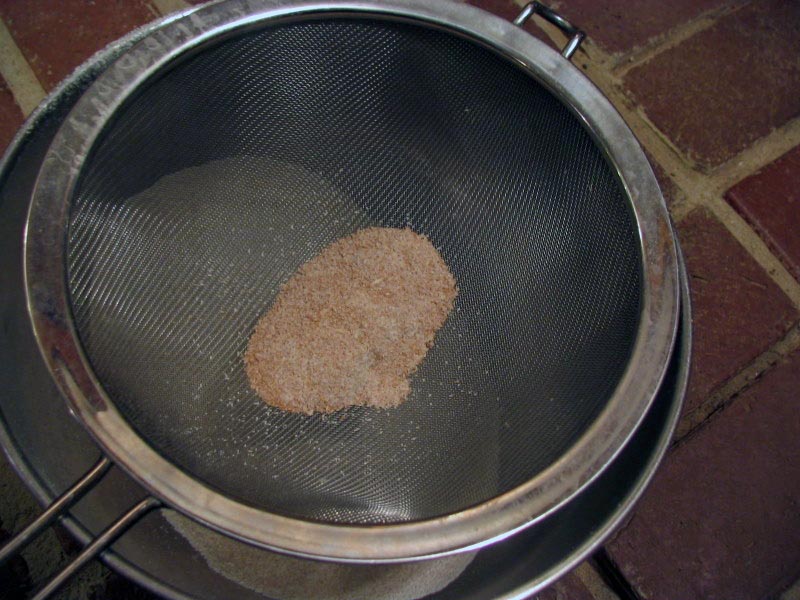
Poolish is a soft mixture of flour, water and yeast that ferments overnight (or longer) and then gets incorporated into a bread dough.  In this recipe, the dough contains both white and whole wheat flour, but the whole wheat is first sifted to remove some of the bran.  It’s an interesting method, and here’s all the bran left behind after sifting a few ounces of flour:

sifted

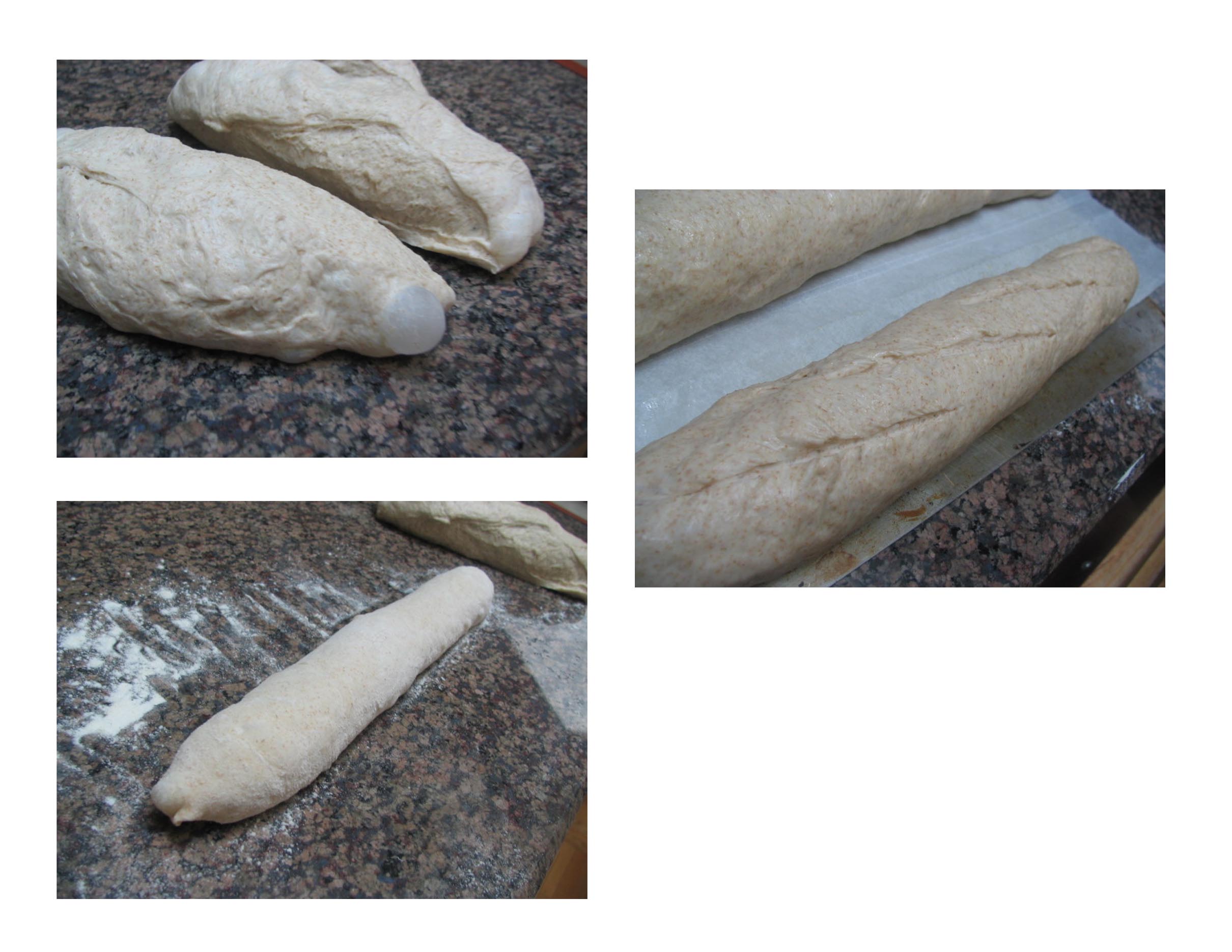
Reinhart’s recipe calls for kneading the dough.  I prefer folding instead of kneading, so that’s what I did: 3 folding cycles during the initial 2 hours of fermentation.  After cutting the dough into three pieces, I shaped each one as a baguette.  After two more hours rising, the baguettes were slashed with sharp razor blade, and placed in the oven.

Notice how bubbly the dough was…

compositeEven though  my slashing skills still need improvement, this time my shaping wasn’t too bad.   There are many online videos showing how to shape a baguette;  maybe one day if I get really good at it… I’ll post my own  😉

In the meantime, you can watch a particularly instructive video here….

These baguettes were delicious!   I’d probably reduce the proportion of whole wheat in the dough, but this recipe is already a winner for me and my husband.

twobaguettes

BBA#25: PIZZA NAPOLETANA

pizza2

I was looking forward to this recipe, because for years I’ve been making pizza dough from a recipe published in Fine Cooking;  the BBA Challenge gave me the impetus to try something different.   Interestingly enough, my usual method is similar to Peter Reinhart’s, but it takes a little less olive oil, and is made in seconds (literally) in the food processor.

Reinhart’s recipe uses a regular mixer (or hand kneading) to make the dough, that then goes into the refrigerator for 1 day.  Two hours before making the pizza, he brings the balls of dough to room temperature.  In the book you’ll see a photo of Peter himself throwing the dough up in the air like a pro. I was looking forward to giving it a try, but my dough was just too uncooperative.   As I prefer to avoid  wearing the food that I’m cooking, I stretched it with my hands instead. 😉

Without further ado, some pictures of my pizza adventure!

The dough is supposed to stick to the bottom of the mixer, never clearing it completely…

dough1

I made four balls of dough with the full recipe….

dough2

And after spending the night in the fridge, they came back for a final rise at room temperature…  very soft and bubbly-looking…

ballsdough

Some of the ingredients we chose: mushrooms, tomatoes, black olives, sliced ham, fresh basil…  plus the usual suspects (homemade tomato sauce & mozzarella cheese)

ingredients

Ready for the oven, a mushroom and black olive concoction….

readyoven

The pizza was good, but both me and my resident food critic prefer the Fine Cooking recipe, which I’ll describe on my blog in the near future.

IMG_2664

I should point out that most of the bakers loved this recipe, and you can check two of them at these links:

for “The Other Side of Fifty”, click here….

For TxFarmer and her take on a pine nuts pizza, click here….

Twenty-five recipes down, only eighteen to go!