MANDIOCA FRITA 101: FRIED YUCCA ROOT

I suspect that many people have never tried it, and that those who saw manioc root for sale didn’t take it home, because it looks too strange and intimidating.   That’s  all quite sad, because it means they’re missing this: the Brazilian version of french fries.

For many Brazilians, “mandioca frita” is even better than french fries.  I know, it sounds heretical, but trust me – once you try it you will be hooked.  Crunchy outside, creamy inside, with a flavor that can only be described as addictive.    I won’t lie to you, mandioca  frita takes some effort.  But  if you follow my instructions you won’t regret it.

Manioc, also known as cassava and yucca, is a major ingredient in many cuisines of the world.  You can read all about it here.

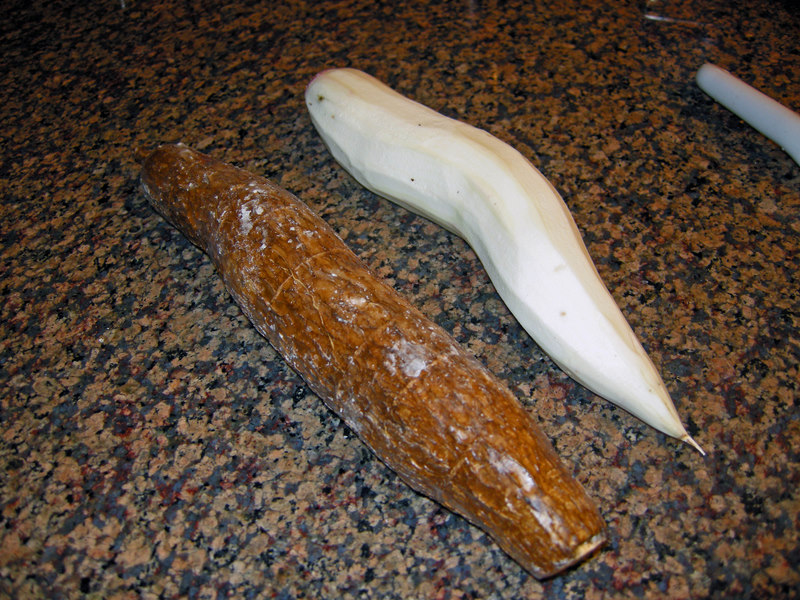
To cook the manioc, you first must peel it, a task that requires a good quality veggie peeler.  The root is often sold covered with a thin layer of paraffin, but don’t worry about it, just peel the brown skin to reveal the  white root underneath (Don’t even consider feeding the peel to your garbage disposal – you’ve been warned!).

Here’s a before and after shot…
Next, using a big, sharp knife and some caution cut it into pieces:  it’s a reasonably tough root….

… now you’re ready to begin cooking.  Fill a large pan with slightly salted water, and place the pieces of manioc inside.  Bring it to a boil, reduce the heat and allow the pieces to cook until they’re tender, easily pierced with a fork  (the time is somewhat unpredictable,  anywhere from 25 to 50  minutes).  Some pieces might burst open;  just remove them from the water.   In this photo you can see what they look like when ready.

Cooking manioc is a labor of love.   Not all the pieces will be ready at the same time, and some pieces might never become tender.  In Brazil, “mandioca” is sold in street markets as well as grocery stores, and similar to what happens in France, once you establish a relationship with a particular seller in your neighborhood,  you’ll always have great quality mandioca.  😉

Once you cook it, you’ll notice a tough “string” in the very center of the root:  remove it before frying.  It’s too tough to eat, although it won’t hurt you if you don’t remove it.

Here in the US I’ve found excellent manioc root in Asian markets, but as you can see from the next photo, in the same batch I had a mixture of varieties (white and yellow), something that never happens in Brazil, because they would be sold separately.   Their taste is almost identical, although in my family you might witness heated discussions defending the qualities of one kind over another.  To avoid taking sides,  I pledge endless love for both.

At this point you can fry them right away or save them for later.  I normally cook a large batch, fry as many as we want for dinner, and then freeze the rest.  If you have a vac-saver system, you can use it to store the  cooked manioc root.    When you want to fry them, simply remove from the freezer and let them sit for half an hour; no need to even completely defrost them,  although I wouldn’t go straight from frozen into the hot oil.

To fry the cooked pieces, add 1/2 inch of vegetable oil to a large skillet  and heat it until the manioc sizzles when it touches the oil.  Fry as many pieces as will fit without crowding, and allow the first side to brown before moving them around, or they’ll get a bit greasy.    When finished frying, put them on absorbent paper and add some salt to taste.

Now, close your eyes, and dream of a tropical beach, coconut trees, a hammock, and perhaps a refreshing “caipirinha” with your mandioca frita!

TRIED AND TASTED ROUNDUP

Last month I participated for the first time of a monthly net-event called “Tried and Tasted“, in which food bloggers pick recipes from one particular blog to cook and post their comments.

The blog that took the center stage was Kevin’s “Closet Cooking“.    You can see the roundup of 21 of his recipes by visiting Hema’s site, “Salt to Taste”, cliking here.

LET IT SNOW, LET IT SNOW, EGGS IN SNOW

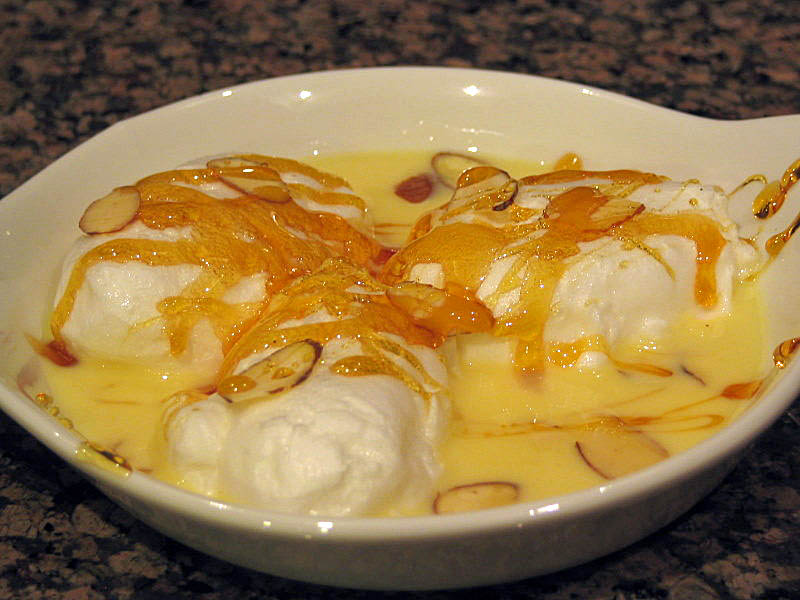
Eggs in snow” or “oeufs a la neige” or “ovos nevados“… conveys the same delight in any language: a classy, delicious, impressive dessert, that’s surprisingly simple to make. Besides that, you can prepare its components in advance, which is the golden rule for a relaxed host.


OEUFS A LA NEIGE

(adapted from several sources)

for the creme anglaise
4 egg yolks
1/2 cup sugar
1 tsp cornstarch (optional)
1 + 1/2 cup boiling milk

for the meringue
4 egg whites
6 Tbs sugar
1 tsp vanilla
1/4 tsp cream of tartar
1/4 tsp salt

for the caramel glaze
2/3 cup sugar
1/4 cup water

Thinly sliced almonds (optional)

Prepare the creme anglaise: beat the sugar and yolks with an electric mixer for a few minutes, until the color turns pale yellow and the texture becomes somewhat thick (ribbon stage). Beat in the cornstarch, if you decide to use it, and while still beating, slowly add the hot milk without scorching the egg yolks.
Transfer the mixture to a saucepan and warm over low heat, while constantly stirring. Don’t let it boil, but bring the temperature to 170F on a candy thermometer. Remove from heat and pass it through a fine sieve to remove any bits of egg yolk that might ruin the texture of the creme anglaise. Put it in the fridge until ready to assemble the dessert.

Prepare the meringue:
Starting with egg whites at room temperature, beat them with the vanilla, cream of tartar, and salt until soft peaks form. Add the sugar and continue beating at very high speed, until the peaks are all glossy and thick.
Heat water in a large skillet to 180F (at this point, the water will form bubbles on the edges). Using two tablespoons or an ice cream scoop, spoon mounds of meringue and gently dislodge them into the water. You can cook several at the same time, making sure that the water never boils. If it does the meringues will disintegrate. Cook them for 3-4 minutes per side, then transfer to a baking sheet lined with a soft cloth to drain any excess water. Reserve in the fridge.

When ready to assemble the dessert, add about 1/4 cup of creme anglaise to the serving dish and add 3 cooked meringues to the dish. Sprinkle on some almonds and glaze everything with streams of caramel, made as follows:

Add the sugar to a small saucepan, drizzle the water on top. Set the mixture over medium-low heat, and gently swirl the pan until the sugar dissolves. Then, increase the heat to high, cover the pan, and boil the caramel for 2 minutes. Remove the lid and continue boiling until the sugar turns amber. Place the bottom of the pan in cold water to rapidly cool it, and working quickly, dip a fork in the caramel and allow it to stream through the tines of the fork onto the  cooked meringue and almonds.

Serve immediately, or keep in the fridge for 1-2 hours.

ENJOY!

to print the recipe, click here

for more photos and comments, keep reading

BBA#36: STOLLEN

The Bread Baker’s Apprentice Challenge, the adventure of baking every single recipe from Peter Reinhart’s book, brings us to Stollen, a festive European-style fruit-and-nut bread.   Once more, I cannot say I was thrilled about making it –  as far as fruit-breads go,  I like panettone, but have never tasted stollen – the sugar coating seemed excessive to me.   But, as happened in the not-too-distant past,  I was pleasantly surprised by a nice bread that, without the challenge, I would never attempt to make…

The previous three or four breads were all a bit involved, in the sense that they required a sourdough starter, sometimes a soaker in addition to it.  Stollen is much simpler – you can mix and bake the dough in the same day.   The recipe calls for a sponge made just one hour before the complete dough.

The dough doesn’t rise a lot, but it smells wonderful from the very beginning, thanks to the cinnamon, brandy, orange and lemon peel it contains.  Mr. Reinhart offers two different shaping methods, a regular loaf, and a crescent-shaped bread,  with a special fold all along it.
I chose the latter.

A few photos of the preparation…

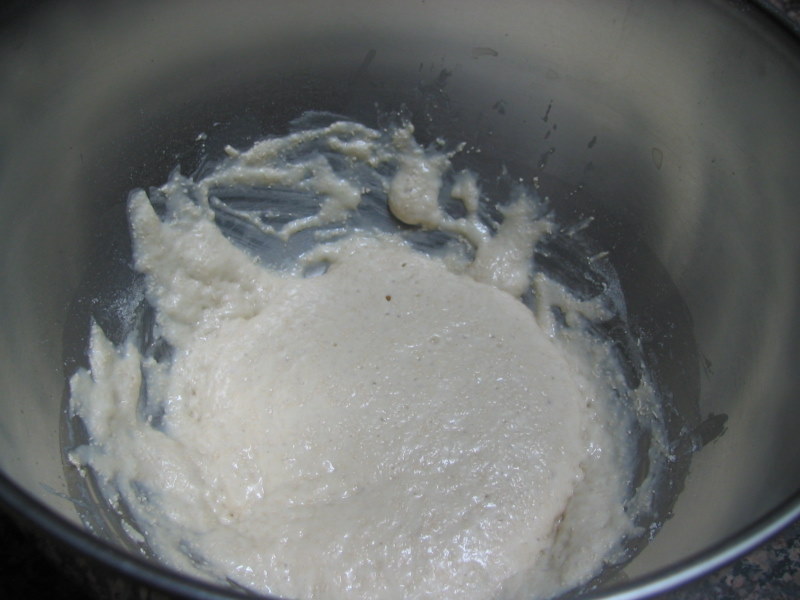
The sponge, almost ready to be mixed with the rest of the ingredients…

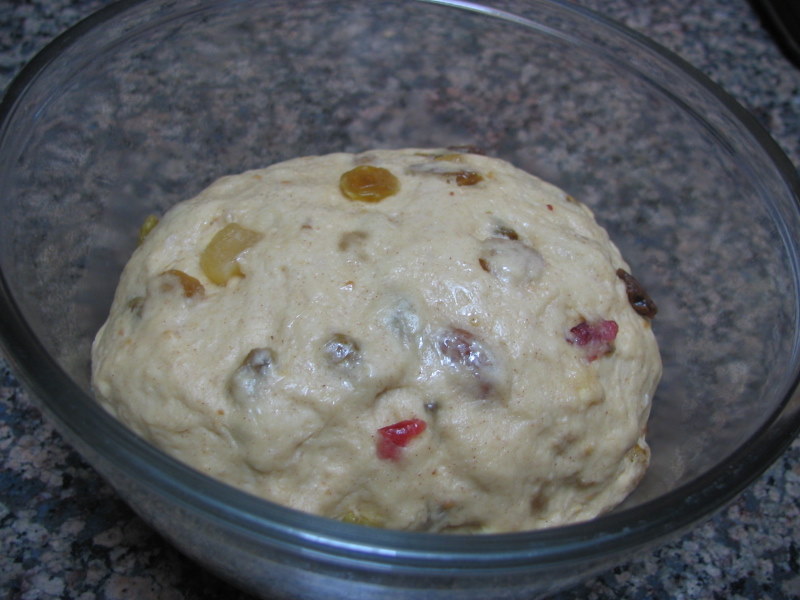
The dough, after 45 minutes rising…

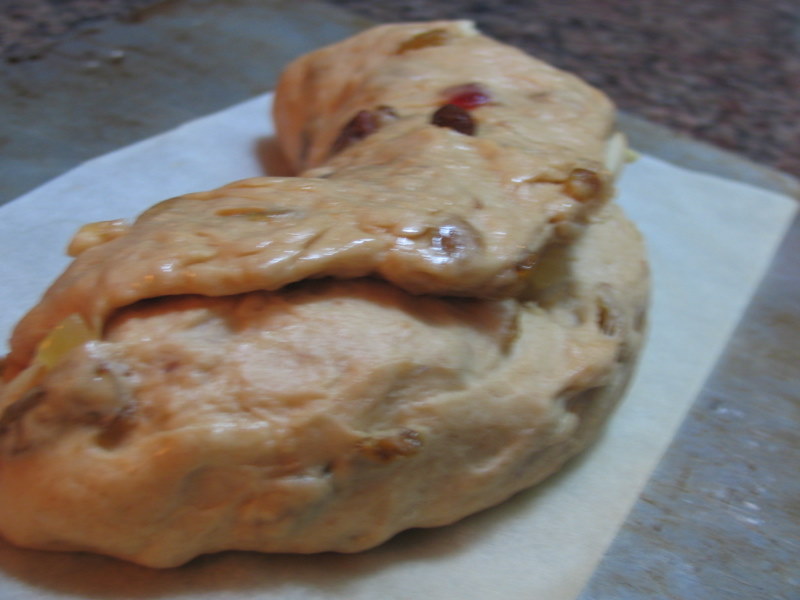
The initial shaping…

The stollen, shaped and ready to go into the oven….

After baking, the loaf is brushed with a little vegetable oil, then dusted with a generous amount of powdered sugar.  After 1 minute, one more layer of powdered sugar is added on top….

One long hour waiting….. until we finally sliced the bread….

For those familiar with panettone, I should say that stollen is quite different.  The texture is a little softer,  the cinnamon taste very obvious and pleasant.   The powdered sugar, that at first seemed a bit too much, is a perfect match to the bread.    Do not skip it…

Thrty six breads down…. seven more to go…

Next on the BBA Challenge:  Swedish Limpa.  Stay tuned!   😉

CROWD PLEASING PULLED PORK

Suppose you´re facing the task of feeding a lot of people, but you´re short on time and low on cash. With this recipe you´ll have no worries, and everyone´ll love the moist, melt-in-your-mouth meat, with bits of tangy, crispy skin to please the palate!

PULLED PORK
(adapted from Gretchen´s and Mean Chef’s recipes)

1 whole pork butt, bone-in

for the dry rub
1/8 cup black pepper
1/4 cup paprika (I used smoked paprika)
1/4 cup turbinado sugar (or brown sugar)
2 tablespoons salt
2 teaspoons dry mustard
1 teaspoon cayenne pepper

Mix all the ingredients (except the meat)  in a bowl to prepare the dry rub (it´s a good idea to wear gloves).

Rub the pork all over with half of the dry rub, then place it in a plastic bag and refrigerate overnight. In the morning remove the pork from the bag and cover it with the rest of the spice mixture. If possible, let it sit at room temperature for a couple of hours, if not just place it in a 275F oven, uncovered on a rack in a roasting pan.

Roast until tender, almost falling apart. Depending on the size, it will take 7 – 9 hours. Longer will not hurt it; the desired internal temperature is 200F.

Pull the pork into pieces with forks, allowing some bits to fall on the floor to the delight of your dogs.

Serve the meat over sandwich buns with the sauce of your choice, or follow my “Brazilian variation”:  transfer the pulled meat to a clean baking dish.  Add 1 cup of water to the roasting pan and place it over the stove-top burner on medium heat to dissolve the bits of pork goodness that stuck to it during the long, slow roasting.  Strain it over a pyrex cup and allow the fat to rise to the top, then discard it.  Use the liquid to moisten the pulled meat, squeeze fresh lemon juice all over, cover with aluminum foil and place in a 350F oven for 20 minutes before serving over rice and beans.  (You can leave it in the oven for longer, it only gets better).

ENJOY!

This recipe fits quite well in the ¨Perfect Sunday Dinner¨ category…

for comments and additional photos, jump to next page