I live in a state of bread anxiety. On Thursdays I revive my sourdough starters and begin the tortuous process of choosing the bread to bake on the weekend. That evening you’ll find me on the sofa, surrounded by bread books, notebooks, pens, pencils, stickers, and close to a computer with multiple open tabs: The Fresh Loaf, Wild Yeast, Makanai, Dan Lepard, King Arthur, Northwest Sourdough… My beloved husband knows it’s useless to converse with with me when I’m in such a “bread daze,” and I can’t come out of it until I make my choice.
This weekend’s pick was an impressive loaf from Maggie Glezer’s book Artisan Baking. She ranks each of her recipes according to its level of difficulty, and this one forewarned “advanced” at the top of the page. But, that didn’t stop me, which ultimately resulted in quite a bit of pain for this baker.

THOM LEONARD’s COUNTRY FRENCH BREAD
(from Maggie Glezer’s Artisan Baking)
Make the levain on the evening before baking by mixing:
25 g fermented firm sourdough starter
140 g lukewarm water
140 g bread flour
Allow it to sit at room temperature for 12 hours, or until it has expanded and just started to sink in the center.
 (click to enlarge)
On baking day:
Prepare the whole wheat component, by measuring 350g whole wheat flour and sifting it with a fine strainer. This will remove the large flakes of bran (you can use it to make muffins). Measure 250g of the sifted product, and start making the dough.
 (click to enlarge)
250 g sifted whole wheat flour
750 g bread flour
30 g rye flour
660 g water
23 g salt
all of the levain made the previous evening
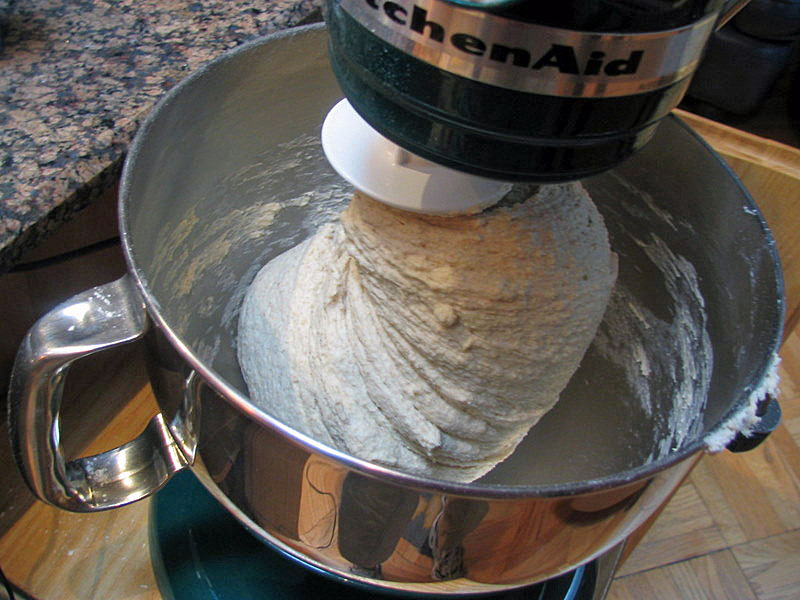
Add the three types of flour to the bowl of a large KitchenAid type mixer. Mix the water with the levain to dissolve it, and add it to the flours. Using the dough hook, mix it for 10-15 minutes, until the dough is very smooth and almost cleans the bowl. Add the salt and continue mixing for 5 more minutes.
 (click to enlarge)
Place the dough in a very large bowl and let it rise for 3 hours, folding three times (at 30, 60, and 90 minutes). After the final folding, just leave it undisturbed for the final 90 minutes. Remove the dough from the container, form it into a ball and let it rest for 10 minutes to relax the gluten (that makes it easier to shape).
(click to enlarge)
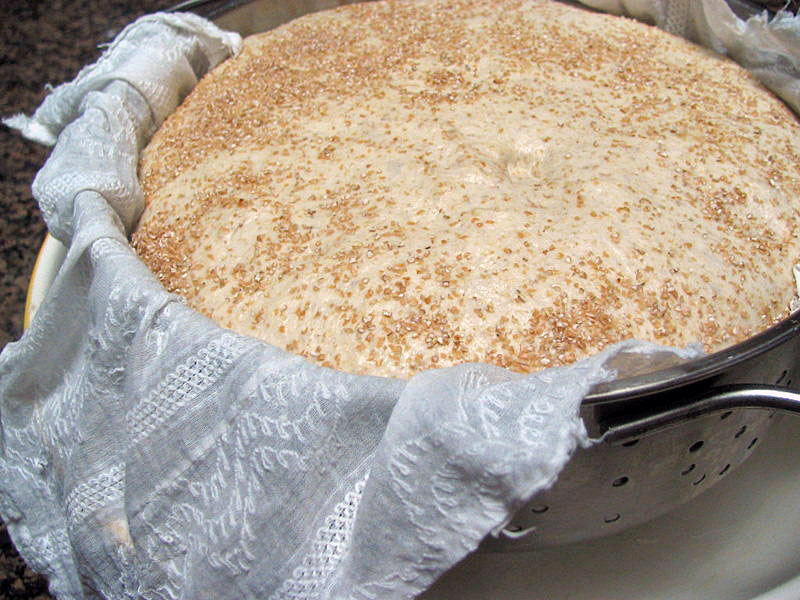
Shape it into a large round loaf, and place it in a suitable container for proofing, lining it with a heavily floured linen, with the smooth side down. Proof at room temperature for 4 hours, or until an indentation made in the dough will not bounce back right away.

 (click to enlarge)
Carefully transfer the bread to a baking sheet lined with parchment paper, slash the surface and bake with an initial burst of steam, in a 450F oven. Bake it for 70 to 80 minutes, rotating the dough after 30 minutes, and reducing the temperature to 400F if it starts to get too dark. Allow it to cool on a rack for several hours before slicing it.
ENJOY!
to print the recipe, click here
Comments: I had high expectations for this bread, because once the kneading was over and the fun part started (the folding!), the elasticity of the dough surprised me: gluten development at its best! The shaping went smoothly and the dough rose beautifully in my improvised banneton: a pasta colander, lined with my improvised baker’s linen. However, improvised is a dangerous word to use twice in the same description.
At the end of 4 hours, the dough was all airy, absolutely perfect! The oven was ready, with baking stones blazing hot, and I was on top of the world! As I inverted the dough on the parchment paper, I could not help but day dream… “When I submit this masterpiece to Susan for Yeastspotting, she’ll call me on the phone to personally compliment me!” …. “The Fresh Loaf will feature this bread on their front page, and leave it there for a year or two“…. “I’ll have my own show on PBS: Bread Baking with Sally“….
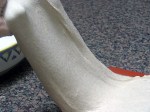
Then, reality interfered. The improvised baker’s linen would not peel off. It was stubbornly glued to my beautiful, airy, gorgeous dough. I screamed and howled in pain! As I was wrestling the fabric off, my beautiful, airy, gorgeous round loaf began to spread sideways and collapse right before my eyes! It was horrible: no glory for me, no phone call from Susan, no highlight on The Fresh Loaf, and definitely no show on PBS. Finally, with the dough threatening to slide off the baking sheet the linen came free and I rushed the loaf into the oven, without slashing, without steam, with just frantic moves and a few well chosen words that are unfit to print.
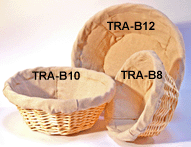
A major lesson learned: a 4.6 pound dough demands a perfect proofing environment, particularly for a 4 hour rise. Now, after helpful advice from the crowd at The Fresh Loaf, I’m seriously considering one of these.
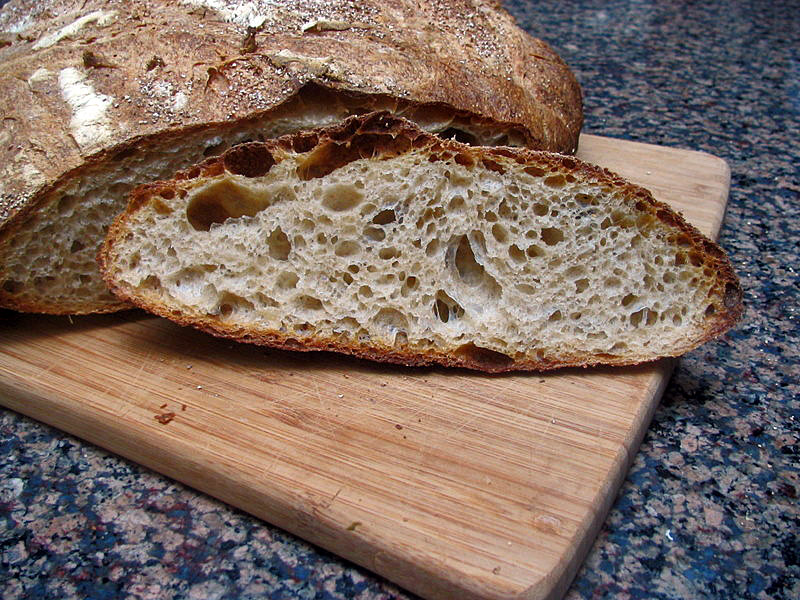
Back to Thom Leonard’s country loaf. Aside from the top crust of my bread , which looked like the aftermath of Freddie Krueger, the crumb was open and the bread was incredibly flavorful. It’s a bread that begs to be in a Croque Monsieur! We shall comply shortly.
A bread that can survive the abuse I inflicted on this dough is worth saving in your personal repertoire. Try it. But do yourself a favor, and use the right tools for the job. You might just get that phone call from Susan….

I am submitting this post to Yeastspotting…


NQBWC92RPPUQ