TAILLEVENT

For some people Paris means fashion: clothes, shoes, perfumes, jewelry and make-up. But me, I couldn’t care less if Louis Vuitton’s gold-encrusted store disappeared from the the planet, and along with it all the $2000 handbags and $800 belts. On the other hand, I still mourn the closing of Bistrot du Papa, a simple restaurant in the 7th arrondissement, that served the best quiche Lorraine we ever tasted. Excuse me while I wipe away some tears.

For a long time we contemplated dining at Taillevent, considered by some the best restaurant in France. Indeed, a place that held a three-star rating for 37 years must be doing things right. This dream stayed unfulfilled for many years, until our 10th wedding anniversary provided the extra push to indulge ourselves. We decided on lunch at Taillevent, rather than dinner, and it met our highest expectations!

Entering some of the upscale restaurants (Tour d’Argent comes to mind… ) is intimidating and overwhelming, almost like stepping – uninvited – into a Hollywood movie. Their exquisitely opulent surroundings transform the initial experience into a dream-like blur that’s difficult to even completely remember. In this respect the sophisticated but inviting ambiance of Taillevent was a pleasant surprise. Its beautifully organized table settings, with a modern theme, were overseen by smartly-dressed waiters who were always available, but never intrusive.

After we made our choices among the lunch menu options, the waiter brought a small lentil soup as an amuse-bouche. Calling it just a lentil soup, however, is an understatement. The texture of the lentil component was between that of a cream soup and a mousse. Served cold, it surrounded an icy cream in the central interior, and contained a small “chip” of Serrano ham floating on top. Its inspiration undoubtedly came from the classic ham and lentil soup, and we both loved the chef’s transformations of this dish! The smokiness of the ham did not overpower the lentils, and the cream component provided a contrast of both flavor and temperature. It was a few spoonfuls of perfection.
(click on the photos to enlarge them)

For his first dish, my husband chose a cream of broccoli soup. The waiter served the bowl empty, except for seven small ravioli inside, and then spooned the (amazingly green) hot cream of broccoli on top. It was light but substantial: the creamy cheese within the ravioli filled the soup with satisfying flavor. I often think of toppings on cream soups, but now I’ll definitely consider hidden surprises at the bottom instead, and pouring the soup at the table made it even more interesting.

For my first dish, I took a chance and went for the fish (rouget), served with a cumin-seasoned eggplant crisp and black olive tapenade. I eat almost everything, but I’m challenged by strong-tasting fish. In this case, though, my risk paid off with what I’m tempted to say was the best dish I’ve ever had. The fish was prepared with its skin on; the meat was flaky, tender and flavorful, but without a hint of ‘fishiness.’ The eggplant crisp and the olive tapenade lent flavor, but were not so pungent as to distract from the main component, the fish. I can’t explain how the eggplant crisp was made – it was not a thin slice of eggplant, but perhaps it was a thin-spread puree that was dried and baked. Maybe Carol from Alinea at Home knows how to prepare it. The plate was embellished with saucy decorations of parsley and mustard coulis.
(click on photo for larger version)

My husband’s main dish was a roasted duck breast, with hydromel and minced dragees (yes, its a type of candy).  The dish was served with a spinach puree, that was, unbelievably, as good as the duck. It was a main dish that blew our gastronomic minds… It’s not new to pair duck with sweets, whether it is oranges, prunes, honey or maple syrup, but the fine dust of candy and hydromel was an eye-opener. I am not sure exactly how the duck meat was prepared, it may have been seared before roasting. The spinach puree was simply outstanding. I detected some nutmeg, without a trace of bitterness in the vegetable. Again, the serving was decorated by spinach crisps, perhaps prepared in the same fashion as the eggplant crisp described above.

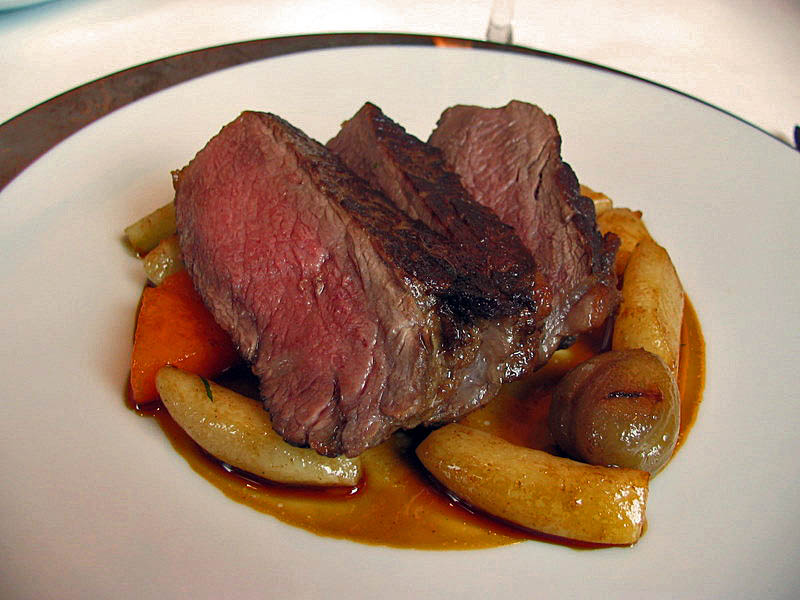
My main dish was a beef filet with soy glaze and caramelized root vegetables. The meat was delicious, and the veggies beneath were perhaps even better: carrots, parsnips, turnips, and a perfectly roasted chestnut.
After the main dishes came a cheese course, in this case brie studded with raisins in a creamy middle layer, served with fine slices of Honey Crisp and Granny Smith apples, and a light “angel hair” of celery and finely minced chives. A smaller portion of cheese would have satisfied me, but sometimes in life sacrifices must be made. 😉
(click on photo for larger version)

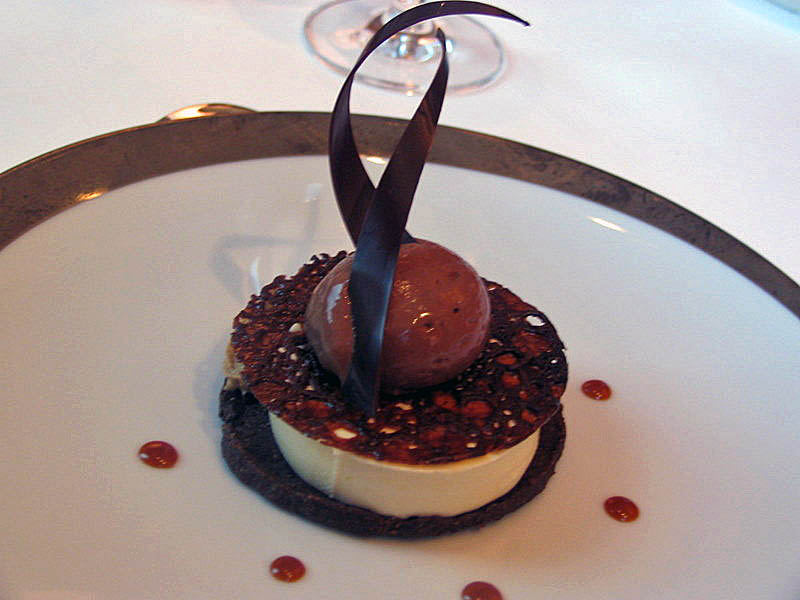
Dessert awaited us. My husband chose a “sable aux deux chocolats”. Dark and white chocolate mousse/cream sandwiched between a lace cookie on top and a chocolate cookie below, surrounded by touches of caramel on the plate. Decadent. Luscious. Sexy.
My dessert was a rhubarb crisp. I’d never experienced rhubarb before, and I’ve been curious about it for a long time. This was my chance, and I wouldn’t let it pass, even if my beloved twists his nose at rhubarb. Friends, I’ve eaten many desserts in my lifetime, but this rhubarb crisp enters my Desserts Hall of Fame. In the picture you’ll see some things on the plate that resemble small specks, perhaps carelessly left by the cook in charge. No, those are little pieces of a sweet ribbon, thin as a sheet of paper, that surrounded the rhubarb mousse, sort of enclosing the two crisps as a package. I wish I knew the preparation. The rhubarb mousse had lemon curd beside it, and everything was topped with a honey sorbet. I can’t master enough adjectives in any language to sufficiently praise this dish; let it suffice to say that even my husband enjoyed it, rhubarb and all… 😉

(click on photo to enlarge it)

We’ve dined in several of the great restaurants of Paris, but Taillevent immediately climbed to the top position, as my favorite.

The restaurant has been managed by the same family since its opening in 1946. Jean-Claude Vrinat was responsible for the three-star rating it obtained in 1973, and for managing it for three decades, even as its many brilliant chefs came and went. He passed away in 2008, and his daughter, Valerie Vrinat, now manages the restaurant, with Alain Soliveres as Head Chef since 2002.

Additional note: I asked for permission to take photos and blog them, and the staff was absolutely wonderful about it.

Add to FacebookAdd to DiggAdd to Del.icio.usAdd to StumbleuponAdd to RedditAdd to BlinklistAdd to TwitterAdd to TechnoratiAdd to Yahoo BuzzAdd to Newsvine

BONJOUR!

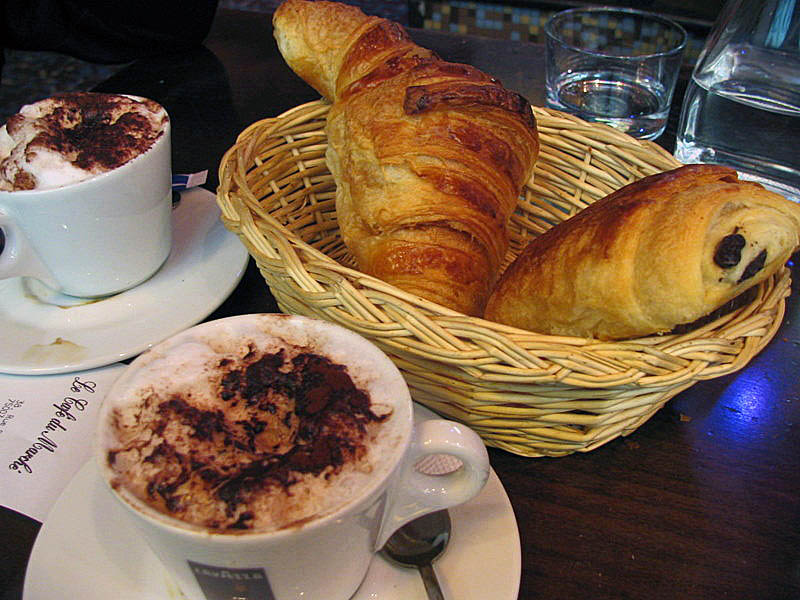
Breakfast…. comme il faut!

Yes, one day I will have to master croissants and pain au chocolat from scratch… but for the time being, no need to worry about it…

(note to self: never ever compose a blog in less than 45 seconds, or you risk a huge typo right on the title! Blogging is hard when you are away from home 😉

PARIS, JE t’AIME…

When we finally took off for Paris our Boeing 777, the biggest and most comfortable of the jumbo jets, didn’t even notice the heavy rain and overcast enveloping Washington DC. And the happy couple it was transporting to the place they love so much didn’t’ mind the foul weather either. Clouds and rain, after all, are the norm in Parisian winter months, so we were ready for it. But, the initial day of such trips is the most difficult: an early morning arrival after a night on the plane with only a few hours of sleep, followed by the huge but requisite struggle to defeat jet lag. To reset our circadian clocks to the new schedule we walked outside as much as possible, and only saw the inside of our hotel room after night fell.

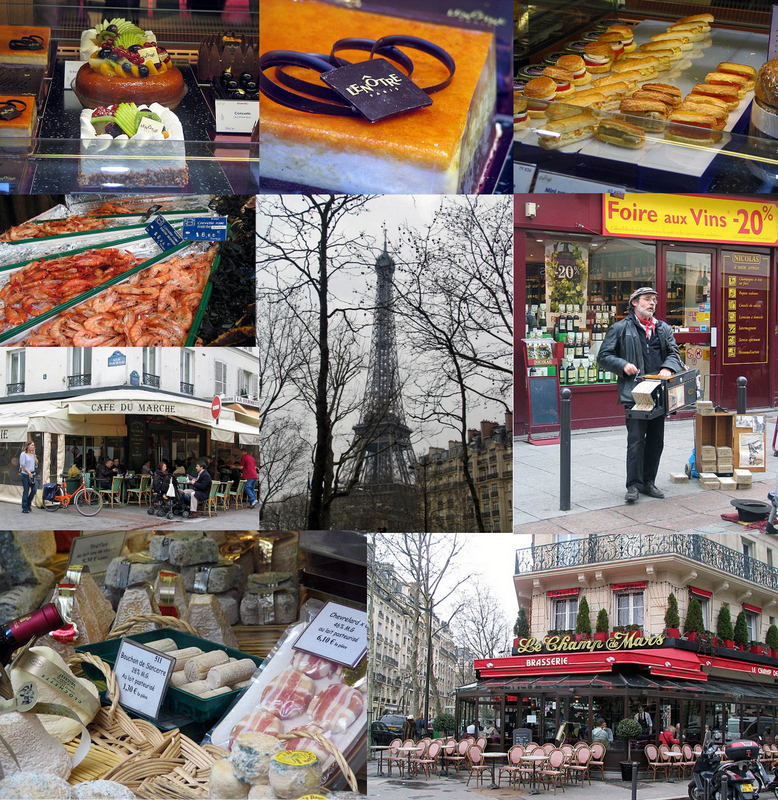
Having lived in Paris for several years we don’t visit many museums or tourist hot spots. “… Been there, done that,” from the Tour Eiffel to La Defense, from Montmartre to the Louvre, from Musee d’Orsay to Musee Salvador Dali, from cemetiere Pere Lachaise to the quartier Latin … Instead, what we love about Paris are the neighborhoods we used to call home. As we turn each corner we pass by each of our favorite cafes, brasseries, and boulangeries. We enjoy repeating our weekly Saturday afternoon walks, and that’s exactly what we did again yesterday… we departed our hotel close to Ecole Militaire and walked and walked, and walked some more….

We stopped at La Grande Epicerie de Paris, where I bought some “pimente d’espelette,” we strolled up rue de Rennes , then turned down to boulevard Montparnasse. We walked and walked some more, stood at the corner of Boulevards St Michel and St Germain, the gateway to Notre Dame, now so beautiful after its recent cleaning, and continued down to the cafe Les Deux Magots, which brings memories of dining outside at countless cafes throughout Paris, savoring the views of people passing by. Yesterday it was 40 F (3 C), but all the seats outside were filled by people from all over the world, each one living their own private love affair with Paris.

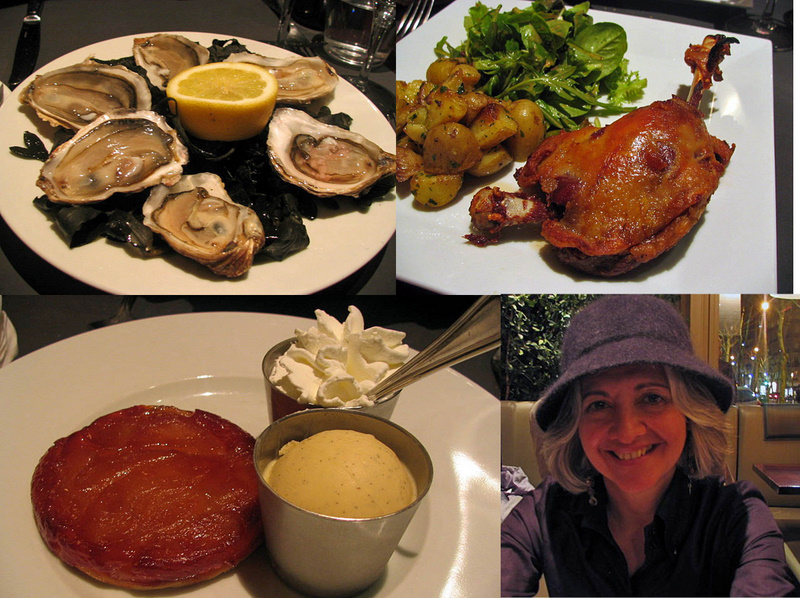
What’s for dinner? It was a simple meal at Le Bosquet, a classic brasserie two blocks from our hotel. The same waiter from several years ago handed us a menu that was almost unchanged. Why change oysters, confit de canard, and tarte Tatin? 😉

On a side note – If you haven’t seen the film Paris, Je t’Aime, I urge you to do so – it is a series of short stories by different directors, filmed in different Parisian neighborhoods. One of our favorites is the final vignette, the narrative (in broken, yet adorable French) of a lonely, middle-aged American woman who, after studying French for a few years, finally visits Paris for the first time in her life. Beautiful, touching, and a declaration of love for one of the most amazing cities in the world.

I feel the same way. It’s so nice to see it all again!

Add to FacebookAdd to DiggAdd to Del.icio.usAdd to StumbleuponAdd to RedditAdd to BlinklistAdd to TwitterAdd to TechnoratiAdd to Yahoo BuzzAdd to Newsvine

MY NEW FAVORITE TOMATO SAUCE

Strange things happen in my kitchen.  Countless recipes wait in an imaginary line,  that most will stay in for years, until I finally get around to making them.  But occasionally a recipe casts a spell on me, forcing a menu change, a search for exotic ingredients, the abandonment of seasonal cooking, and my personal resolve to drop everything else and cook it right away, as soon as humanly possible.  I bring this up because it happened last weekend, when the  Barefoot Contessa’s guest chef, Joseph Realmuto,  shared the recipe for his restaurant’s favorite tomato sauce (for the past 22 years).  It involved vodka,  slow roasted tomatoes and onions, and was finished with heavy cream.   I stopped in my tracks, slowly turned, headed  to the kitchen,  and made it.  And that, my friends, was the right move… 😉


PENNE A LA VECCHIA BETTOLA

(adapted from Joseph Realmuto, original recipe from La Vecchia Bettola, Firenze)

1/4 cup olive oil
1/2 yellow onion, diced
1 clove garlic, diced
1/2 T dried red pepper flakes
1 T dried oregano
1/2 cup vodka
1 can best quality whole tomatoes (28 ounces)
salt and black pepper to taste
1/4 cup heavy cream
fresh herbs of your choice (oregano, basil)
parmiggiano reggiano cheese, grated

Heat the oven to 375 F.

Heat the olive oil in a skillet, add the onions, cook for about 8 minutes over medium heat, add the garlic, red pepper flakes, and dried oregano, and saute for a couple of minutes, mixing constantly. Add the vodka and simmer until the mixture is slightly reduced. Drain the tomatoes and add them to the skillet, crushing them slightly with your hands or a large wooden spoon (careful, they will splatter!). Season lightly with salt. Cover the skillet and place in the oven for one and a half hours. Remove the skillet from the oven, let it cool for 15 minutes, then place the contents in a blender. Puree until smooth.

While you cook the pasta in plenty of salted boiling water, finish the sauce back in the skillet, setting over medium heat, and adding heavy cream. Adjust seasoning with salt and pepper. Simmer for about 5 minutes, add the cooked pasta, and allow them to gently simmer for a few more minutes. Add fresh herbs and parmiggiano cheese right before serving.

ENJOY!

to print the recipe, click here

Comments: In this day and age it’s hard to believe I’d even bother with another recipe for tomato sauce.   I usually alternate between my two favorites: the first involves a quick saute of onions in olive oil, a can of tomatoes, salt, pepper and some herbs; the second is a   very popular recipe from Marcella Hazan, worth all the butter it calls for.  😉

With the addition of this recipe I have my own tomato trilogy. It’s a breeze to prepare, but the combination of vodka and slow roasted tomatoes makes it taste complex. I reduced the cream  because 1 full cup of heavy cream seemed excessive;  feel free to do as your heart (and palate) desires. The vodka provides a background of heat that’s perfect with the intense flavor of tomatoes, concentrated by roasting.  It’s a delicious sauce that may be prepared in advance and blended right before finishing.

CROISSANTS: PARIS AT HOME ON A SPECIAL DAY

Today is our 10th wedding anniversary, so to start the day on a wonderful note, I decided to bring a little bit of Paris – the place where we met and later lived for a year – to our home. Even if croissants are not originally from France, they convey its image with every delicious bite. When we lived in Paris, we used to go for long runs on Saturdays that always ended with a “pain au chocolat pour le monsieur, croissant pur beurre pour madame“. With the mandatory coffee or hot chocolate, depending on the weather, and our mood… Wonderful memories!

CROISSANTS DU BOULANGER
(original recipe from The Baker’s Companion, adapted by Ford, from The Fresh Loaf website)

for the dough

2 large eggs plus scalded low fat milk cooled to 90°F to make 2 cups (16 oz.)
1 tsp sugar for unsweetened dough
5 1/2 to 6 cups (23.3 to 25.5 oz.) all purpose unbleached flour
2 1/4 tsp (7 g) instant yeast
2 tsp salt
2 Tbs. (1 oz.) melted butter

for the butter
3 + 3/4 sticks (15 oz.) unsalted butter
1/2 cup (2.1 oz.) unbleached flour
flour for sprinkling

Beat the eggs and milk and 1 tsp 1 tsp of sugar. Beat in the yeast and 3 cups of flour until all is well blended. Cover and let stand at room temperature for an hour or so. In a separate bowl blend the salt, and 2 1/2 cup of flour. Hold until the yeast mixture has doubled in size.

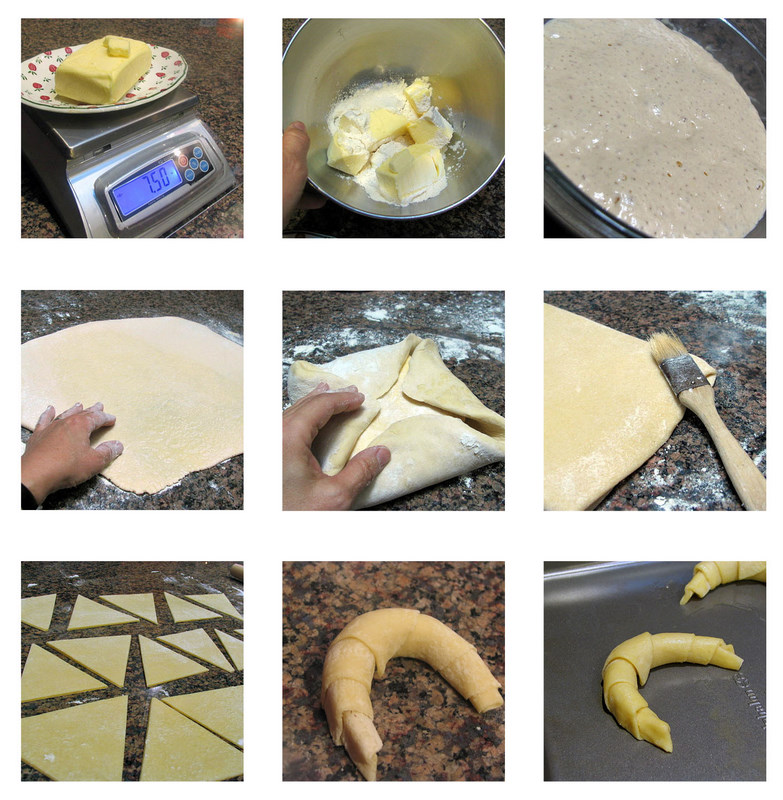
Blend the 3 + 3/4 sticks of butter and the 1/2 cup of flour. Lightly flour a piece of plastic wrap and place the butter mixture on it. Shape the butter into an 8” x 8” square. Wrap it and place it into the refrigerator until the dough is ready.

Back to the dough, add the melted butter and beat well. Add in the flour mixture and mix well to form a rough ball, then knead for 8 to 10 minutes on a lightly floured surface, or knead in an electric mixer, using a dough hook. Cover the dough and place it in the refrigerator for an hour.

Rolling & Folding: Remove the dough from the refrigerator and put it on a lightly floured surface. Gently roll it into a square about 12 inches on a side. No need to obsess about the dimensions, just try to be close. Put the butter square in the center of the dough square but turn it so that the corners of the butter square point toward the sides of the dough square. Fold the corners of the dough over the butter until they meet in the middle. Pinch and seal the edges of the dough together.

Turn the square over and tap it gently with your rolling pin or by hand into a rectangular shape. Make sure everything is still completely, but lightly, floured. Begin rolling the dough from the center, away from and towards you, into a larger rectangle 20 inches long and 10 inches wide. Puncture any air bubble with a toothpick. Keep the dough, the work surface, and the rolling pin well dusted with flour.

When the dough is the right size, fold the bottom third of the dough up beyond the center and the top third over (like a business letter) and turn the dough package a quarter turn to the right so it looks like a book ready to be opened. If the dough is still cold and still relaxed, do another rolling and turning as before. If it begins to feel too soft or wants to resist being rolled, cover it, put it on a small baking sheet, and refrigerate it for 15 minutes or longer (even a day) to chill and relax.

If you’ve successfully rolled it out and folded it twice, you’ve completed two turns. Classic puff pastry gets six; and puffed dough gets four. Continue refrigerating it after each two turns, or more often if necessary, until four turns are completed. Refrigerate the dough for at least two hours or preferably overnight. One recipe is adequate for two dozen croissants.

Making the croissants…

1 recipe of dough above
egg wash

Preheat the oven to 400°F.

Cut the chilled puff dough in half. On a lightly floured surface, roll one half of the dough to a 12” x 18” rectangle. Trim the edges, using a very sharp knife or a pizza-cutting wheel. This removes the folded edges that would inhibit the puffing of the dough.

Cut the dough into three strips lengthwise, 4” x 18”. Then cut these strips in half to give six rectangles 4” x 9”. Make a diagonal cut on each of these rectangles to give a total of twelve triangles. Make a 1” cut in the 4” base of one of the triangle. If you desire to fill the croissant, place a small amount of filling along the base before rolling it. Pull this base slightly stretching it, and then roll the dough toward the apex. Tuck the point on the bottom and bend the ends to make a crescent. Repeat with the other eleven triangles.

Place the croissants on a lightly greased, parchment-lined baking sheet about a half-inch apart. Cover with a greased plastic sheet, and allow to rise until doubled. When fully proofed, about 45 to 60 minutes, brush the croissants with the egg wash. Bake in the 400°F oven until deep golden brown, about 20 minutes. The interior temperature should be 195 to 200°F. Cool the rolls on a wire rack, before eating or storing.

Repeat with the other half of the dough or store it in the refrigerator or freezer for later.

jump for more