A FOCACCIA EXPERIMENT

A few months ago I followed an interesting discussion at The Fresh Loaf forum, in which a member (Kevin) made a mistake while scaling up a recipe (I can relate to that too well, by the way) and ended up with one of the best focaccias he’d ever made!  Being a very experienced baker, he made several batches of the same recipe, to convince himself that the small alteration in the method was indeed responsible for the outcome.  It all comes down to holding back some of the water (and the salt) in the recipe, and adding it a little later to the dough.  The rationale behind doing it was actually discussed a few years ago by Steve in his blog “Breadcetera” – check it out by clicking here.

I was anxious to try this variation in my favorite, default recipe, and this past weekend I finally had a chance to perform this important experiment.

DOUBLE-HYDRATION FOCACCIA
(inspired by The Fresh Loaf Forum)

2 cups lukewarm water, divided
2 tsp active dry yeast
4 cups unbleached bread flour
3 tsp salt
2-3  tsp olive oil
2 T chopped fresh rosemary
1 tsp kosher salt

Measure 1 + 1/2 cup of  water in a large bowl, sprinkle yeast over water and stir until dissolved. Using a strong wooden spoon mix 2 cups of flour until smooth, about 2 minutes. Add the remaining 2 cups of flour, and knead with your hands (inside the bowl is fine), until the dough forms a very shaggy mass. Cover the bowl with plastic wrap and let it sit at room temperature for 20 minutes.

Dissolve the salt in the remaining 1/2 cup of (lukewarm) water.  Add it to the dough, and mix with your hands using a squishing/kneading motion.  Do not be alarmed by the look of the dough at this point.   Slowly the water and salt will find their way into the mixture.  Once it all seems incorporated, cover the bowl and let it rise undisturbed for 1 hour and 20 minutes.   The dough will be very bubbly at this point.

Heat the oven to 450F. Lightly oil a 9 x 13 inch baking sheet. Pour the dough onto the sheet,  brush the surface with 2 tsp olive oil. Dip your fingers in cold water or olive oil and make indentations all over the dough, working to stretch the dough as you go.  Brush the surface with another teaspoon of olive oil, sprinkle with rosemary and  salt.

Place in the oven and bake for about 20 minutes, until golden brown. Cool on a wire rack and….

ENJOY!

to print the recipe, click here

Comments:  Compared to the regular recipe, this focaccia rose a lot more, had a more airy crumb, and a softer crust.  If you like to use focaccia to made a sandwich, a panini-type production, this recipe is perfect for it.  However, to make a proper comparison,  I must wait until we get home.  With a large oven, I will be able to make two batches, bake them at the same time and draw a clear conclusion.   So, stay tuned.  June is not too far away.  (I say that with mixed feelings,  it won’t be easy to say goodbye to Los Angeles… )

I am submitting this post to Susan’s Yeastspotting, a must-visit site for all lovers of bread…

and, I am also joining a fun blog party, hosted by Alyssa from Cupcake Apothecary:  “A Themed Bakers Sunday.”   This week the theme is a favorite of mine: Bread!   Check out all the other entries and vote for your favorite!

ONE YEAR AGO: Pierre Nury’s Bougnat (awesome recipe!)

Add to FacebookAdd to DiggAdd to Del.icio.usAdd to StumbleuponAdd to RedditAdd to BlinklistAdd to TwitterAdd to TechnoratiAdd to Yahoo BuzzAdd to Newsvine

GAMBERETTI CON RUCOLA E POMODORI

Nope, this recipe didn’t come from an Italian cookbook.  I hope Martha Stewart won’t mind that I took some liberties with the title for her creation,   but it just sounds too lovely in the language of Dante: “… Gamberetti… Rucola… Pomodori,”  …just beautiful!

This year I insist on “quick and easy dinners,” because life is awfully busy for us here in LA.  It’s now our final month at UCLA, so this type of recipe is a life-saver.  Cook some pasta (we used cappellini, that’s ready in five minutes),  grab some lettuce for a simple salad, and all of a sudden you’ll have a meal from a trattoria by the Mediterranean Sea.

SAUTEED SHRIMP WITH ARUGULA AND TOMATOES
(adapted from Martha Stewart’s Everyday Food, June 2010)

1 Tbs olive oil
1 cup cherry tomatoes
1 garlic clove, lightly smashed
1 pound large shrimp
4 cups baby arugula leaves
salt and pepper
juice of half a lemon

Heat the olive oil in a large skillet, add the garlic and sautee for a couple of minutes in gentle heat, until it gets fragrant and starts to develop some color.  Remove the garlic and discard it.  Add the tomatoes, season with a little salt and pepper, increase the heat, and cook, stirring often, until they blister and release some liquid.

Add the shrimp and cook until opaque, not more than 4 minutes. Add the arugula leaves, a little more salt, and toss until wilted.  Squeeze the lemon juice over the pan, and toss to combine.   Adjust seasoning, and serve over pasta or white rice.

ENJOY!

to print the recipe, click here

Comments:  My preference for arugula or spinach is always changing.  Sometimes I settle on spinach, for its mellowness and delicate taste.   Then, my mood switches and I grab bag after bag of arugula at the store and bring it home.  Its leaves are sturdier, it wilts with dignity.  😉 And the peppery bite, no spinach can match it.  As you might guess, I’m going through the arugula phase right now.

ONE YEAR AGO:  Grissini

Add to FacebookAdd to DiggAdd to Del.icio.usAdd to StumbleuponAdd to RedditAdd to BlinklistAdd to TwitterAdd to TechnoratiAdd to Yahoo BuzzAdd to Newsvine

PAIN DE PROVENCE

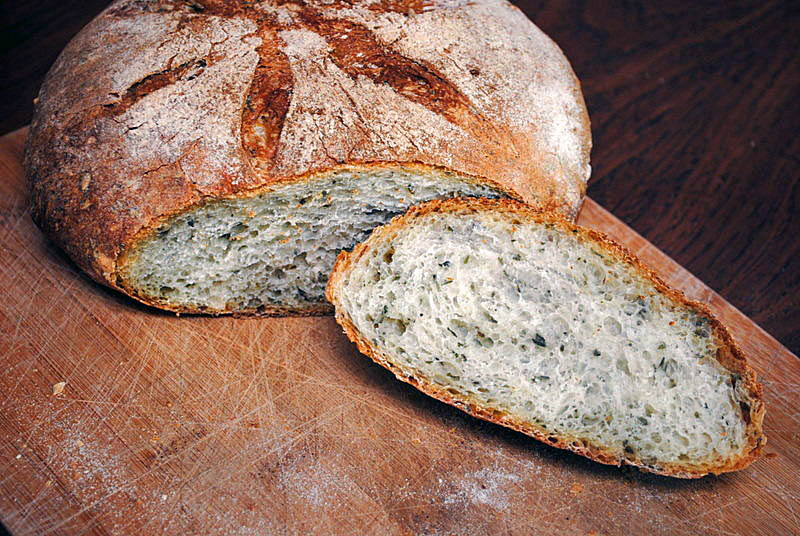
As I mentioned before, I get a lot of inspiration for bread baking over at The Fresh Loaf Forum.  Browsing through their huge collection of recipes, one made me quite nostalgic, thinking about our good times living in France.  I absolutely had to make it: a “boule” loaded with herbes de Provence!  It cannot possibly get much better than that.   The recipe comes from Floyd, The Fresh Loaf’s host and a very accomplished bread baker. He got his inspiration from a recipe found in  Bernard Clayton’s Complete Book of Breads.  My copy, by the way, sits patiently at home, waiting for our return…   😉

I cut the recipe in half to make it easier to bake in my small Breville electric oven, but I’m posting the regular version, which will produce a larger loaf.  The dough requires an overnight poolish, but is very simple and straightforward to make.    Don’t be alarmed by the amount of herbs, they perfume the bread with just enough intensity to make you fall in love with it more and more at each bite.

PAIN DE PROVENCE
(adapted from Floyd’s recipe)

for the poolish (made 8 to 18 hours before the final dough):
1 cup bread  flour
1 cup water
1/2 teaspoon instant yeast

for the dough:
All the poolish made the day before
2 cups bread flour
1/2 cup Herbes de Provence
1 + 1/2 teaspoon instant yeast
1 teaspoon salt
1/4 cup orange liqueur such as Grand Marnier (I substituted orange juice)
1/4-1/2 cup water

The night before baking, make the poolish by mixing together 1 cup of flour, 1 cup of water, and 1/2 teaspoon of yeast to make a batter. Cover the container with plastic wrap and set aside for 8 to 18 hours until you are ready to make the final dough.

To make the dough, combine the remaining flour with the remaining yeast, salt, and herbs. Add the poolish, the liqueur, and 1/4 cup of the additional water. Mix the ingredients, and, if necessary, add more water or flour until the proper consistency is reached .

Mix by gentle kneading, and leave it undisturbed for 20  minutes in a lightly greased bowl.   Do three more cycles of gentle kneading (or folding)  every 30 minutes.  At the end of the last kneading (a little less than 2 hs of bulk fermentation),  let the dough rise undisturbed  for a full hour.

Remove the dough from the bowl and shape it into a ball or long loaf. Cover the loaf with a damp towel and allow it to rise again until doubled in size, which takes between 60 and 90 more minutes.

While the loaf is in its final rise, preheat the oven to 450F, with a baking stone inside, if you will be using it.   Just prior to placing the loaf in the oven, score the top of it with a sharp knife or razor blade.

Place the loaf in the oven and bake for 20 minutes at 450, then rotate it 180 degrees and reduce the oven temperature to 375 and baked it another 25 minutes. The internal temperature of the loaf should be around 200F.

Remove from the oven and allow to cool for at least a half an hour before serving.

ENJOY!

to print the recipe, click here

Comments: Of all the spices present in herbes de Provence, lavender is the one that I detect first and foremost.  I once visited that part of France at the time when the lavender fields were in full bloom, and the smell everywhere is simply unforgettable.   I thought the amount of herbs in the dough could be a bit excessive, but reading Floyd’s remarks about it gave me the reassurance to make it exactly as he did.  The aroma of the herbs is evident from the moment you mix the dough, but once the bread is midway through baking, you cannot wait to try the first slice.

The crumb is light and airy, and the bread is quite unique for its delicate herbal tones.  I have a special sandwich in mind for this bread,  but that is a story to be told another time…   😉

I am sending this to Yeastspotting….

ONE YEAR AGO:  Golspie Loaf

Add to FacebookAdd to DiggAdd to Del.icio.usAdd to StumbleuponAdd to RedditAdd to BlinklistAdd to TwitterAdd to TechnoratiAdd to Yahoo BuzzAdd to Newsvine

SHANGHAI SOUP DUMPLINGS

Years ago I saw an episode of No Reservations in which Bourdain visited Shanghai, and indulged in their famous xiaolongbao (soup dumplings).   His description, and the whole visual experience left my mouth watering. Thanks to Amelia, who left a comment with a youtube to that particular episode, you can watch the whole thing here.   I searched for the recipes online and in cookbooks, but it quickly became clear that to make those dumplings you need to be born in China, and raised by a mom who grew up watching her own mom and Grandma making them in their home kitchen.  For all the intervening years I’d hoped to find them in a Chinese restaurant somewhere, but I never did.  My frustration ended yesterday, on the last day of April, when the Tan family invited us to join them for lunch at Din Tai Fung Dumpling House in Arcadia, a neighborhood 30 miles east of UCLA.

The place has a well-deserved reputation for THE best soup dumplings outside of Taipei, and you need not take my Brazilian-American word for it, (even though I am a lover of  the Chinese culture).  Our friend’s  grandfather knew and worked with the founder of the first Din Tai Fung (in Taipei).  Her family is part of the fascinating history of the place, which you can read about here.  The Tans have tried countless soup dumplings in the US and Asia, and agree that apart from Taipei’s original spot, the Arcadia location is the winner.

(image from Wikipedia)

So, what makes Shanghai dumplings special?   Well, for one thing, they are not called soup dumplings because you serve them floating in a bowl of soup.  The soup is actually the filling!  The skin surrounding the dumpling is so thin that it seems physically impossible for it to hold anything, especially a liquid!  But that’s exactly what’s inside: a rich chicken stock that warms your body and soul the instant you bite into the dumpling.  As you savor the delicate shell of dough only one thought occupies your mind:  how many of these babies can I eat without being rude?   😉  Everyone in Din Tai Fung suffers from this same dilemma, and the solution is simple: keep ordering them.  At some point you might be willing to smile at the person across the table and say, “no, thanks, you take the last one…  really!”  

So, if you find yourself in Los Angeles, stop by Din Tai Fung (before 11:30am, or the waiting list will scare you) and be ready for a meal you won’t forget!  For directions, click here.

ONE YEAR AGO: Bite-sized Chocolate Pleasure

Add to FacebookAdd to DiggAdd to Del.icio.usAdd to StumbleuponAdd to RedditAdd to BlinklistAdd to TwitterAdd to TechnoratiAdd to Yahoo BuzzAdd to Newsvine

SPRINGTIME SALAD

The moment I saw this recipe in the latest issue of Fine Cooking, I knew I had to make it right away.  First, because it involves asparagus.  Secondly, because they are prepared in a novel way  – the spears are shaved as ribbons.    I am already quite fond of thinly sliced raw asparagus as in this farro salad, so I looked forward to trying this new (to me, anyway ;-)) method to serve them.

SHAVED ASPARAGUS SALAD
(adapted from Fine Coking magazine)

for the vinaigrette:
3 tablespoons rice vinegar
2 tablespoons lemon juice
2 tablespoons extra-virgin olive oil
2 teaspoons agave nectar  (or 1 Tablespoon honey)
1 tablespoon finely chopped shallots
salt and  black pepper to taste

for the salad:
1/2 lb. thick asparagus, trimmed
2 cups baby arugula
1/3 cup toasted cashew nuts
2 oz. thinly shaved aged Gouda

Make the vinaigrette by whisking together the vinegar, lemon juice, olive oil, agave nectar, shallots in a small bowl. Season with salt and pepper.  Refrigerate if not using right away.

Remove the tips of the asparagus and put them in a large bowl. Using a vegetable peeler, shave a stalk discarding the first shaving, which will contain only the thick outer layer.  When shaving the first side becomes awkward, turn stalk over and repeat. Add all shavings to the bowl with the tips. Repeat with remaining stalks. Toss asparagus with 1/4 cup of vinaigrette and let sit for 10 to 15 minutes.  Add arugula and toss, adding more dressing if needed to coat the leaves.  Top with the shaved cheese and cashews, adjust seasoning and serve right away.

ENJOY!

to print the recipe, click here

Comments:  This salad dressing is very close to perfection.  The original recipe used honey, but I’m so fond of agave nectar that whenever I have the opportunity, I use it instead.  Once you add the dressing to the shaved asparagus, the transformation is quite obvious: within a few minutes the ribbons start to soften up.   Don’t do it too early, or they will get mushy.   For obvious reasons, the salad won’t keep at its best for very long, so if you are serving it at a dinner party, keep that in mind.    The asparagus tips will retain most of their bite, adding a nice texture together with the cashew nuts.

At first, I thought about substituting parmiggiano or ricotta salata for the cheese component of this recipe. Aged Gouda is not a cheese we normally buy, but its slightly smoked taste worked surprisingly well with the arugula and asparagus.  We gave it two thumbs up!

I can see many variations of this recipe during Spring and Summer months.  And, I was not the only one who enjoyed it: browsing through “One Perfect Bite” the other day, I noticed that Mary also loved it.  Check it out by jumping here.

ONE YEAR AGO:  Indonesian Delight

Add to FacebookAdd to DiggAdd to Del.icio.usAdd to StumbleuponAdd to RedditAdd to BlinklistAdd to TwitterAdd to TechnoratiAdd to Yahoo BuzzAdd to Newsvine