VEGETABLE MILHOJAS

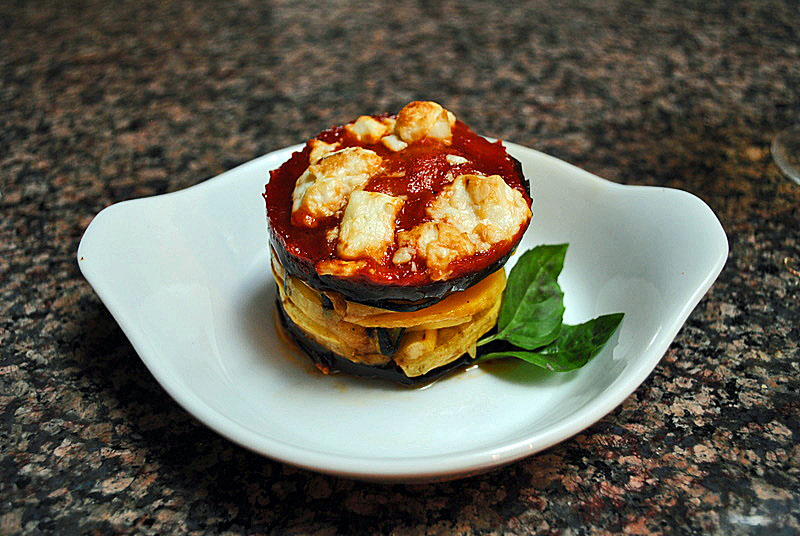
I prepared this recipe the week before our departure to the “nano-kitchen,”  (which I’m still adapting to), but using only the appliances I took with us, as a warm up for the “adventure.”   I’d also  like to say that this is a simple and straightforward recipe.   In some ways it’s not, but in other ways it is:  it takes  time and effort in the prep work, but once that’s completed it’s painless.  After tasting it, I predict that you won’t mind the road you traveled to make it.  I suggest that you assemble it on a weekend afternoon with nice music playing, perhaps this excellent  CD from Yo Yo Ma (skip the Metallica, or you may lose some fingertips).  I made individual servings with 3″ ring molds that I originally bought for cakes, but never used for that purpose.
VEGETABLE MILHOJAS
(adapted from Michael Bauer’s Secrets of Success)

for the tomato sauce:
1 Tbs olive oil
1/2 lb tomatoes, seeded and diced
2  garlic cloves
5 basil leaves
salt and pepper to taste

for the veggies
1/2 pound eggplant, sliced 1/8 inch thick
1/2 pound zucchini, sliced 1/8 inch thick
1/2 pound kabocha (or other squash), peeled, sliced 1/8 inch thick
1/2 pound celery root, peeled, sliced 1/8 inch thick
1/2 bunch basil  + 1/2 cup olive oil
1/2 pound soft goat cheese (Montrachet type)
salt and pepper

Make the tomato sauce by sauteeing the garlic in olive oil for 30 seconds, adding the tomatoes, basil, salt and pepper.  Cook on medium heat for a couple of minutes and reserve.

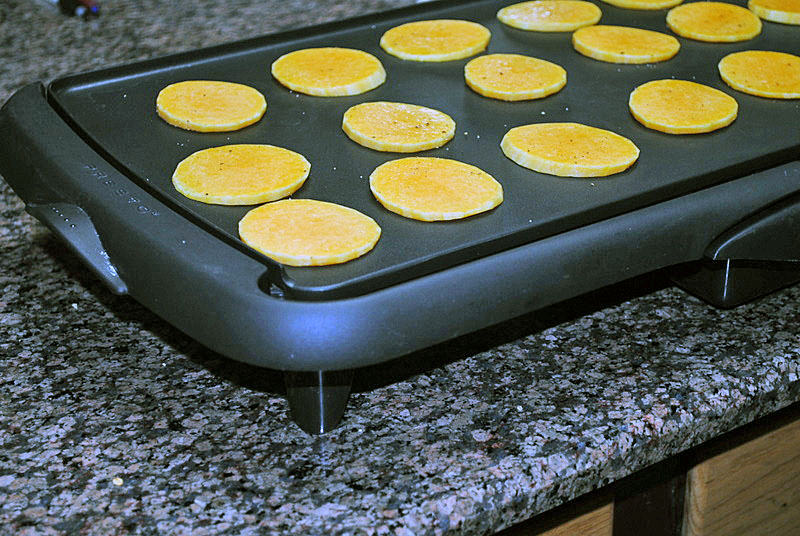
Heat a non-stick skillet (or preferably a large electric griddle), sprinkle each slice of vegetables with a little salt and pepper, and add to the hot surface of your non-stick pan (or griddle) for a couple of minutes on each side, until it just starts to show some color.  Do not let it burn, or completely cook.  Reserve the slices.

Mix the olive oil with the basil (you can use a food processor or finely slice the basil to help releasing its flavor.

Assemble the dish: coat a 8 x 8 inch baking dish slightly with olive oil to prevent the veggies from sticking.  Layer the eggplant slices, zucchini, squash, and celery root.  Add a little basil oil as you form each layer.  Continue layering the veggies until they are all used up.   Spoon some tomato sauce over the top, crumble the goat cheese and bake in a 450F oven for 10-15 minutes until the veggies are hot and the cheese shows some golden brown spots.

(If making the dish in individual rings, coat them slightly with olive oil to help removing the rings before serving – bake on a baking sheet, and use a flat spatula to remove each ring to the serving plate).

ENJOY!

to print the recipe, click here

Comments: Michael Bauer states that the secret of this dish is to thin-slice the vegetables,  and he’s absolutely right.  By doing so, the different layers bake into a single entity in which each flavor mingles with that of its  neighbors. It’s a feast for the taste buds.   I advise you to avoid excess  tomato sauce, because this is not about the tomatoes,  which just give it some extra moisture and flavor.  This recipe lets the veggies do the talking.  I couldn’t find celery root, so instead I used butternut squash, for its texture and color.  “Dry sauteéing” is an interesting, low-fat technique.  You’ll still need some oil while layering the dish, but it will finish lighter than similar versions that rely on “regular” sauteéing.  Eggplant, in particular, absorbs oil and I usually avoid frying it, so this preparation suits my style.  Play with different vegetables, as it’s fun to change this basic recipe.  It’s perfect for entertaining:  assemble it ahead of time, and bake it just before serving.
ONE  YEAR AGO: A peachy salad for a sunny day!

Add to FacebookAdd to DiggAdd to Del.icio.usAdd to StumbleuponAdd to RedditAdd to BlinklistAdd to TwitterAdd to TechnoratiAdd to Yahoo BuzzAdd to Newsvine

FARRO: GOOD FOR YOU AND TASTES GREAT TOO

Farro:  a fun word for a mysterious grain, about which a lot of controversy exists as to its origin.  Some say it’s a type of wheat, but that’s not the case,  farro is a grain from a related, but different plant.  It was a staple at the height of the Roman Empire,  and persevered since those days until now in central parts of Italy, where it’s still grown,  consumed and exported.   Farro is loaded with vitamins and low in gluten, so even people with gluten allergies may enjoy it. Plus, it performs well in  many kinds of recipes, from risottos to breads, from stews to salads.  What an amazing little grain, that’s perfect as the focus of my 200th post!   😉

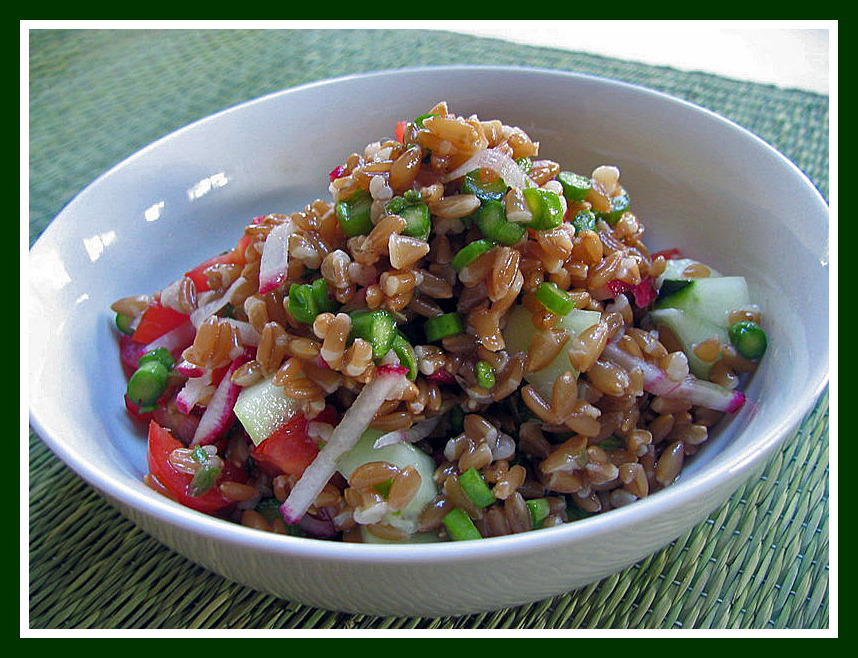
BEWITCHING FARRO SALAD
(from my kitchen)

to cook the grain:
1 cup farro  (not the pearled variety)
2.5 cups water
1/2 tsp salt

for the dressing (it will make more than you need):
1/2 cup olive oil
juice and zest of 1 lemon (or other citric fruits, alone or in combination)
pinch of salt
ground black pepper

for the salad:
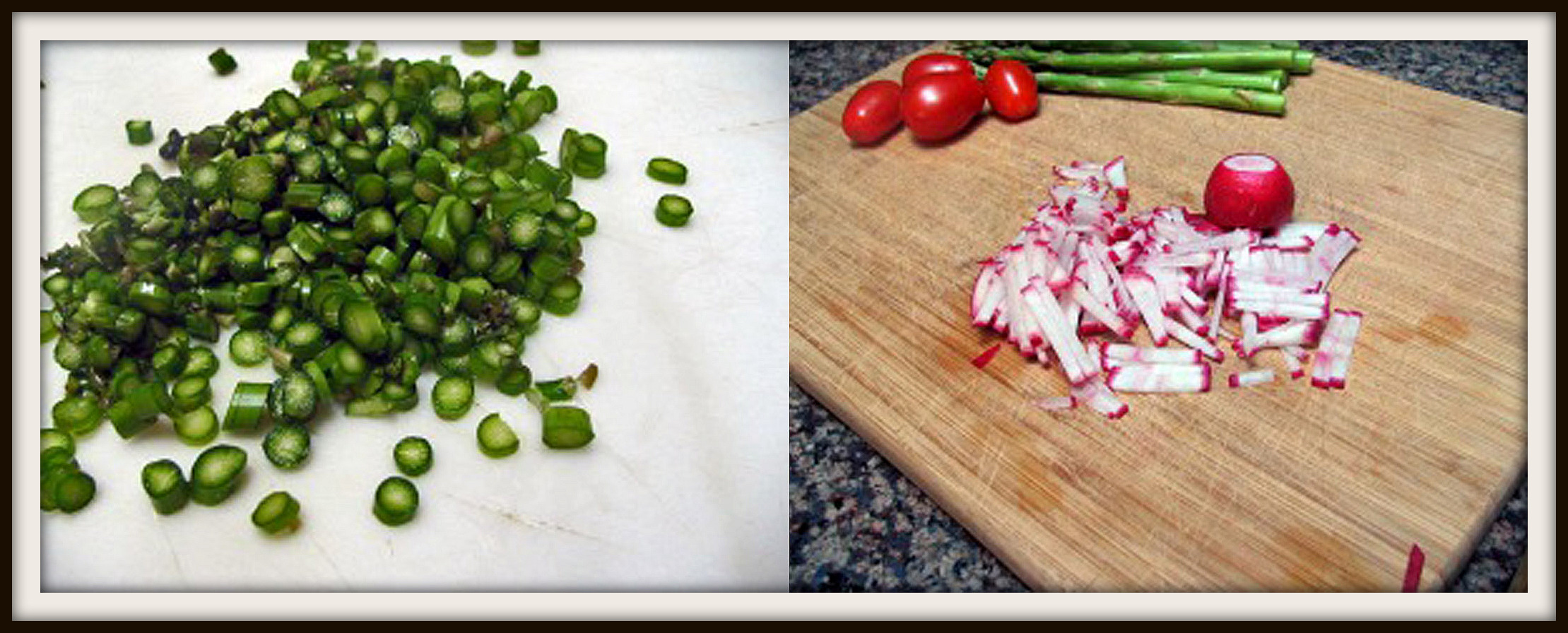
asparagus, finely sliced in tiny “coins”
radishes, cut in match sticks
diced tomatoes
diced cucumbers
minced cilantro (optional)

Cook the farro by mixing it with water and salt in a saucepan, bringing it to a boil and gently simmering it for 45 minutes (or a little longer, taste to decide when it’s fully cooked, but don’t let it get mushy).  If the grain cooks but there’s some water left, drain it. Otherwise just fluff it with a fork and allow it to cool to room temperature.

Make the salad dressing by mixing the olive oil with lemon juice, zest, salt and pepper.  Reserve.  Add the asparagus and radishes to a small bowl and sprinkle with some of the salad dressing, mixing to lightly coat them.

At serving time, mix the cooked farro with the diced tomatoes, cucumbers, cilantro (if using), asparagus and radishes, add more dressing to taste, adjust the seasoning.

ENJOY!

to print the recipe, click here


Comments: A couple of years ago I watched Anne Burrell  use raw asparagus as the main ingredient in an unusual salad.  She inspired me in this farro recipe.   Since the asparagus spears are raw,  thinly slice both them and the radishes.   If you add some dressing to these two ingredients and allow them to rest while you prepare the remainder of the salad, it will mellow their sharpness.

I haven’t given any exact amounts for the ingredients so that you can play with them, using more or less, depending on your own taste.  Skip some, add something else (onions, diced olives, capers, mint leaves), and adapt the dressing too: orange juice complements asparagus and farro quite nicely!

The grain doesn’t go mushy in the fridge overnight, and in fact the salad was still outstanding next day. I can see raw asparagus in our future quite often: couscous, orzo, and cracked wheat salads will never be the same…

My husband, after polishing off leftovers, said: “You are making this again, right”? – I guess food bloggers’ partners live in fear of never tasting the same dish twice… 😉

ONE YEAR AGO: From Sea to Table:  SUSHI

Add to FacebookAdd to DiggAdd to Del.icio.usAdd to StumbleuponAdd to RedditAdd to BlinklistAdd to TwitterAdd to TechnoratiAdd to Yahoo BuzzAdd to Newsvine

SUMMER’S TOMATOES…

…. always bring basil to mind. The classic threesome includes mozzarella, in a tasty caprese salad, but recently Fine Cooking offered a different twist: hearty beefsteak tomatoes topped with grilled corn and dressed with delicate basil oil, all of which was prepared in minutes. When it’s too hot to cook inside this meal is a breath of fresh air: everything’s grilled outside, the house stays cool, and so do you. 😉

GRILLED CORN AND TOMATO SALAD WITH BASIL OIL
(Fine Cooking Grilling issue, 2010)

for basil oil

1 cup basil leaves
1/2 cup olive oil
1/2 tsp salt

for the salad:
2 ears of corn, husks removed
2 Tbs olive oil
salt and pepper
2 large beefsteak tomatoes

Make the basil oil: bring a pot of water to boil, add the basil leaves and blanch them for 10 seconds. Immediately drain them and plunge them in a bowl with ice water to stop cooking. Drain the leaves again, squeeze them to remove excess water, and place over paper towels to dry. Chop the basil coarsely and add into a blender. Add the oil and salt, blend to form a puree. Let the puree settle for about 30 minutes, strain through cheesecloth or a chinois, pressing the leaves to release all the oil. Keep in the refrigerator until ready to use.

Prepare the corn: break the corn cobs in half, toss them with the olive oil, season with salt and pepper and cook them over a hot grill until browned in spots (about 2 minutes on each side, six minutes total). When cooked, return them to the bowl and allow them to cool. When you can handle them, cut off the kernels (lengthwise) with a large knife, and then set the cut corn aside until you’re ready to assemble the salad.

Make the salad: Slice the tomatoes 1/2 inch thick and season with salt and pepper. Arrange the slices on a plate, scatter the corn kernels over them and drizzle with basil oil.

ENJOY!

to print the recipe, click here

Comments: Until recently I’d never grilled an ear of corn. We’d always bring the corn to a boil in water with a little sugar and salt. That’s the way my husband’s family has always prepared corn, and trust me, it’s an excellent approach. I don’t even butter mine because it’s so flavorful; just a dash of salt and pepper is enough. But, for reasons that will soon become clear I’ve been grilling more often, sometimes even making a full meal in the grill.

I was satisfied by how well the beefsteak tomato worked in this recipe. We normally don’t buy them, but prefer smaller tomatoes (Campari, cherry, or grape). However, in this recipe the beefsteaks shine! If you find them in your farmer’s market, then don’t think twice and make this salad.

The basil oil is a bit of trouble to prepare, but worth the half an hour. Blanching the leaves produces a bright and beautiful green oil. Store any leftover basil oil in the fridge for about 1 week.

Note to self: Grill more corn! 😉

ONE YEAR AGO:  Focaccia

Add to FacebookAdd to DiggAdd to Del.icio.usAdd to StumbleuponAdd to RedditAdd to BlinklistAdd to TwitterAdd to TechnoratiAdd to Yahoo BuzzAdd to Newsvine

IMPROMPTU PASTA DINNER

It was a dark and stormy night… no, not really, but it was a busy day at work and we wanted to go home, get some comfy clothes, kick back and relax.  My night to cook: I pulled out a cookbook, but even browsing for recipes seemed like an herculean effort, so I opened the fridge searching for inspiration. Voila’: half a bunch of asparagus! In the pantry, I spotted a can of Muir fire-roasted tomatoes (love that stuff!).  It was all that I needed.  Dinner took shape in less than 20 min, resulting in two happy humans and an enjoyable evening ahead of us.

PASTA WITH ASPARAGUS COINS and TOMATOES
(from the Bewitching Kitchen)

1 shallot
1 T olive oil
fresh asparagus
1 small can Muir fire-roasted tomatoes
salt and pepper
grated parmiggiano-reggiano cheese
pasta of your preference

Set a large pot with salted water to boil.

Using a sharp knife, cut the asparagus into small coins, trying to get them in similar sizes, about 1/4 inch thick.  Dice the shallot.  Open the can of tomatoes.

Heat the olive oil in a large skillet, saute the shallots until translucent, immediately add the asparagus coins, and cook them in medium-high heat, moving them around. Season with salt and pepper, and try a bite after a couple of minutes.  They should be still very firm.   Add the tomatoes, cook for a few more minutes, adjust seasoning.

Meanwhile, cook the pasta until al dente.  Drain and add to the skillet with the asparagus/tomato sauce.  Cook them together for a minute or so, add parmiggiano on top and serve.

ENJOY!

to print the recipe, click here

Comments: Slicing asparagus in little coins is a fun way to enjoy it.  In Secrets of a Restaurant Chef, Anne Burrell made a salad of raw asparagus cut this way – I’ve been saving the recipe to try it when Spring comes.  Time for a little disclaimer:  we understand that buying asparagus in mid-winter is politically incorrect.  Yes, they traveled a long distance.  But, we needed an asparagus-fix. It might even speed the arrival of Spring!   😉

MOROCCAN COOKED CARROT SALAD

Simple. Quick. Delicious.  From a cookbook that I highly recommend, Mediterranean Fresh, by Joyce Goldstein.   The secret is in the dressing, that pairs citrus and cumin, giving the carrots a very subtle background of heat.   Do not skip toasting the cumin seeds.  In recipes with so few ingredients, you need to bring out the best in each of them, and toasting spices does just that, makes them talk to you loud and clear.


MOROCCAN COOKED CARROT SALAD

(adapted from Mediterranean Fresh)

1/2 cup mixed citrus dressing (recipe follows)
1/8 tsp cayenne pepper
1/2 tsp toasted cumin seed, ground
2 Tbs sugar
1 pound carrots
salt to taste
fresh parsley, minced

Mixed citrus dressing
Whisk together all these ingredients:
1/2 cup olive oil
zest of 1 orange
1/4 cup freshly squeezed orange juice
2 Tbs fresh lemon juice
1/2 tsp sugar, if needed (I omitted)
salt and pepper

Toast whole cumin seeds using a small non-stick skillet over medium heat, moving them constantly to avoid burning. Let them cool slightly, and grind them. Mix the citrus dressing with the spices and sugar.

Peel the carrots and cut in thin slices. Cook in boiling salted water for 5 minutes, or until they start to get tender, but do not overcook. Drain and toss with the dressing. Adjust the seasoning, and add minced parsley just before serving.   Serve warm or at room temperature.

ENJOY!

to print the recipe, click here

Comments: If this salad does not appeal to you because you are not fond of carrots, consider making the dressing, because it will go quite well on many veggies as well as composed salads. I can envision my default method to cook asparagus getting a boost from this mixed citrus dressing at the end. The original recipe called for three tablespoons of sugar, I used only two, as carrots are naturally sweet already.

The recipe serves 4 to 6 people, I scaled it down for the two of us, but next time I’ll make a full batch to have leftovers. We had just a tiny bit left, which was still wonderful next day, but left me craving for more.