SALMON SOUS-VIDE WITH MISO-MAPLE GLAZE

I am very picky about salmon, for my taste it should not be cooked even slightly past medium-rare. Our default method is grilling, and all credit should go to Phil for hitting it perfectly every single time.  I don’t even try to grill it myself, when it’s my turn to cook dinner and I happen to be craving a nice piece of salmon, I bat my eyelashes in his direction, and he cooks it for me…. Now let’s consider the sous-vide approach: you can choose the temperature that takes the fish to that exact point you love the most, seal a bag, press a few buttons, and call it a day. No need to bat eyelashes! HA!

Due to the popularity of seafood in sous-vide cooking, one can easily spend hours comparing methods, recipes, and finishing techniques. A gazillion recipes out there.  I did quite a bit of research on the subject before settling on this recipe.  It rewarded us with a perfectly cooked filet, topped with a salty-sweet glaze of miso and soy.   Of course, if you don’t have a sous-vide you can still cook it using other methods, roasting in the oven, grilling,  then spread the glaze and run the meat under the broiler to give it that healthy glow and intensify the flavors.

SalmonSousVide1

.

SALMON SOUS-VIDE WITH MISO-MAPLE GLAZE
(slightly modified from Cooking Madly)
.
450g (1 pound) fresh salmon
500g (2 cups) water
25g (3 tablespoons) salt
20g (1/4 cup) sugar
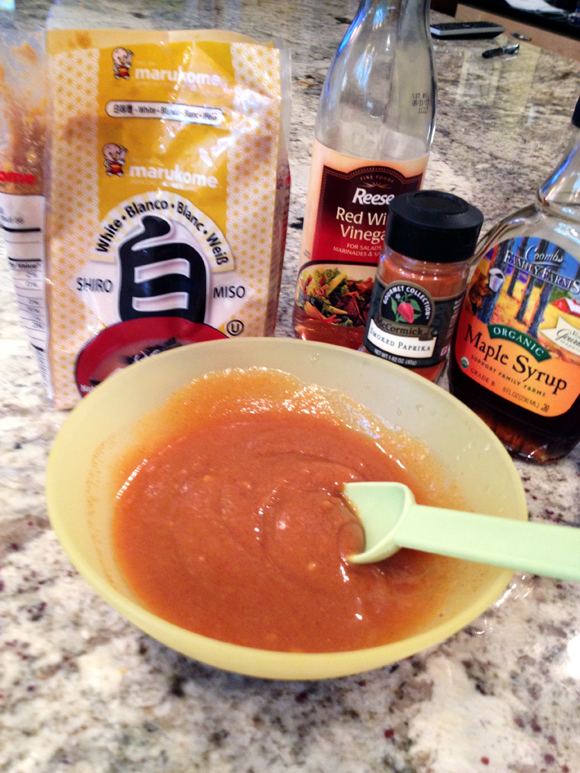
70g (1/4 cup) white miso
60g (1/4 cup) maple syrup
14g (1 tablespoon) red wine vinegar
1g (1/2 teaspoon) smoked paprika
.
Whisk together water, salt, and sugar until dissolved. Prepare salmon by removing skin (optional) and pin bones and cover with brine. Refrigerate for 2 hours.
.
While salmon is brining, whisk together miso, maple syrup, red wine vinegar, and smoked paprika in a small bowl.
.
Discard brine and thoroughly rinse salmon. Place in a vacuum seal pouch with ½ of the miso sauce and seal. Cook sous-vide for 20 minutes at 122°F. Start broiler preheating at the same time.
.
When salmon is cooked, open bag and discard liquid. Place salmon on a baking sheet, brush a small amount of sauce over the top, and broil until the top starts to brown.
.
Finish with remaining sauce and serve.
.
ENJOY!
.
to print the recipe, click here
.
ingredients

Comments:
  At first I was a bit skeptical that brining would be necessary, since the main reason for it is retaining moisture. In my mind, that would not be a concern when cooking sous-vide. But in fact there is a rationale behind it.  Have you noticed that sometimes a white liquid forms on the surface of salmon as it cooks?  That is albumin,  a protein that sometimes gets pushed out during cooking. Some methods are more prone to this sipping of albumin, poaching being one of them.  There is nothing bad as far as taste is concerned, but if you want to avoid that, brining works best.
.
Obviously, in the name of proper scientific conduct, I should have cooked two pieces of fish – one brined, one not – to compare the effect of brining on overall texture and taste. But sometimes it feels nice to leave the scientific approach at work, and not take cooking too seriously.  That’s what I did…   😉
.
composite
This marinade is spectacular, and I have also used it on pork tenderloin. I love how just a few simple ingredients can perform magic: miso is like nothing else, vinegar cuts the sweetness, smoked paprika heats things up, and maple makes my heart sing.  At the risk of repeating myself, if you do not have a sous-vide gadget, simply cook your salmon the way you like it, and use this marinade to brush the surface at the end of cooking. It caramelizes beautifully…  It might just make your heart sing too…  😉
.
ONE YEAR AGO: Avocado “Hummus”.
.
TWO YEARS AGO: Moving is not for sissies!
.
THREE YEARS AGO:
 Awesome Broccolini
.
FOUR YEARS AGO
Pizza! Pizza!
.
FIVE YEARS AGO: 
 From Backyard to Kitchen

COOKING SOUS-VIDE: SWEET AND SPICY ASIAN PORK LOIN

I am so excited to publish this post!  My first experiment with the Anova sous-vide gadget, actually if I must be completely honest, it was the second experiment, the first shall remain unblogged.  It involved soft-boiled eggs, and a garbage disposal. Pretty sad combination.  But, I did not let that bring me down, next day I rolled up my sleeves, and went to work on a recipe for pork loin that I found on SVKitchen: Sous-vide Recipes and Techniques for the Home Cook.

served

SWEET AND SPICY ASIAN PORK LOIN
(slightly modified from this recipe)

3 pounds boneless pork loin (not pork tenderloin), trimmed of excess fat, cut into 2-inch pieces
2 stalks lemongrass, 3 outer layers and top third removed and discarded, thinly sliced
½ cup soy sauce
⅔ cup packed brown sugar
1 tablespoon Sriracha sauce
2 tablespoons minced fresh ginger
2 teaspoons Chinese five-spice powder
1 teaspoon kosher salt
1 teaspoon freshly ground black pepper
2 scallions, sliced on a diagonal, for garnish

Heat the water bath to 132°F (56°C).

In a bowl large enough to accommodate the pork, combine the lemongrass, soy sauce, brown sugar, chili-garlic sauce, ginger, five-spice, salt, and pepper. Add the pork and toss everything together to coat evenly. Divide the pork between two large zip lock food bags and seal using the water displacement method.

Cook for 6 hours.

Carefully open the food bags and serve the pork over cooked rice garnished with the sliced scallions.

ENJOY!

to print the recipe, click here

Composite1
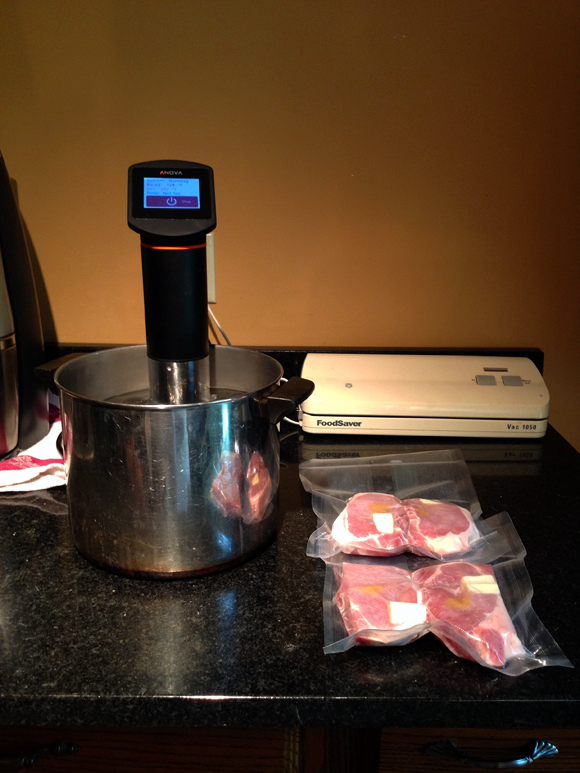
In this photo, you see the Anova gadget attached to the large pan, and the water heating nicely to the correct temperature.  After mixing the pieces of meat with the marinade, two large Ziplock bags are sealed using the water displacement method.  I lowered the bag in a bowl of warm water (that makes the plastic more pliable and facilitates removing all air bubbles). The last photo shows the two bags sealed and ready to dive into the water-bath.  Easy as pie!

composite2
I set the timer for 6 hours, but due to important commitments such as helping Phil mow the front lawn & folding laundry, time was extended to 6 hours and 45 minutes. I hoped it would not be a problem. It wasn’t. In fact, it confirmed one of the advantages of sous–vide cooking: once the temperature is reached and properly equilibrated through the meat, you can take your time. Within limits, of course, there will be a change in texture if you push it too far. But this too far becomes a matter of hours, not minutes. Sweet!

Pork Sous-vide

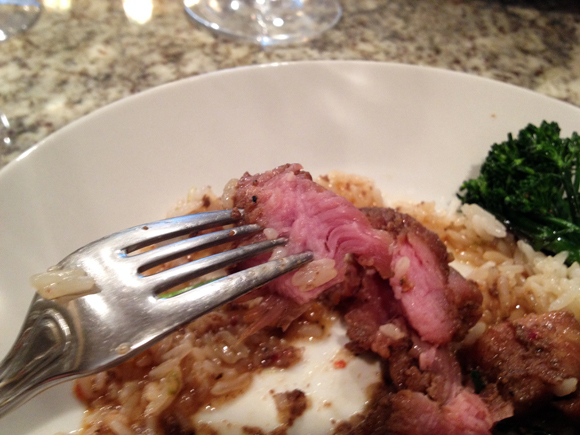
Here is a close up of the meat as you bite into it… moist and tender all the way through!

Meat
Final comments:
 SVKitchen is a fantastic source of recipes and tips for sous-vide cooking, I have several recipes already bookmarked. The site is not getting updates anymore which is kind of sad, but you can still find a ton of stuff and they are also very helpful by email.

One of the things I learned right away from sous-vide cooking is: take notes.  Small variations in temperature will change the result of a recipe, and some can be pretty tricky to nail. Soft-boiled eggs are one classic example. Apparently, once you hit the jackpot with the method that pleases you, it will be quite reproducible.  I am not there yet, but slowly improving.  A very informative and fun article dealing exclusively with soft-boiled eggs can be found here.

Another important point in sous-vide is that for the most part the food will not look appetizing once it’s cooked.  The sous-vide obviously doesn’t brown the food and doesn’t reduce a liquid.  Normally you will need to do a final stove-top, oven, or grill step to bring the dish to completion.  Still, the idea that you can prepare your food in advance and wrap it up in minutes at dinner is quite attractive for those who work full days.  But more important than that is the ability to have perfectly cooked seafood, poultry to work with. Goodbye, tough scallops & shrimp… goodbye dried up chicken breasts & pork loin…

So far, I am really having fun with this new toy.  It is compact, can be stored away in a shelf when not in use, and I found an even better spot to put it in action: the countertop in our laundry room, adjacent to the kitchen.  There Anova enjoys the company of the vacuum sealer,  and on the left of the picture we have a sink, so it’s all quite functional.

AnovaSetting

I hope you enjoyed this first post on sous-vide, stay tuned for new adventures on Anova Land…  

ONE YEAR AGO:  Farewell to a Bewitching Kitchen

TWO YEARS AGO: In My Kitchen. June 2012

THREE YEARS AGO: Goodbye L.A.

FOUR YEARS AGO: 7-6-5 Pork Tenderloin