VEGETABLE MILHOJAS

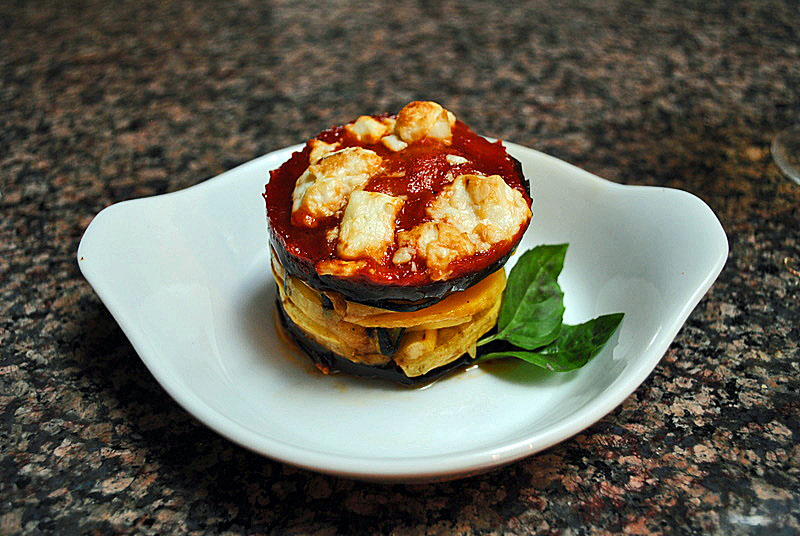
I prepared this recipe the week before our departure to the “nano-kitchen,”  (which I’m still adapting to), but using only the appliances I took with us, as a warm up for the “adventure.”   I’d also  like to say that this is a simple and straightforward recipe.   In some ways it’s not, but in other ways it is:  it takes  time and effort in the prep work, but once that’s completed it’s painless.  After tasting it, I predict that you won’t mind the road you traveled to make it.  I suggest that you assemble it on a weekend afternoon with nice music playing, perhaps this excellent  CD from Yo Yo Ma (skip the Metallica, or you may lose some fingertips).  I made individual servings with 3″ ring molds that I originally bought for cakes, but never used for that purpose.

VEGETABLE MILHOJAS
(adapted from Michael Bauer’s Secrets of Success)

for the tomato sauce:
1 Tbs olive oil
1/2 lb tomatoes, seeded and diced
2  garlic cloves
5 basil leaves
salt and pepper to taste

for the veggies
1/2 pound eggplant, sliced 1/8 inch thick
1/2 pound zucchini, sliced 1/8 inch thick
1/2 pound kabocha (or other squash), peeled, sliced 1/8 inch thick
1/2 pound celery root, peeled, sliced 1/8 inch thick
1/2 bunch basil  + 1/2 cup olive oil
1/2 pound soft goat cheese (Montrachet type)
salt and pepper

Make the tomato sauce by sauteeing the garlic in olive oil for 30 seconds, adding the tomatoes, basil, salt and pepper.  Cook on medium heat for a couple of minutes and reserve.

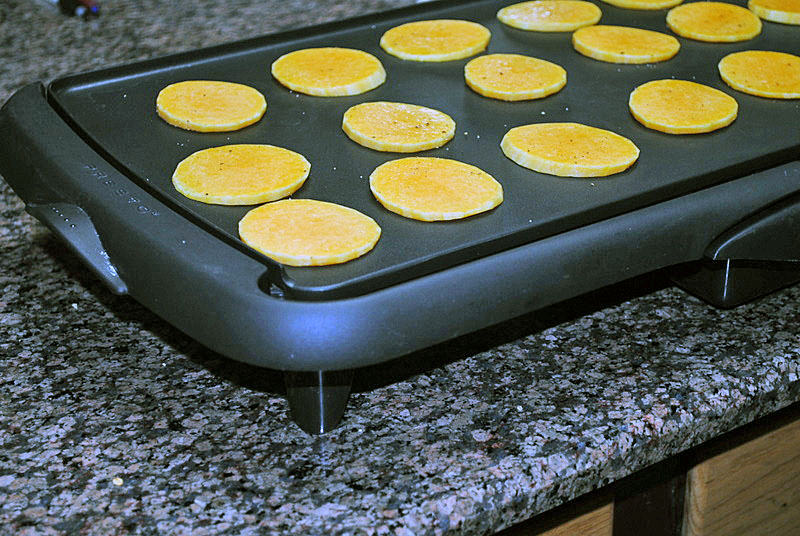
Heat a non-stick skillet (or preferably a large electric griddle), sprinkle each slice of vegetables with a little salt and pepper, and add to the hot surface of your non-stick pan (or griddle) for a couple of minutes on each side, until it just starts to show some color.  Do not let it burn, or completely cook.  Reserve the slices.

Mix the olive oil with the basil (you can use a food processor or finely slice the basil to help releasing its flavor.

Assemble the dish: coat a 8 x 8 inch baking dish slightly with olive oil to prevent the veggies from sticking.  Layer the eggplant slices, zucchini, squash, and celery root.  Add a little basil oil as you form each layer.  Continue layering the veggies until they are all used up.   Spoon some tomato sauce over the top, crumble the goat cheese and bake in a 450F oven for 10-15 minutes until the veggies are hot and the cheese shows some golden brown spots.

(If making the dish in individual rings, coat them slightly with olive oil to help removing the rings before serving – bake on a baking sheet, and use a flat spatula to remove each ring to the serving plate).

ENJOY!

to print the recipe, click here

Comments: Michael Bauer states that the secret of this dish is to thin-slice the vegetables,  and he’s absolutely right.  By doing so, the different layers bake into a single entity in which each flavor mingles with that of its  neighbors. It’s a feast for the taste buds.   I advise you to avoid excess  tomato sauce, because this is not about the tomatoes,  which just give it some extra moisture and flavor.  This recipe lets the veggies do the talking.  I couldn’t find celery root, so instead I used butternut squash, for its texture and color.  “Dry sauteéing” is an interesting, low-fat technique.  You’ll still need some oil while layering the dish, but it will finish lighter than similar versions that rely on “regular” sauteéing.  Eggplant, in particular, absorbs oil and I usually avoid frying it, so this preparation suits my style.  Play with different vegetables, as it’s fun to change this basic recipe.  It’s perfect for entertaining:  assemble it ahead of time, and bake it just before serving.

ONE  YEAR AGO: A peachy salad for a sunny day!

Add to FacebookAdd to DiggAdd to Del.icio.usAdd to StumbleuponAdd to RedditAdd to BlinklistAdd to TwitterAdd to TechnoratiAdd to Yahoo BuzzAdd to Newsvine

SUMMER’S TOMATOES…

…. always bring basil to mind. The classic threesome includes mozzarella, in a tasty caprese salad, but recently Fine Cooking offered a different twist: hearty beefsteak tomatoes topped with grilled corn and dressed with delicate basil oil, all of which was prepared in minutes. When it’s too hot to cook inside this meal is a breath of fresh air: everything’s grilled outside, the house stays cool, and so do you. 😉

GRILLED CORN AND TOMATO SALAD WITH BASIL OIL
(Fine Cooking Grilling issue, 2010)

for basil oil

1 cup basil leaves
1/2 cup olive oil
1/2 tsp salt

for the salad:
2 ears of corn, husks removed
2 Tbs olive oil
salt and pepper
2 large beefsteak tomatoes

Make the basil oil: bring a pot of water to boil, add the basil leaves and blanch them for 10 seconds. Immediately drain them and plunge them in a bowl with ice water to stop cooking. Drain the leaves again, squeeze them to remove excess water, and place over paper towels to dry. Chop the basil coarsely and add into a blender. Add the oil and salt, blend to form a puree. Let the puree settle for about 30 minutes, strain through cheesecloth or a chinois, pressing the leaves to release all the oil. Keep in the refrigerator until ready to use.

Prepare the corn: break the corn cobs in half, toss them with the olive oil, season with salt and pepper and cook them over a hot grill until browned in spots (about 2 minutes on each side, six minutes total). When cooked, return them to the bowl and allow them to cool. When you can handle them, cut off the kernels (lengthwise) with a large knife, and then set the cut corn aside until you’re ready to assemble the salad.

Make the salad: Slice the tomatoes 1/2 inch thick and season with salt and pepper. Arrange the slices on a plate, scatter the corn kernels over them and drizzle with basil oil.

ENJOY!

to print the recipe, click here

Comments: Until recently I’d never grilled an ear of corn. We’d always bring the corn to a boil in water with a little sugar and salt. That’s the way my husband’s family has always prepared corn, and trust me, it’s an excellent approach. I don’t even butter mine because it’s so flavorful; just a dash of salt and pepper is enough. But, for reasons that will soon become clear I’ve been grilling more often, sometimes even making a full meal in the grill.

I was satisfied by how well the beefsteak tomato worked in this recipe. We normally don’t buy them, but prefer smaller tomatoes (Campari, cherry, or grape). However, in this recipe the beefsteaks shine! If you find them in your farmer’s market, then don’t think twice and make this salad.

The basil oil is a bit of trouble to prepare, but worth the half an hour. Blanching the leaves produces a bright and beautiful green oil. Store any leftover basil oil in the fridge for about 1 week.

Note to self: Grill more corn! 😉

ONE YEAR AGO:  Focaccia

Add to FacebookAdd to DiggAdd to Del.icio.usAdd to StumbleuponAdd to RedditAdd to BlinklistAdd to TwitterAdd to TechnoratiAdd to Yahoo BuzzAdd to Newsvine

TWICE-BAKED GOAT CHEESE SOUFFLE

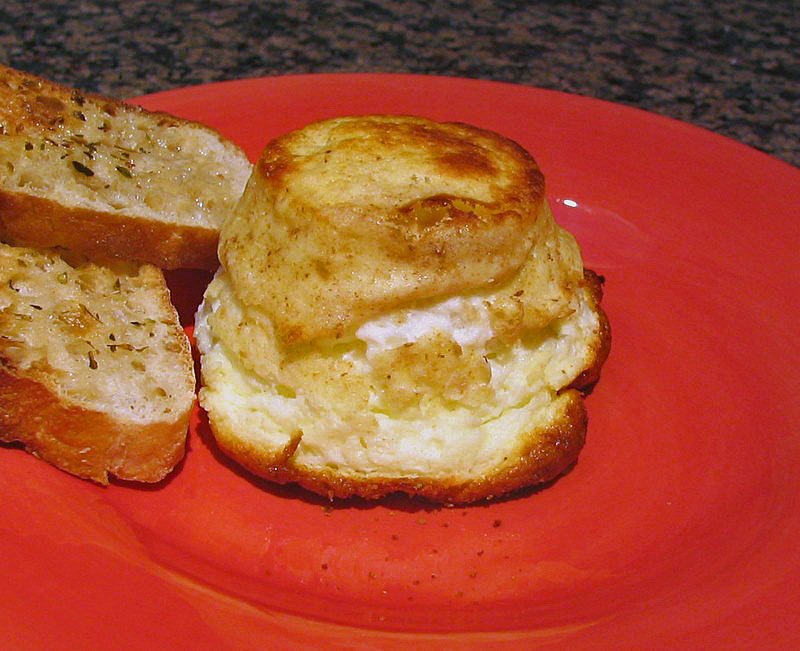
If you’re intimidated by the prospect of making a souffle, then this recipe is a special gift for you.  This double-baking method (oven time separated by hours,  if convenient) is great for entertaining: no more guessing about when’s the correct time to put the souffle in the oven;  no more anticipating when the guests will be ready to eat the puffed-up, gorgeous masterpiece.    Plus, I’ve always felt that  individual servings (in this case individual souffles) makes each guest feel special. 😉 The recipe comes from Secrets of Success, one of my favorite cookbooks.

TWICE-BAKED GOAT CHEESE SOUFFLE
(from Michael Bauer’s Secrets of Success, original recipe from Barbara Mulas & Mark Drazek)

butter for greasing ramekins, plus 3 Tbs
1 cup bread crumbs
3 Tbs cake flour
1 cup milk, warmed slightly in a microwave
10 ounces goat cheese, divided
3 large egg yolks
salt and pepper
1 cup egg whites (about 7 large eggs)

Heat the oven to 425F.

Butter 8 ramekins (5 ounce size), and coat them with bread crumbs. Reserve remaining bread crumbs.

Melt the butter in a saute pan, add the flour and cook, stirring, for 20 seconds. Whisk in the milk, cook stirring until slightly thickened, 1 to 2 minutes. Crumble 8 ounces of the goat cheese in a large bowl (you will have 2 ounces left), add the hot milk/flour mixture, stir to combine. Add the egg yolks one at a time, mix well, and season with salt and pepper.

Beat the egg whites by hand or with an electric mixer until stiff peaks form. Delicately mix half the egg whites into the cheese mixture to lighten it a little. Then, fold the rest of the egg whites. Fill the ramekins halfway with the mixture, crumble a little goat cheese on top, and fill the ramekins to the top with the remainder of the souffle mixture. Sprinkle the top with bread crumbs.

Place the ramekins in a large baking dish, and fill it halfway up the sides of the ramekins with very hot (or boiling) water. Bake on the center of the oven until golden, about 25 minutes. Remove from the oven, let it sit in the water for about 15 minutes, then carefully unmold them, by running a knife around the edges and inverting the ramekins over a plate. Transfer them to a baking dish. They can be held at room temperature for up to 6 hours.

When you are ready to serve them, bake at 425F until golden brown, 5 to 7 minutes.

ENJOY!


to print the recipe, click here


Comments: I’ve used this recipe many times in the past few years, sometimes with feta cheese instead of goat cheese, but always with the same delicious outcome. It is important to coat the ramekins well with butter, so that they easily un-mold.   One or two of pieces of bruschetta on the side  completes the perfect opening for a special dinner.

The recipe comes from Zax, a now (unfortunately) defunct restaurant in Berkeley.   You can find old reviews online praising this dish, and once you try it, you’ll praise it too!

Note to self:  try this method with other flavors.   According to Bauer, the key to making a twice-baked souffle is the use of cake flour:   it gives the final product a more refined texture.

ONE YEAR AGO: Hearts of Palm Pie

Add to FacebookAdd to DiggAdd to Del.icio.usAdd to StumbleuponAdd to RedditAdd to BlinklistAdd to TwitterAdd to TechnoratiAdd to Yahoo BuzzAdd to Newsvine

receita em portugues na proxima pagina…..

Continue reading

FLIRTING WITH ORZO

My Brazilian nature often predisposes me towards rice, but the more I cook orzo, the more I like it.   It might be more versatile than rice,  it cooks faster, and it’s  absolutely fool proof, all of which adds to its charm. The inspiration for this recipe came from an old Fine Cooking magazine, but I simplified it quite a bit  because the original seemed a tad too busy:  too many flavors fighting for attention.   This pared-down version was a winner!


ORZO WITH SHIITAKE MUSHROOMS AND SPINACH
(very loosely adapted from Fine Cooking magazine)

1 cup orzo
2 Tbs olive oil
1 shallot, finely diced
8 oz spinach leaves, stemmed, and coarsely chopped
4 oz fresh shiitake mushrooms, sliced (or dried, reconstituted with hot water)
1/2 lemon, juice and zest
salt and pepper
parmiggiano-reggiano (optional)

Start cooking the orzo on a large pot with salted water (it should take around 9 minutes).
Heat the olive oil on a large skillet and saute the shallots, lightly seasoned with salt and pepper.  Add the sliced shiitake mushrooms, saute until they start to get golden brown.   Add the chopped spinach, cook until it begins to wilt.  At this point, if the orzo is not cooked yet, turn the heat off and reserve.

When the orzo is almost cooked, remove 1/4 cup of the cooking water and reserve it.   Turn the heat back to medium on the skillet with the spinach mix, squirt lemon juice and zest, season with salt and pepper.  Drain the orzo and add it to the skillet, mixing well.  Add some of the pasta water if necessary.  Adjust seasoning with salt and pepper.  If desired, sprinkle parmiggiano-reggiano on top.

ENJOY!

to print the recipe, click here

Comments: For years I’ve made quick pan sauces for pasta with  the cooking water and some sauteed veggies.  Spinach is a constant player in such dishes, but this was the first time I chopped the leaves before sauteeing.   Voila‘:  it was much better!  Somehow, even with baby spinach, the whole leaves had a tendency to clump instead of reaching a nice distribution.   Live and learn.   😉

This was a quick dish to put together! It will drop into my regular rotation of meals for busy weeknights, keeping the orzo/spinach/lemon foundation and playing with other options: black olives, sundried tomatoes, roasted red bell pepper, artichoke hearts….

Add to FacebookAdd to DiggAdd to Del.icio.usAdd to StumbleuponAdd to RedditAdd to BlinklistAdd to TwitterAdd to TechnoratiAdd to Yahoo BuzzAdd to Newsvine

receita em portugues na proxima pagina….
proxima pagina

ZEN AND THE ART OF RISOTTO

For a long time certain of my favorite dishes (for example souffles and risottos) were restricted to restaurants, because I felt intimidated to make them myself. I lost my souffle-phobia thanks to my friend Vanda, who kept sending me e-mails about the broccoli or spinach & cheese or other tasty spur-of-the-moment souffle that she was serving for dinner. Indeed, she can whip up a souffle in her sleep…   but because she was 6,000 miles away in Brazil, I resorted to Julia Child in order to Master the Art of Souffle Cooking.

Risotto took a little more time. I had some failures that slowed down my learning curve. Then it hit me: my main problem was lack of patience. You can’t rush it, and you can’t be completely sure how long it will take. Risotto takes however long it needs to reach the stage of perfection, and that is its Zen beauty.

This recipe reinforces the Zen of risotto with green tea as the cooking liquid. I found it in a nice food blog years ago, and made it several times. It’s lighter than traditional versions, and a perfect dish for Spring!

GREEN TEA RISOTTO WITH PEAS
(adapted from Cooking Books blog)

1 quart water
4 bags green tea
oil for the pan
3/4 cups frozen peas, thawed
1/4 cup fresh parsley, minced
Juice of 1 lemon
1 cup Arborio rice
1 small shallot, chopped
Salt and pepper to taste
1/4 cup grated parmeggiano-reggiano cheese

Bring 1 quart of water to a near boil, then pour it over 4 bags of green tea in a pot, allowing to steep for 2 minutes. Remove the bags and place the pot over low heat to keep it warm.

Blanch the peas in boiling water for one minute, then drain and run them under cold water to stop the cooking process. Set aside.

Warm the olive oil in a large pan or heavy-bottomed pot and sauté the shallots until they soften. Add the rice, season lightly with salt, and cook, stirring, for 4-5 minutes, then begin adding the tea, one ladle at a time. Stir constantly until all of the tea has been absorbed by the rice and add another ladle. Continue this process, adding tea and stirring to incorporate. The rice will take at least 20 minutes to be ready, check it from time to time.

Stir in the grated cheese and peas until the cheese is melted and incorporated and the peas are warmed through. Remove the risotto from the heat, and begin adding the lemon juice, tasting, until it has a bright flavor. Then stir in the parsley and season to taste with salt and pepper.

Serve with a few shavings of parmiggiano over the top.

ENJOY!

to print the recipe, click here

Comments: Most recipes for risotto start with some white wine and end with quite a bit of butter. You can modify this basic recipe to take it in that direction, or try this lighter version, that is still very satisfying. It is important to avoid over-brewing your tea, because green tea can quickly become bitter. I used this tea from Peet’s, a favorite of mine. The original recipe called for mint, but our mint was not growing yet, so I used parsley instead. I think fresh tarragon will be excellent too.

Add to FacebookAdd to DiggAdd to Del.icio.usAdd to StumbleuponAdd to RedditAdd to BlinklistAdd to TwitterAdd to TechnoratiAdd to Yahoo BuzzAdd to Newsvine