RADICALLY SIMPLE

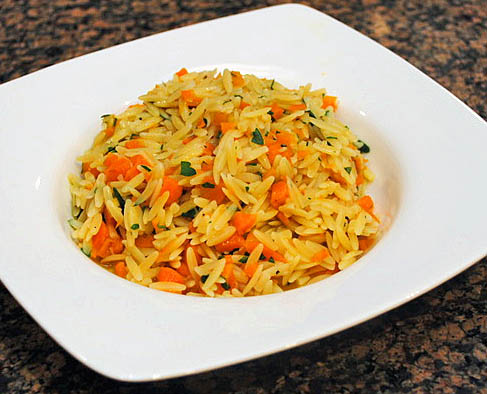
I’ve owned plenty of cookbooks in my lifetime.  More than I need, more than I’ll ever be able to cook from,  even if I tried a new recipe every day and lived to 105 years old.  Seasoned cookbook enthusiast that I am, my next statement may surprise you, but don’t take it lightly:  Radically Simple by Rozanne Gold is my favorite.  Ever!  No other book tempts me to cook every single recipe within it, as this one does.  All her recipes are appealing, not for their simplicity, but because she always transforms a few ingredients into something special, something different, something unique and enticing.  Take this humble orzo, for example, and dress it up just right.
CARROT “NIB” ORZO
(reprinted with permission from Rozanne Gold)

6 oz baby carrots
2Tbs butter
8 oz orzo pasta
1 + 1/2 cups chicken stock
1  to 1 + 1/2 cup water
1 garlic clove
salt and pepper
1/4 cup Parmigiano Reggiano cheese
1/2 cup chopped chives, divided (I used parsley)

Place the baby carrots in the bowl of a food processor and process a few times, until the pieces are a little bigger than the grains of orzo.

Melt the butter in a saucepan, add the orzo and carrots, season lightly with salt and pepper, and cook for 5 minutes stirring often, until the pasta starts to get a golden color and is fragrant.  Add the chicken stock, 3/4 of the water, the garlic clove squeezed through a press, and simmer, stirring occasionally, until the liquid is almost all absorbed and the pasta is tender, about 12 minutes. You may or may not need to add all the water. Add the Parmigiano cheese, 1/3 cup of the chives, and gently mix. Adjust seasoning with salt and pepper, garnish with the remaining chives, and…

ENJOY!

to print the recipe, click here

Comments:  If all recipes in this cookbook please me as much as this one, it will be hard to cook from a different source!  😉  Toasting the orzo and treating it like Arborio rice in a risotto preparation considerably changes the texture of the pasta.  Orzo has a tendency to be a bit “slippery”, but not in this dish: it feels wholesome, binding nicely with the other components.   The bits of carrots give a hint of sweetness and add a lot to the dish.  I had to exert extreme self-control to put the leftovers in the fridge, instead of leaving them in front of us while we talked after dinner.  Those can be very caloric conversations!

Radically Simple is a must-have if you love great food, with interesting twists in the preparation.  A pasta that cooks in the oven without ever seeing a drop of water?   It’s in there.  Using beets to make a veggie stock with unique color and flavor?  It’s there too. So, if you haven’t done so already, then order your copy now, and the moment it reaches your home lay on a comfy sofa, and savor it…  😉

ONE YEAR AGOA Sticky Situation

TWO YEARS AGO:  The Garden

Add to FacebookAdd to DiggAdd to Del.icio.usAdd to StumbleuponAdd to RedditAdd to BlinklistAdd to TwitterAdd to TechnoratiAdd to Yahoo BuzzAdd to Newsvine

INA GARTEN’S BANANA BRAN MUFFINS

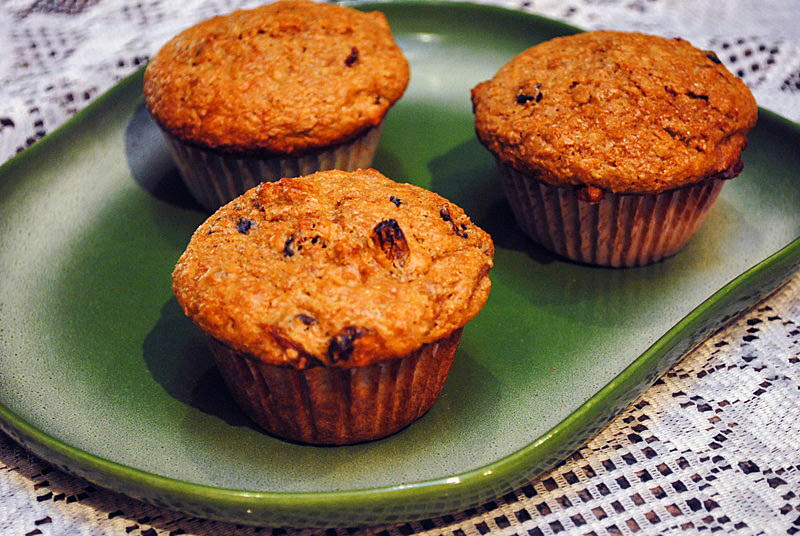
I don’t cook Ina Garten‘s recipes that often because they tend to be way too rich (says she who recently baked a cake with a few hundred calories per bite..  ;-)).   But these muffins have just the right amount of indulgence, well balanced by all their healthy components: unprocessed bran, fruits, and nuts.   I am always happy when I find a good recipe for bran muffins, Phil’s favorite ways to start the day: one of these babies, warmed up slightly in the oven, next to a steaming cup of cappuccino.

CHUNKY BANANA BRAN MUFFINS
(adapted from Ina Garten, FoodTV Network)

1 cup unprocessed wheat bran
1 cup buttermilk (shaken)
4 tablespoons unsalted butter, at room temperature
1/4 cup light brown sugar, lightly packed
2 + 1/2 large eggs, at room temperature
3 tablespoons molasses
2 tablespoons agave nectar
1 teaspoon grated orange zest
1/2 teaspoon pure vanilla extract
1 + 1/2 cups all-purpose flour
3/4 teaspoon baking powder
1/4 teaspoon baking soda
1/2 teaspoon kosher salt
1 cup mixed dried raisins, blueberries, cranberries
1 cup large-diced bananas
1/2 cup chopped walnuts

Preheat the oven to 350 degrees F. Place paper liners into a muffin tin.

Combine the bran and buttermilk and set aside. Cream the butter and sugar in the bowl of an electric mixer for about 5 minutes, until light and fluffy. With the mixer on low, add the eggs, one at a time. Scrape the bowl and then add the molasses, agave nectar, orange zest, and vanilla. (The mixture will look curdled.) Add the bran/buttermilk mixture and combine.

In a separate bowl, sift together the flour, baking powder, baking soda, and salt. With the mixer on low speed, slowly add the flour mixture to the batter just until combined.  Fold in the dried fruits, bananas and walnuts with a rubber spatula.

Fill the muffin cups to the top and bake for 25 to 30 minutes, until a cake tester comes out clean.

ENJOY!

to print the recipe, click here

Comments:  Most recipes of this type call for over-ripe bananas, all brown and mushy.  In this recipe, Ina used bananas that were good enough to eat as a fruit, ripe, but not falling apart at all.  I was a bit intrigued, but followed her lead.  Verdict:  not only it works, but it’s probably what makes these muffins quite special, the little morsels of concentrated banana flavor.

Phil gave his seal of approval to the recipe, so all you bran muffin lovers can go ahead and give it a shot.  😉

ONE YEAR AGOBeer Bread with Roasted Barley

TWO YEARS AGO:  Tomato Confit with Arugula and Zucchini

Add to FacebookAdd to DiggAdd to Del.icio.usAdd to StumbleuponAdd to RedditAdd to BlinklistAdd to TwitterAdd to TechnoratiAdd to Yahoo BuzzAdd to Newsvine

BABY BACK RIBS ON THE 4th OF JULY

Barbecued ribs are a classic to celebrate this holiday at the height of the Summer.  In Brazil, barbecue means grilling large pieces of meat that were seasoned with coarse salt and pepper…  and nothing else.  No marinades, no rubs, no extra flavors.   Because I was raised with that concept, I sometimes twisted my nose at American barbecue,  particularly those in which the meat is suffocated by seasonings.

Then one day I found myself in an Oklahoma rib joint, where I tried barbecued pork ribs for the first time, all sticky, messy, gooey and covered with a screaming-red barbecue sauce.   I shook my head in disbelief – why mask the flavor of the meat with all that stuff? – but the first bite clarified the issue forever: barbecue sauce is awesome, funky, and sexy!  It turned those ribs into a life-changing experience! Seriously, from that day forward I was hooked, and soon became a barbecue sauce snob. It has to be just right, without liquid smoke and without excessive sweetness.   A little hickory flavor is acceptable, even desirable, as long as it’s subtle.  For the most part the bottled, grocery store varieties fail my personal test.  Instead I make my own sauce and exclusively use it on pork ribs.  It’s a match like Romeo and Juliet.

OVEN-BARBECUED RIBS
(adapted from Easy Basics for Good Cooking, 1987)

2 slabs of pork ribs (baby back or spareribs)
1 lemon, thinly sliced
1 onion, thinly sliced (no need to peel)
salt and pepper
juice of the lemon

for the barbecue sauce
1 cup tomato ketchup
1/2 cup water
1/4 cup red vinegar
1/4 cup brown sugar, packed
1 tsp paprika (smoked, if available)
1 tsp mustard
1 tsp chili powder (hot)
1 tsp Worcestershire sauce
1/2 tsp cayenne pepper
1/2 tsp salt

Remove the membrane from the underside of the ribs (use a paper towel to grab it and it should peel off easily).  Place the ribs on a rimmed baking dish, cover it with the lemon and onion slices, season with salt and pepper, and squeeze the lemon juice all over.   Cover tightly with aluminum foil and bake for 2 hours at 300F.

Meanwhile make the barbecue sauce by mixing all ingredients in a saucepan and bringing to a boil.  Reduce the heat and simmer for 15 minutes, stirring every once in a while.  If not using the sauce right away, refrigerate.

When the ribs are baked, remove the aluminum foil, discard the lemon and onion slices, and any liquid accumulated in the bottom of the baking pan. Brush a good amount of barbecue sauce all over the ribs and either refrigerate for a day or two, or proceed with the final cooking right away.

To finish the ribs in the oven, place them in a 425 F lightly covered with aluminum foil, for 45 minutes. They will look like this at the end of the baking time. Uncover, brush a little more barbecue sauce on top of the ribs, and bake for 15 to 20 minutes, until nicely browned on top.  You can also finish them in a medium grill until cooked to your liking.  Serve the ribs with additional barbecue sauce on the side.

ENJOY!

to print the recipe, click here

Comments: People may split into two camps when it comes to  barbecued ribs: those who want their meat falling off the bone, and those who prefer to work a little hard and nibble the meat from the bone. I’m part of the first group. Life is hard enough, and I want my ribs (rather, the pig’s) tender. 😉 If you’re on my team, then these ribs are almost all that you need for your 4th of July dinner. Close the deal with this dessert, and you are in for a memorable meal!

A PIE FOR YOUR 4th OF JULY

++++++++++++++++++++++++++++++++++++++++++++

ONE YEAR AGO: A Golden Sandwich Bread

TWO YEARS AGO: Ossobuco Milanese

Add to FacebookAdd to DiggAdd to Del.icio.usAdd to StumbleuponAdd to RedditAdd to BlinklistAdd to TwitterAdd to TechnoratiAdd to Yahoo BuzzAdd to Newsvine

PANE DE CASA & CROSTINI

We were invited for a dinner party last Saturday, and I asked the hostess if I could take some homemade bread. Keep in mind that she had just returned from Paris and would be serving us, her lucky guests, an assortment of cheeses brought straight from the City of Light.  My mind was already set on this great post by Celia with a step-by-step tutorial for making her “pane de casa,” a variation of ciabatta. It seemed like a perfect option for the occasion.  Celia experimented and optimized a recipe that includes semolina flour in the dough with great success!  All I had to do was to follow in her footsteps…  😉

CELIA’s PANE DE CASA
(from Celia, Fig Jam and Lime Cordial blog)

500g (3½ cups) bakers/bread flour
500g (3½ cups) fine semolina (durum wheat) flour
7g (1¾ teaspoons) dried/instant yeast (or one sachet)
18g (2¾ teaspoons) fine sea salt
750g (3 cups) fridge cold water
rye flour, for dusting

In a large mixing bowl, whisk together the flours, yeast and salt.
Add the cold water, and mix the ingredients together to form a sticky dough. Really squelch the mix through your fingers until evenly combined. Scrape off your hand and cover the bowl with a towel. Allow to rest for 15 minutes.

Give the dough a quick knead in the mixing bowl – after the short rest time it will have relaxed a little. Just fold it over itself a dozen or so times, and then scrape your hand off again and cover the bowl with plastic wrap. Allow to prove until well risen – this might take up to three hours depending on your kitchen conditions. In our kitchen the dough was ready in a little over 2 hours. It should be very airy and full of bubbles, almost fully doubled in size.

Heat the oven to 480 F (220 C). If you are using pizza stones, place them on the racks to heat up, and tear off four sheets of parchment paper. If you do not have pizza stones, line a couple of baking trays with parchment.

Heavily dust the bench and your hands with rye flour, then scrape the dough out gently – be careful not to knock all the air out of it. Fold the top of the dough into the middle, and then fold the bottom over to enclose it, forming a long rectangle. Keep your hands well dusted with rye flour, and use your scraper if necessary to help you handle the dough. Dust the top of the dough with more rye flour, then using your scraper, cut the dough into four roughly equal pieces. Dust your hands again with rye flour. Pick each piece of dough up by the ends, give it a little stretch, and then place it on a sheet of parchment to go onto the pizza stones, or onto the lined baking tray.

Spray the top of each loaf with a little water. Turn the oven down to 425 F (220 C) and put the loaves in to bake for 20 minutes. Then rotate the loaves (if you’re baking on stones, remove the parchment now) or the oven tray, and lower the heat to 350 F (125 C). Bake for a further 15 minutes, or until the loaves are crusty and hollow-sounding when tapped.

To make the crostini:
1/4 cup olive oil
pinch of dried herbs of your choice (I used herbes de Provence)

Mix the olive oil with the herbs.  Once the bread is completely cold (or next day), cut it in slices 1/4 inch thick. Brush the oil very lightly on both sides of the bread, and grill each side until nice marks form.  Give each slice a slight turn  after a couple of minutes to produce a crisscross pattern.

ENJOY!

to print the recipe, click here

Comments:  As you can see in the photo, two of my loaves ended up lighter and the crust opened almost as if the bread had been scored (it had not). Those were baked exactly as Celia did, spraying a little water on the surface.  The other loaves were baked under an inverted roasting pan previously filled and empty of hot water to generate steam in the initial 20 minutes of baking.   The difference in the crust was quite amazing!   For this type of bread, I prefer the ones baked uncovered.  Their taste was very similar, and so was their crumb structure.

In theory, crostini is simply a toasted bread and could be made in the oven, but for me nothing beats the taste and texture provided by grilling.  The use of herbs is optional, I made half of our crostini plain, so we could have some flexibility with the different cheeses.

This is a wonderful bread, with a beautiful yellowish tint due to the semolina, that also makes it last longer than regular ciabatta. Even if you are a novice in bread baking, with Celia’s detailed instructions and photos, you’ll be able to bake it without problems.

I am submitting this post to Susan’s Yeastspotting

ONE YEAR AGO: Down-Home Dig-in Chili

TWO YEARS AGO: Cinnamon Rolls

Add to FacebookAdd to DiggAdd to Del.icio.usAdd to StumbleuponAdd to RedditAdd to BlinklistAdd to TwitterAdd to TechnoratiAdd to Yahoo BuzzAdd to Newsvine

KOREAN BARBECUE BURGER

Coming back home to our kitchen was wonderful, of course, but coming back to my 6 shelves of cookbooks was almost as good!   Whenever I got tired of unpacking and organizing stuff, I would take a “cookbook-break” – not really opening any of them to avoid getting too distracted, but just looking at the titles and trying to remember my favorite recipes inside.  That led me to the shocking realization that quite a few books remain “uncooked from.”   One of my goals – which I intend to take without pressure – is to bring them to life in our kitchen. The first one was The Steamy Kitchen Cookbook, a colorful, fun book written by  Jaden Hair.  I’ve had it for a couple of years, inside I found a small card with quite a few page numbers market “to try soon.”  No one can say I lack good intentions.  😉

KOREAN BARBECUE-STYLE BURGER
(adapted from The Steamy Kitchen Cookbook)

1 + 1/2 pounds ground beef
1 Tsp finely minced garlic
2 Tbs minced ginger
2 + 1/2 Tbs soy sauce
2 + 1/2 Tbs brown sugar
3 Tbs finely minced green onions
3 tsp sesame seeds
1/4 to 1/2 tsp salt
freshly ground black pepper
4 hamburger buns

for the pickled veggies
1 cup matchstick cut carrots
1 cup matchstick cut cucumber
1/2 tsp sesame seeds
4 tsp rice vinegar
1/2 tsp sugar

Mix the ground beef with the garlic, ginger, soy sauce, brown sugar, green onion, sesame seeds, salt and pepper.   Try to mix it gently, but incorporating the ingredients well.   Divide the mixture in 4 equal portions and shape them as patties, making a small indentation in the center, as you see in this photo.   Let the meat rest while you prepare the quick veggie pickle by mixing  all the ingredients in a bowl. Wait 5-10 minutes and the pickle will be ready.

Cook the hamburger on a hot grill or on a frying pan with a little oil, for 5 to 6 minutes per side.  Serve with the carrot-cucumber pickle and other toppings of your choice.

ENJOY!

to print the recipe, click here

Comments:  My main modification in the recipe was to reduce a little the amount of garlic – in case you didn’t notice, we tend to use garlic with a lot more restraint than most cooks – and also the amount of ginger.  In her recipe, she used 3 tablespoons of ginger and we both thought even 2 Tbs was a little much, the ginger taste is quite pronounced.   If you are more of a purist when it comes to tasting the meat first, consider reducing it further.  The hamburger turns out moist, succulent, the brown sugar/soy imparts a beautiful color.

I had to refrain from eating the pickled carrot/cucumber by the spoonful.  Loved it!  It goes perfectly with the burger.  If you find good quality kimchi, consider that as a topping too.

Summer is hamburger season by definition, and the 4th of July is right at the corner, so this could be a nice change of pace for the usual burger, celebrating the melting pot of cultures this country is all about!

ONE YEAR AGO: A twist on pesto

TWO YEARS AGO:  When life gives you chard…

Add to FacebookAdd to DiggAdd to Del.icio.usAdd to StumbleuponAdd to RedditAdd to BlinklistAdd to TwitterAdd to TechnoratiAdd to Yahoo BuzzAdd to Newsvine